DeepSeek Is Building Its Own AI Chip — What This Means for Nvidia and Your Portfolio
Breaking news analysis for Singapore investors holding tech ETFs and US equities — what DeepSeek’s chip ambitions signal for Nvidia’s dominance.
Chinese AI lab DeepSeek is developing its own artificial intelligence chip, according to a Reuters exclusive citing three sources familiar with the project. The move signals a direct challenge to Nvidia’s dominance in AI hardware. Nvidia shares fell 1.5% in premarket trading on the news. For Singapore investors with exposure through CSPX, VWRA, or semiconductor ETFs like SMH, this is a development worth watching closely.
Not financial advice. All figures are for educational reference only. Data verified as at 7 July 2026.
- Reuters reports DeepSeek is building a custom AI chip — reducing its dependence on Nvidia GPUs and US-controlled supply chains
- Nvidia dropped 1.5% premarket; if you hold SMH, ~20% of your portfolio is Nvidia. CSPX and VWRA have lower but real exposure (5–7%)
- Don’t panic sell. This is a long-term competitive risk, not an immediate earnings hit. Diversified ETF holders are better positioned than single-stock bettors
What Happened — The Reuters Exclusive
On 7 July 2026, Reuters reported that DeepSeek — the Chinese AI startup that stunned the world in January 2026 with its low-cost R1 model — is now developing its own custom AI training chip. The report cites three people with direct knowledge of the project.
This isn’t a vague aspiration. DeepSeek has been quietly recruiting chip design engineers since February 2025, according to the sources. The company already demonstrated it can run competitive AI models on non-Nvidia hardware when its V4 model launched on Huawei’s Ascend chips in April 2026, as reported by TechPowerUp and Digitimes.
Nvidia shares dropped 1.5% in premarket trading following the Reuters report. That may sound small, but for a company with a market capitalisation exceeding USD 3 trillion, even a 1.5% move represents roughly USD 45 billion in value evaporating before the market even opens.
DeepSeek’s Chip Ambitions Timeline
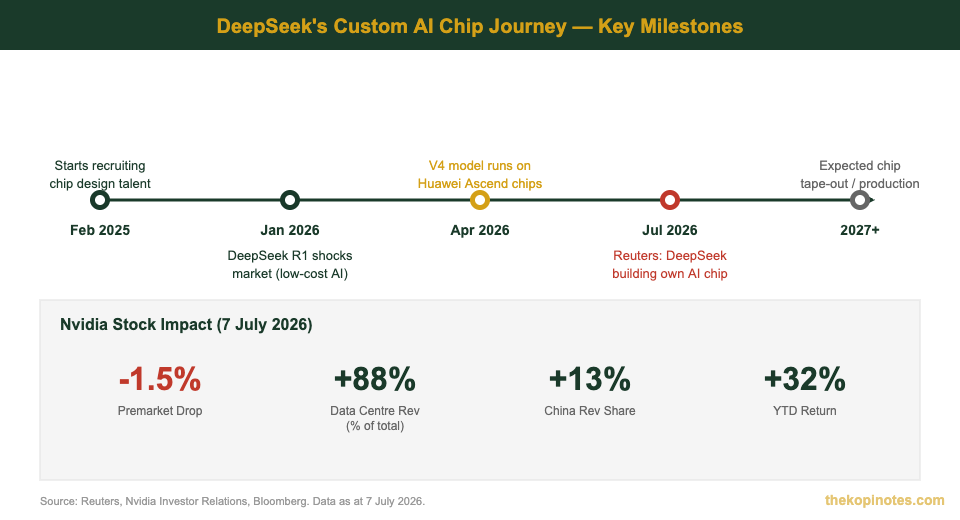
To understand why this matters, you need to see how quickly DeepSeek has moved. Here is the key timeline:
| Date | Event | Significance |
|---|---|---|
| Feb 2025 | Starts recruiting chip design engineers | Signals intent to reduce hardware dependence |
| Jan 2026 | DeepSeek R1 model launches; rivals GPT-4 at fraction of cost | Proves software can compensate for inferior hardware |
| Apr 2026 | V4 model runs on Huawei Ascend 910C chips | Shows DeepSeek can operate without Nvidia silicon |
| Jul 2026 | Reuters reports custom chip development underway | Vertical integration — designing chips purpose-built for DeepSeek’s architecture |
| 2027+ | Expected tape-out and production (estimated) | Full self-sufficiency from US chip supply chains |
Source: Reuters, TechPowerUp, Digitimes, TechStartups. Timeline as at 7 July 2026.
The pattern is clear. DeepSeek is systematically reducing its dependence on Nvidia — first through software optimisation, then through Huawei’s chips, and now by designing its own silicon entirely. For context, Google already builds its own TPU chips for AI training, so this is not unprecedented. However, a Chinese startup doing it under US export restrictions makes the geopolitical stakes far higher.
Why This Matters for Nvidia
Nvidia dominates the AI chip market. As at Q1 2026, its data centre business accounted for approximately 88% of total revenue, according to Nvidia’s investor relations. The company’s H100 and H200 GPUs are the standard hardware for training large language models worldwide.
However, Nvidia’s grip faces two risks from DeepSeek’s move:
Risk 1 — Demand erosion. If DeepSeek’s custom chips perform well enough, other Chinese AI companies may follow the same path. China represents about 13% of Nvidia’s revenue directly, but the indirect demand from Chinese cloud providers buying through intermediaries is likely higher. Every chip DeepSeek builds for itself is a chip not purchased from Nvidia.
Risk 2 — Narrative shift. Nvidia’s stock trades at a premium partly because the market believes its chips are irreplaceable. Each successful non-Nvidia AI deployment — whether on Huawei Ascend, Google TPU, or now DeepSeek custom silicon — chips away at that narrative. The 1.5% premarket drop on this news alone shows how sensitive the stock is to competition stories.
| Nvidia Metric | Value |
|---|---|
| Market Cap | ~USD 3.2 trillion (as at 4 Jul 2026) |
| Premarket Move (7 Jul) | -1.5% |
| Data Centre Revenue Share | ~88% of total revenue |
| China Revenue Share | ~13% (direct) |
| YTD Return 2026 | +32% (before today) |
| Forward P/E | ~35x |
Source: Bloomberg, Nvidia Investor Relations. Data as at 4–7 July 2026.
That said, let’s keep perspective. Nvidia’s data centre revenue continues to grow rapidly. Even if DeepSeek produces a working chip by 2027, it would take years before it could scale production to meaningfully dent Nvidia’s market share. The immediate financial impact is minimal — this is a long-term competitive risk, not a near-term earnings problem.
What Singapore Investors Should Know
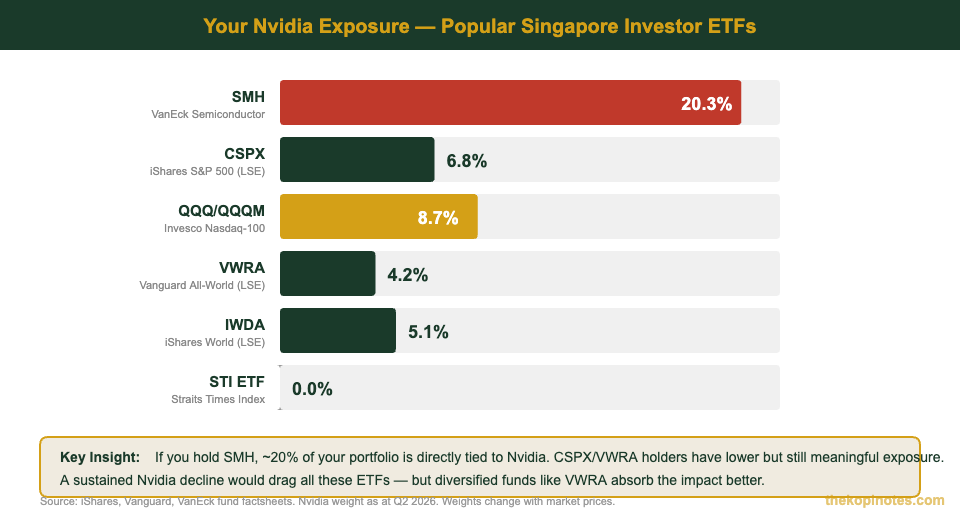
If you invest through a moomoo Singapore review brokerage account or similar platforms, you likely have some Nvidia exposure through your ETFs. Here is how much weight Nvidia carries in the most popular ETFs among Singapore investors:
| ETF | Index | Nvidia Weight | Impact of -10% Nvidia |
|---|---|---|---|
| SMH | MVIS US Semiconductor 25 | ~20.3% | -2.0% portfolio drag |
| QQQ / QQQM | Nasdaq-100 | ~8.7% | -0.9% portfolio drag |
| CSPX | S&P 500 | ~6.8% | -0.7% portfolio drag |
| IWDA | MSCI World | ~5.1% | -0.5% portfolio drag |
| VWRA | FTSE All-World | ~4.2% | -0.4% portfolio drag |
| STI ETF | Straits Times Index | 0% | No direct impact |
Source: iShares, Vanguard, VanEck fund factsheets. Nvidia weights as at Q2 2026. Weights change daily with market prices.
The maths is straightforward. If Nvidia falls 10% from here, a pure SMH holder loses about 2% of their portfolio value from that single stock. A CSPX holder loses about 0.7%. A VWRA holder loses about 0.4%.
This is precisely why diversification matters. If you’ve been considering using the Singapore retirement calculator to stress-test your portfolio, today is a good day to plug in a “tech correction” scenario and see how your plan holds up.
What Should You Do Now?
Short answer: probably nothing dramatic. Here is a measured framework for how to think about this news, depending on your situation:
If you hold broad market ETFs (CSPX, VWRA, IWDA): Your Nvidia exposure is real but moderate — between 4% and 7%. These ETFs are self-rebalancing. If Nvidia’s weight shrinks because the stock falls, other companies automatically take up a larger share. This is diversification working as designed. Keep investing according to your plan.
If you hold semiconductor ETFs (SMH, SOXX): You have concentrated exposure. A 20% Nvidia weight means this single stock meaningfully drives your returns. Consider whether this concentration aligns with your risk tolerance. If you are nervous, trimming towards a broader ETF like CSPX or VWRA would reduce single-stock risk without abandoning tech exposure entirely.
If you hold individual Nvidia shares: Understand that you are making an active bet on one company. DeepSeek’s chip effort is just one of several competitive threats — AMD, Intel, Google TPU, Amazon Trainium, and now potentially DeepSeek. Single-stock positions require active monitoring. If managing that stress doesn’t suit you, a Syfe referral code and sign-up bonus can get you started with a diversified portfolio approach instead.
Regardless of what you hold, this is also a good time to revisit your CPF investment strategy. Your CPF funds in the Ordinary Account earn a guaranteed 2.5% — completely insulated from AI chip wars. For many Singaporeans, maintaining a healthy CPF allocation alongside market investments provides a useful ballast during volatile periods.
The Bigger Picture — US-China AI Chip War
DeepSeek’s chip ambitions don’t exist in a vacuum. They are a direct response to US export controls that have progressively restricted China’s access to advanced Nvidia GPUs. The Biden-era chip export restrictions, continued under the current administration, were designed to slow China’s AI progress by cutting off hardware access.
The irony is that these restrictions may be accelerating China’s push for chip self-sufficiency. DeepSeek has already shown it can build competitive AI models with less hardware. Now it’s designing the hardware too. Huawei’s Ascend chips — while still behind Nvidia on raw performance — are improving rapidly. According to WCCFTech, Huawei’s next-generation Ascend 920 is expected to narrow the gap significantly.
For investors, this creates a complex picture. US chip companies like Nvidia benefit from being the global standard, but they’re simultaneously losing one of their fastest-growing markets. Chinese alternatives may take years to match Nvidia’s performance, but they don’t need to match it perfectly — they just need to be “good enough” for Chinese AI companies that have no alternative.
As TechStartups noted, DeepSeek’s R1 model already demonstrated that clever software engineering can compensate for inferior hardware. If DeepSeek applies the same philosophy to chip design — optimising specifically for its own model architectures rather than building general-purpose GPUs — the resulting chip could be highly competitive for its specific use case, even if it can’t match Nvidia in benchmarks.
Data verified as at 7 July 2026. Nvidia weights and stock metrics may have changed by the time you read this. Always check the latest fund factsheets before making investment decisions.
Frequently Asked Questions
What is the DeepSeek AI chip news about?
On 7 July 2026, Reuters reported that Chinese AI startup DeepSeek is developing its own custom AI training chip, citing three sources. This would reduce DeepSeek’s dependence on Nvidia GPUs and US-controlled chip supply chains. DeepSeek has been recruiting chip designers since February 2025 and already runs its V4 model on Huawei Ascend chips.
How does DeepSeek's chip affect Nvidia stock?
Nvidia fell 1.5% in premarket trading on the news. The concern is that if DeepSeek — and potentially other Chinese AI companies — build their own chips, demand for Nvidia’s GPUs in China could decline. China accounts for roughly 13% of Nvidia’s direct revenue. However, the immediate financial impact is small; this is a long-term competitive risk rather than a near-term earnings hit.
Should Singapore investors sell their tech ETFs because of this news?
No. A single news event about a chip still in development is not a reason to overhaul your portfolio. If you hold broad ETFs like CSPX or VWRA, your Nvidia exposure is between 4% and 7% — significant but not dominant. These ETFs are diversified across hundreds of stocks. Stick to your investment plan and avoid reacting emotionally to headlines.
How much Nvidia exposure do CSPX and VWRA have?
As at Q2 2026, CSPX (iShares Core S&P 500 on LSE) has approximately 6.8% exposure to Nvidia. VWRA (Vanguard FTSE All-World on LSE) has approximately 4.2%. By comparison, the semiconductor ETF SMH has about 20.3% in Nvidia. These weights change daily as stock prices move.
Is DeepSeek's custom chip a real threat to Nvidia or just hype?
It’s real but will take time. Designing and manufacturing an AI chip is a multi-year, multi-billion dollar effort. Even Google’s TPU took years to become competitive. However, DeepSeek has credibility — it already shocked the industry by building frontier AI models at a fraction of the cost, and it runs models on non-Nvidia hardware. The talent recruitment since February 2025 suggests this is a serious programme, not a press release.
What other companies are building AI chips to compete with Nvidia?
Several major players are investing in custom AI chips. Google builds TPUs (now in v5 generation), Amazon developed Trainium and Inferentia chips, Microsoft is working on its Maia accelerator, and AMD offers MI300 GPUs. In China, Huawei’s Ascend 910C chips are already used by DeepSeek for its V4 model. DeepSeek’s entry means yet another competitor in an increasingly crowded field — which is bearish for Nvidia’s pricing power over the long term.
Should I buy the Nvidia dip as a Singapore investor?
That depends on your risk tolerance and conviction. A 1.5% premarket dip is noise, not a crash. If you believe Nvidia’s technological lead is durable and AI spending will keep growing, the dip could be an opportunity. If you are unsure, buying broad market ETFs like CSPX or VWRA gives you Nvidia exposure alongside 500+ other stocks — reducing single-company risk. This article is not financial advice; consult a licensed advisor for personalised recommendations.
Build a Portfolio That Weathers Any Storm
Don’t let single-stock news derail your long-term plan. Diversify across global ETFs and plan your retirement with real numbers.
This article was researched with the help of AI. While we strive to keep all information accurate and up to date, there may be errors. If you notice any discrepancies, please contact us.