CSPX Stock: What It Is, Current Price & How to Buy in Singapore (2026)
The complete Singapore investor’s guide to CSPX — LSE ticker, live price, TER, tax advantages, and step-by-step broker instructions.
CSPX stock is the London Stock Exchange ticker for the iShares Core S&P 500 UCITS ETF (Acc), an Ireland-domiciled fund that tracks all 500 companies in the S&P 500 index. Singapore investors treat CSPX like a stock — buying and selling shares through brokers such as Interactive Brokers, Saxo, or MooMoo. Unlike US-listed SPY or VOO, CSPX offers two critical tax advantages for Singapore residents: a 15% dividend withholding tax rate (vs 30% for US-domiciled ETFs) and zero US estate tax exposure on any holding size.
Not financial advice. All figures are for educational reference only. Data as at May 2026 unless noted.
Table of Contents
Contents — Click to expand
- What Is CSPX Stock?
- Key Facts at a Glance
- CSPX Stock Price: How to Check It
- Why Singapore Investors Choose CSPX Over US Alternatives
- CSPX Expense Ratio and Total Cost
- How to Buy CSPX in Singapore (Step-by-Step)
- CSPX vs Alternatives: Which S&P 500 ETF Is Best?
- Who Should Buy CSPX?
- Frequently Asked Questions
What Is CSPX Stock?
CSPX is the LSE ticker symbol for the iShares Core S&P 500 UCITS ETF (Acc), managed by BlackRock. When investors search “CSPX stock,” they are referring to this ETF’s tradeable shares on the London Stock Exchange, which behave exactly like a stock — they have a live bid/ask price, trade in real time during LSE market hours (9:00am–5:30pm London time), and can be bought or sold through any broker that provides LSE access.
Despite the word “stock,” CSPX is an exchange-traded fund (ETF), not a single company share. Each CSPX “stock” you buy gives you proportional ownership of all 500 companies in the S&P 500 index — from Apple and Microsoft to Berkshire Hathaway and Visa. As at May 2026, CSPX holds approximately 503 securities and has an AUM of over USD 60 billion, making it one of the largest and most liquid UCITS ETFs in the world.
The “Acc” in the fund name stands for accumulating. Instead of paying out dividends, CSPX automatically reinvests all dividend income back into the fund. For Singapore investors, this is highly efficient: there is no dividend distribution to be taxed at source, the fund compounds silently, and you only realise gains when you sell — at which point Singapore’s zero capital gains tax means you keep everything.
CSPX trades in US dollars (USD) on the LSE, despite being listed in London. Your broker will handle the currency conversion from SGD to USD when you place an order.
Key Facts at a Glance
| Metric | Detail |
|---|---|
| Full Name | iShares Core S&P 500 UCITS ETF (Acc) |
| LSE Ticker | CSPX |
| Index Tracked | S&P 500 (500 largest US companies) |
| Domicile | Ireland (UCITS) |
| Structure | Accumulating (dividends reinvested) |
| TER (Expense Ratio) | 0.07% p.a. |
| AUM | USD ~60 billion (as at May 2026) |
| Number of Holdings | ~503 |
| Trading Currency | USD |
| Exchange | London Stock Exchange (LSE) |
| ISIN | IE00B5BMR087 |
| Fund Manager | BlackRock (iShares) |
Source: iShares CSPX factsheet, May 2026
CSPX Stock Price: How to Check It
The CSPX stock price changes every second during LSE trading hours (Monday to Friday, 9:00am–5:30pm London time, which is 4:00pm–12:30am Singapore time). Outside of these hours, the price shown on financial platforms is the previous day’s closing price.
As at May 2026, the CSPX share price is approximately USD 570–600 per unit, depending on S&P 500 performance. This price has grown significantly from around USD 200 in 2016, reflecting the compound growth of the S&P 500 index plus the reinvestment of dividends (since CSPX is accumulating).
You can check the live CSPX stock price on these platforms:
- Google Finance — search “CSPX LON” or “CSPX:LON”
- Bloomberg — ticker CSPX:LN
- Interactive Brokers — search CSPX under LSE exchange in your trading account
- iShares official page — iShares CSPX product page shows real-time NAV and price
- Yahoo Finance — search “CSPX.L”
Note that the NAV (Net Asset Value) and the market price can differ slightly during the trading day. For most retail investors, the difference is negligible (typically <0.1%). Always use a limit order rather than a market order when buying CSPX to avoid overpaying on the spread.
Why Singapore Investors Choose CSPX Over US Alternatives
Singapore investors who want S&P 500 exposure have two main routes: US-listed ETFs like VOO or SPY, or LSE-listed UCITS ETFs like CSPX. For most Singapore residents, CSPX is the clearly superior choice for two structural reasons: withholding tax efficiency and US estate tax avoidance.
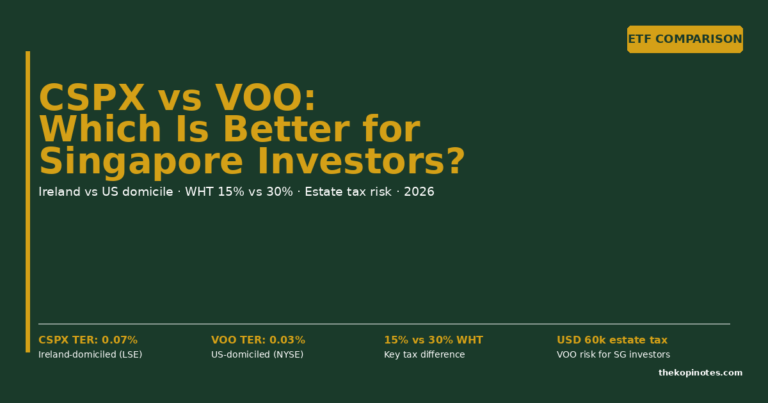
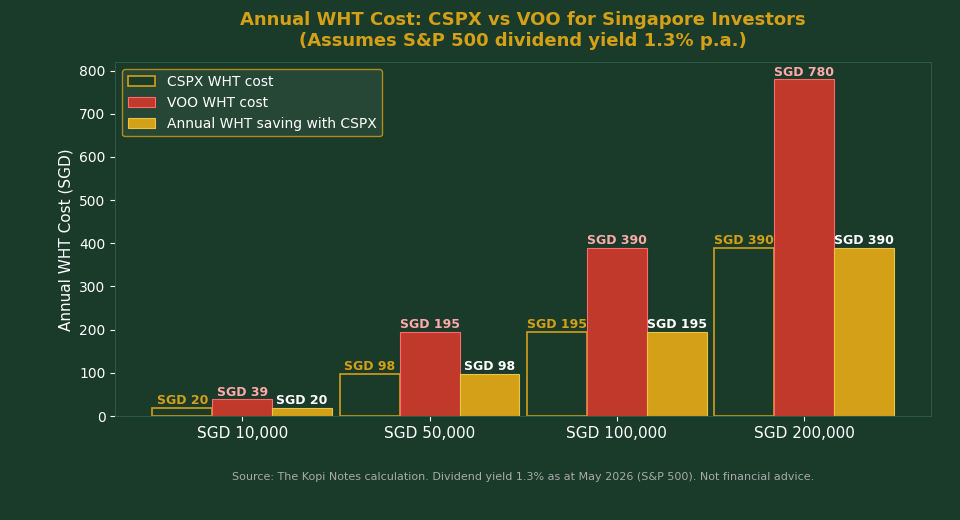
Withholding Tax (WHT): S&P 500 companies pay dividends, which are taxed at source before reaching the ETF. For a US-domiciled ETF like VOO, the full 30% US withholding tax applies because there is no tax treaty benefit. For CSPX (Ireland-domiciled), the Ireland-US tax treaty reduces this to 15%. Since CSPX is accumulating, this 15% is deducted internally before reinvestment — but you still benefit from the 15% rate vs 30%.
US Estate Tax: If a Singapore resident dies holding more than USD 60,000 in US-listed assets (including ETFs like VOO or SPY), the US IRS can claim estate tax of up to 40% on the excess. CSPX is domiciled in Ireland, not the US — so this estate tax does not apply, regardless of your holding size. This is a major concern for Singapore investors with large portfolios.
| Factor | CSPX (LSE, Ireland) | VOO / SPY (NYSE, USA) |
|---|---|---|
| Dividend WHT Rate | 15% | 30% |
| US Estate Tax Risk | None | Yes (above USD 60k) |
| Singapore Capital Gains Tax | None | None |
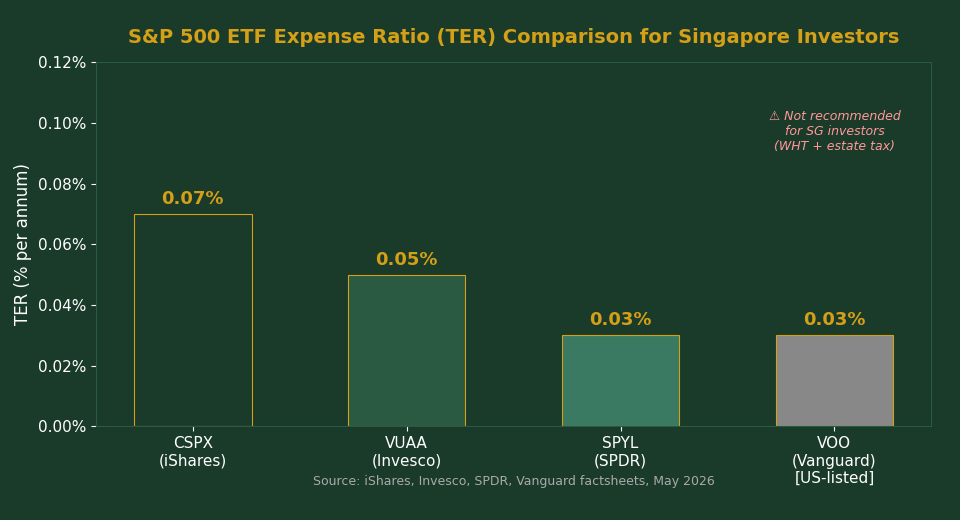
| TER | 0.07% p.a. | 0.03% p.a. |
| Net advantage for SG investor | Better overall | Higher WHT offsets lower TER |
Source: iShares factsheet, Vanguard factsheet, IRS Publication 559, May 2026
The 0.04% higher TER of CSPX vs VOO is easily outweighed by the 15% WHT saving on dividend income. The S&P 500’s dividend yield is approximately 1.3% p.a. as at May 2026. For a SGD 100,000 CSPX portfolio, this means roughly SGD 1,300 in annual dividends — of which CSPX loses 15% (SGD 195) vs VOO losing 30% (SGD 390). The WHT saving of SGD 195 per year far exceeds the extra TER cost of SGD 40 per year. CSPX wins by approximately SGD 155 per year for every SGD 100,000 invested.
CSPX Expense Ratio and Total Cost
CSPX has a Total Expense Ratio (TER) of 0.07% per annum, as stated in the iShares CSPX factsheet (May 2026). The TER is deducted daily from the fund’s NAV and is not invoiced separately — you simply see it reflected in a slightly lower share price growth than the underlying index. At 0.07%, CSPX is one of the cheapest large ETFs available to Singapore investors buying on the LSE.
For context, a SGD 50,000 portfolio in CSPX incurs approximately SGD 35 per year in management fees. A SGD 200,000 portfolio pays around SGD 140 per year. These are remarkably low costs for broad US market exposure.
Beyond the TER, the real total cost of owning CSPX includes brokerage commissions and the bid-ask spread. Interactive Brokers charges as little as USD 1.00 per trade for LSE-listed ETFs, making it the most cost-effective platform for CSPX. Saxo Markets and MooMoo Singapore charge slightly more but offer cleaner mobile interfaces. See the step-by-step broker guide below for a full breakdown of platform costs.
How to Buy CSPX Stock in Singapore (Step-by-Step)
Buying CSPX is straightforward through any broker with LSE access. Here is a step-by-step guide for the most popular platforms used by Singapore investors, along with our Syfe referral code and FSMOne referral code for sign-up bonuses.
Option 1: Interactive Brokers (IBKR) — Best for Cost
- Open and fund an IBKR account (minimum USD 0 for IBKR Lite; SGD 2,000 recommended starting amount)
- Log into the IBKR Trader Workstation or mobile app
- In the search bar, type CSPX and select London Stock Exchange (LSE) from the dropdown
- Choose USD as the trading currency
- Set order type to Limit and enter your desired price (check the live bid/ask first)
- Enter the number of shares (CSPX has no fractional share option on IBKR for LSE)
- Review and submit — IBKR charges approximately USD 1.00 flat per LSE trade
Option 2: Saxo Markets Singapore — Best for Research Tools
- Open a Saxo Singapore account (minimum SGD 3,000 to avoid inactivity fees)
- Fund your account in SGD — Saxo automatically converts to USD when you buy CSPX
- Search CSPX in Saxo’s platform and confirm the exchange is London Stock Exchange
- Commission: 0.08% of trade value, minimum USD 8 per order
- Place a limit order; your SGD is converted at Saxo’s FX rate (typically mid-rate + 0.25%)
Option 3: MooMoo Singapore — Best Mobile Experience
- Open a MooMoo Singapore account — promotions regularly include free stocks or commission-free periods
- Navigate to Markets → Global → London Stock Exchange
- Search CSPX and select the USD-denominated share
- Place a limit order; MooMoo charges 0.03% commission (min USD 0.99) for US and HK stocks — confirm current LSE rates in-app
Option 4: Syfe Brokerage — Best for Beginners
- Open a Syfe Brokerage account using our Syfe referral code for a sign-up bonus
- Syfe Brokerage offers commission-free US-listed ETFs; for LSE-listed CSPX, check their current fee schedule in-app
- Syfe’s interface is the simplest for first-time investors — clean, mobile-first, designed for Singapore investors
- CSPX is available under the Global Stocks section
Important tip: Always use a limit order rather than a market order when buying CSPX. The LSE closes at 12:30am Singapore time — placing a market order near close can result in a poor fill. A limit order ensures you pay no more than your target price.
CSPX vs Alternatives: Which S&P 500 ETF Is Best?
Singapore investors have several options for S&P 500 exposure. The key choice is between LSE-listed UCITS ETFs (CSPX, SPYL, VUAA) and US-listed ETFs (VOO, SPY, IVV). As established above, LSE-listed options win on tax efficiency for Singapore residents. Within LSE-listed S&P 500 ETFs, the comparison is closer. For a detailed breakdown of CSPX versus other S&P 500 options, see our Singapore REIT ETF guide for a broader view of ETF options including S-REIT exposure:
| ETF | Ticker | TER | Structure | AUM | Best For |
|---|---|---|---|---|---|
| iShares Core S&P 500 UCITS ETF | CSPX | 0.07% | Acc | USD ~60B | Largest liquidity, most widely held |
| SPDR Portfolio S&P 500 UCITS ETF | SPYL | 0.03% | Acc | USD ~4B | Lowest TER, lower share price entry |
| Invesco S&P 500 UCITS ETF (Acc) | VUAA | 0.05% | Acc | USD ~10B | Mid-range option, lower price than CSPX |
| Vanguard S&P 500 UCITS ETF (Dist) | VUSD | 0.07% | Dist | USD ~45B | Distributing version (pays dividends) |
| Vanguard S&P 500 ETF | VOO | 0.03% | Dist | USD ~550B | US-domiciled — NOT recommended for SG investors due to WHT + estate tax |
Source: iShares, Invesco, SPDR, Vanguard factsheets, May 2026
Among the LSE-listed options, CSPX is preferred by most Singapore investors because of its massive AUM (USD ~60B), meaning tighter bid-ask spreads and lower slippage cost. SPYL has the lowest TER at 0.03% but is a newer fund with lower liquidity. For most investors, the 0.04% TER difference between CSPX and SPYL is less than SGD 40 per year on a SGD 100,000 portfolio — smaller than a single trade’s commission at most brokers. Liquidity and spread matter more at this level.
Who Should Buy CSPX?
CSPX is an excellent core holding for a wide range of Singapore investors, but it is not for everyone. Here is a clear breakdown:
CSPX is ideal if you:
- Want broad, diversified exposure to the 500 largest US companies in a single trade
- Are a long-term investor (5+ years) comfortable with equity market volatility
- Want automatic dividend reinvestment without having to manage payouts
- Have a portfolio above SGD 10,000 where the per-trade commission is proportionally small
- Are concerned about US estate tax on your dependants — CSPX completely eliminates this risk
- Want to pair global equity exposure with a solid CPF investment strategy (note: CSPX is SRS-compatible but not CPFIS-eligible)
Consider alternatives if you:
- Want Singapore income-generating assets — look at best S-REITs in Singapore 2026 for dividend-focused options
- Want safer, capital-preserved fixed income — Singapore T-bills 2026 or Singapore Savings Bonds offer capital protection with guaranteed returns
- Are investing via CPF OA — CSPX is not CPFIS-approved; look at SGX-listed ETFs instead
- Want broader global diversification beyond just the US — consider VWRA (all-world) instead of CSPX
- Are planning for retirement income — use our Singapore retirement calculator to model whether CSPX fits your withdrawal timeline
CSPX is not a low-risk investment. The S&P 500 has experienced drawdowns of over 30% in bear markets (e.g. -33% in March 2020, -25% in 2022). Investors must be comfortable holding through these periods without selling. For most long-term investors, this volatility is the price of the superior long-term returns that CSPX has historically delivered.
Disclaimer: This article is for educational purposes only and does not constitute financial advice. Please consult a licensed financial adviser before making investment decisions. All data as at May 2026.
Frequently Asked Questions
What is CSPX stock and is it the same as VOO or SPY?
CSPX is the LSE ticker for the iShares Core S&P 500 UCITS ETF (Acc), which tracks the same S&P 500 index as VOO and SPY but is structured as an Ireland-domiciled UCITS fund. For Singapore investors, CSPX is significantly better than VOO or SPY because it attracts only 15% withholding tax on US dividends (vs 30% for VOO/SPY) and has no US estate tax exposure above USD 60,000. The underlying index and performance are nearly identical, but the tax structure makes CSPX the preferred choice for Singapore residents.
How do I check the CSPX stock price today?
You can check the live CSPX price on Google Finance (search “CSPX:LON”), Yahoo Finance (search “CSPX.L”), or directly within your brokerage app (IBKR, Saxo, MooMoo) during LSE trading hours — 9:00am to 5:30pm London time, which is 4:00pm to 12:30am Singapore time. Outside these hours, you will see the previous day’s closing price. The iShares website also shows the official NAV, which is calculated once daily after LSE close.
Can I buy CSPX using my CPF or SRS funds?
CSPX is not eligible for the CPF Investment Scheme (CPFIS) as it is listed on the London Stock Exchange, not SGX. However, CSPX can be purchased through certain brokers using your Supplementary Retirement Scheme (SRS) account — check with your SRS operator (DBS, OCBC, or UOB) and chosen broker on whether they support SRS-funded purchases of LSE-listed securities. Most Singapore investors use cash brokerage accounts (IBKR, Saxo, MooMoo) to buy CSPX.
What is the minimum investment to buy one CSPX stock?
CSPX trades at approximately USD 570–600 per share as at May 2026, so the minimum is roughly one share plus brokerage commission. On Interactive Brokers, that means approximately USD 571–601 plus USD 1 commission. Most brokers do not offer fractional shares for LSE-listed ETFs, so you must buy whole shares. With IBKR’s low minimum commission of USD 1 per trade, CSPX is accessible even for investors starting with SGD 800–850 (approximately one share of CSPX).
Is CSPX safe? What are the risks?
CSPX is backed by BlackRock, the world’s largest asset manager, and tracks the S&P 500 — the 500 largest US-listed companies. The fund itself is UCITS-regulated, meaning it must hold actual shares in the underlying companies (physical replication) and cannot use excessive leverage. That said, CSPX is an equity investment and subject to stock market risk: the S&P 500 fell more than 30% during the 2020 COVID crash and about 25% in 2022. Currency risk also applies, as CSPX trades in USD but Singapore investors typically hold SGD. Investors should only invest money they can leave for at least 5–10 years.
Why does CSPX have a higher TER than VOO if they track the same index?
VOO charges 0.03% p.a. while CSPX charges 0.07% p.a. — a 0.04% difference. This is because UCITS funds carry slightly higher compliance, reporting, and custody costs to operate within the European regulatory framework (UCITS). However, for Singapore investors, this higher TER is more than offset by CSPX’s withholding tax advantage: the 15% WHT rate on US dividends (vs 30% for VOO) saves approximately SGD 195 per year on a SGD 100,000 portfolio, versus the extra TER cost of only SGD 40. CSPX is the better net-return option for Singapore investors despite the higher TER.
Ready to Buy CSPX?
Open a brokerage account today and start building your S&P 500 position. Use our referral links for exclusive sign-up bonuses.
This article was researched with the help of AI. While we strive to keep all information accurate and up to date, there may be errors. If you notice any discrepancies, please contact us.