Mapletree Logistics Trust Share Price 2026 (M44U): 2H2026 DPU Outlook, China Headwinds & Investor Verdict
Published October 2026 · SGX: M44U · Category: S-REITs · Deep Dive
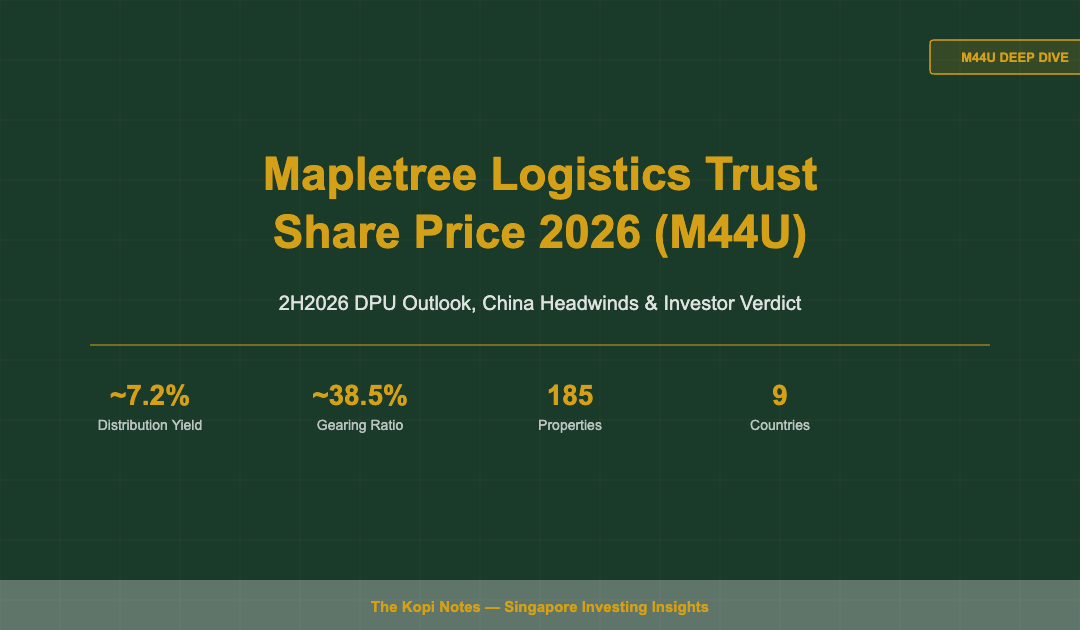
Mapletree Logistics Trust (SGX: M44U) is one of Singapore’s largest logistics S-REITs, with 185 properties across 9 Asia-Pacific countries and a distribution yield of approximately 7.2% as at October 2026. For income-focused investors, the key question heading into 2H2026 is whether MLT’s DPU can hold steady despite mounting China headwinds and elevated gearing. This deep dive breaks down the numbers, the risks, and the investor verdict.
Not financial advice. All figures are for educational reference only. Data as at October 2026 unless noted.
Table of Contents
Jump to a Section
- What Is Mapletree Logistics Trust?
- MLT Share Price Performance 2026
- 2H2026 DPU Outlook: Is the Distribution Sustainable?
- China Exposure: The Key Risk Factor
- Portfolio Resilience: Japan, Australia & ASEAN
- Gearing & Balance Sheet Analysis
- MLT vs S-REIT Yield Comparison
- Buy, Hold or Sell? Investor Verdict
- Frequently Asked Questions
What Is Mapletree Logistics Trust?
Mapletree Logistics Trust (M44U) was listed on the SGX in 2005 and is managed by Mapletree Investments, a Singapore government-linked logistics and industrial property group. MLT focuses on modern warehouse and distribution centre assets across Asia-Pacific, serving blue-chip tenants in e-commerce, cold storage, manufacturing, and 3PL (third-party logistics).
As at 2H2026, MLT’s portfolio spans 185 properties across 9 countries with a total assets under management (AUM) of approximately S$12.8 billion. Its tenant base includes regional giants such as Cainiao (Alibaba’s logistics arm), JD.com, and leading FMCG manufacturers — providing stable, long-term income streams.
For Singapore investors building a passive income Singapore portfolio, MLT has historically been a core holding due to its consistent DPU track record and geographic diversification across the growth markets of Asia. However, recent macro headwinds have complicated the investment thesis.
MLT Share Price Performance 2026
Mapletree Logistics Trust’s share price has been range-bound in 2026, hovering between S$1.40 and S$1.65 for much of the year. As at October 2026, M44U trades at approximately S$1.48–S$1.52, representing a discount of roughly 20–22% to its NAV of ~S$1.89 per unit.
This P/NAV discount reflects the market’s cautious stance on several fronts: China property market contagion risk, the impact of higher-for-longer interest rates on borrowing costs, and questions around the sustainability of distributions given a softening logistics demand environment in key markets.
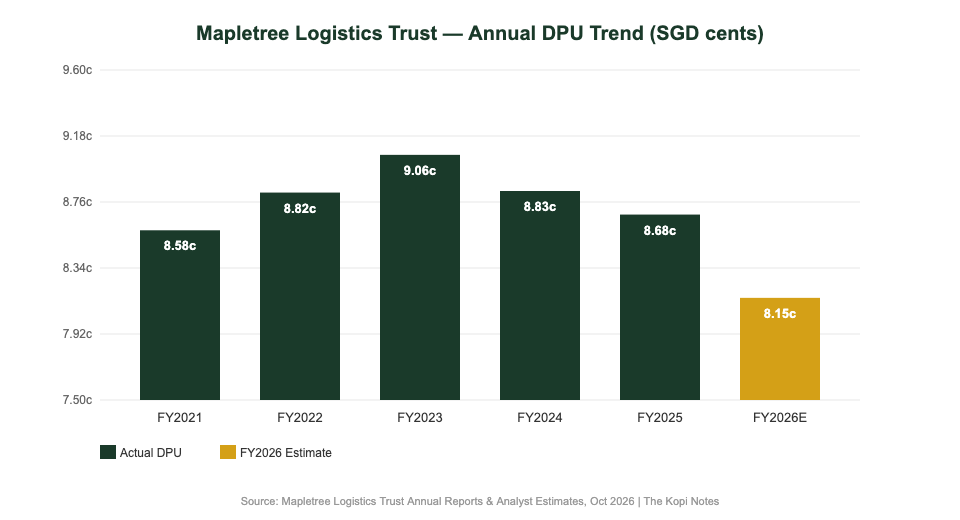
That said, for long-term income investors, a P/NAV discount can represent an attractive entry point — provided the underlying DPU remains defensible. The chart below tracks MLT’s annual DPU from FY2021 to the FY2026 estimate.
2H2026 DPU Outlook: Is the Distribution Sustainable?
This is the central question for MLT investors. After peaking at 9.06 Singapore cents per unit in FY2023, MLT’s annual DPU has been on a gradual decline: FY2024 delivered 8.83c, FY2025 came in at 8.68c, and consensus estimates for FY2026 point to approximately 8.10–8.20 cents — a further ~6% reduction from the FY2023 peak.
The key DPU drivers for 2H2026 are:
- Interest costs: MLT carries debt at a mix of fixed and floating rates. While rates have stabilised in Singapore, the refinancing of legacy low-rate facilities at current market rates continues to put pressure on distributable income. Every 25bps rise in borrowing cost reduces DPU by approximately 0.05–0.06 cents.
- China rental reversions: China contributes ~35% of MLT’s NPI but has seen negative rental reversions in select submarkets due to oversupply in logistics hubs near Guangdong and East China. Management has guided for occupancy to remain above 90% but rental rates remain under pressure.
- Currency headwinds: With a significant portion of income in RMB, JPY, and AUD, a stronger SGD reduces distributable income when converted. The RMB depreciation in 2025–2026 has been a headwind, partially offset by JPY resilience.
- New acquisitions: MLT completed selective acquisitions in Japan and Australia in 1H2026, contributing positively to DPU from 2H2026 onwards — providing a partial offset to the China and FX pressures.
On balance, the 2H2026 DPU is expected to be approximately 4.05–4.10 cents, keeping the full-year FY2026 figure just above the 8.10c mark. Distribution coverage remains above 100% (i.e., the trust is not paying out more than it earns), which is a key sustainability signal.
Investors looking to model MLT’s income contribution to their retirement income should check out our Singapore retirement calculator to see how a yield of ~7.2% compounds over a 10–20 year horizon.
China Exposure: The Key Risk Factor
With approximately 35% of AUM concentrated in China, MLT carries the largest single-country China exposure among Singapore’s major logistics REITs. This is both a long-term structural opportunity (Asia’s biggest consumer market) and the biggest near-term risk.
Key China-specific risks for MLT in 2H2026:
- Logistics oversupply: Tier-1 Chinese cities saw a wave of new warehouse completions in 2023–2025, pushing vacancy rates higher in some submarkets and dampening rental reversions.
- E-commerce slowdown: The post-pandemic normalisation of Chinese e-commerce growth has reduced demand for additional logistics space from Alibaba/JD.com platforms — historically MLT’s anchor tenants.
- RMB depreciation: The RMB has weakened ~4–5% against SGD since 2024, directly eroding China-sourced NPI when converted to SGD for distribution purposes.
- Geopolitical risk: Escalating US-China trade tensions introduce tail risk around supply chain disruption and potential tenant restructuring.
MLT’s management has acknowledged these headwinds and has committed to a gradual reduction of China’s portfolio share from ~35% towards ~30% over the next 3 years, via selective divestment of non-core assets and capital recycling into Japan and Australia.
This strategy mirrors what we analysed in our deep-dive on MLT’s Japan and Australia portfolio expansion, where management outlined a deliberate de-risking roadmap through geographic diversification.
Portfolio Resilience: Japan, Australia & ASEAN
While China grabs the headlines, MLT’s non-China portfolio provides a solid income floor. Japan (~22% of AUM), Singapore (~14%), and Australia (~11%) collectively contribute ~47% of NPI and are performing well.
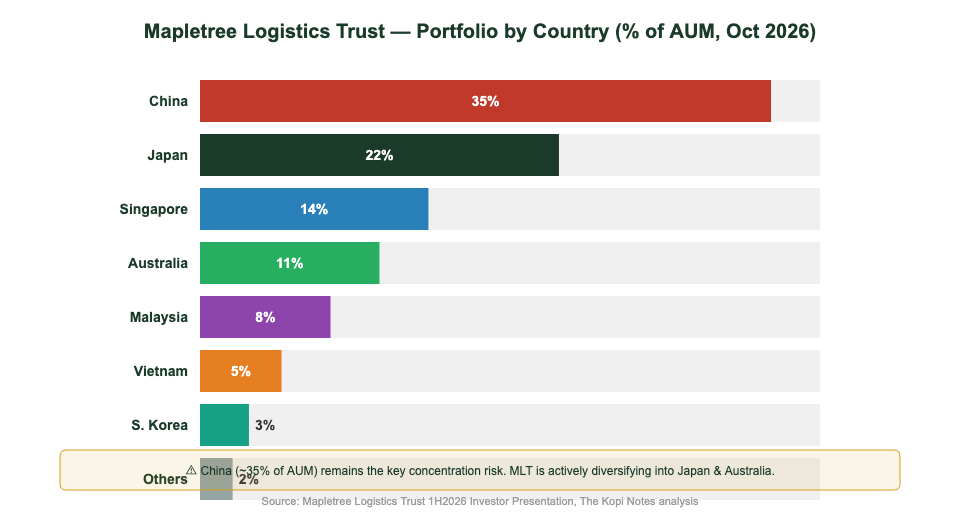
Japan: MLT’s Japan portfolio benefits from structurally tight logistics vacancy rates (sub-2% in Greater Tokyo), steady rental growth, and resilient domestic consumption. Recent acquisitions in the Osaka/Kobe logistics corridor further strengthen this segment. JPY has shown relative stability in 2026, limiting FX drag.
Australia: The Australian logistics market has seen strong tenant demand driven by domestic e-commerce penetration catching up with other markets. MLT’s Australian assets are predominantly in Sydney and Melbourne prime logistics corridors with WALE of ~5.2 years — providing excellent income visibility.
ASEAN (Malaysia, Vietnam, South Korea): Southeast Asian logistics fundamentals remain constructive, with Vietnam benefiting from supply chain diversification out of China (the “China+1” strategy) and Malaysia seeing robust growth in Selangor/Shah Alam logistics hubs. These markets collectively contribute ~16% of AUM and growing.
The non-China portfolio’s combined occupancy rate of approximately 98.2% provides a strong base of stable income — effectively offsetting about half of the China NPI pressure.
Gearing & Balance Sheet Analysis
MLT’s aggregate leverage (gearing ratio) stands at approximately 38.5% as at 1H2026, which is within MAS’s regulatory cap of 50% but above the 35–36% level that many REIT investors consider “comfortable.” The trust has ~S$2.1 billion of debt maturing within the next 3 years, with an average cost of debt of approximately 3.65% p.a.
| Metric | MLT 1H2026 | Peer Average | Assessment |
|---|---|---|---|
| Gearing Ratio | 38.5% | 36.2% | ⚠ Slightly Elevated |
| Interest Coverage Ratio | 3.1x | 3.4x | ⚠ Adequate |
| Avg Cost of Debt (p.a.) | 3.65% | 3.52% | ⚠ Above Peer |
| % Fixed Rate Debt | ~72% | ~68% | ✓ Well Hedged |
| Debt Maturity (avg) | 3.4 years | 3.1 years | ✓ Well Spread |
| WALE (portfolio) | 4.1 years | 3.8 years | ✓ Strong Visibility |
Source: Mapletree Logistics Trust 1H2026 Results Presentation; Peer average includes MLT, KDC REIT, MIT, CLAR (industrial/logistics REITs). The Kopi Notes analysis, October 2026.
The gearing picture is manageable but leaves limited headroom for acquisitions without equity fundraising. MLT may need to conduct a preferential offering or private placement to fund future growth — a scenario that could be mildly dilutive to existing unitholders. Investors tracking similar balance sheet metrics may find our analysis of the best S-REITs in Singapore 2026 useful for a broader peer comparison.
MLT vs S-REIT Yield Comparison (2026)
How does MLT’s current yield stack up against comparable S-REITs? The table below compares yield, gearing, and P/NAV across Singapore’s major logistics and industrial REITs as at October 2026.
| REIT | Ticker | Yield (Est.) | Gearing | P/NAV |
|---|---|---|---|---|
| Mapletree Logistics Trust | M44U | ~7.2% | 38.5% | 0.78x |
| Mapletree Industrial Trust | ME8U | ~6.5% | 36.2% | 0.92x |
| Keppel DC REIT | AJBU | ~5.8% | 34.1% | 1.42x |
| CapitaLand Ascendas REIT | A17U | ~6.1% | 37.8% | 1.05x |
| AIMS APAC REIT | O5RU | ~7.8% | 33.5% | 0.86x |
Source: SGX data, company announcements, analyst consensus estimates. Yields based on annualised DPU vs share prices as at October 2026. For reference only — not a buy/sell recommendation. The Kopi Notes, October 2026.
MLT offers the highest yield among the major industrial/logistics S-REITs (excluding AIMS APAC REIT), with a significant P/NAV discount. This combination of high yield + deep NAV discount can attract contrarian income investors — but the discount also reflects genuine China risk and balance sheet uncertainty that should not be dismissed.
Buy, Hold or Sell MLT? The Investor Verdict
Putting it all together, here is TKN’s balanced assessment of MLT heading into 2H2026:
Bull Case (BUY): At ~7.2% yield and 0.78x P/NAV, MLT offers a meaningful income premium and a deep discount to book value. If China logistics demand stabilises, RMB recovers modestly, and interest rates begin to ease in 2027, MLT’s DPU has room to recover towards 8.5–9c — generating both income and capital appreciation. The Japan and Australia portfolio provides a high-quality income base that de-risks the thesis.
Bear Case (SELL/REDUCE): China exposure remains a structural drag that could worsen if the property market contagion deepens or US-China tariffs escalate. Gearing at 38.5% limits balance sheet flexibility. If DPU falls further towards 7.5–7.8c, the current yield becomes less compelling relative to T-bills (yielding ~3.6%) and AAA bonds.
Base Case (HOLD): MLT is likely a HOLD at current prices for existing investors with a 3–5 year horizon. The 7.2% yield provides adequate compensation for the China risk, provided investors accept that DPU may grind slightly lower before stabilising. New investors may consider accumulating in tranches near S$1.40–1.45 where the margin of safety improves further.
Not financial advice. Always consult a licensed financial adviser before investing. Past DPU performance is not a guarantee of future distributions.
How to Invest in MLT via Robo-Advisors
Singapore investors can gain exposure to MLT and the broader S-REIT sector through platforms that offer S-REIT portfolios and ETFs:
- Syfe referral code (SRPRFFFCD) — Syfe’s REIT+ portfolio tracks the iEdge S-REIT Leaders Index and includes MLT as a core holding. Ideal for investors who want diversified S-REIT exposure without stock-picking.
- Endowus referral code (2V343) — Endowus offers S-REIT funds and allows CPF-OA and SRS investment in REIT-focused funds, making it one of the most tax-efficient ways to invest in the sector.
- FSMOne referral code (P0544985) — Direct brokerage platform for buying MLT shares on the SGX, with competitive commission rates.
Frequently Asked Questions
Is Mapletree Logistics Trust a good investment in 2026?
What is MLT's current DPU and distribution yield?
Why is MLT's share price declining in 2026?
How much of MLT's portfolio is in China?
Can I invest in MLT through my CPF or SRS account?
What is the WALE for MLT's portfolio?
This article was researched with the help of AI. While we strive to keep all information accurate and up to date, there may be errors. If you notice any discrepancies, please contact us.