Mapletree Logistics Trust Share Price 2026: Japan Dominance, AUD Recovery & FY2H2027 DPU Forecast (SGX: M44U)
MLT’s Japan portfolio now commands 27% of assets — the trust’s single largest market — while Australian assets show early AUD/SGD recovery signals. Here’s what Singapore investors need to know about the share price outlook and FY2H2027 DPU trajectory.
Table of Contents — Click to expand
Mapletree Logistics Trust (SGX: M44U) is Singapore’s largest pure-play logistics REIT by market capitalisation, holding a pan-Asian portfolio spanning Japan, Singapore, China, Australia, Vietnam, Hong Kong and India. As at October 2026, MLT trades near S$1.43–S$1.50, implying a forward yield of approximately 6.0–6.5% on estimated FY2H2027 DPU — making it one of the most watched names among Singapore dividend investors seeking exposure to the structural tailwind of Asia-Pacific e-commerce logistics demand.
Not financial advice. All figures are for educational reference only. Data as at October 2026 unless noted.
MLT Share Price Overview (Oct 2026)
Mapletree Logistics Trust has navigated a challenging rate cycle since its FY24 peak, with the share price retreating from a high above S$1.80 (2022) to the S$1.40–S$1.55 range in 2026 as higher interest rates compressed valuations across Singapore REITs. However, with the US Federal Reserve commencing rate cuts in late 2024 and Singapore interbank rates easing, MLT’s interest cost headwinds are beginning to abate.
MLT’s share price is influenced by three main levers in 2026: (1) the performance of its Japan portfolio, now its largest market by AUM; (2) AUD/SGD exchange rate movements affecting Australia distributions; and (3) China portfolio occupancy, which remains below 90% amid soft domestic demand.
| Metric | Value (Oct 2026) |
|---|---|
| Share Price (est.) | ~S$1.45 |
| Market Cap (est.) | ~S$8.9bn |
| P/NAV | ~0.88× |
| Forward Yield (est.) | ~6.2% |
| Portfolio AUM | ~S$13.5bn |
| No. of Properties | ~188 |
| Occupancy Rate | ~95.8% |
| Gearing | ~38.2% |
Source: MLT SGX filings, consensus estimates, The Kopi Notes estimates. Oct 2026. Not a recommendation.
Japan Portfolio: Why It Now Leads
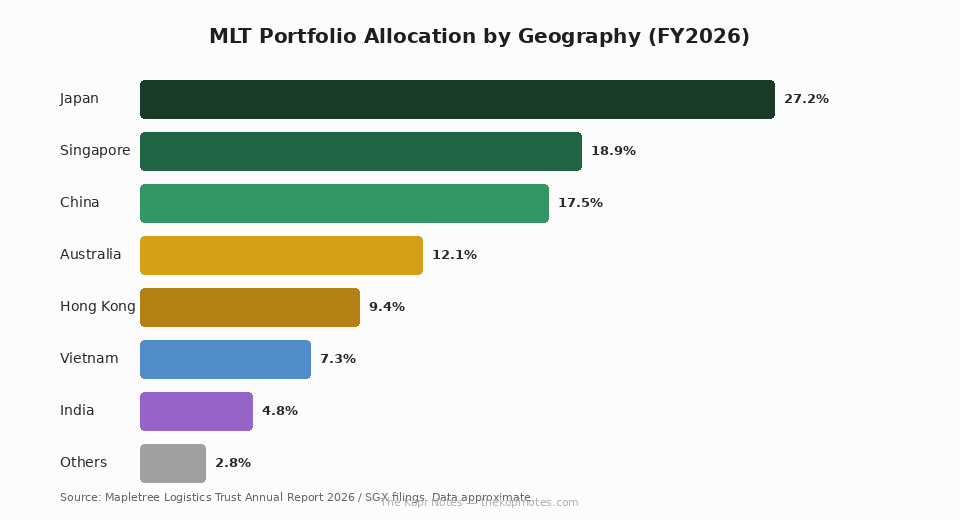
Japan has become MLT’s crown jewel — overtaking Singapore in 2024 to become the trust’s largest market by AUM, at approximately 27% of total assets. This reflects deliberate portfolio strategy: MLT has steadily acquired modern, Grade-A logistics assets in Greater Tokyo, Osaka and Nagoya, where supply constraints are structural and tenant demand is robust due to Japan’s e-commerce adoption acceleration post-COVID.
What makes Japan compelling for a logistics REIT in 2026:
First, Japan’s logistics market is undersupplied relative to demand. The country has historically under-invested in modern logistics infrastructure, and major e-commerce platforms (Amazon Japan, Rakuten, Mercari) are competing aggressively for Grade-A multi-storey warehouse space near urban centres. This drives strong rental reversion — MLT Japan has reported positive rental reversions of 8–15% on renewals in the Greater Tokyo corridor.
Second, the JPY/SGD dynamic cuts both ways. A weaker yen (2022–2024 period) compressed SGD distributions from Japan assets. However, as the Bank of Japan has cautiously moved away from negative interest rate policy, JPY has partially recovered versus SGD, which benefits MLT’s DPU when converting Japanese rents back to Singapore dollars.
Third, long master lease structures in Japan provide DPU visibility. MLT Japan’s weighted average lease expiry (WALE) exceeds 6 years, significantly reducing income risk from tenant churn.
Australia: AUD Recovery and Asset Quality
Australia represents approximately 12% of MLT’s AUM — a meaningful contributor that saw headwinds through 2023–2024 as AUD weakened relative to SGD. In 2026, the picture has improved. The Reserve Bank of Australia began cutting rates in early 2025, which has supported AUD versus SGD, and MLT’s Australian logistics assets — concentrated in Sydney, Melbourne and Brisbane — benefit from e-commerce tail winds similar to Japan.
A Singapore investor holding S$50,000 in MLT at a 6.2% yield would receive approximately S$3,100 in annual distributions. Of this, roughly S$372 (12%) is effectively sourced from AUD-denominated rents. A 5% AUD/SGD appreciation, as seen through 2025–2026, adds approximately S$18 annually to that investor’s effective distribution — a modest but directionally positive development.
MLT’s Australian properties are modern, purpose-built logistics facilities leased to large 3PL operators and e-commerce tenants, with long WALEs averaging 5+ years. Occupancy in Australia has remained above 97%, reflecting tight vacancy in key logistics markets near major ports and urban nodes.
The key risk for Australia is cap rate expansion if Australian interest rates remain elevated longer than expected, which could pressure asset valuations and push gearing higher. MLT management has flagged Australian cap rates as one to watch through FY2026–2027.
If you’re building a passive income Singapore portfolio, MLT’s pan-Asian logistics exposure across Japan and Australia provides geographic diversification that most Singapore-listed REITs cannot offer.
FY2H2027 DPU Forecast
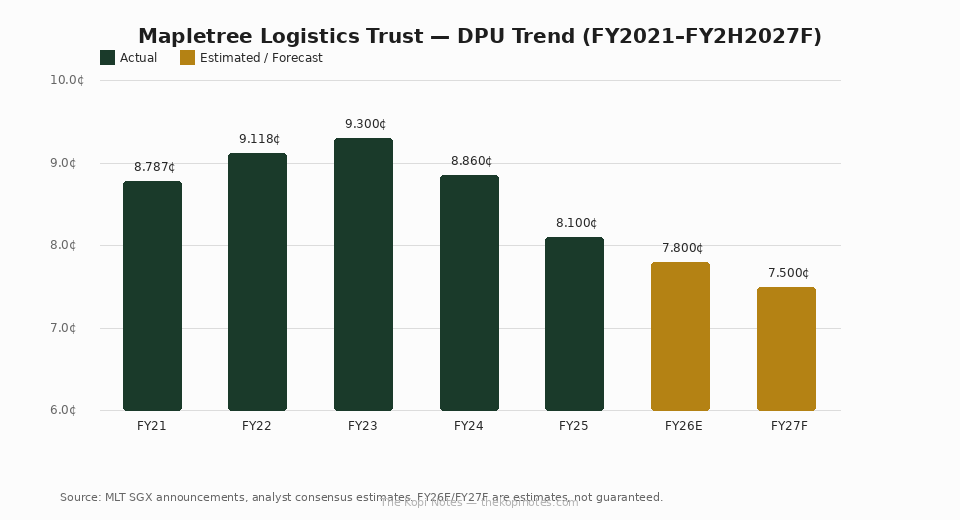
MLT’s DPU peaked at 9.300 cents in FY2023 before declining to approximately 8.1 cents in FY2025 as higher financing costs bit into distributable income. The question for investors is: where does DPU stabilise, and can it recover?
Consensus estimates suggest FY2026 DPU of approximately 7.8–8.0 cents and FY2H2027 DPU (annualised) of approximately 7.5–8.0 cents. The drivers:
On the positive side: Japan rental reversions, AUD stabilisation, and falling cost of debt as existing fixed-rate hedges are rolled at lower rates (MLT refinanced approximately S$1.2bn of debt in FY2025–2026 at improved spreads). Management commentary has guided for NPI margin recovery as older fixed-rate debt matures.
On the negative side: China occupancy below 90% continues to suppress rental income from MLT’s second-largest market. Any further RMB/SGD weakening would amplify this. Additionally, MLT’s debt expiry profile is manageable but not trivial — approximately 20–25% of total debt matures within 2 years, requiring refinancing at current spreads.
To track your own income projections against this DPU trajectory, try the Singapore retirement calculator — it lets you model REIT dividends alongside CPF and other income streams.
Gearing & Balance Sheet Health
MLT’s aggregate leverage (gearing) stood at approximately 38.2% as at mid-2026 — comfortably below MAS’s 50% regulatory cap, but elevated versus the 33–35% range management historically targeted. This reflects the dilutive effect of property revaluations in China (where cap rates expanded) and AUD-denominated assets.
| Gearing Scenario | Impact |
|---|---|
| Below 35% (target) | Ample headroom for acquisitions; positive signal |
| 35–40% (current ~38%) | Manageable; limits large acquisitions without equity |
| 40–45% range | Raises refinancing risk; higher cost of debt |
| Above 45% | MAS scrutiny zone; very restrictive on growth |
Source: MAS REIT regulations, MLT annual report guidance. For educational purposes only.
MLT’s interest coverage ratio (ICR) remains above 3× — above MAS’s 1.5× minimum and a comfortable buffer against rising debt costs. Management has prioritised fixed-rate hedging: approximately 70–75% of MLT’s debt is on fixed rates or interest rate swaps, providing near-term DPU predictability. For more on how to assess REIT balance sheet strength, see the best S-REITs in Singapore 2026 comparison guide.
Valuation: Is MLT Cheap at Current Levels?
At ~S$1.45 and 0.88× Price/NAV (below book), MLT is trading at levels that historically represented entry points. A P/NAV below 1× means you are buying S$1 of net assets for S$0.88 — a discount that many long-term Singapore REIT investors view as a margin of safety, provided the underlying assets hold their values.
However, the discount is not free money. China assets (17–18% of AUM) carry cap rate risk if valuers mark them down further. Any further downward revaluation of Chinese logistics properties would reduce NAV per unit, meaning the apparent discount could narrow without the share price recovering.
By comparison, MLT’s forward yield of ~6.2% is attractive relative to the 10-year Singapore Government Securities (SGS) yield of approximately 3.2–3.5% as at late 2026, offering a spread of roughly 270–290 basis points. This spread is above MLT’s 5-year historical average of ~220bps, suggesting the market is pricing in risk — which creates opportunity for investors with a longer time horizon. For comparison with similar diversified logistics names, see our previous analysis: MLT dividend sustainability and the Vietnam and Malaysia portfolio deep-dive.
Investors seeking to build exposure via a robo-advisor (for automatic portfolio rebalancing including REITs) can explore our Syfe referral code for sign-up bonuses, or the Endowus referral code for CPF and SRS-eligible investment products.
Key Risks to Watch
No investment is without risk. For MLT specifically in FY2026–2027, the key risk factors are:
China occupancy drag: If China occupancy does not recover towards 92–93%, rental income from MLT’s second-largest market stays suppressed. Management has guided cautiously on China recovery timelines amid soft domestic demand.
JPY and AUD currency exposure: MLT earns in JPY and AUD but distributes in SGD. A significant JPY weakening (e.g. back below 165 JPY/SGD territory) would compress Japan contribution to DPU. This is the single largest currency risk given Japan’s 27% AUM weight.
Acquisition pipeline: MLT’s sponsor, Mapletree Investments, has a deep logistics pipeline. However, with gearing at 38%, any significant acquisition would likely require equity fundraising (rights issue or private placement), which is dilutive to existing unitholders.
Interest rate normalisation pace: If US Fed rate cuts slow or reverse, Singapore REIT yields would face renewed compression pressure, potentially widening the spread required by the market and pushing MLT’s share price lower.
For a broader view of the S-REIT sector’s interest rate dynamics, see our passive income Singapore guide.
Buy, Hold or Sell? Our Assessment
MLT remains a high-quality logistics REIT with defensible competitive advantages: a dominant Japan portfolio with structural rental growth, long WALEs across its best markets, and a credible sponsor pipeline. The share price has pulled back materially from 2022 highs, creating a value window for patient income investors.
For Singapore dividend investors, the key question is whether 6.2% yield with moderate DPU recovery risk is sufficient compensation for China and currency headwinds. At 0.88× P/NAV with a well-hedged balance sheet, MLT offers reasonable value versus its own history and peer group. It is not the highest-yielding S-REIT available — but it offers portfolio-grade quality and geographic diversification that smaller S-REIT investors often underweight.
If you are building a REIT portfolio and want to see how MLT fits alongside your CPF and other savings, the retirement planning calculator is a useful starting point. For brokerage platform choice, see our FSMOne referral code for a platform commonly used by Singapore REIT investors.
Frequently Asked Questions — MLT Share Price 2026
What is the current Mapletree Logistics Trust share price?
As at October 2026, MLT (SGX: M44U) trades around S$1.43–S$1.50. The share price has been range-bound as investors balance the trust’s improving Japan portfolio performance against ongoing China occupancy headwinds and currency risk from JPY and AUD exposure. Always check the SGX or your brokerage platform for the real-time price before any investment decision.
What is MLT's DPU for FY2H2027 and forward yield?
Consensus analyst estimates point to a full-year FY2027 DPU of approximately 7.5–8.0 Singapore cents. At a share price of S$1.45, this implies a forward yield of approximately 5.2–5.5% (annualised). This is below the FY2023 peak DPU of 9.3 cents but represents a stabilisation after the FY2024–2025 decline driven by higher financing costs. These are estimates, not guaranteed distributions — actual DPU depends on NPI performance, exchange rates, and financing costs.
Why is Japan MLT's largest market, and does that affect the DPU?
Japan became MLT’s largest market by AUM (approximately 27%) through deliberate acquisition of modern logistics assets in Greater Tokyo and Osaka. Japan offers structural supply constraints, positive rental reversions of 8–15%, and long lease WALEs of 6+ years. However, DPU from Japan is affected by JPY/SGD exchange rates — a weaker yen reduces the SGD value of Japanese rents. With the Bank of Japan moving away from ultra-loose policy in 2024–2025, the JPY has partially recovered, which is a mild positive for MLT’s DPU outlook.
How does MLT compare to other S-REITs in terms of yield and risk?
MLT’s ~6.2% forward yield sits in the mid-range of the S-REIT universe. Industrial and logistics REITs tend to offer moderate yields with defensive income characteristics — higher than office REITs, lower than some retail or hospitality names. MLT’s geographic diversification (8 markets) adds complexity but also reduces single-market concentration risk. Its P/NAV of ~0.88× is below the historical average, suggesting the market is pricing in some risk — primarily around China and currency exposure. For a broader comparison, see our best S-REITs guide.
Can I buy MLT using my CPF Ordinary Account or SRS?
Yes. MLT (SGX: M44U) is eligible for investment under the CPF Investment Scheme (CPFIS), allowing you to use CPF Ordinary Account funds to purchase units via an approved broker. MLT is also eligible under the Supplementary Retirement Scheme (SRS), which offers tax deferral benefits. Note that CPFIS and SRS funds invested in REITs carry investment risk — the value can fall below the amount invested. Robo-advisors such as Endowus and Syfe also offer REIT portfolios that may include MLT-like exposure via funds, and may be suitable for investors who prefer managed exposure over direct stock picking.
What is MLT's gearing and is it a concern?
MLT’s aggregate leverage (gearing) is approximately 38.2% as at mid-2026, which is above management’s long-run target of 33–35% but well below MAS’s 50% regulatory cap. The elevated gearing reflects property value compressions in China. MLT’s interest coverage ratio remains above 3×, and approximately 70–75% of debt is on fixed rates or swaps, providing near-term DPU stability. The gearing level limits large acquisitive growth without equity fundraising, which is a mild concern but not an immediate distress signal.
This article was researched with the help of AI. While we strive to keep all information accurate and up to date, there may be errors. If you notice any discrepancies, please contact us.