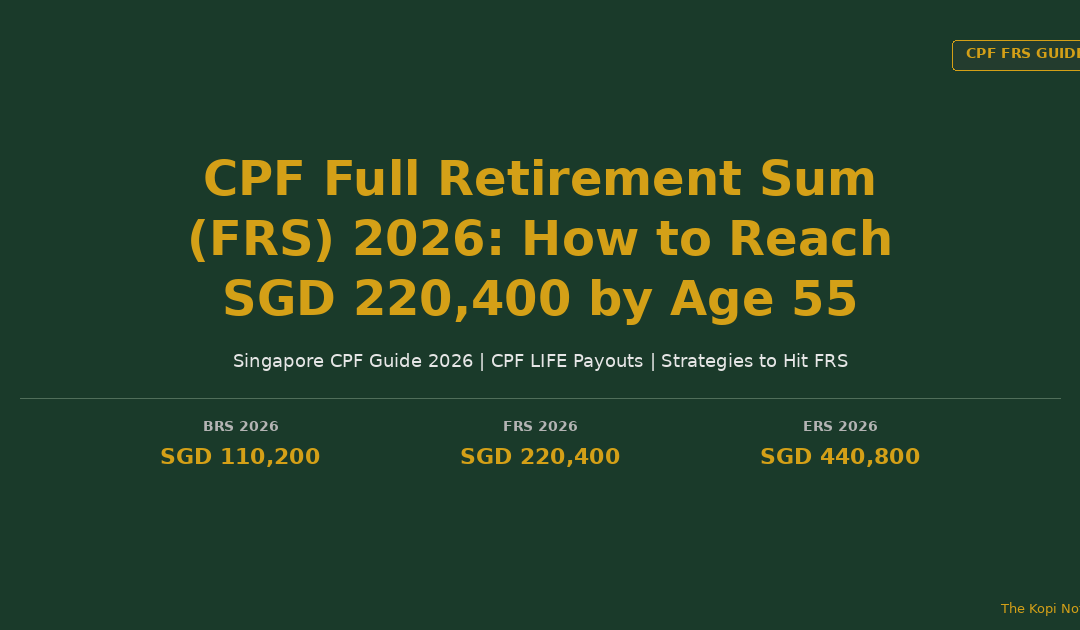
CPF Full Retirement Sum (FRS) 2026: How to Reach SGD 220,400 by Age 55
Updated: October 2026 | CPF Board 2026 Data | 8-min read
The CPF Full Retirement Sum (FRS) for 2026 is SGD 220,400. Members who set aside the FRS in their Retirement Account by age 55 are eligible for monthly CPF LIFE payouts of approximately SGD 1,640–SGD 1,750 from age 65, rising to SGD 2,190–SGD 2,370 if they defer to age 70. The FRS is adjusted upward by roughly 3–4% each year to keep pace with inflation and rising living costs. This guide explains how the FRS works, where it sits relative to the Basic (BRS) and Enhanced (ERS) Retirement Sums, and the six most effective strategies Singapore residents can use to reach the FRS before their 55th birthday.
Not financial advice. All figures are for educational reference only. Data as at October 2026 unless otherwise noted. Consult a licensed financial adviser for personalised guidance.
What Is the CPF Full Retirement Sum?
The Full Retirement Sum (FRS) is a CPF policy benchmark that determines how much you need in your Retirement Account (RA) to receive a lifelong monthly payout under the CPF LIFE scheme. It was introduced to give Singaporeans a clear savings target — a number to aim for during their working years.
When you turn 55, your CPF Board automatically creates a Retirement Account. Savings from your Special Account (SA) and, if needed, your Ordinary Account (OA) are transferred into the RA up to the Full Retirement Sum. Any balance above the FRS in your SA and OA remains accessible for investment, housing, or education.
Three tiers exist to accommodate different retirement goals:
- Basic Retirement Sum (BRS): the minimum. Provides a baseline payout if you own property with a remaining lease that covers your expected lifespan.
- Full Retirement Sum (FRS): the standard target. Twice the BRS. Provides a comfortable baseline for retirement without relying on property.
- Enhanced Retirement Sum (ERS): the maximum. Four times the BRS. For members who want the highest CPF LIFE payouts and are willing to commit more to their RA.
For your CPF investment strategy, understanding where you stand relative to the FRS is the essential first step.
FRS 2026 Figures: BRS, FRS and ERS
The three retirement sum tiers effective for members turning 55 in 2026 are as follows. These figures apply to members born in 1971 (turning 55 in 2026).
| Retirement Sum | 2026 Amount | Monthly Payout (Age 65)* | Monthly Payout (Age 70)* |
|---|---|---|---|
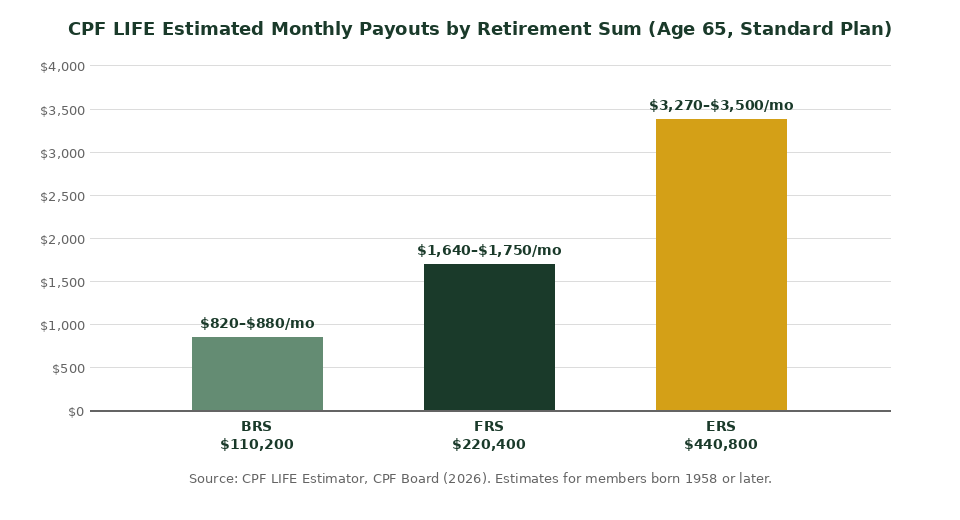
| Basic Retirement Sum (BRS) | SGD 110,200 | SGD 820–$880 | SGD 1,090–$1,180 |
| Full Retirement Sum (FRS) | SGD 220,400 | SGD 1,640–$1,750 | SGD 2,190–$2,370 |
| Enhanced Retirement Sum (ERS) | SGD 440,800 | SGD 3,270–$3,500 | SGD 4,360–$4,740 |
*Estimates from CPF LIFE Estimator, CPF Board (October 2026). Standard Plan. Actual payouts depend on your birth year, CPF LIFE plan choice, and prevailing interest rates. Members born in 1958 or later participate in CPF LIFE.
The ERS is exactly four times the BRS, a ratio CPF Board has maintained consistently. The FRS sits precisely at two times the BRS. A member who sets aside the FRS can expect roughly SGD 1,690 per month from age 65 — enough to cover basic to moderate retirement expenses in Singapore, though not comprehensive if you include healthcare, travel and lifestyle costs.
Comparing the FRS payout to median household expenditure in Singapore (approximately SGD 4,500 per month for a household of 3.4 persons, per SingStat 2023), two CPF LIFE payouts (a couple) at FRS would cover around 75% of median household expenses, making the FRS a meaningful but not self-sufficient retirement foundation.
FRS Progression: 2022–2026
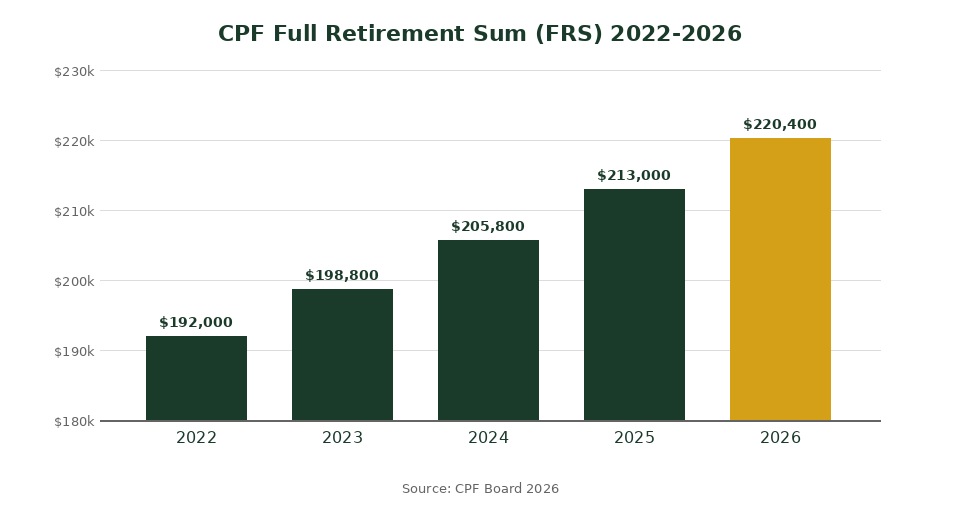
CPF Board increases the retirement sums annually to account for inflation and rising wages. The FRS has grown at approximately 3.5% per year over the past five years, slightly above Singapore’s headline CPI.
| Year | BRS | FRS | ERS | FRS YoY Change |
|---|---|---|---|---|
| 2022 | $96,000 | $192,000 | $288,000 | — |
| 2023 | $99,400 | $198,800 | $298,200 | +3.5% |
| 2024 | $102,900 | $205,800 | $308,700 | +3.5% |
| 2025 | $106,500 | $213,000 | $319,500 | +3.5% |
| 2026 | $110,200 | $220,400 | $440,800 | +3.5% |
Source: CPF Board, 2022–2026. ERS from 2025 onwards is set at 4x BRS (previously 3x BRS); 2022–2024 ERS figures shown under old 3x formula.
Key implication: If you are currently 45, the FRS you will face at 55 (in 2036) is estimated to be approximately SGD 313,000–SGD 322,000 (assuming continued 3.5% annual increases). Planning with the current FRS as your floor understates your actual target — factor in annual increases when calculating how much more you need to save each year.
CPF LIFE Payouts at FRS: What You Actually Receive
CPF LIFE (Lifelong Income For the Elderly) is a national annuity scheme that provides monthly payouts for as long as you live. Members born in 1958 or later are automatically enrolled. The scheme pools longevity risk across the population, meaning you continue to receive payouts even if you outlive your RA savings.
There are three CPF LIFE plan options. The Standard Plan (the default) offers higher monthly payouts and leaves a smaller bequest. The Basic Plan offers lower monthly payouts but leaves a larger sum for your beneficiaries. The Escalating Plan starts lower but increases at 2% per year, providing inflation protection over a long retirement.
A member with the FRS (SGD 220,400) on the Standard Plan can expect approximately:
- Age 65 payout: SGD 1,640–SGD 1,750 per month
- Age 67 payout (deferred by 2 years): ~SGD 1,830–SGD 1,960 per month
- Age 70 payout (deferred by 5 years): SGD 2,190–SGD 2,370 per month
Deferring your payout start age from 65 to 70 increases your monthly amount by approximately 7% per year of deferral — a meaningful boost for those who continue working into their late 60s and do not need immediate CPF income. Use the Singapore retirement calculator to model different start ages alongside your other income sources.
For couples where both members reach the FRS, combined monthly payouts would be approximately SGD 3,280–SGD 3,500 at age 65 — a materially comfortable base, particularly if housing is paid off.
6 Strategies to Reach the CPF FRS by Age 55
Reaching SGD 220,400 (or the FRS applicable when you turn 55) requires a combination of consistent contributions, smart account management and, for some, voluntary top-ups. Here are the six most effective approaches.
1. Maximise Your SA Interest Rate
The Special Account earns 4% per annum guaranteed, with an additional 1% on the first SGD 60,000 of combined balances (and another 1% on the first SGD 30,000 from age 55). This guaranteed 4–6% risk-free return is one of the best yields available in Singapore. The most important lever is time — every extra dollar in your SA compounds significantly over a 20–30 year career. Avoid unnecessary SA withdrawals (which are only permitted for investments, and only if SA exceeds the FRS).
2. Make Voluntary Cash Top-Ups Under the Retirement Sum Topping-Up Scheme (RSTU)
You can make cash top-ups to your SA (before 55) or RA (from 55) under the RSTU. In 2026, the tax relief cap is SGD 8,000 per year for yourself and an additional SGD 8,000 for qualifying family members. Top-ups earn the SA/RA interest rate (4%) immediately. For every SGD 8,000 top-up per year over 15 years, you accumulate approximately SGD 170,000 in SA/RA value at 4% compounding — a material portion of the FRS on its own.
3. Transfer from OA to SA (Before Age 55)
OA earns 2.5% interest. SA earns 4%. Transferring from OA to SA (the OA-to-SA transfer) is irreversible but earns an additional 1.5% per year on the transferred amount. A transfer of SGD 50,000 at age 35 earns approximately SGD 29,000 more in SA than if left in OA by age 55. This transfer is capped — you cannot transfer if your SA already exceeds the prevailing FRS.
4. Invest OA Savings in Higher-Return Assets (CPFIS)
The CPF Investment Scheme (CPFIS) allows you to invest OA savings exceeding SGD 20,000 in approved instruments. While the SA cannot be invested under CPFIS for the FRS build-up (SA-to-FRS transfer is generally prioritised), OA invested in low-cost ETFs via Endowus or FSMOne can potentially earn 5–8% annually over long periods — meaningfully above the 2.5% OA floor. Use your Endowus referral code (2V343) to start with a fee rebate when investing your CPF-OA. Similarly, the Syfe referral code (SRPRFFFCD) provides access to Syfe’s CPF-connected solutions.
5. Leverage Employer Contributions and NS Make-Up Pay
Employer CPF contributions (currently 17% of monthly wage for employees under 55) are a direct boost to your SA and OA. Negotiating a higher salary has a CPF multiplier effect — every SGD 10,000 annual salary increase adds roughly SGD 3,700 to your combined CPF accounts per year. For NSmen, making up CPF contributions missed during full-time National Service can incrementally improve your long-term RA balance.
6. Reduce Housing CPF Usage to Protect SA
Many Singaporeans drain their OA to finance HDB flat purchases and service monthly mortgage repayments. While this is common, it delays the SA build-up indirectly (because OA cannot be transferred to SA once depleted). Consider using less CPF and more cash for mortgage repayments where affordable, or explore refinancing options once you approach your 40s. For those close to 55, reducing CPF housing draw-downs in the final decade before retirement can materially improve the RA balance at 55.
Cash Top-Up vs CPF Transfer: Which Is Better?
Both routes build your RA/SA balance, but they differ in source and tax treatment:
| Feature | Cash Top-Up (RSTU) | OA-to-SA Transfer |
|---|---|---|
| Source of funds | Your cash / bank savings | Existing CPF-OA balance |
| Tax relief | Yes — up to SGD 8,000 p.a. | No tax relief |
| Reversible? | No | No — permanent |
| Interest earned | SA rate (4%) | SA rate (4%) vs OA rate (2.5%) |
| Best for | Tax relief seekers with spare cash | Optimising OA that isn’t needed for housing |
| Annual cap | Up to FRS top-up limit | Up to prevailing FRS |
Source: CPF Board, 2026. Both mechanisms are subject to the prevailing FRS cap and cannot be made once your SA/RA exceeds the FRS.
In practice, cash top-ups are more attractive for higher-income earners who benefit from Singapore’s marginal income tax relief (top marginal rate 24%), because the tax saving partially offsets the cash commitment. For those with large OA balances earning 2.5%, the OA-to-SA transfer is typically the first step — it costs nothing and immediately earns an extra 1.5% per year.
Where to Invest Your CPF-OA for Higher Returns
For CPF-OA balances above SGD 20,000, CPFIS allows investment in approved unit trusts and ETFs. Three platforms are popular among Singapore investors for CPF investing:
- Endowus: The only platform offering a full-fee rebate on trailer fees from CPF investments. It provides access to institutional-class funds (Dimensional, PIMCO, Lion Global) and 100% CPF-OA-invested portfolios. Use the Endowus referral code 2V343 for a welcome bonus. Endowus is widely regarded as one of the most cost-efficient routes for CPF-OA investing.
- Syfe: Offers the Syfe Core Equity100 and income-focused portfolios. The Syfe referral code SRPRFFFCD provides a fee waiver on your first SGD 30,000 invested for 6 months.
- FSMOne: A brokerage platform with access to CPF-approved unit trusts and ETFs at low transaction fees. Use FSMOne referral code P0544985 when signing up.
For the Singapore T-bills and savings bonds route (no CPFIS required, CPF-OA funds only), refer to the Singapore T-bills 2026 guide and the Singapore Savings Bonds guide for current cut-off yields.
Note: CPFIS returns are not guaranteed. Historical long-run equity returns (5–8% p.a. for a diversified global equity portfolio) exceed the SA’s 4% floor, but involve market risk and volatility. For balances you are certain you will need for the FRS, the SA’s guaranteed 4% is the safer choice.
Frequently Asked Questions
What is the CPF FRS for 2026?
How much will I get from CPF LIFE if I reach the FRS?
Can I exceed the FRS in my Retirement Account?
What happens if I don't reach the FRS at age 55?
Does the FRS increase every year?
What is the difference between the FRS and the BRS?
Can I make a cash top-up to my CPF to hit the FRS?
Start Building Towards Your FRS Today
Whether you choose to invest your CPF-OA via Endowus, top up your SA with cash, or simply optimise the OA-to-SA transfer, the most important step is starting early. Use the tools and referral links below to get started with fee savings.
Disclaimer: The Kopi Notes may earn referral fees when you sign up via the links above, at no extra cost to you. All CPF figures and payout estimates are sourced from CPF Board and are for educational reference only. This is not financial advice. Consult a licensed financial adviser before making CPF contribution or investment decisions.
This article was researched with the help of AI. While we strive to keep all information accurate and up to date, there may be errors. If you notice any discrepancies, please contact us.