Mapletree Logistics Trust Share Price 2026: Vietnam & Malaysia Logistics Hub Expansion Deep-Dive (SGX: M44U)
Asia’s most geographically diversified logistics REIT — with growth markets in Vietnam and Malaysia offsetting China headwinds.
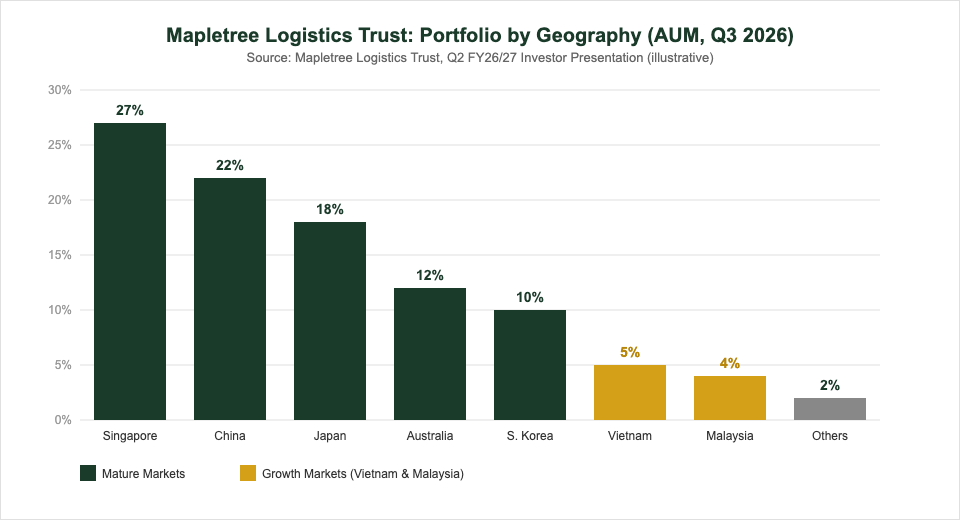
Mapletree Logistics Trust (SGX: M44U) is one of Asia’s largest listed logistics REITs, with over 185 properties across Singapore, China, Japan, Australia, South Korea, Vietnam, Malaysia, India, and Bangladesh. While China assets have weighed on DPU in recent quarters, its Vietnam and Malaysia portfolios — spanning e-commerce hubs, semiconductor logistics parks, and last-mile distribution centres — are emerging as the REIT’s most compelling growth engines heading into Q4 2026.
Not financial advice. All figures are for educational reference only. Data as at Q3 2026 unless noted.
Table of Contents
Contents — Click to expand
- What Is Mapletree Logistics Trust?
- Key Facts at a Glance
- Vietnam Portfolio: SE Asia’s Fastest-Growing Logistics Market
- Malaysia Portfolio: Penang Semiconductor Hub & Klang Valley
- DPU Impact Analysis: Growth Markets vs Mature Portfolio
- Share Price Performance & Valuation
- Investment Case: Buy, Hold or Wait in Q4 2026?
- Frequently Asked Questions
What Is Mapletree Logistics Trust?
Mapletree Logistics Trust (MLT) was listed on the Singapore Exchange in July 2005 — making it one of Singapore’s oldest and largest REITs. Sponsored by Mapletree Investments Pte Ltd (a Temasek-linked real estate developer), MLT focuses exclusively on logistics and warehouse assets across Asia.
As at Q3 2026, MLT owns or has interests in over 185 properties with a total assets under management (AUM) of approximately SGD 13–14 billion. Its portfolio spans nine countries — Singapore, China, Hong Kong, Japan, South Korea, Australia, Vietnam, Malaysia, India, and Bangladesh — giving it the broadest geographic footprint of any SGX-listed logistics REIT.
The trust distributes income quarterly, with distributions typically declared in February, May, August, and November each year. MLT is managed on a full distribution basis, meaning substantially all distributable income is paid out to unitholders.
Unlike industrial REITs that hold factories or business parks, MLT’s assets are purpose-built logistics facilities: ramp-up warehouses, multi-tenanted logistics hubs, cold-chain facilities, and modern distribution centres. Its tenants include multinational 3PLs (third-party logistics providers), e-commerce fulfilment operators, and manufacturing exporters.
Key Facts at a Glance
| Metric | Detail |
|---|---|
| SGX Ticker | M44U |
| Listing Date | July 2005 |
| Sponsor | Mapletree Investments Pte Ltd (Temasek-linked) |
| Property Type | Logistics, warehousing, distribution centres |
| Countries | 9 (Singapore, China, Japan, Australia, S. Korea, Vietnam, Malaysia, India, Bangladesh) |
| No. of Properties | ~185+ |
| AUM (approx.) | SGD ~13–14 billion (as at Q3 2026) |
| Distribution Frequency | Quarterly |
| Gearing Ratio | ~40–42% (as at Q3 2026) |
| Portfolio Occupancy | ~95–97% (overall) |
Source: Mapletree Logistics Trust SGX disclosures, Q2 FY26/27 Investor Presentation
Vietnam Portfolio: Southeast Asia’s Fastest-Growing Logistics Market
Vietnam is arguably MLT’s most exciting growth frontier. The country has emerged as one of Asia’s top manufacturing relocation destinations — a direct beneficiary of supply chain diversification away from China, driven by geopolitical tensions, tariff regimes, and cost competitiveness. Electronics giants, semiconductor suppliers, and e-commerce platforms have all expanded their Vietnam operations significantly since 2023.
MLT’s Vietnam portfolio spans key logistics corridors including the Greater Ho Chi Minh City region (Binh Duong, Long An, Ba Ria-Vung Tau provinces) and the Northern Vietnam industrial belt near Hanoi (Bac Ninh, Hung Yen). These locations sit adjacent to Vietnam’s two largest export manufacturing clusters.
Key characteristics of MLT’s Vietnam assets:
- Tenant profile: Mix of multinational 3PLs, electronics manufacturers, and consumer goods distributors
- Occupancy: Consistently above 95% — some properties are fully leased with waitlists
- Rental reversion: Positive, driven by strong demand and limited Grade A supply near major industrial parks
- NPI contribution: ~5% of portfolio NPI (FY2026), growing toward 7–8% by FY2028 as new acquisitions bed in
- Currency: VND revenues largely hedged via SGD forward contracts at the trust level
A Singapore investor considering MLT’s Vietnam exposure benefits indirectly — the REIT handles all currency hedging, taxation, and management. For an individual investor, gaining exposure to Vietnam’s logistics boom through a Temasek-linked SGX-listed structure is significantly lower risk than direct Vietnam property investment.
Vietnam’s logistics real estate market is structurally undersupplied relative to demand. Industrial production output has grown 10–15% year-on-year across key provinces, yet Grade A logistics supply additions remain limited by infrastructure constraints and land approval timelines. This supply-demand gap supports above-average rent growth for existing quality assets — exactly the type MLT holds.
Malaysia Portfolio: Penang Semiconductor Hub & Klang Valley Distribution
Malaysia is MLT’s other key growth market in Southeast Asia. The trust holds properties in two distinct sub-markets: the Penang semiconductor corridor and the Klang Valley e-commerce logistics belt.
Penang: Malaysia’s Penang island and mainland (Seberang Perai) form one of Southeast Asia’s most important semiconductor manufacturing clusters. Companies including Intel, Micron, Infineon, and Texas Instruments have significant operations here. MLT’s Penang assets serve these semiconductor supply chains — storing components, finished chips, and precision manufacturing equipment. Penang logistics properties command a premium due to the specialised nature of tenants and strict technical requirements (clean floor specifications, vibration control, 24/7 power reliability).
Klang Valley: Malaysia’s economic heartland, Greater Kuala Lumpur, drives demand for e-commerce last-mile and wholesale distribution logistics. Shopee, Lazada, and Zalora have all expanded their Malaysian fulfilment infrastructure, requiring modern multi-temperature warehousing near population centres. MLT’s Shah Alam, Subang, and Petaling Jaya assets are well-positioned for this secular growth trend.
Johor (emerging): MLT’s exposure to Johor is growing alongside the broader Johor-Singapore Special Economic Zone (JS-SEZ) development. Cross-border logistics between Johor and Singapore represents a structural opportunity for Grade A warehousing adjacent to the Second Link. As the JS-SEZ matures through 2026–2028, asset values in this corridor are expected to appreciate materially.
| MLT Growth Market | Key Locations | Tenant Types | Occupancy (est.) | Rent Trend |
|---|---|---|---|---|
| Vietnam | Ho Chi Minh, Binh Duong, Hanoi belt | 3PLs, electronics, e-commerce | ~96% | Positive (+5–8%) |
| Malaysia (Penang) | Bayan Lepas, Seberang Perai | Semiconductor supply chain | ~98% | Positive (+4–6%) |
| Malaysia (Klang Valley) | Shah Alam, Subang, PJ | E-commerce, FMCG, retail distribution | ~94% | Stable (+2–4%) |
| Malaysia (Johor) | Iskandar, Pasir Gudang | Cross-border logistics, manufacturing | ~90% | Rising (JS-SEZ catalyst) |
Source: MLT Q2 FY26/27 Investor Presentation, CBRE Malaysia Logistics Market Report Q2 2026 (illustrative estimates).
DPU Impact Analysis: Growth Markets vs Mature Portfolio
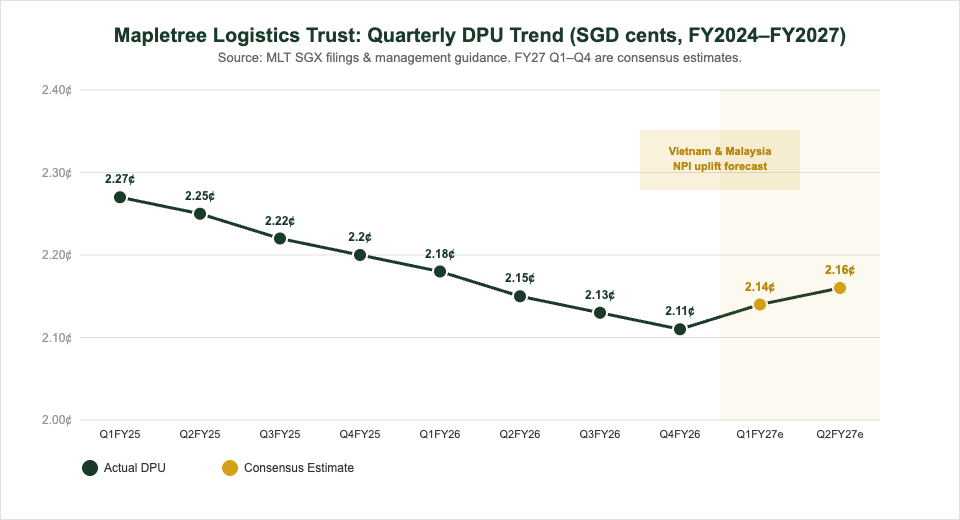
MLT’s DPU trajectory over FY2024–FY2026 has been a tale of two portfolios. Its mature markets — China, Japan, and Australia — have delivered stable but pressure-tested NPI. China, in particular, has been a drag: slower e-commerce growth, prolonged property sector weakness, and RMB depreciation versus SGD have combined to reduce DPU contribution from Chinese assets.
Vietnam and Malaysia, by contrast, are contributing incremental NPI that partially offsets this drag. Here’s how the math works for a Singapore investor:
Worked example (illustrative): Suppose a Singapore investor holds SGD 10,000 of MLT at a yield of ~7.5% (indicative as at Q3 2026). Annual DPU would be approximately SGD 750. If Vietnam and Malaysia NPI grows 10% year-on-year while contributing ~9% of total NPI, the accretive impact adds roughly SGD 6–7 to annual income on that SGD 10,000 holding. Modest individually — but across MLT’s full unitholding base, this translates into a measurable DPU stabilisation effect heading into FY2027.
The key DPU risk factors to watch:
- China NPI drag: If Chinese logistics vacancies persist or rents decline, this offsets Vietnam/Malaysia gains
- Interest costs: MLT’s gearing of ~40–42% means it is sensitive to refinancing rates; the Fed’s Q3 2026 rate cuts are a positive, potentially saving SGD 15–20 million annually on debt costs when hedges roll
- FX translation: Strengthening SGD reduces the translated SGD value of VND, MYR, AUD, and JPY revenues — a structural headwind for a multi-currency portfolio like MLT’s
- Acquisitions pipeline: New Vietnam/Malaysia assets must be acquired at accretive yields (>5.5% initial NPI yield) to be DPU-additive
For investors interested in passive income from Singapore REITs, MLT’s growth-market exposure makes its DPU profile more resilient than a single-geography trust — even if near-term DPU growth is modest.
Share Price Performance & Valuation
MLT’s share price has faced sustained pressure since mid-2022 when global interest rates began rising sharply. As a yield-sensitive instrument, logistics REITs generally re-rate downward when risk-free rates climb — reducing the spread advantage that made MLT’s ~5–6% yield attractive relative to Singapore Savings Bonds or T-bills.
Heading into Q4 2026, MLT has stabilised as the interest rate cycle turns. The US Federal Reserve’s rate cuts in Q3 2026 have improved sentiment toward REITs broadly. MLT’s share price has recovered partially but still trades at a noticeable discount to its book NAV — a discount that has historically attracted value investors during rate easing cycles.
Key valuation metrics to monitor (indicative as at Q3 2026):
- Price-to-Book (P/B): Below 1.0x — implies the market values MLT’s asset base at less than book value; historically a zone associated with subsequent positive total returns for patient investors
- Distribution yield: ~7–8% on current share price (illustrative) — significantly above the 10-year Singapore government bond yield
- NAV per unit: Flat-to-slightly declining as China revaluations offset Vietnam/Malaysia asset appreciation
- Spread vs risk-free: MLT’s yield spread versus the SGS 10-year bond has widened — historically, spreads above 400bps have been associated with attractive entry points for patient REIT investors
For investors comparing MLT to alternatives, our guide to the best S-REITs in Singapore 2026 provides a broader yield and quality comparison across the sector. You can also use the Singapore retirement calculator to model how MLT distributions fit into a passive income portfolio plan.
Investment Case: Buy, Hold or Wait in Q4 2026?
MLT sits at an interesting inflection point for Singapore investors in October 2026. Here is an honest assessment of the bull and bear cases:
| Bull Case (Buy / Accumulate) | Bear Case (Wait / Underweight) |
|---|---|
| Fed rate cuts reduce MLT’s interest cost burden; could save SGD 15–20M/year as fixed hedges roll over | China NPI drag may persist for 2–3 more quarters; property sector weakness not yet resolved |
| Vietnam & Malaysia NPI growing faster than the rest of the portfolio; structural supply chain diversification tailwind | Gearing at ~40–42% limits near-term acquisition capacity; equity fundraising risk if a large deal is pursued |
| Trading at discount to NAV — a margin of safety for long-term holders vs book value | DPU growth muted in FY2026–27; yield investors seeking growth may prefer industrial REITs with better rent reversion |
| Temasek-linked sponsor with strong balance sheet; right-of-first-refusal pipeline for quality ASEAN assets | FX headwinds (strong SGD) translate to lower distributable income from VND, MYR, AUD, JPY revenues |
This table is for educational illustration only. Not financial advice. Please assess your own investment needs and risk tolerance before investing.
Bottom line: MLT’s Vietnam and Malaysia exposure provides a genuine growth narrative that distinguishes it from peers with heavier China concentration. For investors comfortable with a ~18–24 month horizon, the combination of recovering DPU, rate cut tailwinds, and a below-NAV entry point makes MLT a logical inclusion in a diversified S-REIT portfolio. Shorter-term traders should watch for China recovery signals before sizing up.
For those investing through broker platforms, our Syfe referral code (SRPRFFFCD) and FSMOne referral code (P0544985) offer sign-up bonuses for accounts opened through The Kopi Notes. MLT is accessible through both platforms. For larger portfolios or frequent trading, Interactive Brokers (IBKR) offers the tightest spreads — see our IBKR referral code page for the sign-up link. For comparison with other REITs and investment strategies, our best S-REITs 2026 guide covers the full sector.
Disclaimer: All figures in this article are educational estimates based on publicly available data. Investors should refer to official SGX disclosures, MLT quarterly investor presentations, and their own financial advisors before making investment decisions.
Frequently Asked Questions
What is Mapletree Logistics Trust's current share price?
Mapletree Logistics Trust (SGX: M44U) share price fluctuates with market conditions and should be checked on SGX.com or your broker’s platform for the most up-to-date figure. As at Q3 2026, MLT has been trading at a discount to its book NAV per unit amid rate normalisation. Check the SGX website or your broker’s app for live pricing before making any investment decision.
What is Mapletree Logistics Trust's DPU and yield?
MLT distributes income quarterly. Its full-year DPU for FY2026 has been under modest pressure due to China NPI headwinds. Based on publicly available SGX disclosures, the annualised DPU has ranged in the SGD 0.082–0.088 per unit range in recent periods. At current share prices, this translates to an indicative yield of approximately 7–8%. Always verify the latest DPU figures from MLT’s official investor presentations and SGX announcements.
Why is Mapletree Logistics Trust's share price under pressure?
MLT’s share price has faced headwinds from two main sources: (1) rising global interest rates since 2022, which compress REIT yield spreads and reduce relative attractiveness versus risk-free bonds; and (2) weaker-than-expected performance from its China assets, as slower domestic consumption and property sector weakness have dampened logistics demand and rental growth in Chinese cities. As rate cuts materialise in 2026, the headwind from factor (1) is easing.
How big is Mapletree Logistics Trust's Vietnam portfolio?
Vietnam represents approximately 5% of MLT’s total AUM as at Q3 2026, with properties concentrated in the Greater Ho Chi Minh City industrial belt (Binh Duong, Long An) and Northern Vietnam near Hanoi. The portfolio is 100% focused on modern logistics and warehousing assets serving electronics manufacturers, e-commerce operators, and third-party logistics providers. Occupancy in Vietnam has consistently remained above 95%.
Is Mapletree Logistics Trust a good investment in 2026?
MLT offers a combination of geographic diversification, Temasek-linked sponsor quality, and an attractive yield at current price levels — factors that make it a legitimate consideration for income-focused investors. The key risks are China NPI drag, FX translation headwinds, and limited near-term DPU growth. For investors with an 18–24 month horizon, the rate cut tailwind and below-NAV pricing provide a reasonable margin of safety. This is not financial advice; please consult a licensed financial advisor before investing.
Can I use CPF or SRS to invest in Mapletree Logistics Trust?
Yes — MLT is CPF Investment Scheme (CPFIS) approved for both OA (Ordinary Account) and SA (Special Account) monies, subject to the prevailing CPFIS-eligible list and individual CPF investment limits. It is also SRS-eligible and can be purchased through SRS accounts via most brokers. Always verify the current CPFIS list on the CPF Board’s official website before proceeding, as eligibility can change.
Ready to Invest in Singapore REITs?
Open a brokerage account and start building your S-REIT portfolio today. Use our referral links for exclusive sign-up bonuses.
This article was researched with the help of AI. While we strive to keep all information accurate and up to date, there may be errors. If you notice any discrepancies, please contact us.