UOB SRS Account: How to Open and Invest in ETFs for Maximum Tax Savings (2026)
A complete guide for Singapore investors — SRS tax relief, ETF investing strategies, and step-by-step instructions for UOB, DBS and OCBC.
The UOB SRS Account is a Supplementary Retirement Scheme account offered by UOB Bank, one of three approved SRS operators in Singapore. It lets you contribute up to SGD 15,300 per year (citizens and PRs) in exchange for full tax relief on every dollar contributed. Funds in your UOB SRS account can be invested in ETFs, unit trusts, stocks and bonds through UOB Kay Hian or third-party platforms like Endowus referral code and FSMOne — making it one of the most tax-efficient ways to build a long-term investment portfolio in Singapore.
Not financial advice. All figures are for educational reference only. Data as at Q3 2026 unless noted.
Table of Contents
Contents — Click to expand
What Is the UOB SRS Account?
The Supplementary Retirement Scheme (SRS) is a voluntary savings scheme administered by the Ministry of Finance and operated by three approved banks: UOB, DBS, and OCBC. The UOB SRS Account is opened directly with UOB Bank and provides access to a broad range of investment products, including ETFs listed on the London Stock Exchange (LSE), Singapore-listed stocks and REITs, unit trusts, bonds, and insurance products.
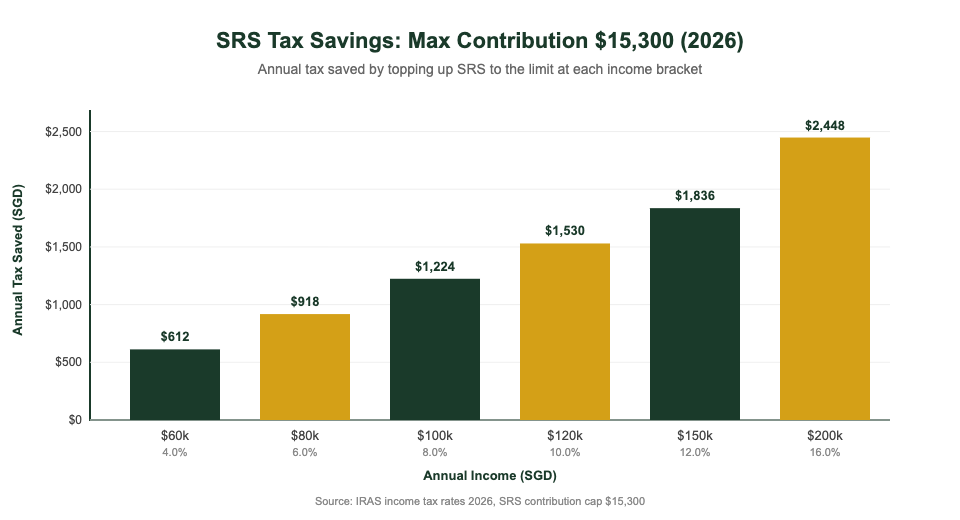
Unlike CPF, the SRS is entirely voluntary — you decide how much to contribute each year, up to the annual cap of SGD 15,300 for Singapore citizens and permanent residents (SGD 35,700 for foreigners). Every dollar you contribute reduces your chargeable income by exactly the same amount, which means the tax savings are immediate and tangible. A Singapore investor earning SGD 120,000 per year who tops up the full SGD 15,300 saves SGD 1,530 in income tax for that year alone.
Your UOB SRS contributions sit in a cash account earning a nominal rate (currently around 0.05% p.a.) unless you invest them. Left uninvested, SRS funds grow very slowly. The smart strategy is to invest your SRS funds in diversified, low-cost ETFs — and keep them invested for the long term, ideally until statutory retirement age.
| SRS Account Detail | 2026 Figure |
|---|---|
| Annual Cap (Citizens / PRs) | SGD 15,300 |
| Annual Cap (Foreigners) | SGD 35,700 |
| Tax Relief Type | Full deduction from chargeable income |
| SRS Operators | UOB, DBS, OCBC (choose one) |
| Statutory Retirement Age | 63 years |
| Withdrawal Tax (at retirement) | 50% of amount withdrawn is taxable |
| Early Withdrawal Penalty | 100% taxable + 5% penalty charge |
Source: Ministry of Finance Singapore, IRAS, October 2026
SRS Tax Savings: How Much Can You Actually Save?
The tax savings from an SRS contribution depend entirely on your marginal income tax rate. The higher your income, the more valuable each SRS dollar becomes. Singapore’s income tax is progressive, ranging from 2% at the lower end to 24% for incomes above SGD 1 million.
For a Singapore investor earning SGD 100,000 per year and contributing the maximum SGD 15,300 to their UOB SRS Account, the annual tax saving works out to approximately SGD 1,224 — based on the marginal rate applying to income between SGD 80,000 and SGD 120,000. Over 20 years of contributions (with the SRS cap held constant), that is over SGD 24,480 in cumulative tax savings before any investment returns are considered. When you also factor in the compounding investment growth on your ETF holdings within SRS, the long-term advantage is significant.
Here is how the savings scale by income level, assuming a full SGD 15,300 annual contribution:
UOB SRS vs DBS SRS vs OCBC SRS
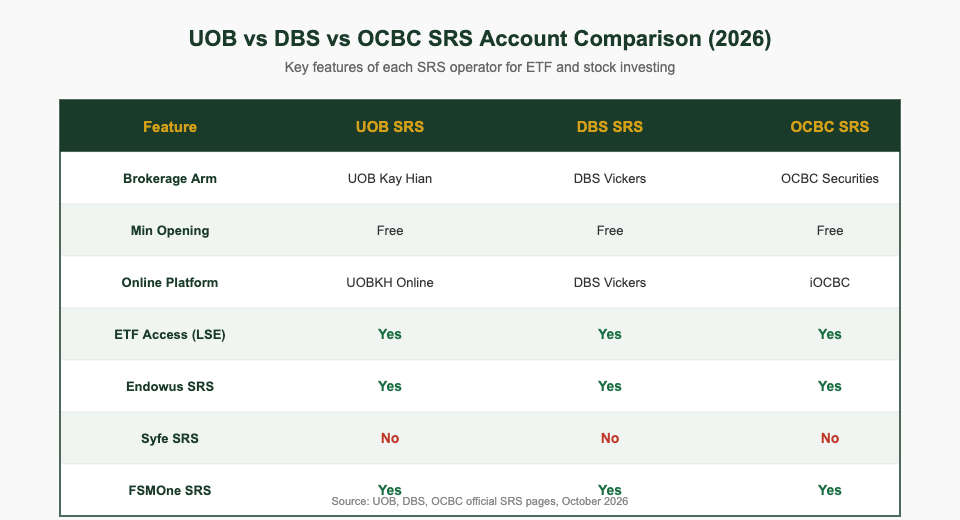
All three SRS operators — UOB, DBS, and OCBC — offer the same core SRS structure mandated by the government. The key differences lie in which investment platform you are tied to for direct brokerage, and which third-party platforms you can link your SRS funds to.
You can only hold one SRS account in Singapore, and once opened, you cannot transfer it to another bank. Choose your SRS operator with care — particularly if you already use a specific brokerage or robo-advisory platform for ETF investing.
One critical point: Endowus and FSMOne accept SRS funds regardless of which bank holds your SRS account. So even if you open your SRS account with UOB, you can direct contributions to Endowus to invest in low-cost ETFs or the Endowus Income funds. This makes the choice of SRS operator less critical than it might appear — the main consideration is which bank’s brokerage platform you prefer for direct ETF purchases on the LSE or SGX.
How to Open a UOB SRS Account (Step-by-Step)
Opening a UOB SRS Account takes around 10 minutes if you are already a UOB customer. Even if you bank elsewhere, you can open an SRS account with UOB without switching banks.
- Log in to UOB TMRW or UOB Personal Internet Banking. You need an existing UOB savings or current account to proceed online. If you do not have one, you will need to visit a UOB branch.
- Navigate to Investments > Supplementary Retirement Scheme. Select “Open SRS Account.” Review the terms and confirm your NRIC or FIN details.
- Fund your SRS account. Transfer from your linked UOB account or via FAST from another bank. Contributions can be made anytime before 31 December each year to qualify for that year’s tax relief.
- Invest your SRS funds. Once funded, you can invest via UOB Kay Hian (direct brokerage) or link your SRS account to platforms like Endowus or FSMOne referral code.
If you prefer Endowus for ETF investing via SRS, you do not need to open an account with the same bank — Endowus will instruct you on how to link your existing SRS account from any of the three operators. You can use our Endowus referral code (2V343) to get a fee rebate on your first investment.
Key point: Only one SRS account is allowed per person in Singapore. You cannot open separate SRS accounts at different banks. If you already have an SRS account with DBS or OCBC, you do not need to open a new one — simply contribute to the existing account.
How to Invest Your SRS Funds in ETFs
SRS funds can be invested in a wide range of assets, but for long-term wealth building, low-cost ETFs are the strongest option. There are three main routes Singapore investors use to invest SRS funds in ETFs:
| Platform | ETF Access | SRS Accepted | Min Investment | Best For |
|---|---|---|---|---|
| UOB Kay Hian | SGX + LSE ETFs | Yes | None | DIY investors |
| Endowus | ETF portfolios + funds | Yes | SGD 1,000 | Robo / passive |
| FSMOne | SGX ETFs + unit trusts | Yes | SGD 100 | DIY + funds |
| Syfe | Equity portfolios | No | SGD 1 | Cash investing only |
| IBKR | LSE ETFs (full range) | No | USD 0 | Cash investing only |
Source: Platform websites, verified October 2026. Note: Syfe and IBKR do not accept SRS funds.
For most SRS investors who want broad global ETF exposure with minimal complexity, Endowus is the preferred choice. You invest in Dimensional Fund Advisors or Vanguard-managed portfolios via your SRS funds, with Endowus charging a flat advisory fee. For investors who want direct access to LSE-listed ETFs like CSPX or VWRA within SRS, UOB Kay Hian is the direct brokerage route — though you will need to manage the portfolio yourself. Explore our Singapore REIT ETF guide for SGX-listed REIT ETFs that are also SRS-investable.
Best ETFs to Buy via UOB SRS in 2026
If you are investing your SRS funds via UOB Kay Hian or FSMOne with direct ETF access, these are the most commonly recommended ETFs for SRS portfolios in Singapore:
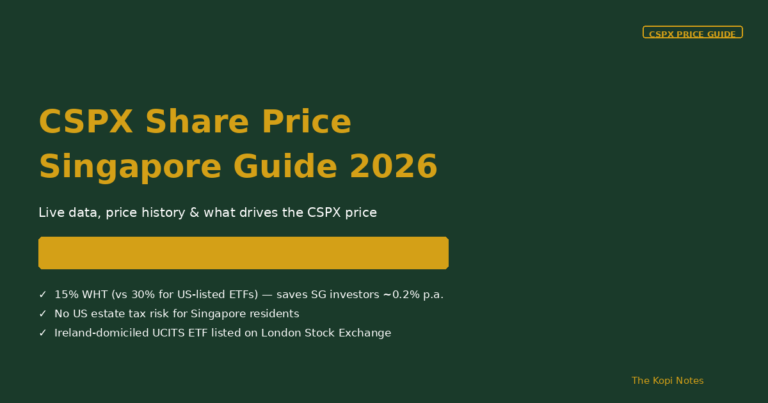
- CSPX (iShares Core S&P 500 UCITS ETF, LSE) — TER 0.07%, Ireland-domiciled, accumulating. Tracks the S&P 500 with 15% US dividend withholding tax (vs 30% for US-listed equivalents). Ideal SRS core holding for US equity exposure.
- VWRA (Vanguard FTSE All-World UCITS ETF, LSE) — TER 0.22%, Ireland-domiciled, accumulating. Tracks 3,500+ global equities. Best for full global diversification in a single ETF within SRS.
- LION-PHILLIP S-REIT ETF (SGX: CLR) — TER 0.55%, tracks Singapore-listed REITs, distributing. Good for SRS investors wanting dividend-like distributions within a tax-advantaged account. See our guide to the best S-REITs in Singapore 2026 for context.
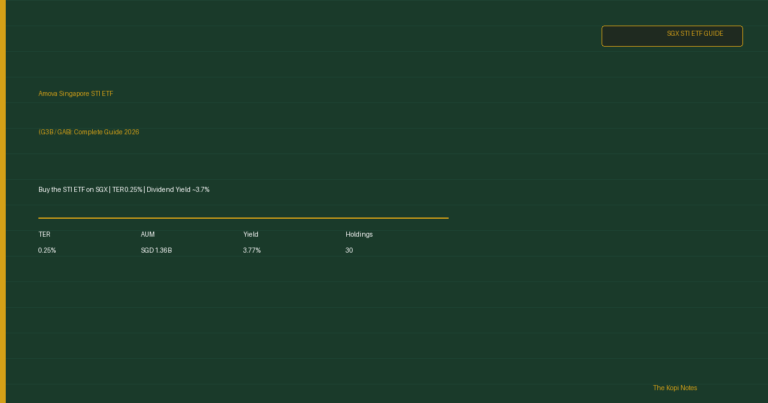
- NIKKO AM STI ETF (SGX: G3B) — TER 0.30%, tracks Straits Times Index (STI), distributing. Low-cost broad Singapore market exposure.
For SRS investors using Endowus, the available portfolios include Dimensional Equity Market portfolios and Vanguard LifeStrategy funds. These provide broad global diversification at institutional fund pricing — often cheaper in total cost than buying ETFs directly on a brokerage platform. Use the Singapore retirement calculator to model how SRS contributions plus ETF returns could grow your retirement nest egg over time.
When choosing between CSPX, VWRA, and other ETFs, consider your investment horizon and tax treatment. Accumulating ETFs (like CSPX and VWRA) reinvest dividends automatically — this compounds your SRS portfolio without triggering taxable distributions. Within SRS, this is particularly advantageous because you delay tax until withdrawal at retirement age, when only 50% of each withdrawal is taxable and your income is likely lower.
SRS Withdrawal Rules: What You Need to Know
The SRS is designed as a long-term retirement vehicle — early withdrawal comes with a significant tax penalty. Here is what you need to know before committing funds to SRS:
At or after statutory retirement age (currently 63): Only 50% of your withdrawals are taxable. Withdrawals can be spread over 10 years to minimise the tax impact. For a retiree with low or no employment income, most SRS withdrawals will be taxed at 0% (below the SGD 20,000 chargeable income threshold), making SRS withdrawals effectively tax-free in practice for modest annual amounts.
Before statutory retirement age: The full withdrawal amount is taxable (not 50%) plus a 5% penalty is imposed on the withdrawn amount. This makes SRS a genuinely long-term commitment — only contribute what you are confident you can leave invested until retirement.
The best SRS strategy for most investors: contribute the maximum each year, invest in broad low-cost ETFs via UOB Kay Hian or Endowus, and let the portfolio compound until retirement. The combination of upfront tax relief, tax-deferred compounding, and the 50% withdrawal concession makes SRS one of the most powerful tax optimisation tools available to Singapore investors.
For a comprehensive overview of how SRS integrates with your overall retirement plan, pair this with a solid CPF investment strategy Singapore — the two accounts complement each other well for long-term retirement building.
Frequently Asked Questions
What is the UOB SRS account annual contribution limit for 2026?
The UOB SRS contribution cap for Singapore citizens and permanent residents is SGD 15,300 per year in 2026. For foreigners working in Singapore, the cap is SGD 35,700. Every dollar contributed is deducted from your chargeable income, giving immediate tax relief. Contributions must be made before 31 December of the calendar year to count for that year’s tax assessment.
Can I invest in ETFs listed on the London Stock Exchange (LSE) via UOB SRS?
Yes. If you invest your UOB SRS funds through UOB Kay Hian, you can access ETFs listed on major international exchanges including the LSE. This gives you access to popular Ireland-domiciled accumulating ETFs like CSPX (iShares Core S&P 500) and VWRA (Vanguard FTSE All-World), which are generally preferred by Singapore investors over their US-listed equivalents due to lower withholding tax (15% vs 30%) and no US estate tax exposure.
Can I use Endowus with a UOB SRS account?
Yes. Endowus accepts SRS funds from all three approved SRS operators — UOB, DBS, and OCBC. After opening your UOB SRS account, you can link it to Endowus and invest in their ETF and fund portfolios. Endowus charges an annual advisory fee and provides access to institutional-class funds at low costs. Use our Endowus referral code (2V343) for a fee rebate on your first investment.
How much tax do I save by maxing out UOB SRS contributions?
The tax saving depends on your marginal income tax rate. For a Singapore resident earning SGD 100,000 per year, contributing the maximum SGD 15,300 saves approximately SGD 1,224 in income tax for that year. At SGD 150,000 income, the saving is approximately SGD 1,836. At higher incomes (above SGD 320,000), where the marginal rate is 22–24%, the saving can exceed SGD 3,000 on the same contribution. Use the IRAS tax calculator to calculate your personal saving.
What happens to my UOB SRS account when I retire?
When you reach or exceed the statutory retirement age (currently 63), you can begin withdrawing from your UOB SRS account. Only 50% of each withdrawal is added to your chargeable income for that year — meaning if you withdraw SGD 40,000, only SGD 20,000 is taxable. Many retirees spread withdrawals over 10 years to keep annual taxable income below the SGD 20,000 threshold, effectively paying zero income tax on their SRS withdrawals. Any ETF positions held in SRS must be liquidated before withdrawal.
Should I open SRS with UOB, DBS or OCBC?
For most investors who plan to invest via Endowus or FSMOne, the choice of SRS operator makes little practical difference — both platforms accept SRS from all three banks. If you plan to invest directly in LSE ETFs (CSPX, VWRA) through a brokerage, consider which bank’s affiliated broker you prefer: UOB Kay Hian (for UOB SRS), DBS Vickers (for DBS SRS), or OCBC Securities (for OCBC SRS). All offer similar commission rates and access to major international exchanges.
Is there a minimum amount to open a UOB SRS account?
There is no minimum balance required to open a UOB SRS account. You can open the account online via UOB TMRW or UOB Personal Internet Banking and fund it with any amount you choose. However, most investment platforms linked to SRS — such as Endowus (SGD 1,000 minimum) — have their own minimum investment thresholds. The SRS account itself has no fees or minimum balance requirements from UOB.
Start Maximising Your SRS Tax Savings Today
Open your SRS account and invest in low-cost ETFs for long-term retirement growth. Use our referral links for exclusive sign-up bonuses.
This article was researched with the help of AI. While we strive to keep all information accurate and up to date, there may be errors. If you notice any discrepancies, please contact us.