CSPX Share Price: Live Data, History & What Drives It (2026 Guide)
A Singapore investor’s complete guide to the CSPX price — how to track it, what moves it, and how to buy this LSE-listed S&P 500 ETF tax-efficiently.
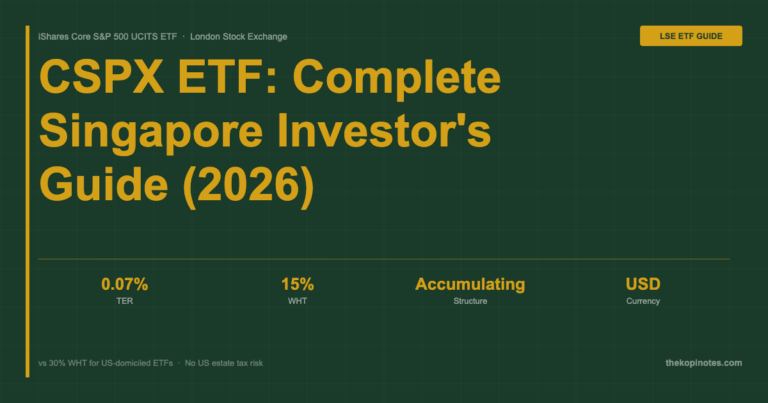
The CSPX share price tracks the iShares Core S&P 500 UCITS ETF, an Ireland-domiciled fund listed on the London Stock Exchange (LSE) in USD. As at April 2026, CSPX trades at approximately USD 560–580 per share. Singapore investors prefer CSPX over US-listed S&P 500 ETFs like VOO or SPY because it attracts only 15% withholding tax on US dividends — not 30% — and carries no US estate tax risk for non-US residents holding above USD 60,000.
Not financial advice. All figures are for educational reference only. Data as at April 2026 unless noted.
Table of Contents
Contents — Click to expand
What Is CSPX and What Does Its Price Represent?
CSPX is the ticker for the iShares Core S&P 500 UCITS ETF (Acc) — a fund managed by BlackRock that replicates the performance of the S&P 500 index, which covers 500 of the largest publicly listed companies in the United States. The fund is domiciled in Ireland, listed on the London Stock Exchange (LSE), and traded in US dollars (USD).
Unlike individual stocks, the CSPX share price does not represent ownership in a single company. Each share of CSPX represents a proportional stake in all 500 companies within the S&P 500 index — weighted by market capitalisation. The largest holdings as at April 2026 include Apple, Microsoft, NVIDIA, Amazon, and Alphabet, which together account for over 25% of the fund’s total weight.
CSPX is an accumulating ETF, meaning it does not pay out dividends. Instead, all dividends received from the underlying US companies are automatically reinvested into the fund. This is why the CSPX price grows over time: it reflects both price appreciation of the S&P 500 and the compounding effect of reinvested dividends. For Singapore investors, this structure is tax-efficient — there is no dividend income to declare.
The fund was launched in May 2010 and has grown to over USD 70 billion in assets under management (AUM) as at April 2026, making it one of the largest UCITS ETFs in the world by AUM. Its scale gives it excellent liquidity on the LSE during European and overlap trading hours.
CSPX Key Facts at a Glance
| Metric | Detail |
|---|---|
| Full Name | iShares Core S&P 500 UCITS ETF (Acc) |
| Ticker (LSE) | CSPX |
| Index Tracked | S&P 500 |
| Domicile | Ireland |
| Structure | Accumulating (dividends reinvested) |
| TER (Expense Ratio) | 0.07% p.a. |
| AUM | ~USD 70 billion (as at April 2026) |
| Number of Holdings | ~503 stocks |
| Currency | USD (traded on LSE) |
| Exchange | London Stock Exchange (LSE) |
| Launch Date | May 2010 |
Source: iShares CSPX factsheet, April 2026
What Drives the CSPX Share Price?
Understanding what moves the CSPX share price helps you make better decisions about when to add to your position and how to interpret short-term volatility. There are five key drivers:
1. S&P 500 Index Performance
CSPX physically replicates the S&P 500 — it buys the actual underlying stocks in proportion to their index weight. So the most direct driver of the CSPX price is the performance of the S&P 500 itself. When US corporate earnings grow, the index rises and CSPX rises with it. When markets fall — as during the COVID-19 crash of March 2020 or the rate-hike selloff of 2022 — CSPX falls in tandem.
2. USD/SGD Exchange Rate
CSPX is priced and traded in USD on the LSE. When you buy it through a Singapore broker, your SGD is converted to USD. If the USD strengthens against the SGD (as it did in 2022), your SGD-denominated return is boosted. If the USD weakens, your returns in SGD terms are reduced — even if the underlying S&P 500 has gone up. This currency exposure is a key consideration for Singapore investors that is often overlooked.
A worked example: if CSPX rises 10% in USD terms but the SGD/USD rate moves from 1.35 to 1.30 (SGD strengthening), your net SGD return is approximately 10% × (1.30/1.35) − 1 = 3.7% — significantly lower than the USD return.
3. Reinvested Dividends (Accumulating Structure)
Because CSPX is accumulating, dividends from the 500 underlying stocks are automatically reinvested. The S&P 500 currently yields around 1.2–1.5% per annum in dividends. Over time, this compounding effect adds to the NAV and contributes to the steady upward drift of the CSPX price beyond pure index price appreciation.
4. US Interest Rate Policy
Federal Reserve decisions on interest rates significantly impact S&P 500 valuations — and by extension, the CSPX share price. Higher interest rates increase the discount rate applied to future earnings, compressing price-to-earnings (P/E) ratios and pushing equity prices lower. Lower rates have the opposite effect. The aggressive rate hiking cycle of 2022–2023 caused CSPX to fall around 18% in USD terms; the subsequent pivot and rate cuts in 2024–2025 helped drive a strong recovery.
5. Market Sentiment and Macro Events
Geopolitical events, US elections, tech earnings surprises (especially from mega-cap names like NVIDIA and Apple that now make up a large weight in the S&P 500), and global economic data all drive short-term movements in CSPX. Because the S&P 500 is dominated by technology and growth companies, CSPX is particularly sensitive to shifts in AI-related sentiment and US tech earnings cycles.
CSPX Price History and Performance
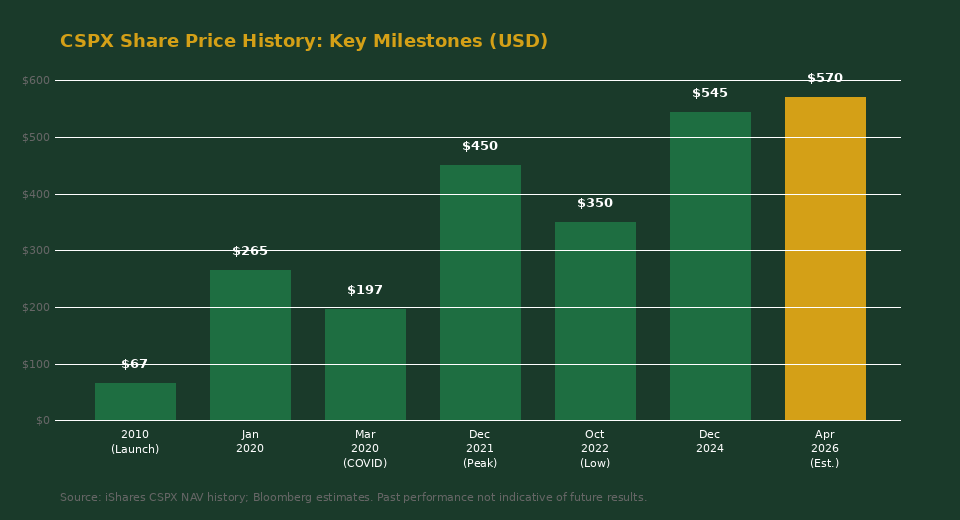
CSPX has delivered strong long-term returns since its launch in May 2010, reflecting the S&P 500’s historic bull run. The table below shows approximate CSPX share price milestones and annualised returns at key points:
| Period / Event | Approx. CSPX Price (USD) | Key Driver |
|---|---|---|
| Launch (May 2010) | ~USD 67 | Post-GFC recovery |
| Pre-COVID (Jan 2020) | ~USD 265 | Decade-long bull market |
| COVID Low (Mar 2020) | ~USD 197 | Pandemic selloff (−26%) |
| Peak 2021 (Dec 2021) | ~USD 450 | Stimulus & tech boom |
| Rate-Hike Low (Oct 2022) | ~USD 350 | Fed aggressive hikes (−22%) |
| 2024 Recovery (Dec 2024) | ~USD 545 | AI rally & rate pivot |
| April 2026 (est.) | ~USD 560–580 | Continued AI & earnings growth |
Source: iShares CSPX NAV history; Bloomberg price estimates. Past performance is not indicative of future results.
Long-term annualised return (since inception to April 2026): approximately 14–15% p.a. in USD terms, including reinvested dividends. This compares favourably to most actively managed funds and reflects the secular growth of US equities over the past decade and a half.
For a Singapore investor who invested SGD 10,000 in CSPX at launch in 2010, that position would be worth approximately SGD 90,000–100,000 by April 2026 (in SGD terms, accounting for currency movements). This illustrates the power of compounding in an accumulating ETF — you didn’t need to reinvest dividends manually; CSPX did it for you. This makes it an excellent vehicle for long-term passive income Singapore investors building wealth towards retirement. You can model your own projections using the Singapore retirement calculator.
CSPX vs Alternatives: Price and Cost Comparison
Singapore investors tracking the S&P 500 have several alternatives to CSPX. The key differences are TER, exchange, domicile (which determines withholding tax), and structure (accumulating vs distributing). Here’s how they compare:
| ETF | TER | Exchange | Domicile | US Div WHT | Structure |
|---|---|---|---|---|---|
| CSPX | 0.07% | LSE | Ireland | 15% | Accumulating |
| SPYL (iShares) | 0.03% | LSE | Ireland | 15% | Accumulating |
| VUAA (Vanguard) | 0.07% | LSE | Ireland | 15% | Accumulating |
| VOO (Vanguard) | 0.03% | NYSE | USA | 30% | Distributing |
| SPY (SPDR) | 0.09% | NYSE | USA | 30% | Distributing |
Source: Fund factsheets (iShares, Vanguard), April 2026
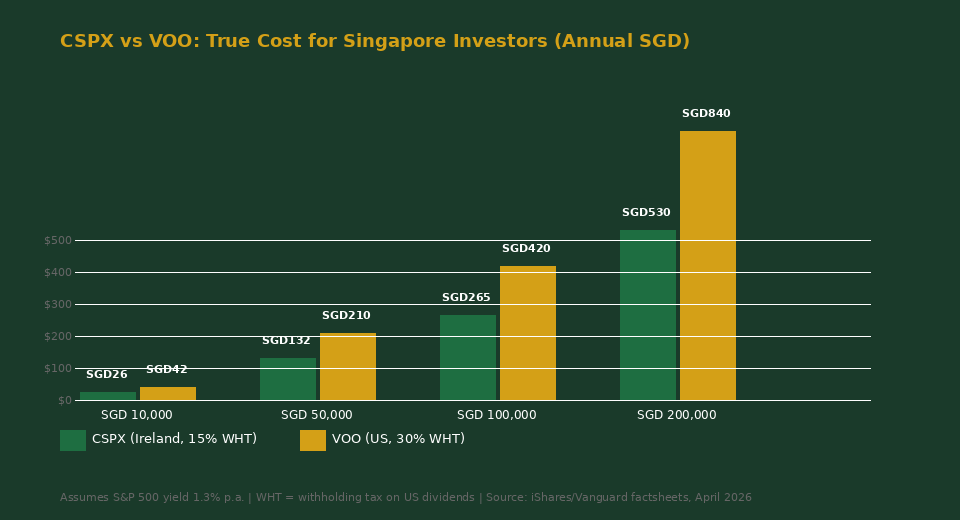
The real cost advantage of CSPX over VOO for Singapore investors: The S&P 500 currently yields approximately 1.3% in dividends per annum. The difference between 15% and 30% withholding tax on that yield is 15% × 1.3% = 0.195% per annum in tax savings. CSPX’s TER is 0.04% higher than VOO (0.07% vs 0.03%), but the WHT saving more than offsets this. On a SGD 100,000 portfolio, this saves you approximately SGD 130–200 per year — compounding significantly over a 20–30 year investment horizon. This is why the passive income Singapore community consistently recommends LSE-listed UCITS ETFs over US-listed equivalents.
For a deeper comparison of CSPX against its closest rivals, see our full breakdown of CSPX vs SPYL vs VUAA for Singapore investors.
How to Track the CSPX Share Price in Singapore
There are several reliable ways to check the current CSPX share price from Singapore:
1. Google Finance / Yahoo Finance
Search for “CSPX LSE” or “CSPX:LON” on Google Finance or Yahoo Finance. These platforms show the live price during LSE trading hours (3pm–11:30pm SGT), the daily change, and historical charts. Note: outside LSE trading hours you will see the last closing price, not a live price.
2. Your Broker Platform
If you hold CSPX through Interactive Brokers (IBKR), Saxo Markets, or moomoo Singapore, your broker platform shows the live bid/ask spread and your position’s current market value in both USD and SGD. IBKR’s Trader Workstation is particularly useful for setting price alerts. You can read a full comparison in our moomoo Singapore review and our IBKR vs Saxo vs moomoo broker comparison.
3. LSE Official Data
The London Stock Exchange website provides official CSPX price data, trade volume, and NAV per unit. This is useful for checking that the market price is close to NAV — a large premium or discount can sometimes signal a liquidity issue.
4. iShares / BlackRock Fund Page
The iShares CSPX fund page publishes the daily NAV (net asset value) per unit, which is the definitive benchmark price. The market price of CSPX should track this closely throughout the trading day.
Trading hours note for Singapore investors: CSPX trades on the LSE, which opens at 9am London time (3pm–4pm SGT in summer, 4pm–5pm SGT in winter). The most liquid trading window is 3pm–11:30pm SGT, when both the LSE and US markets are open. Placing limit orders at market open can help you avoid wide bid/ask spreads.
How to Buy CSPX in Singapore
Buying CSPX as a Singapore resident is straightforward via an international brokerage that provides LSE access. Here is a step-by-step guide for the most popular options:
Interactive Brokers (IBKR) — Best for Cost-Conscious Investors
IBKR offers some of the lowest commissions for LSE-listed ETFs: USD 0.005 per share (minimum USD 1 per trade). For a regular investor buying SGD 1,000–5,000 of CSPX per month, this translates to roughly USD 1–2 in commissions per trade. Fund your IBKR account in SGD and convert to USD using their FX conversion tool before purchasing. Search “CSPX” and ensure the exchange is set to “LSEETF” (London Stock Exchange ETFs). Use the FSMOne referral code if you prefer a Singapore-based platform with RSP (regular savings plan) functionality instead.
Syfe Brokerage — Best for Beginners
Syfe’s brokerage platform allows Singapore investors to buy CSPX with fractional shares and no commission on US and LSE-listed ETFs (subject to platform conditions as at 2026). This makes it ideal for investors starting with smaller amounts. Use the Syfe referral code when signing up for an exclusive cash reward.
Saxo Markets — Premium Platform with Full LSE Access
Saxo Markets provides full access to LSE-listed ETFs including CSPX, with competitive FX rates and a professional trading interface. Commissions start at USD 3 per LSE trade for standard accounts. Saxo is popular among investors managing larger portfolios who want detailed analytics and portfolio tools.
FSMOne — Best for Regular Savings Plans
FSMOne allows Singapore investors to set up automated regular savings plans (RSPs) investing into CSPX on a monthly basis. This is an excellent approach for dollar-cost averaging without needing to manually place orders each month. The FSMOne referral code provides a fee waiver on your first few trades.
CPF and SRS note: CSPX listed on the LSE is not eligible for CPF Investment Scheme (CPFIS) investment. However, it may be purchased using Supplementary Retirement Scheme (SRS) funds through eligible brokers. Check with your broker for current SRS eligibility. For CPF-eligible ETF investing, consider SGX-listed options instead — see our CPF investment strategy Singapore guide.
Disclaimer: All information in this article is for educational purposes only and does not constitute financial advice. Past performance is not indicative of future results. Always conduct your own research or consult a licensed financial adviser before making investment decisions.
Frequently Asked Questions
What is the current CSPX share price?
As at April 2026, the CSPX share price is approximately USD 560–580 per unit. The price fluctuates daily in line with the S&P 500 index performance and USD/SGD exchange rate movements. For the live price, check Google Finance (search “CSPX LSE”), your broker platform, or the official iShares CSPX fund page on BlackRock’s website.
Why is the CSPX share price so high compared to other ETFs?
CSPX has a relatively high price per share (USD 560+) because it has never undergone a stock split since its 2010 launch, and its price has appreciated significantly over the years. This is purely cosmetic — the high per-share price does not make CSPX more expensive than a lower-priced ETF. What matters is the percentage return, not the absolute price. Some brokers like Syfe also offer fractional share investing, allowing you to invest any dollar amount regardless of the per-share price.
Is the CSPX price in USD or SGD?
CSPX is traded on the London Stock Exchange and priced in US dollars (USD). When you buy through a Singapore broker, your SGD is converted to USD at the prevailing exchange rate. Your broker will display the position value in both USD (the base currency of the ETF) and SGD (your local currency). The SGD value will fluctuate with both the CSPX price and the USD/SGD exchange rate.
What time does the CSPX share price update?
CSPX trades live on the London Stock Exchange during LSE trading hours: 9am–5:30pm London time, which is approximately 3pm–11:30pm SGT (Singapore Time) during summer months and 4pm–12:30am SGT during winter. Outside these hours, prices shown on financial platforms reflect the previous day’s closing price or the fund’s official NAV. For the most accurate price, check during LSE trading hours when bid/ask spreads are tightest.
Can I buy CSPX with CPF or SRS funds?
CSPX listed on the LSE is not eligible for investment under the CPF Investment Scheme (CPFIS). For CPF investing, you would need to look at SGX-listed ETFs such as the Nikko AM STI ETF or certain unit trusts approved under CPFIS. However, CSPX may be purchasable using Supplementary Retirement Scheme (SRS) funds through eligible brokers — check with your broker for the current list of SRS-eligible securities. SRS offers tax deductions on contributions, making it useful for investors in higher income brackets.
Is CSPX a safe long-term investment for Singapore investors?
CSPX tracks the S&P 500, which historically has been one of the strongest-performing broad market indices over long time horizons — delivering approximately 10% annualised returns in USD over the past century. However, it is not risk-free. Short-term drawdowns of 20–50% are possible during recessions or market crises. For Singapore investors, there is also currency risk (USD/SGD fluctuations) to consider. CSPX is widely regarded as a core holding suitable for long-term investors with a time horizon of 10+ years who can tolerate short-term volatility.
What is the CSPX expense ratio and how does it affect the price?
CSPX has a Total Expense Ratio (TER) of 0.07% per annum. This fee is deducted daily from the fund’s NAV — meaning it is already reflected in the CSPX share price; you do not pay it separately. For a SGD 50,000 investment, the annual fee is approximately SGD 35. This is very low compared to actively managed funds (which typically charge 1–2%) and even most passive funds. The TER covers fund management, administration, and custody costs.
Ready to Buy CSPX in Singapore?
Open a brokerage account and start investing in CSPX today. Use our referral links for exclusive sign-up bonuses.
This article was researched with the help of AI. While we strive to keep all information accurate and up to date, there may be errors. If you notice any discrepancies, please contact us.