S-REIT Discount to NAV 2026: Which Singapore REITs Trade Below Book Value?
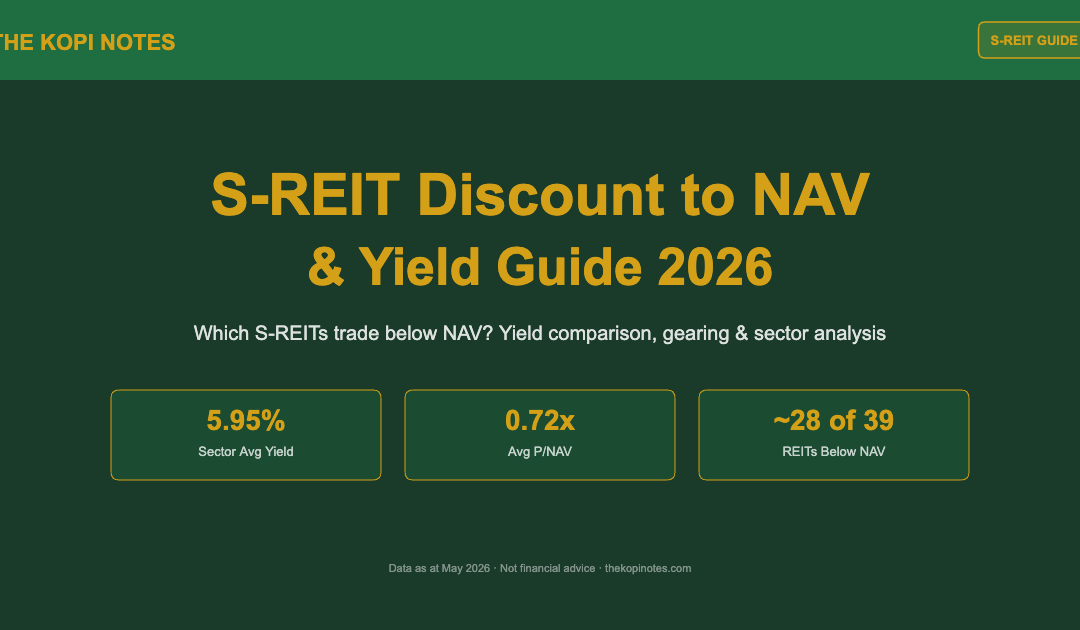
As at May 2026, the average S-REIT Price-to-NAV (P/NAV) ratio stands at 0.72x — meaning the typical Singapore REIT trades at a 28% discount to its net asset value. For income investors and value hunters, this raises a critical question: are these discounts a buying opportunity, or a warning sign?
This guide breaks down the P/NAV ratios and distribution yields of all major S-REITs, explains what drives discount pricing, and identifies which sectors offer the most compelling combination of yield and value.
Not financial advice. Data sourced from Fifth Person S-REIT Data tracker, as at May 2026. Always conduct your own due diligence before investing.
Table of Contents
Contents — Click to expand
- What Is NAV and Why Does P/NAV Matter?
- S-REIT Sector P/NAV & Yield Overview (May 2026)
- Full S-REIT P/NAV & Yield Comparison Table
- S-REIT Yield Comparison Chart
- S-REIT P/NAV Chart
- Why Do S-REITs Trade at a Discount to NAV?
- REITs That Trade at a Premium — and Why
- Gearing Ratios and Balance Sheet Health
- Sector-by-Sector Analysis
- How to Use P/NAV When Investing in S-REITs
- Useful Tools for S-REIT Investors
- FAQ
What Is NAV and Why Does P/NAV Matter?
Net Asset Value (NAV) is the per-unit book value of a REIT’s portfolio — essentially the appraised value of its properties minus all liabilities, divided by the number of units outstanding. If a REIT owns S$1 billion in assets and has S$400 million in debt across 500 million units, its NAV per unit is S$1.20.
Price-to-NAV (P/NAV) compares the market price to this book value:
- P/NAV < 1.0 = trading at a discount (market values the portfolio at less than appraised value)
- P/NAV = 1.0 = trading at fair value (par)
- P/NAV > 1.0 = trading at a premium (market assigns a quality/growth premium)
For S-REIT investors, P/NAV is a key valuation metric — but it must be read alongside yield, gearing, and distribution per unit (DPU) growth to paint a complete picture. A low P/NAV can indicate value, or it can signal that the market is pricing in future NAV write-downs.
Use our S-REIT Yield vs SGS Bond Spread Calculator to assess whether current yields adequately compensate for risk.
S-REIT Sector P/NAV & Yield Overview (May 2026)
The S-REIT sector as a whole has been under pressure since interest rates rose sharply in 2022–2023. Despite rate cut expectations in 2025–2026, many REITs remain significantly below their pre-rate-hike valuations. Here is the current snapshot:
| Metric | Value (May 2026) | Context |
|---|---|---|
| Average P/NAV (simple) | 0.72x | Below 10-yr avg of ~1.0x |
| Avg Distribution Yield | 5.95% | Up from 5.41% in Jan 2026 |
| Yield Spread (vs SGS 10Y) | ~3.75–3.84% | Historically attractive |
| Average Gearing | ~39–40% | Within MAS 50% limit |
| REITs trading below NAV | ~28 of 39 | ~72% of listed S-REITs |
| REITs with yield >7% | 13 of 39 | High-yield segment active |
| Total sector market cap | ~S$94.2B | Down from S$101B Jan 2026 |
Source: Fifth Person S-REIT Data; My Stocks Investing (March 2026 update). Data as at May 2026.
Full S-REIT P/NAV & Yield Comparison Table (May 2026)
The table below covers all major SGX-listed REITs with their current share price, distribution yield, P/NAV ratio, NAV per unit, and gearing ratio. REITs trading above NAV are highlighted.
| REIT | Price (S$) | Yield | P/NAV | NAV/Unit | Gearing |
|---|---|---|---|---|---|
| ParkwayLife REIT | 3.99 | 3.83% | 1.56x ▲ | 2.56 | 33.4% |
| Keppel DC REIT | 2.29 | 4.53% | 1.34x ▲ | 1.71 | 35.3% |
| Centurion Accom. REIT | 1.08 | 6.44% | 1.24x ▲ | 0.87 | 22.1% |
| AIMS APAC REIT | 1.59 | 6.19% | 1.24x ▲ | 1.28 | 48.3% |
| Mapletree Industrial Trust | 1.95 | 6.52% | 1.20x ▲ | 1.63 | 37.2% |
| CapitaLand Ascendas REIT | 2.52 | 5.95% | 1.10x ▲ | 2.29 | 39.0% |
| CICT | 2.29 | 5.06% | 1.07x ▲ | 2.14 | 38.6% |
| Frasers Centrepoint Trust | 2.26 | 5.36% | 1.01x ▲ | 2.23 | 39.6% |
| ESR REIT | 2.38 | 9.21% | 0.93x | 2.55 | 45.9% |
| Mapletree Logistics Trust | 1.18 | 6.15% | 0.94x | 1.26 | 44.3% |
| Frasers Logistics & Comm. | 0.98 | 6.07% | 0.89x | 1.10 | 35.7% |
| Elite UK REIT (GBP) | 0.34 | 8.91% | 0.85x | 0.40 | 41.9% |
| Sasseur REIT | 0.67 | 9.16% | 0.85x | 0.79 | 25.1% |
| NTT DC REIT (USD) | 0.96 | 5.79% | 0.84x | 1.14 | 29.2% |
| Stoneweg Europe (EUR) | 1.52 | 8.81% | 0.75x | 2.03 | 45.3% |
| Daiwa House Log. Trust | 0.48 | 8.93% | 0.75x | 0.65 | 40.2% |
| CapitaLand Ascott Trust | 0.90 | 6.82% | 0.76x | 1.17 | 40.4% |
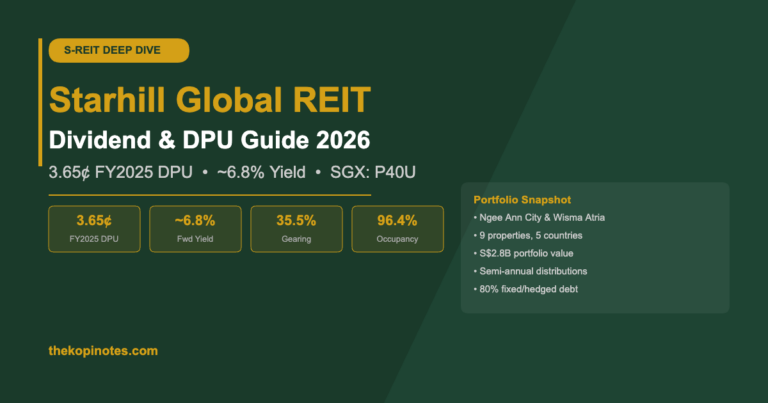
| Starhill Global REIT | 0.55 | 6.70% | 0.77x | 0.71 | 39.3% |
| MPACT | 1.27 | 6.28% | 0.73x | 1.73 | 37.9% |
| Suntec REIT | 1.46 | 4.82% | 0.72x | 2.03 | 41.5% |
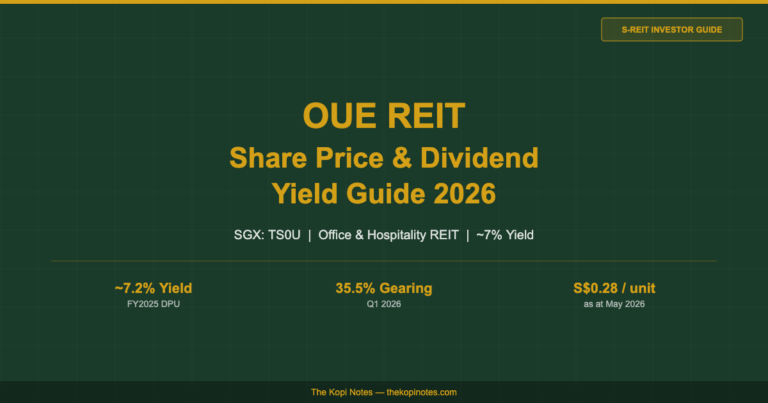
| OUE REIT | 0.35 | 6.37% | 0.62x | 0.56 | 38.5% |
| CapitaLand China Trust | 0.66 | 7.36% | 0.64x | 1.03 | 41.5% |
| Far East Hosp. Trust | 0.56 | 6.55% | 0.64x | 0.88 | 33.0% |
| Digital Core REIT (USD) | 0.49 | 7.27% | 0.62x | 0.80 | 37.1% |
| Keppel REIT | 0.88 | 5.98% | 0.69x | 1.28 | 47.9% |
| First REIT | 0.23 | 9.23% | 0.94x | 0.25 | 44.8% |
| IREIT Global | 0.23 | 10.43% | 0.46x | 0.50 | 44.6% |
| CDL Hospitality Trust | 0.77 | 6.23% | 0.55x | 1.40 | 40.2% |
▲ = trading above NAV (yellow highlight). Source: Fifth Person S-REIT Data, May 2026. Currency note: Elite UK REIT in GBP, Digital Core REIT and NTT DC REIT in USD, Stoneweg Europe in EUR.
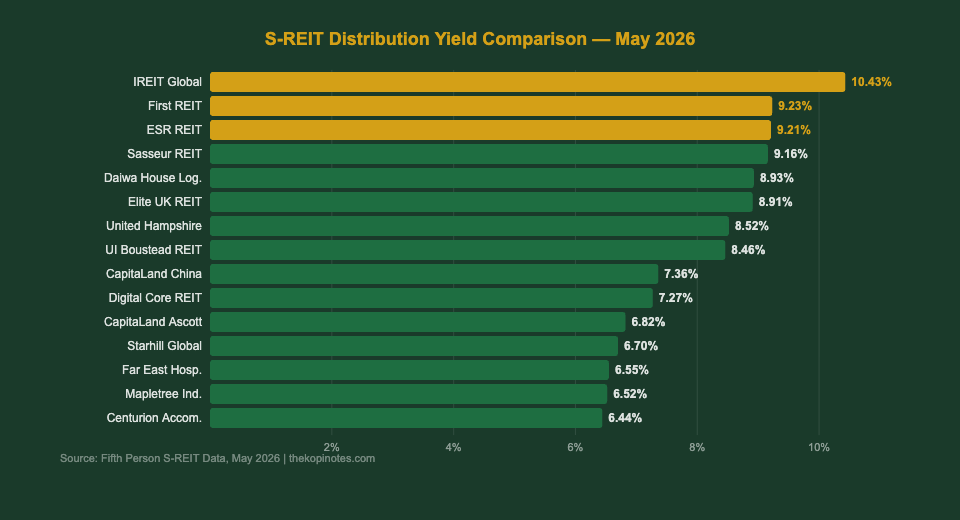
S-REIT distribution yield comparison (top 15) — May 2026. Source: Fifth Person S-REIT Data.
Why Do S-REITs Trade at a Discount to NAV?
A persistent discount to NAV is not unusual for REITs globally during periods of rising interest rates. Here are the main drivers behind the current S-REIT sector discount:
1. Interest Rate Sensitivity
REITs use significant leverage (average gearing ~40%). When borrowing costs rise, interest expenses eat into distributable income, compressing DPU. The Fed’s higher-for-longer stance in 2023–2025 forced the market to reprice REIT valuations downward. Even as rate cut expectations have returned in 2026, many S-REITs have not yet fully recovered their pre-2022 valuations.
2. Asset-Specific Risks
Some REITs trade at deep discounts because the market expects their underlying asset values to fall. Office REITs (Keppel REIT at 0.69x, OUE REIT at 0.62x) face structural headwinds from hybrid work and slower leasing demand. Overseas-focused REITs (IREIT Global at 0.46x, CapitaLand China Trust at 0.64x) carry additional currency, geopolitical, and regulatory risks.
3. Property Appraisal Lag
REIT NAV is based on annual property valuations, which may not reflect current market conditions in real time. If the market expects future appraisals to show write-downs, it prices this in ahead of time — creating an apparent discount even before the NAV is officially reduced.
4. DPU Sustainability Concerns
For some REITs, investors worry that high headline yields are not sustainable — particularly where gearing is elevated, leases are expiring, or forex headwinds are biting into income. A 10.43% yield on IREIT Global, for instance, prices in the risk that distributions could be cut.
REITs That Trade at a Premium — and Why
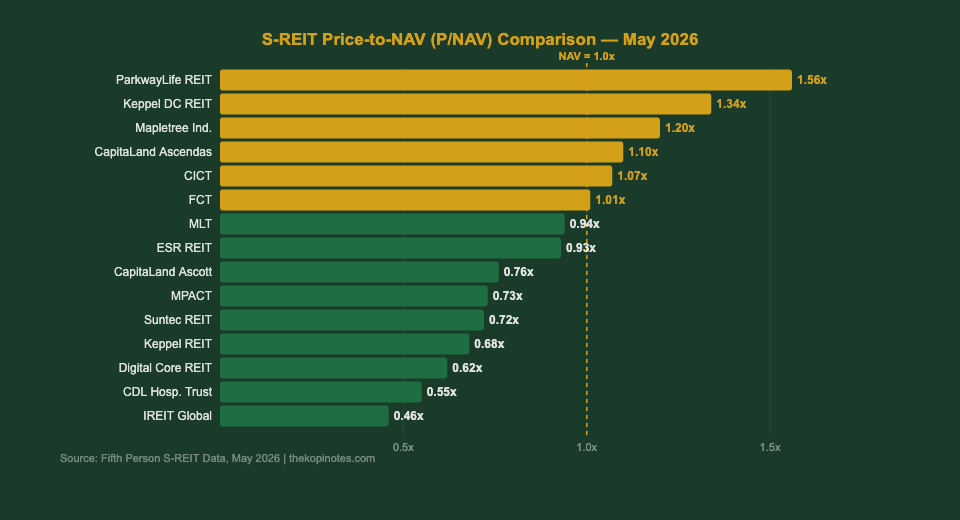
Only 8 of the 39 major S-REITs currently trade above NAV. These are worth examining closely, as they reveal what the market rewards most highly:
| REIT | P/NAV | Why Premium? |
|---|---|---|
| ParkwayLife REIT (1.56x) | 1.56x | Defensive healthcare assets; 19+ consecutive years of DPU growth; triple-net leases with built-in escalators. |
| Keppel DC REIT (1.34x) | 1.34x | Data centre scarcity premium; AI/cloud demand tailwind; hard-to-replicate assets in power-constrained markets. |
| Mapletree Industrial Trust (1.20x) | 1.20x | Data centre + high-specs industrial mix; proven DPU track record; strong Temasek-linked sponsor. |
| CapitaLand Ascendas REIT (1.10x) | 1.10x | Singapore’s largest diversified industrial REIT; institutional-grade portfolio; blue-chip tenants; S$17B AUM. |
| CICT (1.07x) | 1.07x | Singapore’s largest retail/office REIT; dominant suburban mall exposure; near-full occupancy in key assets. |
The pattern is clear: premium valuations go to REITs with defensive income, structural demand tailwinds (data centres, essential healthcare), strong sponsor backing, and a track record of growing DPU.
Gearing Ratios and Balance Sheet Health
MAS sets a gearing limit of 50% for Singapore REITs (or 60% for REITs with a credit rating). The current sector average is ~39–40%, leaving most REITs with reasonable headroom. However, some names warrant attention:
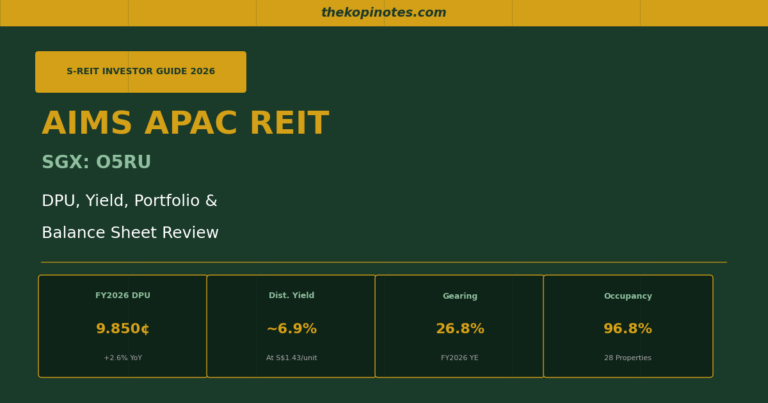
- AIMS APAC REIT (48.3%) — near the top of the comfortable range; limited dry powder for acquisitions
- Keppel REIT (47.9%) — elevated for an office REIT in a softer market
- Lendlease REIT (50.2%) — at the statutory limit; any portfolio stress could trigger covenant concerns
- Sasseur REIT (25.1%) — very low gearing, giving plenty of room to acquire or weather downturns
- Centurion (22.1%) — lowest gearing in the sector; significant capacity for accretive debt-funded growth
- NTT DC REIT (29.2%) — conservative balance sheet for a new data centre REIT
Use our S-REIT Gearing Ratio & ICR Calculator to model how interest rate changes affect a REIT’s interest coverage and DPU.
Sector-by-Sector Analysis
Industrial & Logistics REITs — Best Value-Yield Balance
Industrial and logistics REITs offer the strongest combination of reasonable P/NAV and solid yields. Mapletree Logistics Trust (0.94x, 6.15%), ESR REIT (0.93x, 9.21%), and Frasers Logistics (0.89x, 6.07%) all trade near or slightly below NAV with above-average yields. The industrial sector benefits from e-commerce demand, onshoring trends, and Singapore’s strategic position as a regional logistics hub. For a deeper look, see our Best S-REITs Singapore 2026 guide.
Retail REITs — Resilient but Fully Valued
Singapore’s suburban retail REITs have proven resilient post-COVID. FCT (1.01x) and CICT (1.07x) trade near or above NAV, reflecting strong occupancy (97–99%) and resilient shopper traffic. Their yields of 5.1–5.4% are lower than the sector average, reflecting this quality premium. Learn more: Frasers Centrepoint Trust Guide 2026.
Office REITs — Deep Discount, High Risk
Office REITs trade at the steepest discounts: Keppel REIT (0.69x), Suntec REIT (0.72x), OUE REIT (0.62x). Hybrid work has reduced leasing velocity, and some central CBD assets face lease expiry risk. These may look cheap on P/NAV, but investors must assess whether NAV write-downs are still to come.
Hospitality REITs — Uneven Recovery
Singapore hotel demand has recovered well, but overseas exposure is dragging on REITs with international portfolios. CapitaLand Ascott Trust (0.76x, 6.82%) offers decent yield and broad geographic diversification across ~40 countries, while CDL Hospitality Trust (0.55x, 6.23%) reflects market skepticism about its European and Australian portfolio performance. Detailed analysis: CapitaLand Ascott Trust Investor Guide.
Healthcare REIT — Premium Justified
ParkwayLife REIT (1.56x, 3.83%) is the only healthcare REIT in the S-REIT universe. Its premium reflects 19+ years of unbroken DPU growth, triple-net leases with built-in CPI escalators, and the mission-critical nature of its hospital and nursing home assets. The low yield is the price of quality and predictability.
Data Centre REITs — Diverging Stories
Keppel DC REIT (1.34x, 4.53%) commands a premium on AI/cloud demand tailwinds and Singapore’s power-constrained data centre market. Digital Core REIT (0.62x, 7.27%) trades at a steep discount despite its US data centre portfolio — reflecting concerns about tenant concentration and higher US borrowing costs. NTT DC REIT (0.84x, 5.79%) sits in between as a newer listing still building its track record.
How to Use P/NAV When Investing in S-REITs
P/NAV is a starting point, not a buy signal. Here is a practical framework for Singapore investors:
| P/NAV Range | What It Signals | What to Check Next |
|---|---|---|
| > 1.2x | Market assigns strong quality/growth premium | Is DPU growth justifying the premium? Is yield still acceptable? |
| 1.0x – 1.2x | Fair to slightly premium valuation | Check occupancy, lease expiry profile, sponsor pipeline |
| 0.8x – 1.0x | Mild discount — common in current environment | Is the asset quality stable? Any upcoming lease expiries or refinancing? |
| 0.6x – 0.8x | Significant discount — market is pricing in risk | Understand the risk: structural (office demand), geographic (China/overseas), or operational? |
| < 0.6x | Deep discount — distressed or high-risk territory | Is the NAV itself at risk? Could property valuations fall further? DPU cut risk? |
Always pair P/NAV analysis with: yield spread vs the 10-year SGS bond, gearing headroom, WALE (weighted average lease expiry), and sponsor quality. Our S-REIT Total Return Calculator lets you model the impact of both income and capital appreciation on your investment returns.
Useful Tools for S-REIT Investors
Use our free calculators to sharpen your S-REIT analysis:
Related Reading
Frequently Asked Questions
What does it mean when a REIT trades below NAV?
When a REIT trades below its Net Asset Value (NAV), it means the market is valuing the REIT’s units at less than the book value of its properties minus debts. This can indicate that investors expect future NAV write-downs (falling property values), DPU cuts, or structural challenges in the underlying asset class. A discount to NAV is not automatically a buy signal — you must understand why the discount exists.
Which Singapore REIT has the highest P/NAV?
As at May 2026, ParkwayLife REIT has the highest P/NAV at 1.56x, followed by Keppel DC REIT at 1.34x and Mapletree Industrial Trust at 1.20x. These premiums reflect the market’s appreciation for their defensive income (healthcare), structural demand tailwinds (data centres), and consistent DPU growth track records.
Which S-REITs have the highest distribution yield?
Based on May 2026 data, the highest-yielding S-REITs include IREIT Global (~10.43%), First REIT (~9.23%), ESR REIT (~9.21%), Sasseur REIT (~9.16%), Daiwa House Logistics Trust (~8.93%), and Elite UK REIT (~8.91%). However, very high yields often signal elevated risk — including DPU sustainability concerns, high gearing, overseas asset risk, or structural challenges in the underlying market.
Is a low P/NAV always a good buying opportunity?
Not necessarily. A low P/NAV can reflect genuine value, or it can signal that the market expects the NAV itself to fall through property revaluations. For office REITs, for example, a 0.60–0.70x P/NAV may reflect anticipated write-downs as asset valuations adjust to softer leasing conditions. Always analyse the quality of the underlying assets, lease profile, DPU sustainability, and gearing before interpreting a low P/NAV as a buying signal.
How does the MAS 50% gearing limit affect S-REITs?
The Monetary Authority of Singapore (MAS) caps REIT gearing at 50% of total assets (or 60% for REITs with a minimum credit rating). This protects unitholders by limiting leverage risk. REITs approaching the 50% limit have less flexibility to make acquisitions or weather market downturns without issuing new equity. The current sector average of ~39–40% suggests most S-REITs have reasonable headroom.
How can I invest in Singapore REITs?
Singapore residents can invest in S-REITs through a regular brokerage account (CDP-linked), via the SGX. You can also invest via platforms like Syfe or Endowus which offer REIT-focused portfolios. CPF funds can be used to buy certain S-REITs via a CPFIS-OA account — see our CPF Investment Strategy Guide for details.
This article was researched with the help of AI. While we strive to keep all information accurate and up to date, there may be errors. If you notice any discrepancies, please contact us.