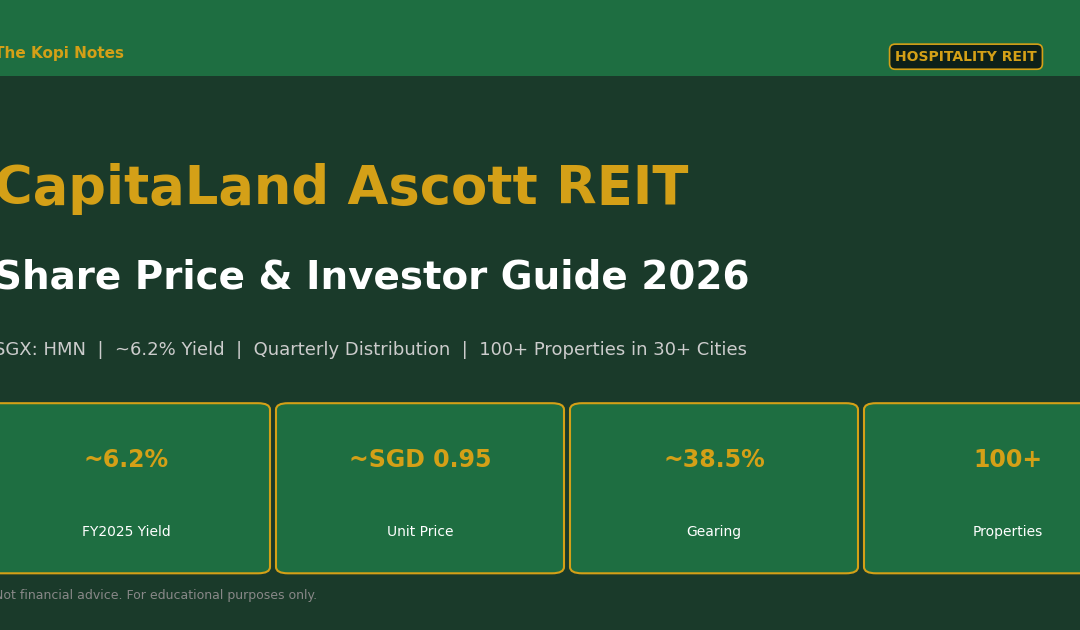
CapitaLand Ascott REIT Share Price & Investor Guide 2026: DPU, ~6% Yield & Lodging Recovery Outlook
Updated May 2026 | SGX: HMN | Hospitality & Serviced Residence REIT | Quarterly Distribution
CapitaLand Ascott REIT (SGX: HMN) — formerly Ascott Residence Trust — is Singapore’s largest hospitality REIT and the world’s largest listed lodging trust by number of units, with over 100 properties across more than 30 cities spanning Asia Pacific, Europe, and the USA. Backed by CapitaLand Investment (CLI), CLAS pays quarterly distributions and has delivered a distribution yield of approximately 6–7% in 2025–2026, making it one of the higher-yielding S-REITs for income-focused investors.
Not financial advice. All figures are for educational reference only. Data as at May 2026 unless noted.
⚠️ Disclaimer: This article is for informational purposes only and does not constitute financial advice. All figures are based on publicly available data from SGX filings and CLAS investor relations disclosures. Always conduct your own due diligence before making any investment decisions.
Table of Contents
Contents — Click to expand
- What Is CapitaLand Ascott REIT (CLAS)?
- CLAS Share Price & Trading Overview 2026
- DPU History & Distribution Yield
- Financial Health: Gearing, ICR & NAV
- Portfolio: 100+ Properties Across 30+ Cities
- S-REIT Peer Comparison Table
- Key Risks in 2026
- How to Buy CLAS in Singapore
- Our Verdict: Should You Buy CLAS in 2026?
- Frequently Asked Questions
1. What Is CapitaLand Ascott REIT (CLAS)?
CapitaLand Ascott REIT was formed in 2022 through the merger of Ascott Residence Trust (ART) and CapitaLand China Trust’s hospitality assets, creating a unified lodging REIT under the CapitaLand Investment umbrella. It is listed on the SGX Mainboard under the ticker HMN and managed by Ascott Residence Trust Management Limited, a wholly owned subsidiary of CapitaLand Investment Limited (CLI).
CLAS is unique among Singapore REITs because it focuses exclusively on lodging assets — serviced residences, co-living properties, student accommodation, and hotels — rather than the more common office, retail, or industrial properties. This gives CLAS a distinct income profile: shorter lease terms (daily to monthly) tied to travel and corporate demand, rather than the long-dated leases typical of office or industrial REITs.
As at Q1 2026, CLAS owns an interest in over 100 properties with approximately 17,000 units across key gateway cities including Singapore, Tokyo, London, Paris, New York, Sydney, and Shanghai. The diversified geographic footprint provides natural income hedging across different economic cycles — when Asia demand softens, European and US properties often pick up the slack.
CLI, as sponsor, holds approximately 40–45% of CLAS units, providing alignment of interest and access to an extensive pipeline of lodging assets through CapitaLand’s global hotel and serviced residence brands: Ascott, Somerset, Quest, Citadines, The Crest Collection, lyf, and Préférence.
2. CLAS Share Price & Trading Overview 2026
CapitaLand Ascott REIT (SGX: HMN) has traded broadly in the range of SGD 0.88–1.05 over the past 12 months, reflecting both the global interest rate environment and the pace of travel recovery across its key markets. As at May 2026, CLAS trades at approximately SGD 0.93–0.97 per unit, a discount of roughly 10–15% to its reported net asset value (NAV) of approximately SGD 1.09 per unit.
This NAV discount is meaningful for investors: it implies you are acquiring real lodging assets in prime global cities at below their appraised value — a situation that has historically reversed as interest rates decline and travel demand strengthens.
| Metric | Value (May 2026) |
|---|---|
| SGX Ticker | HMN |
| Share Price (approx.) | SGD 0.95 |
| 52-Week Range | SGD 0.88 – SGD 1.05 |
| Market Cap | ~SGD 3.6 billion |
| NAV Per Unit | ~SGD 1.09 |
| Price-to-NAV | ~0.87x (discount) |
| Distribution Frequency | Quarterly |
| FY2025 DPU | ~5.87 cents |
| Indicative FY2025 Yield | ~6.2% (at SGD 0.95) |
Source: SGX, CLAS investor relations, May 2026. Share price is indicative and changes daily.
CLAS’s liquidity is reasonable for a mid-cap S-REIT, with average daily trading volumes of roughly 3–6 million units. The REIT is included in the FTSE EPRA Nareit Global Index and several regional REIT indices, giving it exposure to institutional fund flows that track these benchmarks.
3. DPU History & Distribution Yield
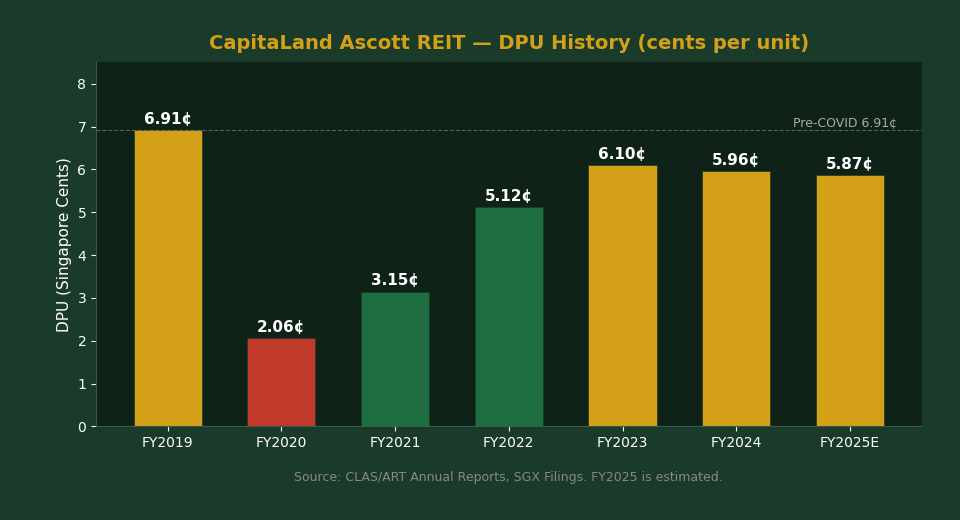
CapitaLand Ascott REIT (as Ascott Residence Trust, pre-merger) has a long track record of distributions dating back to its listing in 2006. The COVID-19 pandemic hit hospitality REITs especially hard — CLAS cut distributions significantly in 2020–2021 as hotel and serviced residence occupancy collapsed globally. The subsequent recovery has been one of the more impressive in the S-REIT space.
| Financial Year | DPU (cents) | YoY Change | Notes |
|---|---|---|---|
| FY2019 | 6.91 | — | Pre-COVID baseline |
| FY2020 | 2.06 | -70% | COVID-19 impact; travel collapse |
| FY2021 | 3.15 | +53% | Partial recovery; ART-Ascott merger |
| FY2022 | 5.12 | +63% | CLAS formed; travel rebound begins |
| FY2023 | 6.10 | +19% | Strong RevPAU recovery across markets |
| FY2024 | 5.96 | -2.3% | High interest costs; FX headwinds (GBP, EUR, JPY) |
| FY2025 | ~5.87 | ~-1.5% | Stabilising; rate cuts beginning to reduce borrowing costs |
Source: CLAS/ART annual reports, SGX filings. FY2025 DPU is estimated based on H1 2025 actual + H2 2025 projection.
The DPU story for CLAS is one of recovery and stabilisation rather than growth. At FY2025’s estimated DPU of ~5.87 cents and a unit price of SGD 0.95, the trailing yield is approximately 6.2% — among the highest in the hospitality REIT sub-sector globally. However, investors should note that unlike office or industrial REITs with 3–5 year leases, CLAS’s distributions are more sensitive to short-term demand fluctuations: occupancy, RevPAU (Revenue per Available Unit), and currency movements all affect quarterly DPU.
For Singapore investors looking to generate passive income in Singapore, CLAS’s quarterly distribution schedule is attractive — compared to the semi-annual distributions paid by many S-REITs, quarterly distributions provide more regular cash flow.
4. Financial Health: Gearing, ICR & NAV
CLAS’s balance sheet is a key watchpoint for prospective investors, given that hospitality REITs carry more operational leverage than net-lease REITs. Here are the key financial metrics as at the most recent reporting period (Q4 2025 / FY2025):
| Metric | CLAS (FY2025) | MAS Regulatory Limit |
|---|---|---|
| Aggregate Leverage (Gearing) | ~38.5% | 50% (45% without ICR ≥2.5x) |
| Interest Coverage Ratio (ICR) | ~2.4x | ≥2.5x to access 50% limit |
| NAV Per Unit | ~SGD 1.09 | — |
| Weighted Avg. Debt Maturity | ~3.2 years | — |
| Fixed-Rate Debt (%) | ~73% | — |
| Weighted Avg. Cost of Debt | ~3.2% | — |
Source: CLAS FY2025 results presentation, SGX filings. Figures are approximate.
The gearing of ~38.5% is manageable and sits well within MAS limits, leaving headroom for debt-funded acquisitions. However, the ICR of ~2.4x is slightly below the 2.5x threshold required to access the 50% gearing limit — meaning CLAS must operate more conservatively on leverage until interest costs fall or NPI recovers. With SORA declining in 2025–2026 and ~73% of debt fixed, CLAS is positioned to see gradual improvement in ICR as floating-rate debt reprices lower.
The weighted average cost of debt at ~3.2% is among the lower borrowing costs in the S-REIT space, reflecting CLAS’s investment-grade credit profile and CLI’s sponsor backing. As the ~27% floating-rate debt reprices in 2026–2027, this should create a tailwind for distributions.
If you’re comparing this against other income options, our Singapore retirement calculator can help you model how a 6% yielding REIT fits within a broader passive income portfolio.
5. Portfolio: 100+ Properties Across 30+ Cities
CLAS’s portfolio is the most geographically diversified of any Singapore-listed REIT, spanning three broad regions:
Asia Pacific (largest exposure, ~55–60% of AUM): Singapore, Japan (Tokyo, Osaka, Fukuoka), Australia (Sydney, Melbourne, Brisbane, Perth), China (Shanghai, Beijing, Guangzhou), Vietnam (Hanoi, Ho Chi Minh City), and the Philippines. Japan is a standout — CLAS owns several serviced residences in Tokyo that benefit from surging inbound tourism and yen weakness driving RevPAU improvements in SGD terms when the yen is strong.
Europe (~25–30% of AUM): UK (London, Edinburgh), France (Paris, Lyon, Bordeaux), Germany (Berlin, Frankfurt), Belgium (Brussels), and Spain. European properties tend to be longer-stay corporate accommodation, providing more stable occupancy than pure tourist hotels.
USA (~10–15% of AUM): New York and other major cities. The US exposure includes some student accommodation assets acquired through Quest Apartment Hotels, providing a counter-cyclical income stream less dependent on corporate travel.
CLAS’s portfolio also increasingly includes lyf co-living properties — a newer asset class targeting younger digital nomads and long-stay corporate guests. The lyf brand has expanded rapidly across Asia Pacific, adding a growth dimension to what is otherwise a yield-focused REIT.
The portfolio strategy of holding diversified lodging types (serviced residences, co-living, hotels, student accommodation) is intentional: different asset types peak at different points in the economic cycle, reducing the income volatility that pure hotel REITs face. Investors interested in the broader Singapore REIT landscape can explore our best S-REITs in Singapore 2026 guide for a complete sector comparison.
6. S-REIT Peer Comparison Table
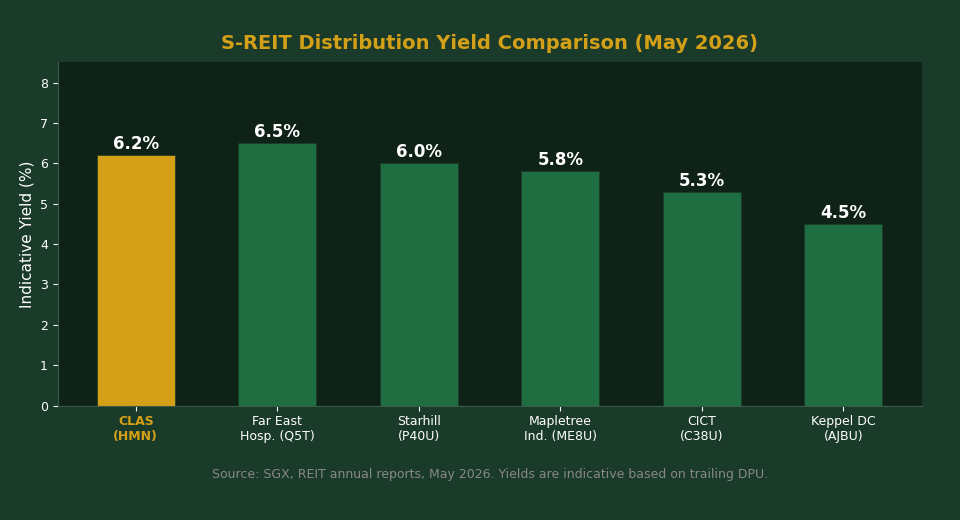
CLAS is the only pure-play lodging REIT of meaningful scale on the SGX. Its closest S-REIT peers are other diversified hospitality trusts and yield-focused income securities:
| REIT | SGX Ticker | Yield (Approx.) | Gearing | Sector |
|---|---|---|---|---|
| CapitaLand Ascott REIT | HMN | ~6.2% | ~38.5% | Hospitality / Lodging |
| Far East Hospitality Trust | Q5T | ~6.5% | ~33% | Hotels / Serviced Res. |
| Starhill Global REIT | P40U | ~6.0% | ~35% | Retail / Hotel Mix |
| CapitaLand Integrated Comm. Trust | C38U | ~5.3% | ~40% | Retail / Office |
| Keppel DC REIT | AJBU | ~4.5% | ~37% | Data Centres |
| Mapletree Industrial Trust | ME8U | ~5.8% | ~38% | Industrial / Data Centres |
Source: SGX, respective REIT annual reports, May 2026. Yields are indicative based on trailing DPU and current market price.
CLAS’s ~6.2% yield positions it attractively relative to defensive industrial REITs and data centre REITs, which trade at lower yields due to longer lease structures and perceived lower risk. The premium yield reflects the hospitality sector’s sensitivity to macro shocks — investors demand extra compensation for this variability. For investors with a higher risk tolerance seeking income, CLAS offers one of the more compelling yield-to-quality trade-offs on the SGX.
7. Key Risks in 2026
1. Currency Risk (FX Headwinds)
CLAS’s largest risk is currency — with properties in GBP, EUR, JPY, AUD, CNY and USD, distributable income is significantly affected by exchange rates. A strengthening SGD erodes the SGD-equivalent DPU from overseas properties. FY2024 saw meaningful FX headwinds from JPY and EUR weakness. Hedging programmes partially mitigate this, but currency risk remains a core feature of investing in CLAS.
2. Short-Lease Operating Leverage
Unlike office or industrial REITs where tenants sign 3–7 year leases, CLAS’s lodging assets operate on short stays. A global recession, pandemic, geopolitical event, or even a regional slowdown can hit occupancy and RevPAU quickly. This creates earnings volatility that is absent in net-lease REIT structures.
3. Interest Rate Sensitivity
Despite ~73% fixed-rate debt, CLAS still has meaningful floating-rate exposure. Higher-for-longer rates suppress the ICR and limit the REIT’s ability to grow via debt-funded acquisitions. The good news: SORA has been declining since mid-2024, and the trend is expected to continue into 2026–2027.
4. China Exposure Recovery
CLAS has notable exposure to China through serviced residences in Shanghai, Beijing, and other tier-1 cities. China’s domestic corporate travel and expatriate demand has been slower to recover than pre-COVID levels, and geopolitical tensions add an additional layer of uncertainty for China-based assets.
5. Dilution Risk from Rights Issues or Placements
To fund acquisitions from CLI’s pipeline, CLAS may issue new units, which dilutes existing unitholders unless accretive. CLI’s large pipeline is a double-edged sword: it provides acquisition opportunities, but also creates expectations of equity fundraising. Investors should monitor CLAS’s debt headroom and equity issuance history carefully.
For investors building a diversified income portfolio, it’s worth checking whether CPF investment strategies can complement REIT holdings for risk-adjusted returns in retirement planning.
8. How to Buy CapitaLand Ascott REIT in Singapore
CLAS units are traded on the SGX Mainboard under the ticker HMN. You can buy CLAS through any SGX-connected brokerage account. The minimum lot size is 100 units, so at SGD 0.95 per unit, the minimum investment is approximately SGD 95 — making it accessible for retail investors.
Recommended platforms for Singapore investors:
For investors who prefer a managed approach, Syfe’s referral code and sign-up bonus gives access to their REIT+ and income-focused portfolios that include CLAS and other high-yield S-REITs with no minimum investment. For direct self-directed trading, FSMOne’s referral code offers competitive commission rates for SGX stocks and REITs. For robo-advisory with CPF-OA integration, Endowus’s referral code provides access to institutional-class fund strategies that complement direct REIT holdings.
As with all income investments, consider your overall asset allocation before investing. CLAS should typically form part of a diversified S-REIT portfolio rather than a concentrated single-REIT position, given its hospitality-sector concentration risk.
9. Our Verdict: Should You Buy CLAS in 2026?
CLAS is best suited for: Investors who want above-average S-REIT yield (~6.2%), quarterly income payments, exposure to global travel recovery, and CLI’s blue-chip sponsor backing — and who are comfortable with hospitality-sector volatility and FX risk.
The bull case: Interest rates are declining, benefiting CLAS’s floating-rate debt and compressing the discount to NAV. Global travel demand remains structurally strong post-COVID, driving RevPAU improvements. The lyf co-living expansion adds a growth angle. At 0.87x NAV, CLAS trades at a discount that has historically corrected in falling-rate environments.
The bear case: FX headwinds (especially from JPY, EUR, GBP) can significantly dent SGD distributions. ICR at ~2.4x limits growth optionality. China property exposure adds geopolitical risk. Short-lease income is inherently more volatile than long-lease industrial or office REITs.
Bottom line: CLAS is a quality hospitality REIT with a globally diversified portfolio, strong sponsor, and an attractive ~6.2% yield at current prices. It is not a set-and-forget defensive income stock — investors need to monitor quarterly RevPAU trends, FX movements, and debt refinancing timelines. But for investors who do their homework and are comfortable with the asset class, CLAS offers compelling risk-adjusted returns in a declining-rate environment.
10. Frequently Asked Questions
What is CapitaLand Ascott REIT's dividend yield in 2026?
Based on FY2025’s estimated DPU of ~5.87 cents and a unit price of approximately SGD 0.95, CapitaLand Ascott REIT (CLAS) offers an indicative distribution yield of approximately 6.2% as at May 2026. The yield will vary with the unit price and any changes in quarterly DPU. CLAS pays distributions quarterly, which is more frequent than many S-REITs that pay semi-annually.
What is CLAS's SGX ticker symbol?
CapitaLand Ascott REIT trades on the SGX Mainboard under the ticker symbol HMN. It was previously listed as Ascott Residence Trust (ART) before the 2022 merger that formed CLAS. If you search for the old ticker “A68U” it will now redirect to HMN on most SGX-connected platforms.
Is CapitaLand Ascott REIT a safe investment?
CLAS has strong sponsor backing from CapitaLand Investment (CLI) and a diversified global lodging portfolio, which provides resilience. However, all REITs carry risk, and CLAS is more volatile than industrial or data centre REITs due to its short-lease hospitality model. Key risks include currency fluctuations, travel demand cycles, and interest rate sensitivity. It is not considered a defensive income stock — it is better suited for investors who understand hospitality sector dynamics and accept moderate-to-high income variability.
How often does CLAS pay dividends?
CapitaLand Ascott REIT pays distributions quarterly — four times per year. This is more frequent than the semi-annual distributions offered by most Singapore REITs. Quarterly income is attractive for investors who rely on their REIT distributions for regular cash flow. Distribution dates are announced after each quarterly results release, typically within 60–90 days of the quarter end.
What is CLAS's gearing ratio and is it safe?
As at FY2025, CLAS’s aggregate leverage (gearing) is approximately 38.5%, which is well within MAS’s regulatory limit of 50% (or 45% without meeting the ICR threshold). This leaves meaningful debt headroom for acquisitions. However, investors should note that the interest coverage ratio (ICR) of ~2.4x is slightly below the 2.5x threshold that would allow CLAS to access the full 50% gearing limit. As rates decline and NPI recovers, the ICR is expected to improve.
Where does CLAS own its properties?
CLAS owns over 100 properties across more than 30 cities worldwide. The three main regions are: Asia Pacific (~55–60% of AUM) including Singapore, Japan, Australia, China, and Vietnam; Europe (~25–30%) including the UK, France, Germany, Belgium, and Spain; and the USA (~10–15%) primarily in New York. This geographic diversification makes CLAS unique among S-REITs — no other Singapore-listed REIT has such broad global lodging exposure.
Can I use CPF to invest in CapitaLand Ascott REIT?
Yes. As a SGX Mainboard-listed REIT, CLAS is eligible for investment using CPF Ordinary Account (OA) funds through the CPF Investment Scheme (CPFIS-OA). You can purchase CLAS units through an approved CPFIS broker using your CPF OA balance. Note that CPF OA funds used for investments will not earn the guaranteed 2.5% p.a. OA interest rate during the period they are invested — so weigh the potential distribution yield against the risk-free CPF OA return before committing.
What is the difference between CLAS and Ascott Residence Trust (ART)?
CapitaLand Ascott REIT (CLAS, SGX: HMN) is the combined entity formed from the 2022 merger of Ascott Residence Trust (ART, SGX: A68U) and certain CapitaLand assets. ART was Singapore’s first and largest hospitality trust when it listed in 2006. The merger with CapitaLand’s lodging assets created CLAS, which is significantly larger — by number of properties, AUM, and geographic diversification — than ART was at the time of merger. CLAS unitholders received a combination of new CLAS units and cash as part of the merger consideration.
References
- CapitaLand Ascott REIT Investor Relations — Financial Results
- SGX: CLAS (HMN) Securities Information
- MAS — Real Estate Investment Trusts (REITs) Regulation
- CapitaLand Investment — Lodging Portfolio
Data in this article is sourced from CLAS investor relations announcements, SGX filings, and public reports as at May 2026. Figures are approximate and subject to change. This article is not financial advice.
This article was researched with the help of AI. While we strive to keep all information accurate and up to date, there may be errors. If you notice any discrepancies, please contact us.