MediSave Limit 2026: Can You Use Your MediSave to Pay for Your Parents' or Spouse's Hospitalisation?
Yes — you can use your own MediSave to pay for an eligible family member’s hospitalisation bill. CPF allows you to tap your MediSave account for immediate family: spouse, children, parents, grandparents (SC/PR), and siblings (SC/PR). The same withdrawal limits apply as if you were paying your own bill, and any shortfall must be settled in cash or through the hospitalised person’s Integrated Shield Plan (ISP).
Not financial advice. All figures are for educational reference only. MediSave withdrawal limits sourced from CPF Board’s official table effective 1 April 2025. Data verified as at October 2026.
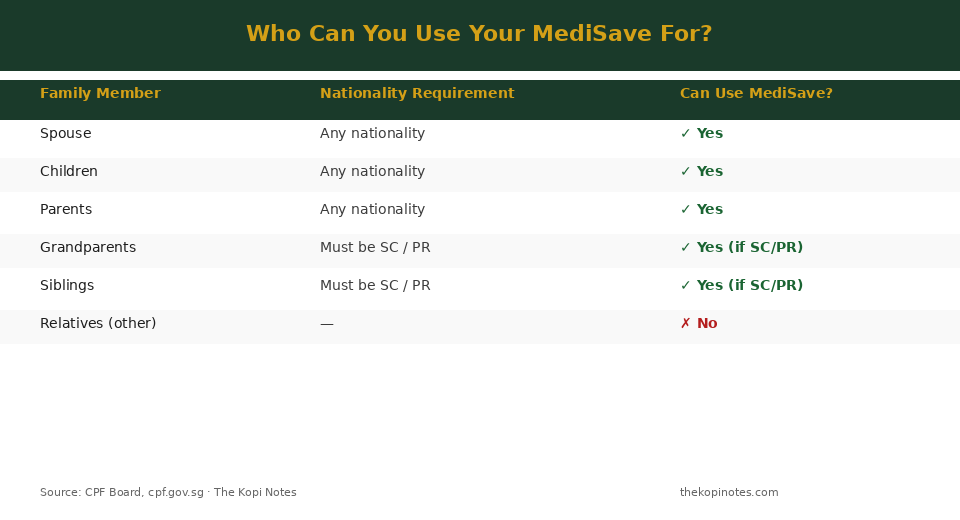
Who Can You Use Your MediSave For?
CPF rules allow you to use your MediSave to pay for hospitalisation expenses incurred by your approved dependants. These are your immediate family members — but there are important nationality conditions for some.
| Family Member | Nationality Requirement | MediSave Eligible? |
|---|---|---|
| Spouse | Any nationality | ✓ Yes |
| Children (incl. adopted) | Any nationality | ✓ Yes |
| Parents (incl. step-parents, in-laws) | Any nationality | ✓ Yes |
| Grandparents (incl. step-grandparents, grandparents-in-law) | Must be SC or PR | ✓ Yes (if SC/PR) |
| Siblings | Must be SC or PR | ✓ Yes (if SC/PR) |
| Aunts, uncles, cousins, friends | — | ✗ Not eligible |
Source: CPF Board, cpf.gov.sg/service/article/can-i-use-my-medisave-to-pay-for-my-family-member-s-hospitalisation-expenses
Notice that spouses, children, and parents can be of any nationality — including foreigners. If your parent is a Malaysian national living in Singapore and is hospitalised at a Singapore hospital, you can still use your MediSave to help pay their bill.
Grandparents and siblings are the exception: they must be Singapore Citizens or Permanent Residents for you to use your MediSave on their behalf.
What MediSave Limits Apply When Paying for a Family Member?
One of the most common misconceptions is that you get “extra” MediSave when a family member contributes. You don’t. The CPF Board applies the same standard withdrawal limits per hospitalisation episode, regardless of whose MediSave account is used to pay.
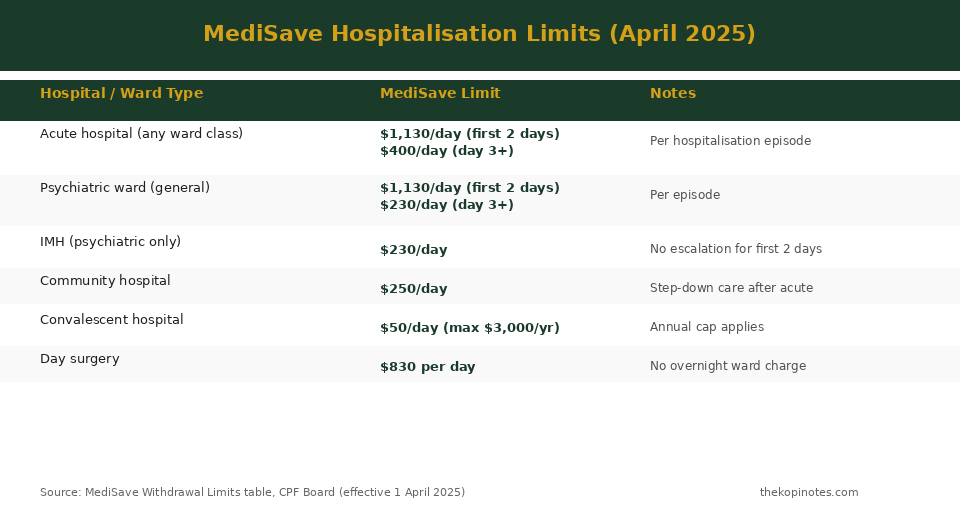
Here are the official limits effective 1 April 2025 (the most recently published CPF withdrawal limits table):
| Hospital / Ward Type | MediSave Daily Limit | Notes |
|---|---|---|
| Acute hospital (C, B2, B1, A, or private ward) | $1,130/day (first 2 days) $400/day (day 3 onwards) |
Applies to all ward classes |
| Psychiatric ward (general) | $1,130/day (first 2 days) $230/day (day 3 onwards) |
Lower ongoing rate |
| Institute of Mental Health (IMH) | $230/day | Flat rate, no first-day premium |
| Approved community hospital (step-down care) | $250/day | After discharge from acute ward |
| Convalescent hospital | $50/day (capped at $3,000/yr) | Annual cap applies |
| Day surgery (no overnight stay) | $830 per procedure day | Plus surgical table limit |
Source: MediSave Withdrawal Limits table, CPF Board (effective 1 April 2025). Check cpf.gov.sg for the latest version.
Key insight: There is no difference between paying for your own hospitalisation and paying for your parent’s. The daily limit of $1,130 for the first two days applies equally in both cases. The ward class does not determine your MediSave limit — it determines the actual ward charge, and the gap between the two must be paid by MediShield Life, your ISP rider, and/or cash.
Surgical Procedure Limits
If the hospitalisation involves surgery, MediSave can also cover part of the surgeon’s and anaesthetist’s fees. The limit depends on the surgical table (1 to 7), with higher tables covering more complex operations. The maximum MediSave claimable for surgical procedures per hospitalisation episode is $5,290 (Table 7C, effective April 2025). This limit applies regardless of how many family members contribute.
How to Claim: Step-by-Step Guide
The MediSave claim for a family member’s hospitalisation is handled at the hospital — you don’t need to submit a separate CPF claim. Here’s how it works in practice:
- At admission: Inform the hospital Business Office that you wish to use your MediSave (not the patient’s) to help pay the bill. They will check that you are an approved dependant.
- Sign the MCAF: You’ll be asked to sign a Medical Claims Authorisation Form (MCAF). This authorises CPF Board to withdraw from your MediSave account and pay the hospital directly.
- Provide your NRIC: The hospital needs your NRIC number (not just the patient’s) to process the claim from your account.
- Multiple contributors: If more than one family member wants to contribute MediSave, each person signs a separate MCAF.
- At discharge: The hospital submits the MediSave claim digitally to CPF Board. Payment goes directly to the hospital — funds don’t pass through you.
Tip: If you’re adding a family MediSave payer after discharge (e.g., you forgot to sign the MCAF during a rushed emergency admission), you can still do so within a limited period. Contact the hospital’s Business Office promptly — they can usually backdate the MCAF application if the claim has not yet been processed.
For more details on how MediSave hospitalisation claims work step by step, see our full guide.
Can Multiple Family Members Pool Their MediSave?
Yes — and this is one of the most useful but least-known features of Singapore’s healthcare financing system. Multiple family members can each contribute their own MediSave toward a single hospitalisation bill.
So if your father is hospitalised and both you and your sibling want to help, you can each authorise MediSave withdrawals from your respective CPF accounts. Each sibling signs a separate MCAF, each withdrawal is tracked separately, and CPF Board processes them together for the hospital.
However — and this is critical — the per-episode withdrawal limit does NOT increase just because multiple people are contributing. The $1,130 daily limit for the first two days and $400/day thereafter apply to the total MediSave claimable for that hospitalisation episode, regardless of how many payers there are. Using five family members’ MediSave accounts does not give you five times the daily limit.
What multiple payers does do is spread the depletion across different MediSave accounts. Instead of drawing down your own account by $3,000, you might draw $1,000 from three accounts. This preserves each individual’s MediSave balance for their own future medical needs — a sound strategy for families where elderly parents face recurring hospitalisation.
“We split Mum’s hospitalisation bill between me, my brother, and Mum’s own MediSave. Each of us contributed about $1,200. None of our accounts got depleted too badly, and we didn’t have to come up with extra cash.” — A common scenario for Singapore sandwich-generation families.
If you’re thinking about MediSave limit planning for retirement, factoring in how much you may need to contribute for ageing parents is an important consideration.
Worked Example: Your Father in a Class B1 Ward (5 Days)
Let’s walk through a real-numbers scenario. Your 70-year-old father is admitted to a restructured hospital for 5 days in a Class B1 ward, requiring a Table 4 surgery (e.g., an appendectomy).
Scenario assumptions:
- Ward: Class B1, restructured hospital
- Stay duration: 5 days
- Surgery: Table 4 procedure
- Father has MediShield Life coverage (no ISP rider)
- Father’s MediSave balance: $12,000 (already has enough)
- Your MediSave balance: $40,000
| Component | Estimated Bill | MediSave Claimable |
|---|---|---|
| Ward charges (5 days) | ~$3,500–$6,000 | $1,130 × 2 + $400 × 3 = $3,460 |
| Surgery (Table 4B, appendectomy) | ~$3,000–$5,000 | Up to $2,440 |
| MediShield Life deductible (Class B1) | $2,000 (patient pays this first) | Covered by MediSave |
| MediShield Life co-insurance (10%) | ~$500–$1,000 | Covered by MediSave |
| Total MediSave usable (all payers combined) | — | Up to ~$5,900 |
These are indicative figures only. Actual bill depends on the specific hospital, surgeon, and procedures performed. MediSave limits effective 1 April 2025. MediShield Life deductibles as at 2025.
In this example, your father’s MediSave alone is likely sufficient to cover the claimable portion. You would only need to contribute your own MediSave if his balance is low or depleted — for example, after a previous hospitalisation earlier in the year.
Want to model your specific scenario? Use a Singapore retirement calculator that factors in projected healthcare costs over your parents’ lifetime.
What If the Bill Exceeds Your Family’s MediSave?
Even after pooling family MediSave accounts, a large bill at a private or Class A ward can leave a significant cash shortfall. When that happens, your options are:
- MediShield Life — pays a portion of the bill above the deductible, subject to claim limits. The hospitalised person must be enrolled (all SC and PR are enrolled automatically). MediShield Life alone won’t cover private hospital rates.
- Integrated Shield Plan (ISP) rider — if your parent or spouse has an ISP with a rider, the rider covers co-payment obligations and can reduce or eliminate the cash portion. See our MediSave limit: rider vs no rider guide for a comparison.
- MediFund — a last-resort safety net for Singapore Citizens who cannot afford their hospitalisation bills at subsidised wards. Administered by the hospital’s medical social worker.
- Cash payment — any remaining balance after MediSave and MediShield Life must be paid in cash (credit card, bank transfer, GIRO). Hospitals may offer instalment plans for large bills.
For ISP coverage details and how riders affect the co-payment structure from 2026, review the latest MOH guidelines on rider changes.
Should You Buy an Integrated Shield Plan for Your Parents?
If your parents don’t have an ISP — or have an ISP without a rider — you may be contributing your MediSave and cash to cover every hospitalisation. That’s a growing financial burden, especially as healthcare costs rise each year.
An ISP for a parent in their 70s typically costs $2,000–$5,000 per year (ISP base premium + rider), depending on the insurer, plan tier, and the parent’s health status. The base ISP premium can be paid using MediSave (subject to the Additional Withdrawal Limit, or AWL):
- Age next birthday 1–40: AWL = $300/year
- Age next birthday 41–70: AWL = $600/year
- Age 71 and above: AWL = $900/year
The rider premium cannot be paid from MediSave — it must be paid in cash. For a parent aged 75, you might pay $900/year from their MediSave for the base ISP and another $1,500–$3,000/year in cash for the rider.
Whether it’s worth it depends on your family’s hospitalisation risk and financial situation. Our best ISP for retirees in Singapore guide compares the top plans for parents aged 65 and above.
If your parent doesn’t currently have an ISP and you want to explore options, Syfe referral code offers access to insurance reviews, and most ISP comparisons are available through fee-based or direct insurer channels.
ISP vs No ISP: Impact on Family MediSave Usage
A parent with a good ISP rider can reduce their hospitalisation cash bill to near-zero — meaning you rarely need to contribute your own MediSave at all. A parent with no ISP will rely heavily on MediShield Life claims plus family MediSave contributions, leaving you to foot a larger cash balance for any expensive episode. Over a 20-year retirement, the difference can be substantial.
For context on whether downgrading an ISP makes sense, particularly if your parent is considering reducing their plan tier due to rising premiums, we’ve also put together a decision checklist.
Frequently Asked Questions
Can I use my MediSave to pay for my parent's hospital bill even if they still have MediSave left?
Does using my MediSave for my parents count toward my own MediSave limit?
My mother is a Malaysian PR — can I use my MediSave to pay her Singapore hospital bill?
How much MediSave can I expect to use for a parent's 3-day stay?
Can I use my MediSave to pay for my spouse's ISP premiums, not just hospitalisation?
What if my sibling is a foreigner — can I still use MediSave for their hospitalisation?
Is there any risk to contributing my MediSave to a family member's bill?
The Bottom Line
Singapore’s MediSave system is more family-friendly than most people realise. You can use your MediSave account to help pay for your spouse’s, children’s, or parents’ hospitalisation — regardless of their nationality. Grandparents and siblings also qualify, as long as they are SC or PR.
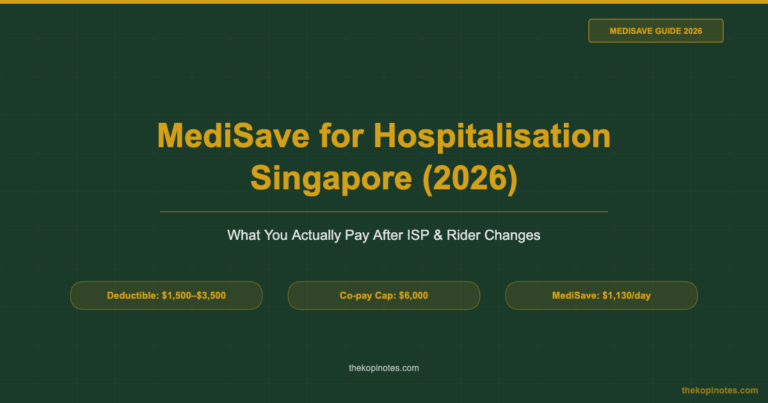
The withdrawal limits are the same as for your own hospitalisation: $1,130/day for the first two days, then $400/day for an acute hospital stay. Multiple family members can pool their MediSave, but the total claimable amount per episode doesn’t increase. What pooling does is spread the financial burden across accounts.
If you’re planning for ageing parents, the most impactful move is ensuring they have an ISP with a rider — reducing the dependence on family MediSave for large hospital bills. Use our guide to the best ISP for Singapore retirees as a starting point.
For personalised advice, consult a licensed financial adviser or your CPF Service Centre. This article is for educational reference only.
Get Free Insurance Advice
Speak with a licensed insurance advisor. No obligation, no cost.
By submitting this form, you agree to our Privacy Policy.
This article was researched with the help of AI. While we strive to keep all information accurate and up to date, there may be errors. If you notice any discrepancies, please contact us.