NTUC Income Rider 2026: Optima Care vs Essential Care Explained (Premiums, Benefits & Should You Switch)
Income Insurance’s two new MOH-compliant riders, compared line by line — premiums, co-payment tiers, cancer cover, and who should switch.
From 1 April 2026, Income Insurance replaced its Deluxe Care and Classic Care riders with two new options: Optima Care and Essential Care. Neither covers your Integrated Shield Plan deductible anymore, and both cap your co-payment at $6,000 a year. Optima Care costs more but pays a bigger share of your bill — Essential Care is the budget option with higher co-payment rates.
Not financial advice. All figures are for educational reference only. Premium tables, co-payment rates and benefit limits below are taken directly from Income Insurance’s official rider documentation and cross-checked against MOH’s rider policy announcement. Data verified as at 16 August 2026.
- Optima Care replaces Deluxe Care. Essential Care replaces Classic Care. Both launched 1 April 2026 under MOH’s new rider rules.
- Optima Care has lower co-payment (5% at panel providers, 8% elsewhere) and richer benefits. Essential Care is cheaper but you pay more per claim (7% at panel, 10% elsewhere).
- Neither rider covers your ISP deductible. You pay that out of pocket first — then the rider’s co-payment share, capped at $6,000 a year at panel or extended panel providers.
Table of Contents
Contents — Click to expand
- What Changed for NTUC Income Riders in 2026?
- Optima Care vs Essential Care: The Core Difference
- Premium Table 2026
- Co-Payment Tiers: Panel, Extended Panel & Others
- Extra Benefits: Cancer Drug Cover, CTGTP & More
- What If You Already Have Deluxe Care or Classic Care?
- Should You Switch?
- Frequently Asked Questions
What Changed for NTUC Income Riders in 2026?
An Integrated Shield Plan (IP) rider is an add-on that reduces what you pay out of pocket after a hospital bill. Without a rider, you pay a deductible plus a co-insurance share of the rest. A rider picks up some or all of that co-insurance.
On 26 November 2025, the Ministry of Health (MOH) announced new design rules for every IP rider sold in Singapore. Two changes matter most. First, from 1 April 2026, new riders can no longer cover your ISP deductible — you now pay that first, either in cash or from MediSave. Second, the minimum co-payment cap rose from $3,000 to $6,000 a year, which sounds worse but simply reflects rising bill sizes. The 5% minimum co-payment rule is unchanged.
MOH’s own modelling expects these leaner riders to cost about 30% less on average than the old, more comprehensive ones — working out to roughly $600 a year in savings for private hospital rider holders and $200 for public hospital (Class A) rider holders, on average. Every insurer had to redesign their riders to comply. We’ve already covered Prudential’s PRUExtra Care rider changes — this article covers Income Insurance’s response: Optima Care and Essential Care.
Optima Care vs Essential Care: The Core Difference
Income Insurance now sells two riders for Enhanced IncomeShield, and the difference between them is simple: Optima Care is the fuller, pricier option; Essential Care is the leaner, cheaper one.
Optima Care attaches to any Enhanced IncomeShield tier — Preferred, Advantage, or Basic — and pays a larger share of your bill at every provider tier. It also comes with extra benefits that Essential Care doesn’t have, including pre- and post-hospitalisation top-ups and, for children, an autism testing benefit and a critical care benefit.
Essential Care also attaches to any tier, but it pays a smaller share of your bill and skips the extra benefits entirely. In exchange, its premiums are meaningfully lower — for a 41-year-old on Enhanced Preferred, Essential Care costs $450 a year versus $1,196 for Optima Care.
| Feature | Optima Care | Essential Care |
|---|---|---|
| Replaces | Deluxe Care | Classic Care |
| Co-payment (panel) | 5% | 7% |
| Co-payment (extended panel / others) | 8% | 10% |
| Co-payment cap (panel/extended panel) | $6,000/year | $6,000/year |
| Cancer Drug Treatment (CDL) benefit | Yes — up to 18x MSHL limit (EP/EA) | Yes — same benefit table applies |
| Extra pre/post-hospitalisation days | Yes, on Advantage plan | No |
| Autism testing & critical care benefit (children) | Yes | No |
Source: Income Insurance, “Enhanced IncomeShield Coverage for Optima Care rider and Essential Care rider,” effective 1 April 2026.
Premium Table 2026
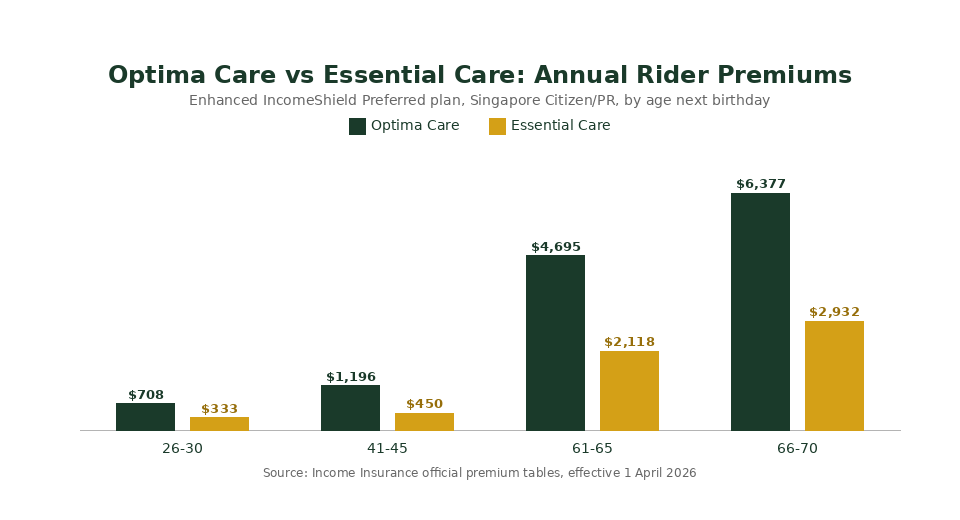
Below are Income’s official standard yearly premiums for both riders, attached to Enhanced IncomeShield Preferred (private hospital cover). Rates include 9% GST and apply from 1 April 2026.
| Age Next Birthday | Optima Care (Preferred) | Essential Care (Preferred) |
|---|---|---|
| 26–30 | $708 | $333 |
| 31–35 | $805 | $346 |
| 41–45 | $1,196 | $450 |
| 51–55 | $2,189 | $1,000 |
| 61–65 | $4,695 | $2,118 |
| 66–70 | $6,377 | $2,932 |
Source: Income Insurance, Optima Care Rider and Essential Care Rider standard premium tables (Enhanced IncomeShield), effective 1 April 2026. Rates are non-guaranteed and may be revised.
The gap widens with age. By age 66–70, Optima Care costs $6,377 a year on the Preferred plan — more than double Essential Care’s $2,932. That’s the price of the lower co-payment and richer benefits. Both riders’ premiums can be paid from MediSave, subject to the prevailing withdrawal limits — see our guide on using MediSave for your Integrated Shield Plan premium for the exact caps by age.
Co-Payment Tiers: Panel, Extended Panel & Others
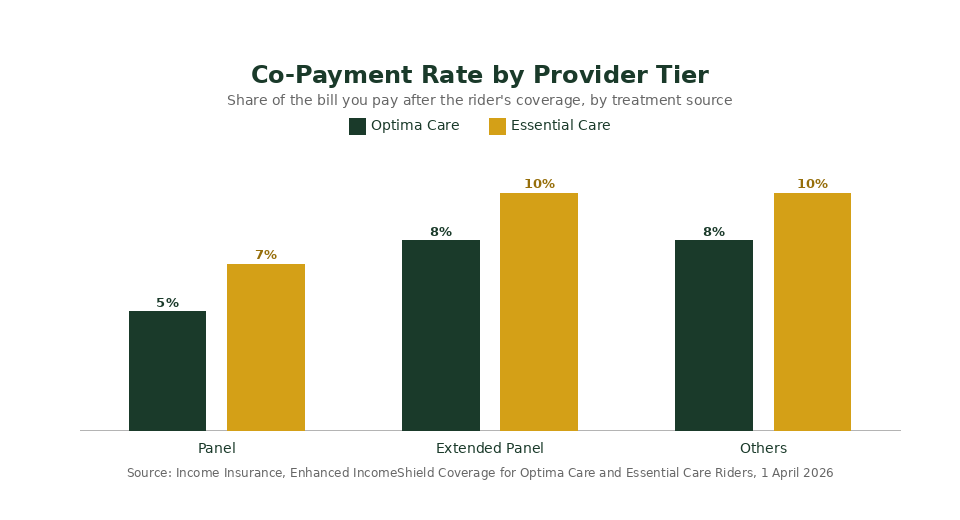
Here’s the part that actually decides how much you pay when you’re hospitalised. Both riders use a tiered co-payment structure — the rate you pay depends on where you get treated, not just which rider you hold.
Panel means a doctor, specialist or hospital on Income’s approved list — this also includes all restructured hospitals. Extended panel means a specialist Income has approved for this rider specifically, even if they’re not on Income’s main panel — often because they’re on another insurer’s panel. Others covers everyone outside both lists.
| Provider Tier | Optima Care Co-Payment | Essential Care Co-Payment | Co-Payment Cap |
|---|---|---|---|
| Panel | 5% | 7% | Up to $6,000/year |
| Extended Panel | 8% | 10% | Up to $6,000/year |
| Others (non-panel) | 8% | 10% | No limit |
Source: Income Insurance, “Enhanced IncomeShield Coverage for Optima Care rider and Essential Care rider,” effective 1 April 2026.
Notice the last column: the $6,000 cap only applies if you’re treated by a panel or extended panel provider. Go outside that network, and your co-payment is uncapped — 8% (Optima) or 10% (Essential) of an unlimited bill. For a serious private hospital admission, that gap can run into tens of thousands of dollars. Staying within Income’s panel isn’t just about convenience — it’s what makes the $6,000 ceiling apply at all.
Extra Benefits: Cancer Drug Cover, CTGTP & More
Both riders extend your Enhanced IncomeShield cancer and cell/gene therapy benefits, but the co-payment terms differ from the general hospitalisation co-payment above.
For outpatient cancer drug treatment on MOH’s Cancer Drug List (CDL), Optima Care’s co-payment is 5% (panel, capped at $6,000/year) or 10% uncapped elsewhere; Essential Care’s is 10% (panel, capped at $6,000/year) or 20% uncapped elsewhere. Both riders share the same monthly benefit ceiling: up to 18 times the MediShield Life claim limit for that drug on Enhanced Preferred or Advantage, and 10 times on Enhanced Basic. For treatments not on the CDL, the cap is $15,000 a month on Preferred, $7,000 on Advantage, and $6,000 on Basic.
Cell, Tissue and Gene Therapy (CTGTP) treatment not on MOH’s official CTGTP list is covered up to $150,000 per lifetime on Preferred or Advantage, and $100,000 on Basic — with a 10% co-payment (uncapped) if treated by a non-panel provider.
Optima Care alone adds a few family-focused extras: an extra 80 days of pre- or post-hospitalisation cover on the Advantage plan when you use a panel provider, a one-time autism testing benefit of up to $1,000 (Preferred) or $500 (Advantage) for children up to 18, and a one-time critical care benefit of up to $50,000 (Preferred) or $30,000 (Advantage) if a child needs 4 or more days in intensive care. Essential Care does not include any of these.
What If You Already Have Deluxe Care or Classic Care?
If you bought Deluxe Care or Classic Care before 27 November 2025, nothing changes immediately. MOH’s transition rule gives insurers until each policyholder’s first renewal after 1 April 2028 to move them onto a compliant rider. Your existing deductible coverage stays in force until then.
If you bought a legacy rider between 27 November 2025 and 31 March 2026, Income was required to tell you upfront that you’d transition to a compliant rider — Optima Care or Essential Care — no later than that same 1 April 2028 deadline.
Either way, you don’t need to do anything right now. But it’s worth checking your policy renewal date and budgeting for the eventual switch, since your deductible coverage will disappear once you move to the new rider.
Should You Switch?
For most existing Deluxe Care or Classic Care holders, there’s no rush — you keep your current deductible coverage until your first renewal after 1 April 2028. Switching early means giving up that deductible cover sooner than you have to, in exchange for a lower premium today.
Optima Care makes sense if you: want the lowest possible co-payment (5% at panel providers), regularly see specialists outside Income’s core panel but on its extended panel, or have young children and value the autism testing and critical care benefits.
Essential Care makes sense if you: are budget-conscious and want rider cover mainly as a backstop against a catastrophic bill, are comfortable paying a larger co-payment share (7–10%) in exchange for meaningfully lower annual premiums, or already have a separate cancer or critical illness plan and don’t need the extra family benefits.
Whichever you choose, remember neither rider covers your deductible anymore. Read our full breakdown of how much you pay before your rider kicks in to budget for that upfront cost. If you’re comparing Income against the other four ISP insurers, our shield plan comparison guide lines up premiums and coverage side by side, and our Enhanced IncomeShield review covers the base plan these riders attach to. For the full picture of what changed across every insurer, see our 2026 ISP rider changes guide.
Beyond your ISP, it’s worth building your rider premiums into your broader financial plan. Our retirement planning calculator can help you model recurring healthcare costs alongside your savings goals.
Disclaimer: This article is for informational purposes only and is not financial advice. Rider premiums, co-payment terms and benefit limits are subject to change by Income Insurance and MOH. Always check the latest product summary and policy conditions at income.com.sg, or speak to a licensed financial adviser, before buying or switching a rider.
Frequently Asked Questions
What is the difference between Optima Care and Essential Care riders?
Optima Care is Income Insurance’s fuller rider, with lower co-payment (5% at panel providers, 8% elsewhere) and extra benefits like additional pre/post-hospitalisation days and child-specific coverage. Essential Care is the leaner, cheaper option, with higher co-payment (7% at panel, 10% elsewhere) and no extra benefits. Both cap co-payment at $6,000 a year at panel or extended panel providers.
Do Optima Care and Essential Care cover my Integrated Shield Plan deductible?
No. Under MOH’s rules effective 1 April 2026, no new IP rider — from any insurer — can cover the minimum ISP deductible. You pay your deductible out of pocket or from MediSave before either rider’s co-payment coverage applies.
How much does the Optima Care rider cost in 2026?
On Enhanced IncomeShield Preferred, Optima Care costs $708 a year at age 26–30, rising to $1,196 at age 41–45, $4,695 at age 61–65, and $6,377 at age 66–70 (Singapore Citizen/PR rates, inclusive of 9% GST, effective 1 April 2026). Premiums are lower on the Advantage and Basic plan tiers.
Can I still buy the old Deluxe Care or Classic Care rider?
No. Income stopped selling Deluxe Care and Classic Care to new customers on 1 April 2026. If you already held one of these riders before 27 November 2025, your coverage continues unchanged until your first policy renewal after 1 April 2028, when you’ll transition to Optima Care or Essential Care.
What happens if I see a doctor outside Income's panel?
Your co-payment rate stays the same as for extended panel providers — 8% under Optima Care or 10% under Essential Care — but the $6,000 annual co-payment cap no longer applies. Your out-of-pocket share of the bill is uncapped if you go outside Income’s panel and extended panel network.
Should I switch from Deluxe Care to Optima Care before 2028?
Not necessarily. Switching early means giving up your existing deductible coverage sooner than required, in exchange for a lower premium now. Most policyholders are better off keeping their legacy rider until their first renewal after 1 April 2028, unless the premium savings clearly outweigh the loss of deductible cover for their situation. Speak to a licensed financial adviser before deciding.
Compare Your Integrated Shield Plan Options
See how NTUC Income stacks up against AIA, Great Eastern, Prudential and Singlife before you switch riders.
Get Free Insurance Advice
Speak with a licensed insurance advisor. No obligation, no cost.
By submitting this form, you agree to our Privacy Policy.
This article was researched with the help of AI. While we strive to keep all information accurate and up to date, there may be errors. If you notice any discrepancies, please contact us.