Best Integrated Shield Plan for Singapore Retirees (2026): Managing Premium Shock After 60
Last updated: October 2026
At age 70 and above, a Class A Integrated Shield Plan (ISP) costs over S$5,600 per year — but MediSave covers only S$900. The cash shortfall of S$4,700+ per year shocks most retirees. This guide compares how the best integrated shield plan singapore retirees can rely on fares across ages 60–80, how far MediSave extends, and when a ward downgrade makes financial sense before retirement.
Not financial advice. All figures are for educational reference only. Data as at October 2026 unless noted.
As Singapore’s population ages, Integrated Shield Plans have become one of the most pressing financial decisions for those approaching or already in retirement. Unlike when you were working, there is no employer subsidy, no increment to absorb rising premiums — just a fixed pool of savings and MediSave that has to stretch across decades of healthcare needs.
Why ISP Premiums Spike After 60
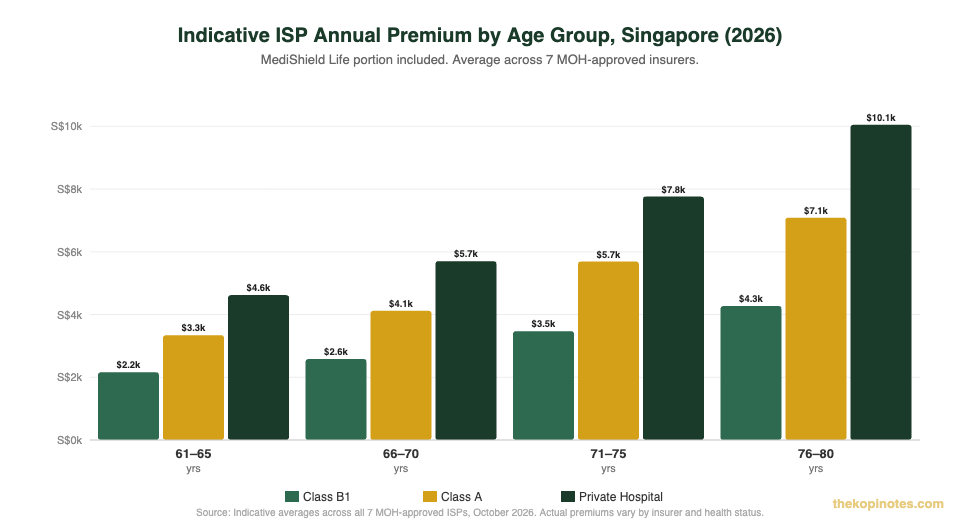
Integrated Shield Plans are individually underwritten and age-banded. Insurers reprice premiums steeply after 60 because the probability of hospitalisation — and its cost — rises sharply with age. Below are indicative average premiums across the seven MOH-approved ISP insurers for each ward tier:
| Age Band | Class B1 | Class A | Private |
|---|---|---|---|
| 56–60 | ~S$1,180 | ~S$2,330 | ~S$3,610 |
| 61–65 | ~S$2,160 | ~S$3,340 | ~S$4,620 |
| 66–70 | ~S$2,580 | ~S$4,120 | ~S$5,700 |
| 71–75 | ~S$3,470 | ~S$5,690 | ~S$7,760 |
| 76–80 | ~S$4,270 | ~S$7,090 | ~S$10,050 |
Source: Indicative averages across 7 MOH-approved ISP insurers. Actual premiums vary by insurer and plan. October 2026.
From age 56–60 to 76–80, a Class A ISP nearly triples in annual cost — rising from ~S$2,330 to ~S$7,090. For a retiree on CPF LIFE payouts, that single line item can consume a disproportionate share of monthly cash flow. See our full ISP premium by age breakdown for insurer-by-insurer comparisons.
How Much MediSave Covers (Additional Withdrawal Limit by Age)
MediSave can be used to pay ISP premiums — but only up to the Additional Withdrawal Limit (AWL) set by CPF Board. This limit increases with age, but not at the same pace as premiums.
| Age Band | MediSave AWL (ISP Base Only) | AWL Including Rider |
|---|---|---|
| Below 40 | S$300 | S$300 |
| 40–70 | S$600 | S$600 |
| 71 and above | S$900 | S$900 |
Source: CPF Board MediSave Additional Withdrawal Limit schedule, October 2026. Rider premiums must be paid fully in cash from April 2021 onwards.
Critically, ISP riders (which remove or cap the deductible and co-insurance) must be paid entirely in cash since 2021. MediSave covers only the base ISP premium, up to the AWL. Our detailed MediSave AWL guide explains how to optimise your MediSave usage in retirement.
Your Real Cash Outlay by Age and Ward
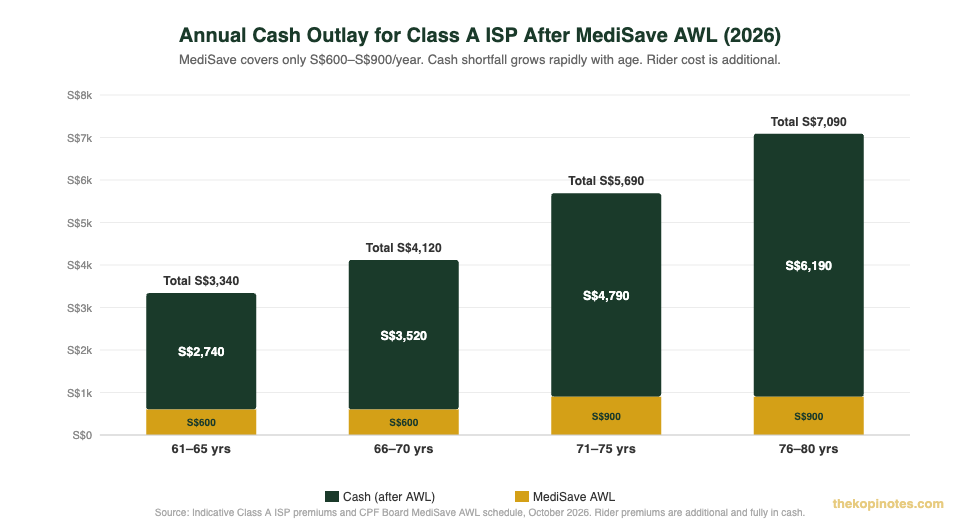
After applying the MediSave AWL, the remaining premium must be paid in cash. Here is the estimated annual cash outlay for the base Class A ISP premium (rider premiums are additional and fully in cash):
| Age Band | Class A Premium | Less: MediSave AWL | Cash Outlay |
|---|---|---|---|
| 61–65 | ~S$3,340 | S$600 | ~S$2,740 |
| 66–70 | ~S$4,120 | S$600 | ~S$3,520 |
| 71–75 | ~S$5,690 | S$900 | ~S$4,790 |
| 76–80 | ~S$7,090 | S$900 | ~S$6,190 |
Source: Indicative ISP premiums and CPF Board AWL schedule, October 2026. Cash outlay figures exclude rider premiums.
By age 76–80, a Class A policyholder pays over S$6,190 per year in cash just for the base plan — before any rider. Compare this to S$4,270 for Class B1 at the same age, which after the S$900 AWL leaves a cash outlay of ~S$3,370. That gap of ~S$2,820 per year is worth considering carefully as you plan your retirement budget. Use our Singapore retirement calculator to factor healthcare premiums into your planning.
April 2026 Rider Changes: What Retirees Need to Know
The Ministry of Health implemented significant changes to ISP riders with effect from April 2026 that affect all policyholders, including existing ones at their first policy renewal after April 1, 2028:
- Co-payment cap raised: The maximum annual co-payment cap for integrated shield plan riders increased from S$3,000 to S$6,000 per policy year. If you were relying on your rider to cap your out-of-pocket costs at S$3,000, this has doubled.
- Rider premiums fell ~30%: The silver lining is that rider premiums dropped by approximately 30% following the cap increase, making some riders more affordable even as the protection level decreased.
- Grandfathering until 2028: Existing policyholders who already have riders are grandfathered on their current terms until the first policy renewal after April 1, 2028. After that, all riders must comply with the new co-pay structure.
For retirees who rely on their ISP rider to limit surgical and hospitalisation costs, the April 2026 changes mean more out-of-pocket exposure. Our ISP rider cancellation guide explains how to evaluate whether keeping or dropping your rider makes sense given the new caps.
Should You Downgrade Your ISP Before or After Retirement?
Downgrading from Private to Class A, or from Class A to Class B1, is a one-way decision that carries long-term consequences. Here is how retirees should think about it:
Reasons to Downgrade
- Premium savings compound over a 10–20 year retirement. At age 71+, downgrading from Private to Class A saves ~S$2,060 per year in cash outlay.
- If you have chronic conditions already excluded from your private coverage, the quality differential narrows significantly.
- Class A wards and public hospitals have improved substantially. For most elective procedures, the clinical outcomes are comparable.
Reasons to Stay or Delay Downgrading
- New health conditions diagnosed after downgrading may be excluded from any future attempt to upgrade. The exclusions are permanent.
- If you rely on a specific specialist or private hospital network, downgrading disrupts that continuity of care.
- Post-retirement income may be higher than expected (SRS withdrawals, rental, investments), making the premium manageable.
The sweet spot for most retirees is to review at age 60–63, before premiums spike substantially, rather than waiting until 70+ when health conditions may have multiplied. Read our full ISP downgrade guide for a step-by-step framework.
Best ISP Pick by Retirement Profile
There is no single “best integrated shield plan singapore” for all retirees. The right choice depends on your health, savings, and retirement income. Here are three common profiles:
Profile 1: Budget-Conscious Retiree (CPF LIFE only)
If your primary income is CPF LIFE payouts and your savings are moderate, the annual cash outlay for a Class A ISP at 71+ (~S$4,790) is significant. Class B1 is worth serious consideration — the S$3,370 cash outlay is still material, but the ~S$1,420 annual saving could fund several months of essential expenses. If your health is stable and you have no strong preference for private hospital care, consider Class B1 with a B1 rider to cap your co-pay exposure.
Profile 2: Comfortable Retiree (Investment income + CPF LIFE)
If you have investment income, rental income, or a substantial SRS balance, Class A ward coverage remains very appropriate. The Class A network gives access to Singapore’s restructured hospitals with the option for single-bedder ward and a wider choice of specialists. Retain your rider through 2028 at minimum to benefit from the grandfathered co-pay cap, then reassess. Compare the best Class A ward shield plans before committing to one insurer.
Profile 3: Affluent Retiree or Complex Medical History
Private ward coverage may remain justifiable if you have complex medical needs requiring consistent access to specific specialists, or if hospital choice is important to you. The key question is whether the premium increase from Class A to Private (~S$2,060 extra in cash per year at 71+) is a worthwhile trade-off versus using that money for other healthcare contingencies. If you are already invested in private health monitoring programmes or specialist relationships, continuity has real value. Check whether your preferred specialists are on the ISP panel vs non-panel doctor list, as panel doctors often come with lower co-insurance rates even on the same plan.
Frequently Asked Questions
What is the best integrated shield plan for Singapore retirees in 2026?
There is no single best plan — it depends on your budget, health status, and preferred hospital type. Class B1 plans offer the lowest premiums (around S$3,470–S$4,270 at age 71–80) and are suitable for cost-conscious retirees. Class A plans provide access to restructured hospitals with better amenities and specialist choice. Private plans are the most expensive (S$7,760–S$10,050 at age 71–80) and best for those with complex medical needs or strong preference for private hospitals. Compare premiums and coverage limits across the 7 MOH-approved insurers before deciding.
How much does MediSave cover for ISP premiums after retirement?
MediSave covers ISP base premiums up to the Additional Withdrawal Limit (AWL): S$600 per year for ages 40–70, and S$900 per year for ages 71 and above. Since April 2021, ISP rider premiums must be paid entirely in cash — MediSave cannot be used for riders. For a Class A plan at age 71+, the cash shortfall after the S$900 AWL is approximately S$4,790 per year at current indicative premiums.
Can I switch my Integrated Shield Plan after retirement?
Yes, you can switch ISP insurers or downgrade your ward class at any time. However, switching insurers may result in new exclusions for pre-existing conditions being imposed by the new insurer. Downgrading ward class (e.g., from Private to Class A) is generally accepted without new exclusions, but upgrading later may trigger underwriting. It is generally advisable to review and make changes while you are in good health, typically in your early 60s before retirement.
What are the April 2026 ISP rider changes and how do they affect retirees?
From April 2026, the annual co-payment cap for ISP riders increased from S$3,000 to S$6,000 per policy year. This means more out-of-pocket exposure for hospital bills exceeding the deductible. The positive change is that rider premiums fell approximately 30% as a result. Existing policyholders are grandfathered on their current terms until the first renewal after April 1, 2028. After that, all riders must comply with the new co-pay structure.
Should I cancel my ISP rider when I retire to save on premiums?
Cancelling your ISP rider eliminates rider premiums (which must be paid in cash) but restores the full deductible and co-insurance on your claims. For retirees with limited cash flow, this can make sense if you maintain a dedicated healthcare reserve fund to cover potential deductibles. However, a single major hospitalisation without a rider can cost tens of thousands in deductible and co-insurance. Evaluate your savings, health risk, and CPF LIFE payouts before cancelling. Our ISP rider cancellation guide covers this decision in detail.
Is MediShield Life enough for retirement without an ISP?
MediShield Life covers Class B2 and C ward hospitalisation in public hospitals. For most elective procedures in restructured hospitals, the co-insurance and deductible can still result in significant out-of-pocket costs. If you are comfortable with Class B2/C wards and public hospital care, MediShield Life alone is viable, especially if you have a substantial MediSave balance. However, ISPs provide more comprehensive coverage, access to better ward classes, and in some cases wider specialist networks — factors that become more relevant as age-related health needs increase.
At what age should I review my Integrated Shield Plan for retirement planning?
The ideal window is age 60–63 — after the first significant premium step-up from the 56–60 band, but before health conditions may have multiplied, reducing your options. At this stage, you can downgrade ward class without significant underwriting risk, and you have time to build a healthcare reserve fund to cover higher co-pays if you choose to reduce rider coverage. Waiting until 70+ means fewer options and potentially more exclusions from any plan changes.
Plan Your Retirement Healthcare Budget
Use our free tools and referral bonuses to optimise your retirement financial plan.
Retirement Calculator Endowus (Code: 2V343) Syfe (Code: SRPRFFFCD)
Get Free Insurance Advice
Speak with a licensed insurance advisor. No obligation, no cost.
By submitting this form, you agree to our Privacy Policy.
This article was researched with the help of AI. While we strive to keep all information accurate and up to date, there may be errors. If you notice any discrepancies, please contact us.