Critical Illness Insurance Singapore: What’s Covered & How to Make a Claim (2026)
Critical illness insurance in Singapore pays a cash lump sum if you are diagnosed with one of the 37 severe-stage conditions standardised by the Life Insurance Association (LIA) CI Framework 2024, which took effect 1 October 2025. Unlike hospitalisation insurance, the payout is unrestricted — you decide how to use it. This guide covers exactly what is covered, what is not, how to file a successful claim, and the most common reasons claims get rejected.
Not financial advice. All figures are for educational reference only. Data verified as at 2 October 2026. Always refer to your insurer’s policy terms for exact definitions.
📋 Table of Contents
- What Is Critical Illness Insurance?
- The 37 Conditions Covered (LIA 2024 Framework)
- What Is NOT Covered
- Top 5 Most Commonly Claimed Conditions in Singapore
- Step-by-Step: How to Make a CI Claim
- Documents Required for a CI Claim
- How Long Does CI Payout Take?
- Common Reasons CI Claims Are Rejected
- Tips to Protect Your Claim
- FAQ
1. What Is Critical Illness Insurance?
Critical illness (CI) insurance is a standalone policy or rider that pays a pre-agreed lump sum — typically SGD 100,000 to SGD 500,000 — upon confirmed diagnosis of a qualifying serious illness. Unlike MediShield Life or Integrated Shield Plans that reimburse hospital bills, CI insurance is an income-replacement product: the money lands in your account and you spend it however you need to — mortgage payments, overseas treatment, family expenses during recovery, or supplementing lost income.
Singapore’s CI market is governed by the LIA CI Framework 2024, which standardises definitions for 37 severe-stage conditions across all insurers. This means the definition of “Heart Attack of Specified Severity” at AIA is identical to the definition at Prudential, FWD, or Great Eastern. The framework took effect on 1 October 2025 for all new policies issued after that date.
Many plans also offer early-stage or intermediate-stage CI riders (under different, insurer-specific definitions) — but the standard 37 conditions described in this guide apply to the severe stage only. For an in-depth look at the LIA framework changes, see our guide to the LIA 2024 CI Framework: what changed and what’s covered.
2. The 37 Conditions Covered (LIA 2024 Framework)
Under the LIA CI Framework 2024, all insurers in Singapore must cover the following 37 severe-stage critical illnesses:
| # | Condition | Category |
|---|---|---|
| 1 | Major Cancer | Cancer |
| 2 | Heart Attack of Specified Severity | Cardiovascular |
| 3 | Stroke with Permanent Neurological Deficit | Neurological |
| 4 | Coronary Artery By-pass Surgery | Cardiovascular |
| 5 | End Stage Kidney Failure | Organ Failure |
| 6 | Irreversible Aplastic Anaemia | Blood Disorder |
| 7 | End Stage Lung Disease | Organ Failure |
| 8 | End Stage Liver Failure | Organ Failure |
| 9 | Coma | Neurological |
| 10 | Deafness (Irreversible Loss of Hearing) | Sensory |
| 11 | Open-Heart Heart Valve Surgery | Cardiovascular |
| 12 | Irreversible Loss of Speech | Sensory |
| 13 | Major Burns | Trauma |
| 14 | Major Organ / Bone Marrow Transplantation | Organ Failure |
| 15 | Multiple Sclerosis | Neurological |
| 16 | Muscular Dystrophy | Neurological |
| 17 | Idiopathic Parkinson’s Disease | Neurological |
| 18 | Surgery to Aorta | Cardiovascular |
| 19 | Alzheimer’s Disease / Severe Dementia | Neurological |
| 20 | Fulminant Hepatitis | Organ Failure |
| 21 | Primary Pulmonary Hypertension | Cardiovascular |
| 22 | Severe Encephalitis | Neurological |
| 23 | Severe Bacterial Meningitis | Neurological |
| 24 | Progressive Scleroderma | Autoimmune |
| 25 | Persistent Vegetative State | Neurological |
| 26 | Systemic Lupus Erythematosus with Lupus Nephritis | Autoimmune |
| 27 | Loss of Independent Existence | Disability |
| 28 | Benign Brain Tumour | Neurological |
| 29 | Motor Neurone Disease | Neurological |
| 30 | Poliomyelitis | Neurological |
| 31 | Major Head Trauma | Trauma |
| 32 | Loss of Limbs | Disability |
| 33 | Loss of Sight (Blindness) | Sensory |
| 34 | Terminal Illness | Other |
| 35 | HIV Due to Blood Transfusion & Occupationally Acquired HIV | Infectious Disease |
| 36 | Angioplasty & Other Invasive Treatment for Coronary Artery Disease | Cardiovascular |
| 37 | Medullary Cystic Disease | Kidney |
Source: LIA CI Framework 2024 (effective 1 October 2025). See lia.org.sg for full definitions.
The key point: these conditions are covered only at the severe stage. For example, standard CI covers “Major Cancer” — but not carcinoma in situ or early-stage thyroid cancer, which fall under early CI riders with insurer-specific definitions.
3. What Is NOT Covered by Standard CI Insurance
Understanding exclusions is just as important as knowing what’s covered. Most standard CI policies in Singapore exclude:
- Pre-existing conditions — any illness diagnosed or showing symptoms before the policy start date
- Early-stage cancers — carcinoma in situ, early-stage thyroid cancer, prostate cancer at low clinical risk, and papillary micro-carcinoma of the thyroid are typically excluded from severe-stage definitions
- Waiting period diagnoses — cancers diagnosed within the first 90 days of policy commencement (most plans) are excluded; other conditions typically have a 30-day waiting period
- Self-inflicted conditions — including attempted suicide
- Alcohol or drug-related conditions
- War and terrorism
- Nuclear, biological, chemical hazards
Note: some insurers offer policies with a shorter or zero waiting period — always read your policy contract, not just the brochure. If you are unsure whether your condition qualifies, request your insurer’s written interpretation before submitting a claim.
4. Top 5 Most Commonly Claimed Conditions in Singapore
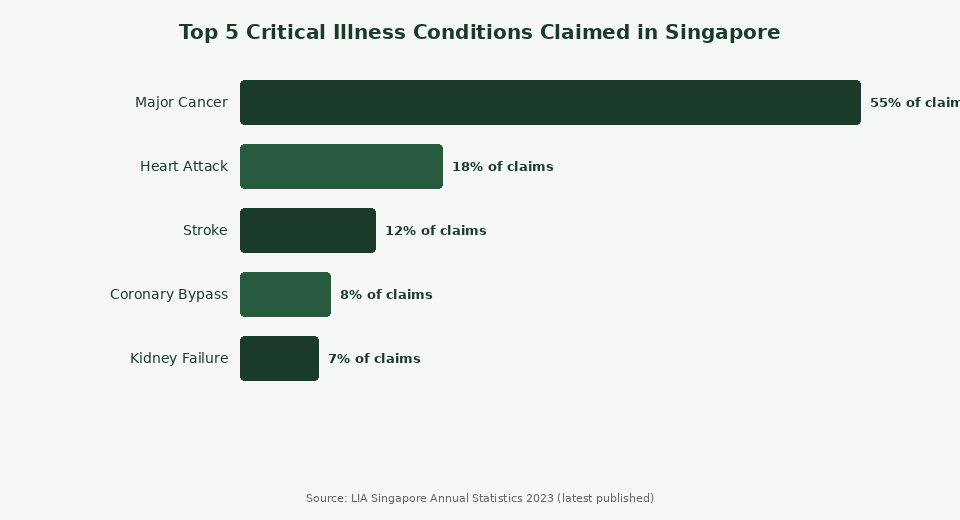
According to LIA Singapore’s Annual Statistics, five conditions account for approximately 90% of all critical illness claims in Singapore:
| Condition | Share of Claims | Why It Matters |
|---|---|---|
| Major Cancer | ~55% | Largest single category; breast, colorectal, and lung cancers are most prevalent |
| Heart Attack | ~18% | Must meet “specified severity” — complete occlusion with elevated enzymes |
| Stroke | ~12% | Requires permanent neurological deficit persisting beyond 24 hours |
| Coronary Bypass Surgery | ~8% | Open-heart bypass; angioplasty alone may not qualify for some plans |
| End-Stage Kidney Failure | ~7% | Must require permanent dialysis or kidney transplant |
Source: LIA Singapore Annual Statistics 2023 (latest published data)
5. Step-by-Step: How to Make a CI Claim in Singapore
Filing a CI claim correctly the first time reduces delays and minimises the risk of rejection. Here is the standard process across all major Singapore insurers:
Step 1: Get a Confirmed Diagnosis from a Singapore-Licensed Specialist
Your attending doctor must be a licensed Singapore medical practitioner — typically a specialist or consultant, not just a GP. The diagnosis report must explicitly state the condition using medical terminology that matches your policy’s definition. A general “cancer” report without staging may not suffice — you may need a biopsy, imaging, or pathology report confirming stage and type.
Step 2: Notify Your Insurer Promptly
Most CI policies require you to notify the insurer within 30 days of diagnosis. Some policies allow up to 60 days. Do not delay — late notification is one of the most common reasons for claim complications. Contact your financial adviser or the insurer’s claims hotline immediately.
Step 3: Obtain and Complete the Claim Forms
Download the CI claim form from your insurer’s website or request one from your adviser. You will need two forms: (1) the Claimant’s Statement, completed by you, and (2) the Attending Physician’s Statement, completed by your doctor (there is typically a medical report fee of SGD 50–200 for this).
Step 4: Compile Supporting Documents
See the complete documents table in the next section. Crucially, ensure all laboratory and diagnostic reports are included — insurers will not accept a claim without the underlying medical evidence. Original documents are preferred; certified true copies are accepted by most insurers.
Step 5: Submit Your Claim
You can submit online (via the insurer’s portal or app), by post, or in person at a customer service centre. Keep copies of everything you submit. Request a written acknowledgement of receipt with a reference number.
Step 6: Insurer Review
The insurer typically reviews within 14–21 working days of receiving a complete claim. They may request additional medical reports or a second specialist opinion. If they request more information, respond promptly — delays from the claimant’s side can stall the process significantly.
Step 7: Payout
Upon approval, the lump sum is disbursed directly to your bank account (or the policy nominee’s account, if the policyholder has passed away). Most insurers aim for payment within 5–10 business days of approval.
6. Documents Required for a CI Claim
| Document | Notes |
|---|---|
| Completed CI Claim Form | Signed by claimant; available on insurer’s website |
| Attending Physician’s Statement | Completed and signed by treating specialist; fee payable to clinic |
| NRIC / Passport Copy | Clear copy of claimant’s identity document |
| Diagnostic / Lab Reports | Biopsy report, histopathology, ECG, CT scan — depends on condition |
| Hospital Discharge Summary | If hospitalised; confirms diagnosis, treatment, and dates |
| Surgery / Procedure Report | For surgical CI claims (bypass, valve surgery, transplant, etc.) |
| Medical History Records | Insurer may request full history to check for pre-existing conditions |
| Bank Account Details | For payout disbursement; must be in claimant’s name |
Requirements vary by insurer. Always download the specific claim form from your insurer’s website. Sources: Great Eastern, Singlife, HSBC Life Singapore claims pages.
If you are claiming under a policy that has both a CI rider and a death benefit, you may need to file two separate claim forms. Check with your adviser or insurer’s claims team.
7. How Long Does CI Payout Take?
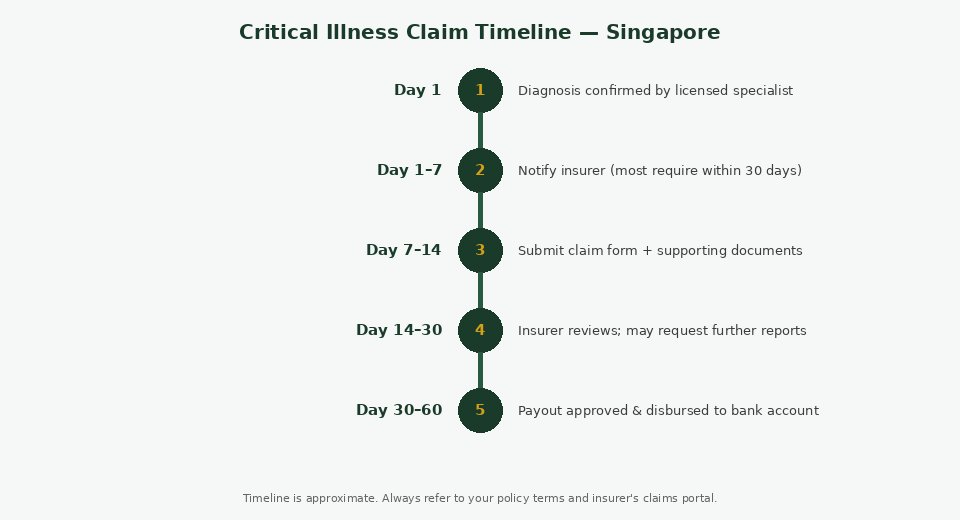
From diagnosis to payout, a straightforward CI claim in Singapore typically takes 30–60 calendar days if all documents are submitted promptly. Complex claims (those requiring independent medical review or where pre-existing conditions are under investigation) can take 3–6 months.
If your claim is delayed beyond 21 working days after a complete submission, contact the insurer’s claims team in writing. If you believe your claim is being unfairly delayed or denied, you can file a complaint with the Financial Industry Disputes Resolution Centre (FIDReC), Singapore’s independent dispute resolution body for financial service complaints.
8. Common Reasons CI Claims Are Rejected in Singapore
Claim rejection is devastating — you are already facing a health crisis and then your insurer declines to pay. Understanding why claims fail is the best way to prevent it:
| Rejection Reason | How to Prevent It |
|---|---|
| Undisclosed pre-existing condition | Disclose everything honestly at application — even minor past conditions |
| Condition doesn’t meet severity definition | Read the exact policy definition before assuming coverage; ask your specialist to document severity clearly |
| Claim filed within waiting period | Know your policy’s waiting period (typically 30–90 days for cancer); note policy start date carefully |
| Late notification to insurer | Notify within 30 days of diagnosis; call immediately, document date of first contact |
| Incomplete or incorrect claim form | Review with your financial adviser before submission; do not leave fields blank |
| Missing medical evidence | Obtain all diagnostic reports upfront — biopsy, imaging, blood results, specialist reports |
If your claim is rejected, you have the right to appeal to the insurer within their stated timeframe (usually 30 days). If the appeal fails, escalate to FIDReC — their mediation and adjudication service is free for claimants.
9. Tips to Protect Your CI Claim
- Keep your policy documents accessible: Store digital copies on a cloud drive and share the location with a trusted family member. You don’t want to be searching for your policy schedule from a hospital bed.
- Name a trusted policy nominee: Ensure your nomination is updated — especially after major life events (marriage, divorce, children). An outdated nomination can delay payouts.
- Work with a financial adviser on your claim: A good adviser will guide you through the forms, check that your documentation is complete, and liaise with the insurer on your behalf. This is especially helpful for complex or borderline cases.
- Get the right specialist: The attending physician’s statement carries significant weight. Ensure your specialist is familiar with insurance claim documentation and can clearly state the diagnosis using the language in your policy.
- Compare CI plans before you need to use them: Check our best CI insurance Singapore comparison to see how different insurers handle early-stage versus severe-stage conditions.
- Review your sum assured annually: Medical inflation in Singapore runs at approximately 10–15% per year. SGD 100,000 bought five years ago may not be enough today. Use our retirement planning calculator to stress-test your coverage gaps.
For passive income to supplement your recovery period, many Singaporeans use dividend investing via passive income strategies in Singapore alongside their CI insurance. If you’re looking to start investing, Endowus (referral code 2V343) offers CPF-linked portfolios, or try Syfe (referral code SRPRFFFCD) for diversified portfolios.
Frequently Asked Questions
How many conditions does critical illness insurance cover in Singapore?
Can I claim CI insurance if I'm still alive?
How long does a CI claim take in Singapore?
What happens if my CI claim is rejected?
Does CI insurance cover cancer in Singapore?
Do I need to inform my employer before filing a CI claim?
Compare CI Plans Before You Buy
Not all CI plans are equal on early-stage conditions, multipay features, and premium rates. Read our full comparison guide before deciding.
Get Free Insurance Advice
Speak with a licensed insurance advisor. No obligation, no cost.
By submitting this form, you agree to our Privacy Policy.
This article was researched with the help of AI. While we strive to keep all information accurate and up to date, there may be errors. If you notice any discrepancies, please contact us.