Life Insurance Singapore 2026: How Much Coverage Do You Actually Need?
A practical needs-analysis guide using the DIME method — with real premium data, a worked example for a typical Singapore family, and step-by-step buying advice.
Life insurance in Singapore provides financial protection for your dependants if you die or become totally permanently disabled (TPD). Most Singaporeans automatically receive S$70,000 under the Dependants’ Protection Scheme (DPS), but the Life Insurance Association Singapore (LIA) recommends 9 to 10 times your annual income. For a household earning S$80,000 per year, that means a potential coverage gap of over S$1 million.
Not financial advice. All figures are for educational reference only. Data verified as at October 2026 unless noted.
Table of Contents
Contents — Click to expand
- Why Life Insurance Matters in Singapore
- Types of Life Insurance in Singapore
- How Much Coverage Do You Need? The DIME Method
- Worked Example: A 35-Year-Old Singapore Family
- What Does Life Insurance Cost in Singapore?
- When Should You Buy Life Insurance?
- How to Buy Life Insurance in Singapore
- Frequently Asked Questions
Why Life Insurance Matters in Singapore
Singapore has one of the highest costs of living in Asia, and most families rely on two incomes to service their home loan, fund children’s education, and build retirement savings. The sudden loss of a breadwinner through death or total permanent disability can unravel years of financial planning overnight.
Every working Singaporean and PR aged 21 to 65 is automatically enrolled in the Dependants’ Protection Scheme (DPS), a government-backed term life policy administered by Great Eastern Life. DPS provides a sum assured of S$70,000 (up to age 59) or S$55,000 (ages 60–65), deducted from your CPF Ordinary Account at premiums as low as S$18 per year.
But S$70,000 covers barely one year’s income for most Singaporeans. The best term life insurance Singapore plans can supplement this significantly at affordable premiums — especially if you buy young. The LIA Singapore Basic Financial Planning Guide recommends starting with 9 to 10 times your annual income as a minimum benchmark. Use our Singapore retirement calculator to estimate how many income-replacement years your family would need.
The key risks of underinsurance:
- Outstanding home loan: A surviving spouse left with an HDB mortgage may be forced to sell the home or struggle with repayments alone.
- Children’s education: NUS/NTU university education costs S$40,000–S$60,000; overseas degrees exceed S$200,000.
- Lost income years: A 35-year-old who passes away leaves a 25-year gap to retirement — representing hundreds of thousands in lost household earnings.
- Debt burden: Car loans, credit cards, and personal loans do not disappear on death — they become the estate’s liability.
Types of Life Insurance in Singapore
Singapore’s life insurance market is regulated by the Monetary Authority of Singapore (MAS). There are five main product types available:
| Type | Coverage | Est. Annual Premium (S$500k) | Best For |
|---|---|---|---|
| Term Life | Death/TPD for a fixed term (e.g. 20–30 years) | From S$388–S$706/yr (age 35) | Most Singaporeans — pure protection at lowest cost |
| Whole Life | Death/TPD for life + cash value / savings element | 4–10x term premiums | Those wanting lifelong cover with a savings component |
| Critical Illness | Lump sum on diagnosis of 37+ covered conditions | From S$600–S$2,500/yr | Supplementary coverage as a rider or standalone plan |
| DPS | Death/TPD, S$70,000 max (to age 59) | From S$18/yr (CPF OA) | All working Singaporeans and PRs (auto-enrolled) |
| Universal Life | Flexible premiums, lifelong coverage + investment element | S$5,000+/yr typically | HNW individuals and estate planning |
Source: MAS, LIA Singapore, insurer published rates, October 2026
For most Singaporeans in the accumulation phase (ages 25–55), term life insurance is the most cost-effective choice. The premium savings from choosing term over whole life are best deployed through a robust CPF investment strategy to build retirement wealth in parallel with your protection coverage.
How Much Coverage Do You Need? The DIME Method
The DIME method is Singapore’s most widely-used framework for calculating life insurance needs. Endorsed by LIA Singapore and used by licensed financial advisers across the island, it breaks your requirement into four components:
| Letter | Component | What to Include |
|---|---|---|
| D | Debt | Car loans, personal loans, credit card balances — any liability without its own insurance cover |
| I | Income | Annual take-home income x 10 years — the LIA Singapore minimum income replacement period |
| M | Mortgage | Outstanding HDB or private property loan balance — so your family can keep the home |
| E | Education | Estimated university costs per child: S$40k–S$60k local; S$180k–S$220k overseas |
Source: LIA Singapore Basic Financial Planning Guide, 2026
Formula: Total Coverage Need = D + I + M + E, minus existing coverage (DPS + employer group life + any personal policy already in force).
The income component is the most flexible variable. LIA Singapore uses 10 years as a baseline, but younger families with long-term commitments may prefer 15–20 years for a conservative estimate. Building passive income in Singapore through dividends or REITs can reduce the income replacement multiple you need, since investment income would partially survive you.
Worked Example: A 35-Year-Old Singapore Family
Let’s apply the DIME method to a realistic Singapore scenario.
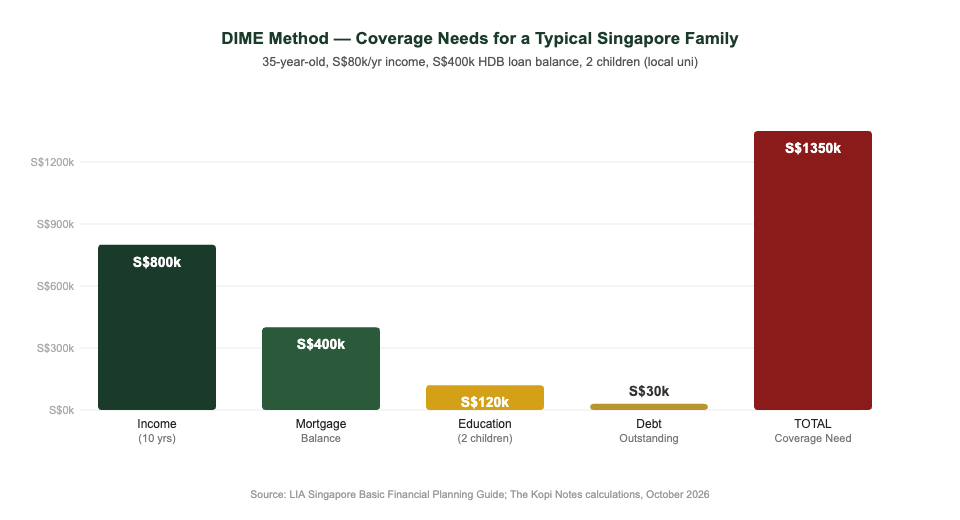
Profile: James, 35, earns S$80,000 per year. Married to Sarah (S$60,000/yr). Two children aged 4 and 7. HDB flat with S$400,000 outstanding. Car loan S$30,000. Credit card balance S$10,000. Employer provides S$200,000 group life cover.
| Component | Calculation | Amount |
|---|---|---|
| D — Debt | Car S$30k + credit card S$10k | S$40,000 |
| I — Income | S$80,000 x 10 years | S$800,000 |
| M — Mortgage | Outstanding HDB loan balance | S$400,000 |
| E — Education | 2 children x S$60,000 local university | S$120,000 |
| Total Raw Coverage Need | S$1,360,000 | |
| Less: DPS (S$70,000) + Employer Group Life (S$200,000) | −S$270,000 | |
| Additional Life Insurance Needed | S$1,090,000 | |
Source: The Kopi Notes DIME method calculation, October 2026. Assumptions: S$60k per child local university, 10-year income replacement. Actual needs vary by family circumstances.
In practice, James would look for a S$1,000,000–S$1,200,000 term life policy. At age 35 (male, non-smoker) on a 25-year term to age 60, this would cost approximately S$800–S$1,700 per year depending on the insurer — roughly S$70–S$140 per month for comprehensive family protection.
What Does Life Insurance Actually Cost in Singapore?
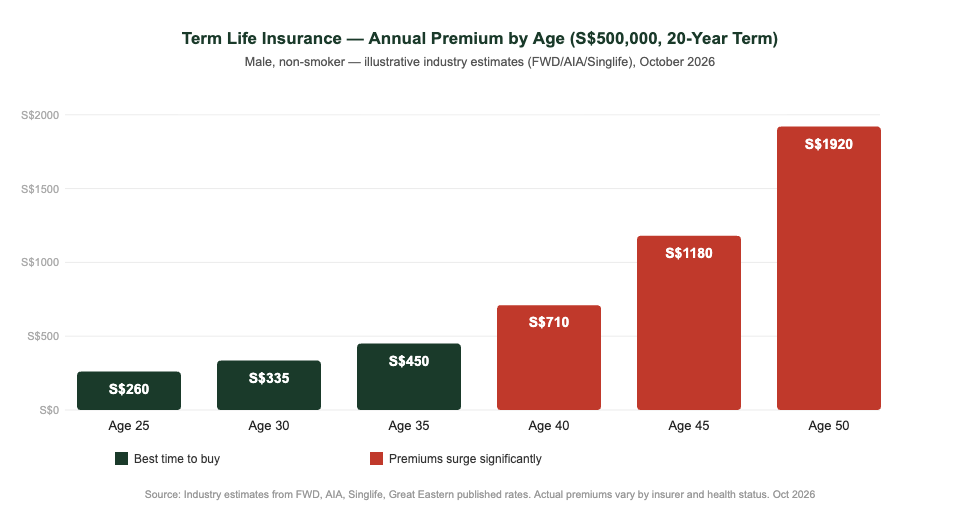
Life insurance is far more affordable than most Singaporeans expect — especially if you buy early. Your age at entry is the single biggest determinant of your premium, followed by your health status and smoking history. Here are illustrative annual premiums for S$500,000 of coverage on a 20-year level term policy (male, non-smoker) based on published rates from major Singapore insurers as at October 2026:
| Age at Entry | FWD Term Life Plus | Singlife Elite Term II | AIA Secure Flexi Term | Great Eastern GREAT Term |
|---|---|---|---|---|
| 25 | ~S$250 | ~S$260 | ~S$280 | ~S$270 |
| 30 | ~S$330 | ~S$340 | ~S$370 | ~S$355 |
| 35 | ~S$388 | ~S$413 | ~S$706 | ~S$480 |
| 40 | ~S$650 | ~S$680 | ~S$820 | ~S$720 |
| 45 | ~S$1,100 | ~S$1,150 | ~S$1,350 | ~S$1,200 |
Source: Published rates FWD, Singlife, AIA, Great Eastern as at October 2026. 20-year level term, male non-smoker, S$500,000 sum assured. Age 35 figures (bold) verified from insurer published data. Other rows are industry estimates. Actual premiums depend on underwriting.
The key insight: waiting from age 35 to 45 nearly triples your annual premium. Over a 20-year term, that delay costs an additional S$14,000–S$20,000 in premiums — money that could instead compound through a Syfe brokerage account or other investments. Lock in your rate while young and healthy.
For those who want standardised coverage without a financial adviser, compareFIRST.sg (administered by MAS and LIA) lists Direct Purchase Insurance (DPI) term life products covering up to S$400,000 per insurer at commission-free pricing. You can buy multiple DPI policies from different insurers for higher total coverage.
When Should You Buy Life Insurance?
The best time to buy is when you have dependants who would suffer financially from your absence. Key Singapore trigger events:
- Marriage: Your spouse may depend on your income to service joint debts or the home loan.
- First child: Your most significant financial dependant — education and living costs span 20+ years.
- Buying a home: An outstanding HDB or private property loan should be covered by life insurance.
- Career milestones: As your income grows and liabilities increase, review your coverage annually.
Life insurance premiums are locked in at the age you first buy — a 25-year-old who starts a 30-year term policy locks in the 25-year-old rate for the entire duration. Integrating life insurance with your CPF investment strategy from the start ensures you are simultaneously protected and growing your retirement wealth.
How to Buy Life Insurance in Singapore
There are three main channels:
1. Through a Financial Adviser (FA): An FA can compare products across multiple insurers and assess your needs holistically. Always ask for a comparison across at least three insurers. FA commissions add a small cost premium over DPI but provide ongoing advice and policy reviews.
2. Direct from an Insurer: AIA, Great Eastern, Prudential, NTUC Income, Manulife, Singlife, and FWD all allow online applications. Fastest route but limits your comparison ability.
3. Direct Purchase Insurance (DPI) via compareFIRST.sg: The MAS-backed compareFIRST.sg portal lists standardised term and whole life DPI products without commission loading, covering up to S$400,000 per insurer. Ideal for Singaporeans who are comfortable self-researching and want the lowest-cost baseline protection.
For holistic financial planning that integrates investments with your insurance coverage — including SRS and CPF-OA strategies — platforms like Endowus allow you to manage both your protection layer and wealth-building layer in one place.
Disclaimer: Life insurance is a personal decision that depends on your family situation, income, debts, and financial goals. This article is for educational purposes only. Speak to a licensed Financial Adviser Representative (FAR) or refer to MAS financial planning resources for personalised guidance. Data verified as at October 2026.
Frequently Asked Questions
How much life insurance do I need in Singapore?
The LIA Singapore recommends at least 9 to 10 times your annual income as a starting benchmark. The DIME method gives a more precise figure: add your outstanding Debt, 10 years of Income, your Mortgage balance, and children’s Education costs — then subtract DPS (S$70,000) and any employer group life cover. For a typical Singapore household earning S$80,000 per year with a home loan and two children, the additional coverage gap is typically S$800,000 to S$1,200,000.
Is the DPS Dependants' Protection Scheme enough for most Singaporeans?
No. DPS provides a maximum of S$70,000 in coverage (up to age 59) — far below what most Singapore families with a home loan and dependants require. DPS is best used as a foundation layer: every working Singaporean should keep DPS active (premiums are as low as S$18/year from CPF OA) and supplement it with personal term life insurance to close the gap. There is no good reason to opt out of DPS.
What is the difference between term life and whole life insurance in Singapore?
Term life provides pure death and TPD coverage for a fixed period (e.g. 20–30 years) at the lowest possible premium — no payout when the term ends. Whole life provides lifelong coverage with a cash value / savings element, but premiums are 4 to 10 times higher. For most Singaporeans in their working years, term life is the recommended choice: the premium savings are better deployed in CPF SA, SRS, or diversified investment portfolios for retirement wealth building.
Can I use CPF or SRS funds to pay life insurance premiums in Singapore?
DPS premiums are automatically deducted from your CPF Ordinary Account (OA) — no cash outlay required. For other life insurance policies, you generally cannot use CPF OA or SA to pay premiums directly. SRS funds can be used for certain whole life, endowment, and annuity policies that qualify under MAS rules, but not for standard term life plans. Most Singaporeans keep their term life premiums as a cash expense and deploy SRS funds toward investment-linked products or CPF-connected annuities.
At what age should I buy life insurance in Singapore?
The earlier the better. Life insurance premiums are locked in at your age and health status when you first apply. A 25-year-old male non-smoker can secure S$500,000 of 20-year term coverage for approximately S$250 to S$280 per year. The same coverage bought at 35 costs S$388 to S$706 per year — and at 45, S$1,100 to S$1,350 per year. The right time to buy is when you acquire your first major financial dependant: typically marriage, your first child, or your first home purchase.
What is Direct Purchase Insurance (DPI) and should I consider it?
Direct Purchase Insurance (DPI) is a commission-free life insurance product introduced by MAS and LIA Singapore. DPI term life plans offer coverage up to S$400,000 per insurer and are available directly on compareFIRST.sg without going through a financial adviser. Because DPI carries no distribution commission, premiums are lower than equivalent adviser-sold products. DPI is ideal for Singaporeans who know their coverage needs, are comfortable self-researching, and want the lowest-cost baseline protection. You can purchase DPI policies from multiple insurers to build higher total coverage beyond S$400,000.
Ready to Protect Your Family’s Financial Future?
Get the right coverage amount, lock in your premium while young, and build wealth alongside your protection.
Get Free Insurance Advice
Speak with a licensed insurance advisor. No obligation, no cost.
By submitting this form, you agree to our Privacy Policy.
This article was researched with the help of AI. While we strive to keep all information accurate and up to date, there may be errors. If you notice any discrepancies, please contact us.