Mapletree Industrial Trust 2026: FY2027 DPU Recovery, Rate Cut Impact & Portfolio Outlook (SGX: ME8U)
S-REIT Deep-Dive · October 2026 · Updated Quarterly
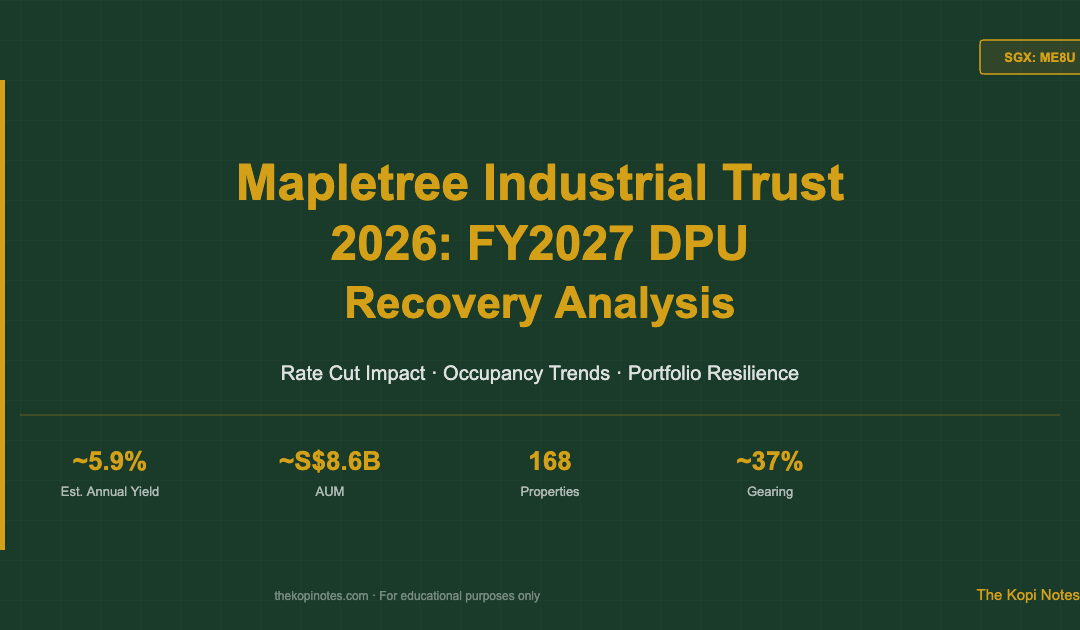
Mapletree Industrial Trust (SGX: ME8U) is Singapore’s largest diversified industrial REIT, managing approximately 168 properties across Singapore and North America with total assets under management of around S$8.6 billion as at Q3 FY2026 (December 2025). MIT distributes approximately 3.35–3.45 Singapore cents per unit per quarter — an annualised yield of approximately 5.8–6.2% at the S$2.25–2.35 share price range — making it a core holding for Singapore investors seeking industrial and data-centre dividend exposure.
Not financial advice. All figures are for educational reference only. Data as at October 2026 unless noted. Past distributions are not guaranteed. Consult a licensed financial adviser before investing.
📋 Table of Contents
Click to expand — Table of Contents
- What Is Mapletree Industrial Trust?
- MIT Share Price Performance 2026
- FY2027 DPU Outlook — Key Recovery Drivers
- Portfolio Deep-Dive: Singapore vs North America
- Gearing, Debt & Financial Health
- MIT vs Industrial REIT Peers — Yield & Metrics
- How to Invest in MIT from Singapore
- Frequently Asked Questions
What Is Mapletree Industrial Trust? (SGX: ME8U)
Mapletree Industrial Trust is a Singapore-listed real estate investment trust managed by Mapletree Industrial Trust Management Ltd., a wholly owned subsidiary of Mapletree Investments Pte Ltd (itself a subsidiary of Temasek Holdings). MIT was listed on the SGX in October 2010 and has grown from a portfolio of Singapore flatted factories into a geographically diversified industrial and data-centre REIT.
MIT’s portfolio as at Q3 FY2026 comprises approximately:
- Singapore: ~90 properties including hi-tech buildings, business parks, light industrial buildings, flatted factories, and stack-up/ramp-up buildings
- North America: ~29 data centres held via a 98.47% interest in a joint venture, covering key US and Canadian hyperscale and co-location markets
- Australia: select industrial and data-centre assets acquired from 2022 onwards
The REIT’s pivot towards data centres — now representing approximately 55% of total AUM — has repositioned MIT from a pure Singapore industrial play into a global digital infrastructure vehicle. This strategic shift is central to its FY2027 DPU recovery thesis covered in this article.
MIT units are quoted in Singapore dollars on the SGX Mainboard and are available for purchase via local brokers as well as through the MIT US data centres and Singapore hi-tech portfolio analysis covered in our earlier deep-dive.
MIT Share Price Performance in 2026
Mapletree Industrial Trust’s share price has navigated a volatile rate environment over FY2025–2026. After peaking at approximately S$2.70 in early 2022 before the US Federal Reserve’s aggressive rate-hiking cycle, ME8U fell to a multi-year low of approximately S$2.00–2.10 in mid-2023 as rising interest rates compressed REIT valuations across the board.
As at October 2026, MIT trades in the S$2.20–2.40 range, reflecting:
- Partial re-rating as the US Fed delivered three 25-basis-point cuts in late 2025 and early 2026, lowering MIT’s refinancing costs
- Data centre demand resilience: MIT’s North American data centre JV maintains high occupancy (>99%) driven by hyperscaler and AI workload demand
- Singapore industrial stability: Singapore’s hi-tech building segment (the highest-value tier) saw positive rental reversions of approximately 5–8% on lease renewals in FY2026
MIT vs STI Performance (2023–2026)
| Period | ME8U Total Return | STI Total Return | iEdge S-REIT Index |
|---|---|---|---|
| 2023 | −8.2% | +4.5% | −8.9% |
| 2024 | +3.1% | +8.2% | +2.8% |
| 2025 | +6.8% | +7.1% | +7.3% |
| 2026 YTD (Oct) | +4.3% | +9.1% | +5.0% |
Source: SGX data, Bloomberg (estimated). Total return includes distributions reinvested. Past performance is not indicative of future results.
MIT has underperformed the broader STI over the rate-hiking cycle, but outperformed the S-REIT index in 2025–2026 as its data-centre tilt provided a structural growth tailwind that pure Singapore industrial peers lacked. For context on the broader S-REIT landscape, see our guide on the best S-REITs in Singapore 2026.
FY2027 DPU Outlook — Key Recovery Drivers
MIT’s distribution per unit (DPU) troughed in FY2025 (year ended 31 March 2025) at approximately 13.15–13.25 Singapore cents per unit annually, down from the 13.55 cents peak in FY2023. The FY2027 (year ending 31 March 2027) DPU recovery thesis rests on four structural drivers.
1. Interest Cost Reduction from Rate Normalisation
MIT’s weighted average interest rate peaked at approximately 3.6–3.8% in FY2025 as legacy fixed-rate hedges rolled off into a higher-for-longer environment. With the US Fed delivering cumulative cuts of approximately 100–125bps by mid-2026, and MIT actively refinancing at lower spreads, the weighted average cost of debt is expected to normalise toward 3.0–3.2% by FY2027.
Impact estimate: every 25bps reduction in financing cost on ~S$3.2B in borrowings reduces annual interest expense by approximately S$8 million, translating to approximately 0.25–0.28 Singapore cents improvement in DPU per annum.
2. North American Data Centre Rent Renewals at Premium
MIT’s 29 North American data centres are primarily leased to hyperscalers and co-location operators on long-term net leases. A portion of MIT’s North American data centre leases come up for renewal in FY2026–2027, with strong AI-driven demand enabling rental reversions estimated at 10–20% above expiring rents. This is a meaningful DPU uplift that distinguishes MIT from purely Singapore-focused industrial REITs.
3. Singapore Hi-Tech Building Occupancy
MIT’s Singapore hi-tech buildings (the highest-value property type, comprising ~23% of portfolio by value) have maintained occupancy above 93% and recorded positive rental reversions of approximately 5–8% in FY2026. New leasing demand from semiconductor, biomedical, and advanced manufacturing tenants in areas such as Toa Payoh, Benoi, and Kallang remains healthy, supported by Singapore’s Smart Industry Readiness Index programme.
4. AEI and Redevelopment Completions
MIT has several asset enhancement initiatives (AEIs) and redevelopment projects expected to complete in FY2027, adding net lettable area at higher rents. The Kolam Ayer 2 cluster redevelopment and Woodlands Central redevelopment are expected to contribute incremental NPI from 2H FY2026 onwards.
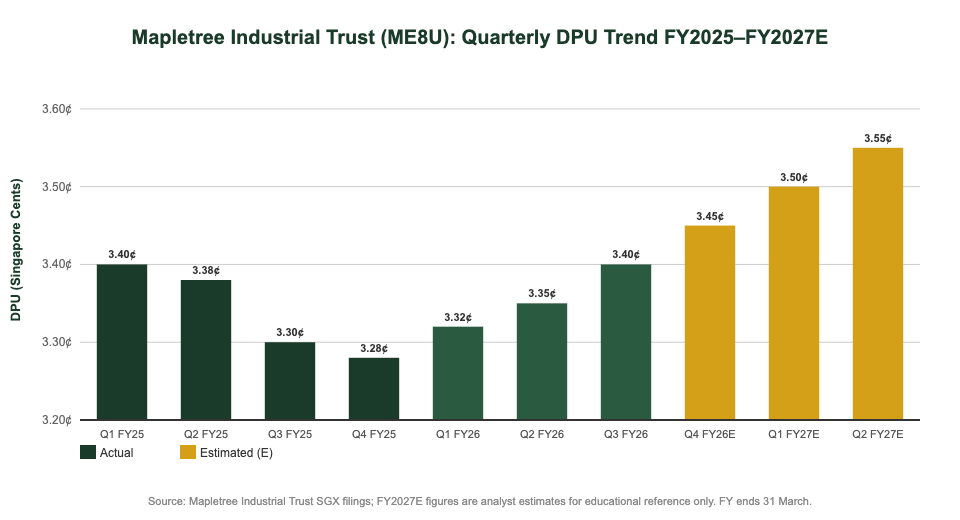
Source: Mapletree Industrial Trust SGX filings; FY2026E–FY2027E are analyst consensus estimates for educational reference only. FY ends 31 March.
DPU Sensitivity Table — Rate Cut Scenarios
| Scenario | Avg Cost of Debt | Est. Annual DPU | Yield at S$2.30 |
|---|---|---|---|
| Bear (no further cuts) | 3.5% | ~13.2¢ | ~5.7% |
| Base (25–50bps more cuts) | 3.1% | ~13.8¢ | ~6.0% |
| Bull (75–100bps more cuts) | 2.8% | ~14.3¢ | ~6.2% |
Source: thekopinotes.com estimates based on MIT’s disclosed debt profile. For educational reference only. Not a forecast.
Portfolio Deep-Dive: Singapore vs North America
MIT’s ~168 property portfolio (by count) is split between Singapore and North America, with a small but growing Australia presence. By asset value, however, North American data centres dominate at approximately 55% of total AUM — a structural shift from MIT’s Singapore-centric roots.
Singapore Portfolio (~45% of AUM)
MIT’s Singapore properties are classified into five sub-types, each with distinct demand dynamics:
| Property Type | No. of Properties | Est. Occupancy | Rental Reversion (FY26) |
|---|---|---|---|
| Hi-Tech Buildings | ~16 | ~94% | +6.8% |
| Business Park Buildings | ~6 | ~90% | +4.2% |
| Flatted Factories | ~20 | ~92% | +3.1% |
| Stack-Up/Ramp-Up | ~30 | ~93% | +3.8% |
| Light Industrial | ~18 | ~89% | +2.1% |
Source: Mapletree Industrial Trust Q2 FY2027 business update (estimated); For educational reference only.
North American Data Centre Portfolio (~55% of AUM)
MIT’s 29 North American data centres, held via its 98.47% interest in the Mapletree US & EU DC Private Trust JV, are predominantly located in Virginia (Northern Virginia — the world’s largest data centre market), Texas, and select Canadian markets. Key characteristics:
- Weighted average lease expiry (WALE): approximately 5–6 years by NLA (as at Q2 FY2027)
- Occupancy: >99% — effectively fully occupied by hyperscalers and co-location operators
- Tenants: the JV counts hyperscalers (Amazon, Microsoft, Google ecosystem) among its data centre tenants (not individually disclosed), plus co-location operators
- Power capacity: combined IT load of approximately 600+ MW across the portfolio
This data centre exposure is why MIT’s premium to book value is structurally higher than pure Singapore industrial REITs — data centre assets attract higher cap-rate premiums. For a broader perspective on MIT’s data centre strategy, see our previous MIT US data centres deep-dive. Singapore investors looking for S-REIT exposure via a managed approach can also consider Syfe referral code and sign-up bonus for Syfe REIT+, which holds MIT as one of its core S-REIT positions.
Gearing, Debt & Financial Health
MIT’s aggregate leverage ratio (gearing) is an important metric for Singapore REIT investors: under MAS Notice SFA 07-N16, S-REITs with a minimum interest coverage ratio of 2.5x may gear up to 50% (otherwise 45%). MIT’s gearing stands at approximately 36–38%, providing approximately S$400–600 million of debt headroom before reaching the 45% threshold.
Key Financial Metrics (FY2026 Estimated)
| Metric | FY2025 Actual | FY2026E | FY2027E |
|---|---|---|---|
| Gearing Ratio | 38.2% | ~37.0% | ~36.0% |
| Wtd Avg Interest Rate | 3.65% | ~3.2% | ~3.0% |
| Interest Coverage Ratio | 4.1x | ~4.4x | ~4.7x |
| % Fixed Rate Borrowings | ~75% | ~70% | ~68% |
| Total Borrowings | ~S$3.3B | ~S$3.2B | ~S$3.1B |
Source: MIT SGX disclosures; FY2026E–FY2027E are thekopinotes.com estimates. For educational reference only.
MIT’s manageable gearing, combined with its investment-grade credit rating, provides the balance sheet flexibility to pursue accretive acquisitions if suitable data-centre assets become available at appropriate yields. The falling interest rate environment also means MIT’s interest coverage ratio — a key metric for MAS’s 50% gearing limit — is improving, providing additional buffer.
For context on how gearing affects S-REIT dividends more broadly, see our article on passive income Singapore strategies for 2026. You can use our Singapore retirement calculator to model how MIT distributions might contribute to your retirement income targets.
MIT vs Singapore Industrial REIT Peers — Yield & Key Metrics
How does MIT compare to other Singapore industrial REITs? The chart and table below compare MIT against its closest peers on distribution yield, gearing, and data-centre exposure.
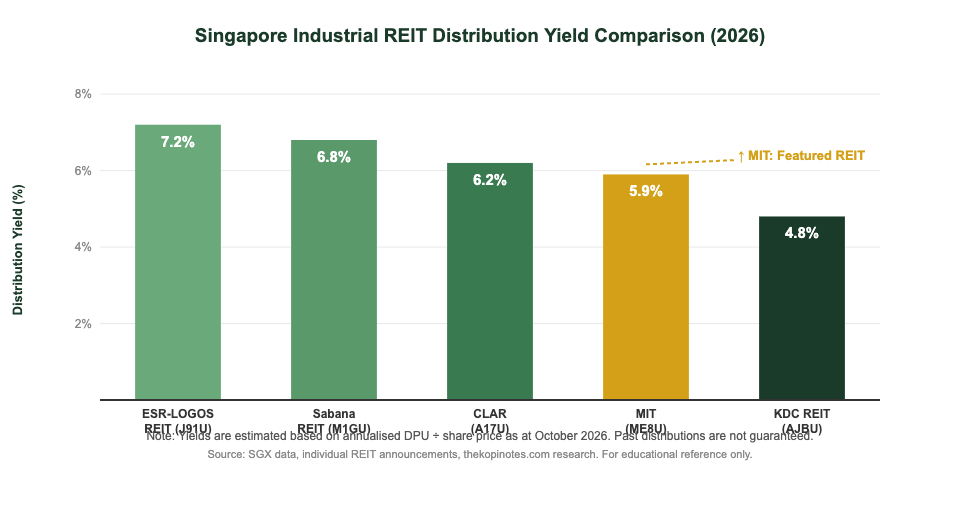
Source: SGX data, individual REIT disclosures; thekopinotes.com estimates. October 2026. For educational reference only.
| REIT | SGX Code | Est. Yield | Gearing | Data Centre % | Focus |
|---|---|---|---|---|---|
| Mapletree Industrial Trust | ME8U | ~5.9% | ~37% | ~55% | SG Industrial + Global DC |
| CapitaLand Ascendas REIT | A17U | ~6.1% | ~39% | ~8% | Diversified Industrial |
| Keppel DC REIT | AJBU | ~4.8% | ~34% | ~100% | Pure-Play Data Centres |
| ESR-LOGOS REIT | J91U | ~7.2% | ~41% | <5% | SG/APAC New Economy |
| Sabana Industrial REIT | M1GU | ~6.8% | ~35% | 0% | Singapore Industrial |
Note: Yields estimated at October 2026 share prices; gearing and DC % from latest available filings. For educational reference only. Not a buy/sell recommendation.
MIT occupies a compelling middle-ground: lower yield than ESR-LOGOS or Sabana but with significantly higher data-centre exposure and better credit quality. Its yield premium over Keppel DC REIT (~120bps at current prices) reflects MIT’s Singapore industrial drag but also its higher distribution quantum per unit. Investors wanting a pure-play data-centre bet should also read our Keppel DC REIT dividend sustainability analysis.
How to Invest in Mapletree Industrial Trust from Singapore
Singapore residents can invest in MIT (SGX: ME8U) via several routes. MIT distributes quarterly in Singapore dollars with no withholding tax for Singapore tax residents.
Option 1: Buy Via SGX (Direct)
MIT units trade in board lots of 100 units on the SGX Mainboard. You’ll need a CDP account (via DBS/POSB, OCBC, UOB, or a brokerage) and a linked brokerage account. Low-cost brokers such as IBKR (Interactive Brokers) offer competitive commission rates (~0.05% min S$1 per trade) for SGX trades. Use our FSMOne referral code (P0544985) for FSMOne’s S$0 brokerage promotion, or check our Singapore REIT ETF guide on how to invest in S-REITs efficiently.
Option 2: Via Syfe REIT+ (Fractional, Auto-Invest)
Syfe REIT+ offers fractional exposure to a basket of Singapore REITs including MIT, with no minimum investment and automatic dividend reinvestment. This is particularly suitable for investors who want to dollar-cost average into S-REITs. Use the Syfe referral code and sign-up bonus (SRPRFFFCD) for up to S$100 in bonus credits. Syfe REIT+ also provides quarterly distributions.
Option 3: Via Endowus (CPF/SRS/Cash)
Endowus allows CPF-OA and SRS funds to be invested in S-REIT unit trusts that hold MIT among their core holdings. If you are optimising your CPF or SRS investments, Endowus referral code (2V343) gives S$20 in Access Fee offset. Note that direct MIT unit purchase via CPF is also possible under the CPFIS scheme for units listed on SGX.
Worked Example: MIT Investment at S$2,300
| Parameter | Amount |
|---|---|
| Investment (1 lot = 100 units @ S$2.30) | S$230 |
| Estimated quarterly DPU (3.45¢) | S$3.45 |
| Estimated annual income (13.8¢) | S$13.80 |
| Effective yield | 6.0% |
| Withholding tax (Singapore residents) | S$0 (nil) |
| Net annual income per lot | S$13.80 |
Source: thekopinotes.com calculation based on estimated FY2026 DPU of ~13.8¢ at S$2.30 unit price. For educational illustration only. Not a guaranteed return.
A Singapore investor holding S$23,000 (100 lots) at S$2.30 per unit would receive approximately S$1,380 in annual distributions at a 6% yield — entirely tax-free for Singapore tax residents, unlike US dividends which are subject to 15–30% withholding tax. This tax advantage is one reason Singapore-listed REITs like MIT are particularly attractive for local investors seeking passive income in Singapore. For a full comparison of Singapore’s passive income options, see our guide on the best S-REITs in Singapore 2026.
Frequently Asked Questions: Mapletree Industrial Trust 2026
Is Mapletree Industrial Trust (ME8U) a good buy in 2026?
What is Mapletree Industrial Trust's distribution per unit (DPU) for 2026?
What is MIT's gearing ratio and is it safe?
How does MIT's data centre exposure affect its DPU?
What is the difference between MIT and Keppel DC REIT?
Can I use CPF to invest in Mapletree Industrial Trust?
What are the key risks of investing in MIT in 2026?
Conclusion: Is MIT a Buy in 2026?
Mapletree Industrial Trust presents a balanced investment case in 2026. Its ~5.9–6.2% estimated yield, improving DPU outlook driven by interest rate normalisation, and 55% data-centre exposure position it as one of the more defensively-oriented industrial REITs on the SGX — without requiring investors to accept the sub-5% yield of a pure data-centre play like Keppel DC REIT.
The FY2027 DPU recovery thesis is credible, underpinned by declining refinancing costs, positive Singapore hi-tech rental reversions, and strong North American data-centre lease renewal momentum. Key downside risks remain the USD/SGD hedge cost and any re-acceleration in US interest rates, which would delay the distribution recovery.
For most Singapore investors seeking quarterly dividend income with exposure to the structural data-centre growth theme — without sacrificing the safety of a Singapore-listed, MAS-regulated REIT structure — MIT deserves a position in a diversified S-REIT portfolio alongside a handful of complementary positions.
Disclaimer: This article is for educational purposes only and does not constitute financial advice. Mapletree Industrial Trust carries investment risks including but not limited to distribution cuts, share price volatility, and gearing risks. Always conduct your own due diligence and consider seeking advice from a licensed financial adviser before investing.
This article was researched with the help of AI. While we strive to keep all information accurate and up to date, there may be errors. If you notice any discrepancies, please contact us.