Highest Yield REITs Singapore 2026: Top S-REITs by Dividend Yield
A data-driven guide for Singapore investors seeking passive income through high-yield S-REITs.
The highest yield REITs in Singapore are currently AIMS APAC REIT (~7.2%), Sabana REIT (~7.0%), and iREIT Global (~6.8%) — all trading at discounts to NAV as at Q2 2026. S-REITs listed on the SGX offer Singapore investors tax-free dividend income (no withholding tax for Singapore residents) with yields well above the CPF Ordinary Account rate. This guide ranks the top S-REITs by trailing yield and explains what each number means for your portfolio.
Not financial advice. All figures are for educational reference only. Data as at Q2 2026 unless noted.
- Top-yielding S-REITs are paying 6-7%+ in 2026, well above fixed deposits and T-bills.
- High yield alone does not mean good value — check P/NAV and DPU sustainability too.
- Diversify across REIT sectors (industrial, healthcare, commercial) to balance risk and income.
Table of Contents
What Is Dividend Yield in S-REITs?
Dividend yield measures how much annual income a REIT pays relative to its current share price. For S-REITs, this is expressed as Distribution Per Unit (DPU — the cash each unit pays you) divided by the current unit price, then multiplied by 100.
For example, if AIMS APAC REIT pays a DPU of S$0.093 per year and its unit price is S$1.29, the yield is 7.2%. That means for every S$10,000 you invest, you receive approximately S$720 in distributions per year.
S-REITs must distribute at least 90% of their taxable income to qualify for tax transparency — meaning the REIT pays no corporate tax on distributed income. As a Singapore resident, you pay no personal income tax on these distributions either. This makes S-REIT distributions one of the most tax-efficient income sources available to Singaporean investors.
Top S-REITs by Yield (2026 Rankings)
As at Q2 2026, the highest-yielding S-REITs include several mid-cap names trading at significant discounts to their Net Asset Value (NAV). High yield often reflects market pessimism about a REIT’s growth prospects or balance sheet — so treat these rankings as a starting point, not a buy list.
Here are the eight top-yielding S-REITs in Singapore ranked by trailing 12-month yield:
| REIT | SGX Ticker | Trailing Yield | Sector | P/NAV |
|---|---|---|---|---|
| AIMS APAC REIT | O5RY | ~7.2% | Industrial | 0.78x |
| Sabana REIT | M1GU | ~7.0% | Industrial | 0.72x |
| iREIT Global | UD1U | ~6.8% | Retail/Office (EU) | 0.68x |
| Suntec REIT | T82U | ~6.5% | Commercial | 0.75x |
| Starhill Global REIT | P40U | ~6.3% | Retail | 0.70x |
| Mapletree Logistics Trust | M44U | ~6.1% | Logistics | 0.82x |
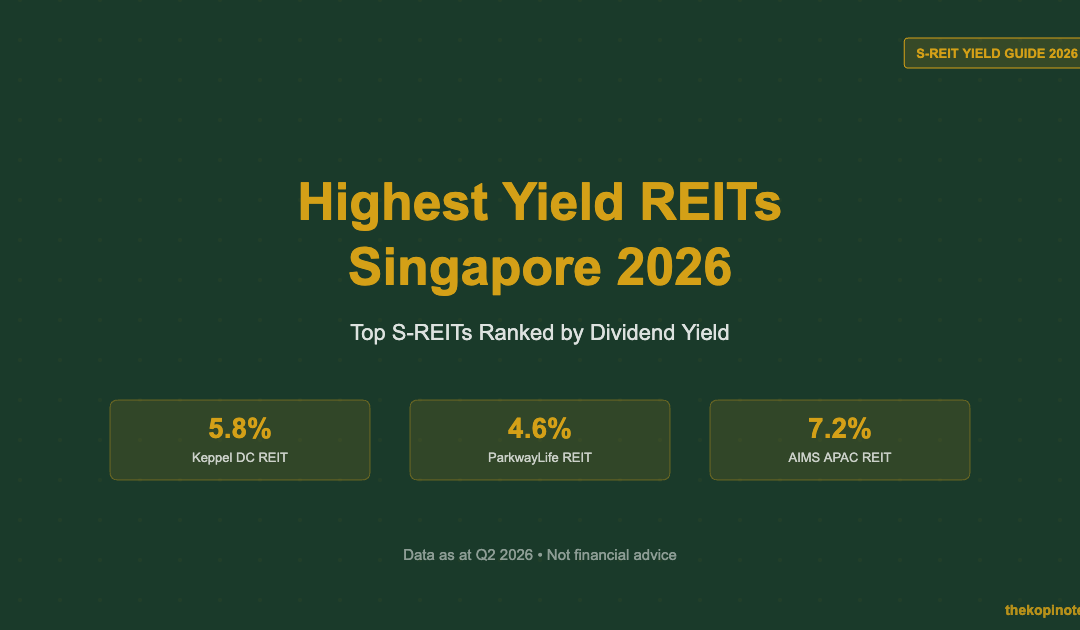
| Keppel DC REIT | AJBU | ~5.8% | Data Centre | 1.05x |
| ParkwayLife REIT | C2PU | ~4.6% | Healthcare | 0.95x |
Source: SGX, Company Announcements (FY2025/Q1-2026 DPU filings). Yields are trailing 12-month DPU divided by unit price as at Q2 2026. P/NAV is approximate. Data for reference only.
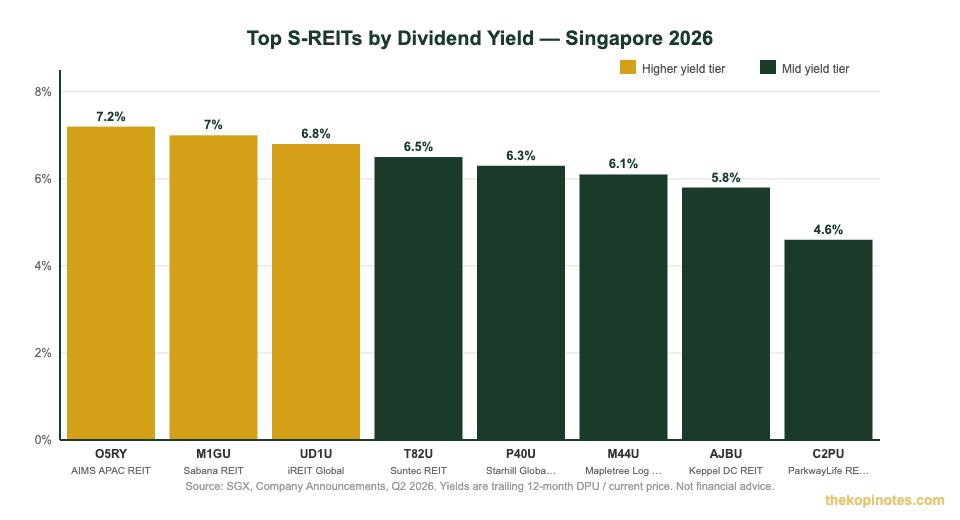
Full Yield Comparison Table
Beyond the top 8, here is a broader view of the S-REIT universe grouped by yield tier. This helps you understand where each REIT sits relative to the market.
| Yield Tier | REITs in This Range | What It Signals |
|---|---|---|
| Above 6.5% | AIMS APAC, Sabana, iREIT Global, Suntec | Market discounting growth or balance-sheet risk |
| 5.0%–6.5% | Starhill, Mapletree Logistics, Keppel DC, FCT, MPACT | Core income range — balanced risk/reward |
| 4.0%–5.0% | ParkwayLife, CapitaLand Ascendas REIT, CICT | Quality/growth REITs — lower yield but stronger DPU trajectory |
| Below 4.0% | NTT DC REIT, hospitality/niche REITs | Growth-oriented or early-stage REITs |
Source: SGX sector data, Q2 2026. For reference only.
Yield vs Price-to-NAV: The Value Check
A high yield can be misleading if it comes with a structurally declining DPU. The best cross-check is the Price-to-NAV (P/NAV) ratio — how much you’re paying for every dollar of the REIT’s underlying asset value.
P/NAV below 1.0x means you’re buying at a discount to assets. P/NAV above 1.0x means you’re paying a premium — typically because the market expects strong future DPU growth, as with Keppel DC REIT at ~1.05x.
For yield-focused investors, the sweet spot in 2026 is REITs with yield above 6% AND P/NAV below 0.85x — which includes AIMS APAC REIT, Sabana REIT, and iREIT Global. However, these REITs carry higher risk. Their deep discounts reflect real concerns: slower rental reversion, gearing levels, or geographic exposure to weaker markets.
Contrast this with passive income strategies for Singapore investors that favour quality REITs with more predictable DPU growth, even at lower starting yields.
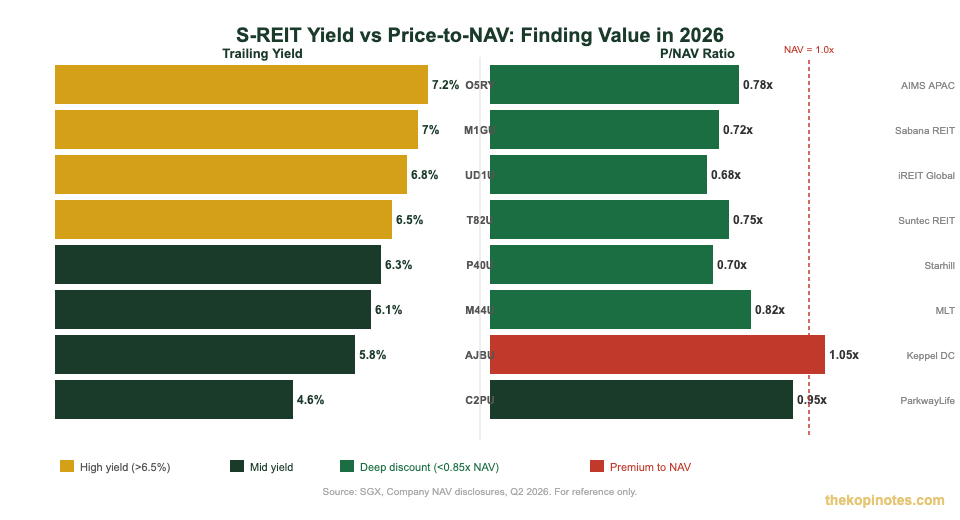
Yield by REIT Sector
S-REITs span six main sectors — and each has a different typical yield range driven by its underlying asset type, lease structure, and growth profile.
| Sector | Typical Yield Range | Key REITs | Income Characteristics |
|---|---|---|---|
| Industrial | 6.0%–7.5% | AIMS APAC, Sabana, CapitaLand Ascendas | Short leases, high yields, exposed to manufacturing demand |
| Commercial / Office | 5.5%–7.0% | Suntec, OUE REIT, CICT | Long leases, steady income but WFH headwinds for office |
| Retail | 5.0%–6.5% | Frasers Centrepoint Trust, Starhill Global | Footfall-driven; suburban malls more resilient |
| Logistics | 5.5%–6.5% | Mapletree Logistics Trust, ESR-LOGOS | E-commerce tailwind; multi-country FX risk |
| Healthcare | 4.0%–5.5% | ParkwayLife REIT, First REIT | Triple-net leases, very stable DPU, defensive |
| Data Centre | 4.5%–6.0% | Keppel DC REIT, NTT DC REIT | AI demand tailwind, premium P/NAV, growth-oriented |
Source: SGX sector data, company filings Q2 2026.
If building a diversified income portfolio, consider combining a high-yield industrial REIT (for income punch) with a healthcare or data centre REIT (for defensive DPU stability). This approach is analysed in detail in our guide to the best S-REITs in Singapore 2026.
How to Buy High-Yield REITs in Singapore
S-REITs are listed on the SGX just like regular stocks. Here is how to get started in five steps.
Step 1: Open a brokerage account. You need a CDP-linked or custodian account. Popular platforms include moomoo Singapore (competitive commissions), Syfe Trade (clean interface for beginners), and Interactive Brokers (best for larger portfolios). Use our Syfe referral code SRPRFFFCD or FSMOne referral code P0544985 for sign-up bonuses.
Step 2: Fund your account in SGD. Most S-REITs trade between S$0.20 and S$3.50 per unit. Minimum board lot is 100 units — so minimum investment is S$20 to S$350 depending on the REIT.
Step 3: Search by SGX ticker. Use the tickers from the comparison table above (e.g. O5RY for AIMS APAC REIT, C2PU for ParkwayLife REIT). Always confirm the counter before placing your order.
Step 4: Consider SRS or CPF where eligible. Most SGX-listed REITs are SRS-investable, giving you a tax deduction on contributions. Some are CPFIS-approved — check the CPF Board’s approved list. See our CPF investment strategy guide for the full breakdown.
Step 5: Reinvest distributions. S-REITs pay quarterly or semi-annual distributions. Use the income to top up your position during market dips for a compounding effect. Our Singapore retirement calculator can project how much income your portfolio generates at any target yield.
Risks of Chasing High Yield
A 7% yield looks attractive — but it can be a trap if you do not understand why it is high. Here are the main risks.
DPU cuts. If rental income falls (tenant defaults, lease expiries), DPU drops and the yield you bought disappears. Always check DPU trend over 3-5 years — not just the latest quarter.
High gearing. MAS caps REIT gearing at 50% of total assets. REITs close to this ceiling have limited room to grow, and rising interest rates eat into distributable income. Check the aggregate leverage ratio in every REIT’s quarterly update.
Currency risk. REITs with overseas assets convert foreign rental income back to SGD. A strong SGD reduces reported DPU. Hedging helps but adds cost.
Structural sector decline. High yield sometimes reflects a declining asset base — older industrial properties or retail malls losing footfall. A 7% yield on a shrinking DPU trajectory is not attractive.
For context on how S-REIT yields compare to fixed income alternatives, see our Singapore T-bills 2026 guide — when T-bill yields drop below 3%, higher-yielding REITs become more attractive on a relative basis.
Disclaimer: This article is for informational purposes only and does not constitute financial advice. Always consult a licensed financial adviser before making investment decisions. Past DPU performance is not a guarantee of future distributions.
Frequently Asked Questions
What is the highest yielding REIT in Singapore in 2026?
As at Q2 2026, AIMS APAC REIT (SGX: O5RY) has one of the highest trailing yields among Singapore REITs at approximately 7.2%, followed by Sabana REIT (~7.0%) and iREIT Global (~6.8%). These high yields partly reflect discounted unit prices — all three trade below their Net Asset Value. Always check DPU sustainability before investing based on yield alone.
Are high-yield S-REITs safe to invest in?
Higher yield generally means higher risk. REITs yielding above 7% typically trade at deep discounts to NAV because the market has concerns about DPU sustainability, gearing levels, or sector headwinds. That said, some high-yield REITs are genuinely mispriced by the market. The key is to assess whether the DPU is stable or growing, gearing is below 40%, and the tenant base is diversified. Do your own due diligence beyond the yield number.
Is dividend income from S-REITs taxable in Singapore?
For Singapore residents (individuals), distributions from Singapore-listed REITs are exempt from personal income tax. S-REITs operate under a tax-transparency regime — they pay no corporate tax on distributed income, and individual Singapore-resident investors pay no withholding tax on distributions. This makes S-REIT income one of the most tax-efficient passive income sources available locally. Note: different rules apply to foreign investors and corporate investors.
Can I buy S-REITs using my CPF or SRS funds?
Many SGX-listed REITs are eligible for investment using Supplementary Retirement Scheme (SRS) funds, which provides an additional tax benefit since SRS contributions reduce your taxable income. For the CPF Investment Scheme (CPFIS), not all S-REITs are approved — check the CPF Board’s current approved list. As at 2026, larger REITs like CapitaLand Integrated Commercial Trust and Mapletree Industrial Trust are typically CPFIS-approved, while smaller mid-cap REITs may not be.
What is a good P/NAV ratio for an S-REIT?
A P/NAV ratio below 1.0x means you are buying the REIT at a discount to its stated asset value — generally considered attractive from a value perspective. Below 0.80x represents a significant discount and may signal either a genuine bargain or a structural issue with the underlying assets. A P/NAV above 1.0x (like Keppel DC REIT at ~1.05x) means the market expects future growth to justify the premium. For income investors, combining a high yield with P/NAV below 0.90x is a useful starting screen.
How often do S-REITs pay distributions?
Most Singapore REITs pay distributions quarterly or semi-annually. ParkwayLife REIT and CapitaLand Ascendas REIT pay quarterly. Suntec REIT pays semi-annually. Check each REIT’s distribution policy in its latest annual report. Distributions are typically paid 6-8 weeks after the close of each reporting period, and you need to be a unitholder on the ex-dividend date to qualify for that distribution.
Which S-REIT sector has the highest average yield in 2026?
The industrial REIT sector has the highest average yields in 2026, with REITs like AIMS APAC REIT and Sabana REIT yielding 7%+. Commercial and logistics REITs come in second at 5.5-7%. Healthcare REITs like ParkwayLife have lower yields (4-5%) but offer the most defensive income profile. Data centre REITs sit in the middle (5-6%) with the strongest growth tailwind from AI-driven demand. Your choice should reflect your income needs and risk tolerance.
Start Building Your S-REIT Income Portfolio
Use our tools and referral links to get started with the best platforms in Singapore.
This article was researched with the help of AI. While we strive to keep all information accurate and up to date, there may be errors. If you notice any discrepancies, please contact us.