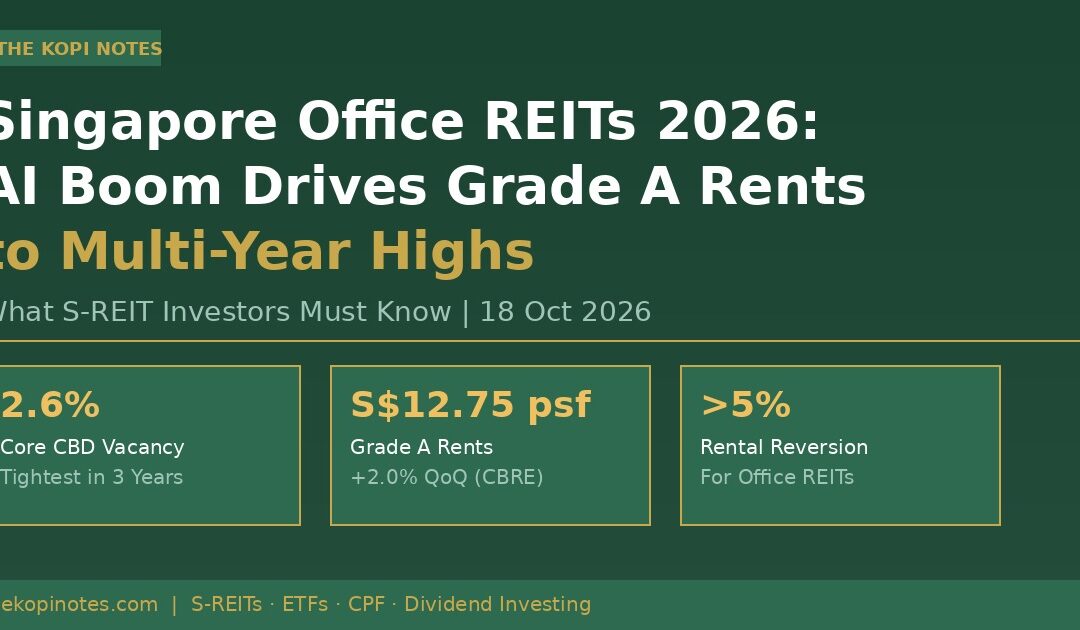
Singapore’s Grade A office market just posted its tightest vacancy in nearly three years, with Core CBD availability crashing to 2.6% and rents climbing to S$12.75 per square foot per month in Q3 2026. The catalyst? A wave of AI companies — OpenAI, Anthropic, Databricks and more — stampeding into Singapore office space. For retail investors holding Singapore office REITs, this is the tailwind they’ve been waiting for.
This is an editorial analysis. Not financial advice. Data verified as at 18 October 2026.
The Q3 2026 Office Market Snapshot: Numbers That Matter
Three of the world’s top commercial real estate brokers — CBRE, JLL, and Knight Frank — all released their Q3 2026 Singapore office market data in mid-October, and the picture is unmistakably bullish.
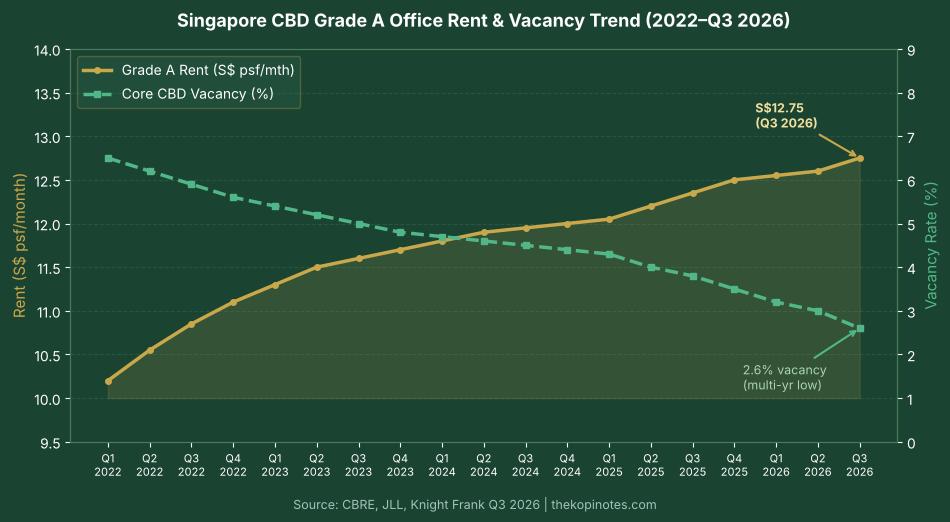
According to CBRE, Core CBD Grade A vacancy tumbled to 2.6% in Q3 2026, the tightest reading in nearly three years. JLL’s broader measure of overall CBD vacancy hit 5.9% — also a 10-quarter low. Meanwhile, Knight Frank put prime Raffles Place-Marina Bay occupancy at 97.4%, up 0.7 percentage points quarter-on-quarter.
On rents, CBRE clocked Core CBD Grade A at S$12.75 psf per month, a 2.0% quarter-on-quarter rise. JLL pegged CBD Grade A gross effective rents at S$12.32 psf per month, up 1.0% QoQ, with year-to-date growth of 2.8%. Knight Frank’s prime Raffles Place-Marina Bay reading came in at S$11.87 psf per month, a 1.5% QoQ gain.
CBRE describes Q3 2026 as the strongest quarterly rental growth since 2022, when office rents surged 8.3% annually as Singapore emerged from the pandemic-era lull. Brokers are now forecasting full-year 2026 Grade A rental growth of 4–5%+.
Q3 2026 Singapore Office Market: Broker Data Comparison
| Broker | Market Segment | Vacancy / Occupancy | Rent (psf/mth) | QoQ Change | YTD Rent Growth |
|---|---|---|---|---|---|
| CBRE | Core CBD Grade A | 2.6% vacancy | S$12.75 | +2.0% | >5% full-year est. |
| JLL | CBD Grade A | 5.9% CBD vacancy (10-qtr low) | S$12.32 | +1.0% | +2.8% |
| Knight Frank | Prime Raffles Place-Marina Bay | 97.4% occupancy | S$11.87 | +1.5% | 3–5% (high end est.) |
Sources: CBRE Q3 2026 Office MarketView; JLL CBD Office Tightness press release; Knight Frank Q3 2026 office data. October 2026.
The AI Demand Surge: Who’s Leasing and Where
The driver behind the vacancy crunch is no mystery. Singapore has become the AI industry’s Southeast Asian hub of choice, and these companies need real office space — not just server racks.
Here are the confirmed and reported AI-linked leasing moves in Q3/Q4 2026:
- Databricks is set to open a 32,000 sq ft regional headquarters at IOI Central Boulevard Towers in November 2026, quadrupling its local footprint. The company has committed to invest over US$350 million (approximately S$447 million) in Singapore over three years and grow its team to more than 500 people locally.
- OpenAI is reportedly in advanced talks for approximately 120,000 sq ft spanning five floors at Shaw Tower, Beach Road (reported by JLL). The company currently occupies roughly 100 desks at a co-working space at CapitaSpring — its eventual move would represent a massive physical-footprint expansion.
- Anthropic is opening its Singapore office in October 2026, taking approximately 100 desks at The Executive Centre, Ocean Financial Centre.
- Mistral AI, Sierra AI and Manus AI (Meta-backed) have also secured dedicated offices or expanded locally in Singapore’s CBD, according to Knight Frank.
JLL’s research notes that technology and AI firms were the main driver of Q3 leasing demand, with larger occupiers starting lease renewal talks 18 to 24 months ahead of expiry — a behavioural signal of confidence in Singapore’s office market trajectory.
For retail investors interested in how AI is reshaping Singapore’s investment landscape, our earlier analysis of Keppel DC REIT’s AI data centre thesis provides useful parallel context — though the office and data centre markets play out very differently.
Which Singapore Office REITs Stand to Benefit?
The rental growth story is compelling. But for retail investors, what matters is whether it translates into higher distributable income per unit (DPU). Let’s look at the four main Singapore office REIT exposures.
Singapore Office REIT Comparison (October 2026)
| REIT | Forward Yield | 1H 2026 DPU | YoY DPU Change | Singapore Office Occupancy | Rental Reversion (1H26) | Gearing |
|---|---|---|---|---|---|---|
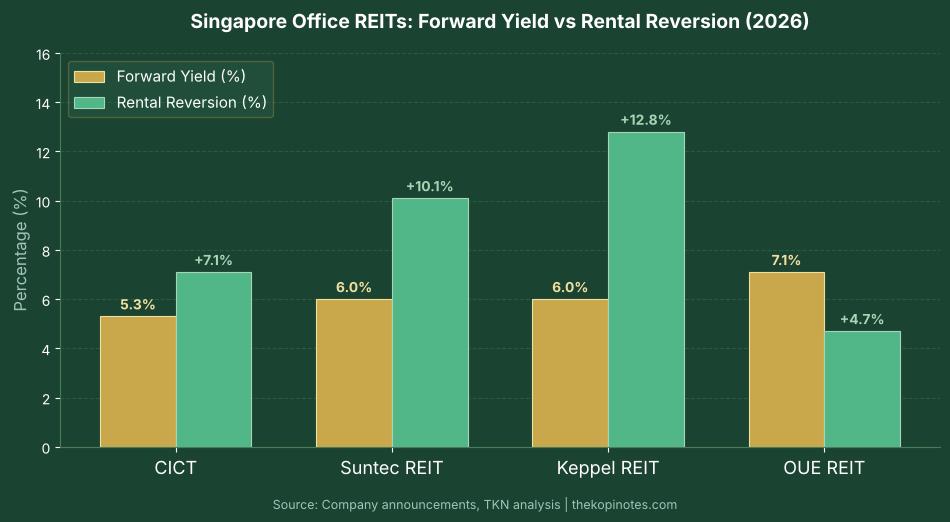
| CapitaLand Integrated Commercial Trust (CICT) | 5.3% | 6.02 cents | +7.1% | 94.4% committed (↑ from 93.7%) | +6.5% | 37.4% |
| Suntec REIT | ~6.0% | 3.936 cents | +24.8% | 99.5% (Singapore office) | +10.1% | 43.0% |
| Keppel REIT | 6.0% | 2.61 cents | -4.0% | 96.0% committed | +12.8% | 40.0% |
| OUE REIT | 7.1% | 1.26 cents | +28.6% (distrib. income) | 91.5% (office) | +4.7% | 41.5% |
Sources: REIT 1H 2026 results announcements; Growbeansprout analysis. Forward yields based on market prices as at October 2026. Past distributions do not guarantee future performance.
A few things jump out from this table:
- Suntec REIT’s 1H DPU surge of 24.8% is striking — with Singapore office occupancy at 99.5% (effectively full) and rental reversions at +10.1%, the tailwind from market rent catching up to below-market passing rents is clearly in motion.
- Keppel REIT’s positive rental reversion of 12.8% is the highest of the group, signalling significant upside as existing leases expire and renew at market rates. The DPU dip of 4% in 1H was related to other portfolio adjustments, not the Singapore office fundamentals.
- OUE REIT’s 7.1% forward yield stands out as the highest in this peer group — its average passing rent of S$11.10 psf is substantially below the S$12.75 CBRE market rate, meaning there’s meaningful reversion upside as leases roll.
- CICT at 5.3% yield is the lowest of the group, reflecting its premium quality, diversified tenant base (retail + office), and investor confidence in its execution.
For a deeper dive into CICT’s upcoming Q3 results, see our October 2026 S-REIT earnings preview.
The Supply Constraint Story: Why 2026 Is the Sweet Spot
What makes this rental growth cycle particularly durable is what’s not coming to market. Singapore’s CBD office pipeline for 2026–2027 is extraordinarily thin.
JLL identifies Newport Tower as the only notable non-strata CBD completion scheduled for 2027. The next meaningful wave of new Grade A supply doesn’t arrive until 2028, when projects including The Skywaters, The Clifford, One Comcentre, and Union Square Central are slated to complete.
CBRE notes that Core CBD Grade A vacancy collapsed from 7.8% after IOI Central Boulevard Towers completed (adding significant new supply) to just 2.6% today — and that was within two years. The market absorbed over 1 million sq ft of new supply without breaking a sweat, entirely on the back of AI and technology demand.
With the next supply wave at least 18 months away, and new entrants still actively searching for space, JLL projects full-year 2026 CBD Grade A rental growth of approximately 4% and cumulative five-year growth of about 15% through to 2030. CBRE’s estimate for full-year 2026 is above 5%, which would be the strongest annual gain since 2022.
For context, our broader Q3 2026 market review covers how these office sector dynamics fit into Singapore’s overall investment landscape: Singapore Q3 2026 Market Wrap: STI at 22.9% YTD While S-REITs Slump.
The Interest Rate Context: MAS Policy and REIT Gearing
No S-REIT analysis is complete without addressing the borrowing cost picture. The Monetary Authority of Singapore held its currency policy band unchanged in its October 2026 monetary policy statement — a surprise to markets that had priced in a modest tightening given persistent energy-driven inflation.
MAS’s decision to hold provides a near-term reprieve for highly leveraged REITs. However, investors should note that Suntec REIT’s gearing of 43% is the highest in the peer group, sitting close to MAS’s 50% regulatory cap. Any deterioration in asset values or need for capital expenditure could put pressure on distribution sustainability.
Keppel REIT (40%) and OUE REIT (41.5%) are also meaningfully leveraged, with OUE’s management guiding for a reduction to approximately 36.6% pro forma. CICT’s 37.4% remains the cleanest balance sheet of the group.
For the full analysis of what the MAS decision means for Singapore’s investment portfolio, see: MAS Holds Policy in October 2026 Surprise: What Singapore Investors Must Do Now.
Key Risks Retail Investors Must Not Ignore
The bull case for Singapore office REITs is compelling, but three risks deserve attention:
1. AI cycle normalisation. MAS has explicitly flagged that Singapore’s economic momentum — partly driven by AI-linked industries — is expected to moderate as the cycle matures. If major tech tenants slow expansion plans or sublease excess space (as happened in global tech downturns of 2022–2023), demand could soften faster than brokers project.
2. The 2028 supply wave. Projects like The Skywaters, The Clifford, and One Comcentre represent a meaningful injection of new Grade A supply. Savvy investors in office REITs should monitor pre-leasing progress on these buildings — if they are absorbed well ahead of completion (as happened at IOI Central Boulevard Towers), the rental cycle extends. If they struggle, the post-2028 rental outlook dims.
3. Leverage sensitivity. Singapore office REITs carry significant debt, and most have been refinancing in a structurally higher interest rate environment compared to 2019–2021 lows. Any reversal of the MAS easing trend, or global credit tightening, flows through to higher borrowing costs and lower DPU.
For investors building a broader income portfolio, our dividend investing guide for Singapore covers how to size REIT allocations responsibly alongside equities and bonds.
Bottom Line for SG Investors
Singapore’s Grade A office market is in a structurally tight position heading into late 2026 and 2027. The AI-driven demand surge from companies including OpenAI, Anthropic, Databricks, and numerous smaller players has absorbed vacancy at an extraordinary pace, and the supply pipeline offers no meaningful relief until 2028.
For Singapore retail investors, the four main office REIT plays — CICT, Suntec REIT, Keppel REIT, and OUE REIT — each offer a different risk/return profile: CICT for quality and balance sheet safety; Suntec for near-fully-occupied momentum; Keppel for the highest rental reversion upside (12.8%); and OUE REIT for the highest yield (7.1%) with the most reversion potential relative to passing rent.
The rental reversion tailwind — where expiring leases that were signed at S$9–11 psf renew at today’s S$12.32–12.75 psf market rates — is a multi-year DPU growth driver that has not yet been fully reflected in distributions. That makes the office REIT sub-sector one of the more interesting corners of the S-REIT market heading into 2027.
Watch the occupancy and rental reversion numbers when CICT, Suntec, and Keppel report Q3 results later this month. Those will be the best real-time confirmation of whether the market data is flowing through to individual portfolio performance.
Also see: S$1B Singapore REIT IPO 2026: What Investors Should Know — for context on how new S-REIT listings are absorbing investor appetite alongside existing names.
Frequently Asked Questions
What is Grade A office space in Singapore’s CBD?
Grade A refers to the highest-quality office buildings in Singapore’s Central Business District — typically newer, large-floor-plate buildings with premium specifications, strong building management, and prestigious addresses in areas like Raffles Place, Marina Bay, and Shenton Way. Landlords benchmark rents against Grade A rates because these set the ceiling for the broader market.
Why are AI companies choosing Singapore for their Asian headquarters?
Singapore offers political stability, a strong rule of law, deep talent in technology and finance, pro-business regulation, excellent connectivity, and increasing availability of AI-ready infrastructure. The government’s National AI Strategy and significant public investments in AI capabilities have made Singapore a preferred hub for global technology firms expanding in Asia. MAS and EDB have also been active in attracting AI companies with regulatory sandboxes and incentive frameworks.
How does rising office rent affect REIT DPU (distribution per unit)?
When market rents rise above the passing rents (what tenants are currently paying), REITs benefit from “positive rental reversion” — tenants renewing or replacing leases pay more, directly boosting rental income and ultimately DPU. The lag depends on lease expiry profiles: REITs with many leases expiring soon benefit faster. Keppel REIT (12.8% reversion) and Suntec REIT (10.1%) currently show the strongest reversion momentum.
What is a safe gearing level for Singapore REITs?
MAS caps Singapore REIT gearing (total borrowings as a percentage of total assets) at 50% — or up to 60% if the REIT maintains a minimum interest coverage ratio. Most well-managed S-REITs target 35–42% gearing to maintain headroom for acquisitions and adverse market movements. In this peer group, CICT’s 37.4% is the most conservative; Suntec’s 43.0% is the highest and leaves less buffer. Higher gearing also increases sensitivity to rising interest rates.
When does new office supply arrive in Singapore that could soften rents?
The most meaningful new Grade A CBD supply is not expected until 2028, when projects including The Skywaters, The Clifford, One Comcentre, and Union Square Central are slated to complete. In 2027, only Newport Tower is scheduled as a notable non-strata CBD completion. This thin pipeline means the current tight market conditions are likely to persist through most of 2027, supporting rental growth — though active AI company expansion remains the key demand-side variable to monitor.
Should I buy Singapore office REITs now based on the rent growth story?
This article is not financial advice. The rental growth thesis is supported by verifiable market data from CBRE, JLL, and Knight Frank, and the supply-demand setup is structurally favourable for 2026–2027. However, individual investment decisions should account for your personal financial situation, existing REIT exposure, interest rate outlook, and risk tolerance. Key risks include AI cycle normalisation, higher refinancing costs, and the 2028 supply wave. Consulting a licensed financial adviser before making significant portfolio changes is always prudent.
This article was researched with the help of AI. While we strive to keep all information accurate and up to date, there may be errors. If you notice any discrepancies, please contact us.