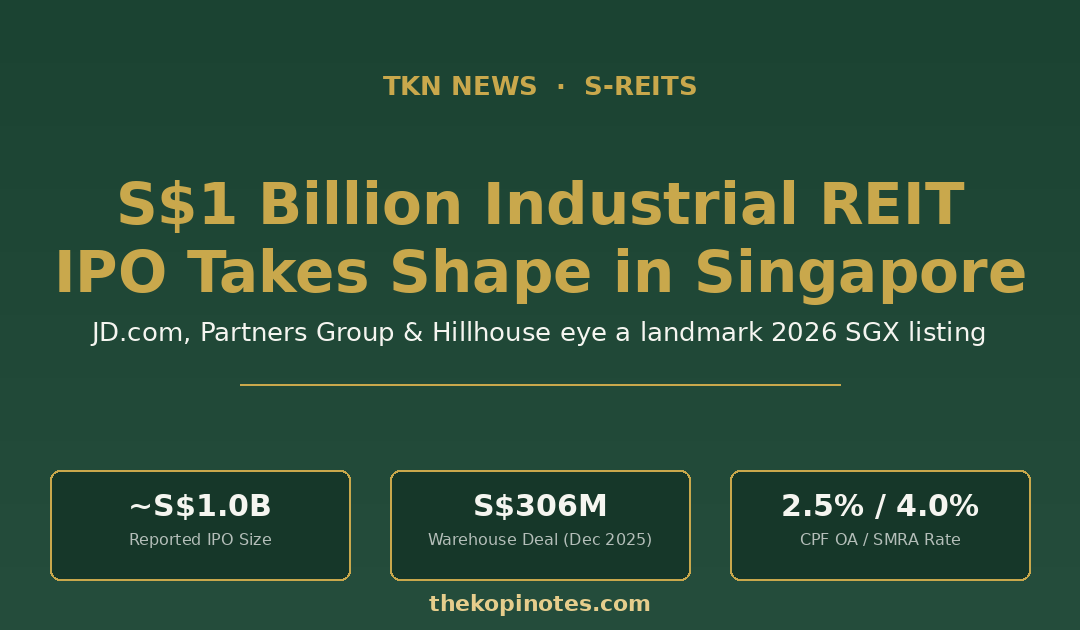
A consortium backed by JD.com’s asset arm, Switzerland’s Partners Group, and Hillhouse-linked EZA Hill is preparing to file for a roughly S$1 billion industrial REIT IPO on the SGX, Bloomberg reported on 10 July 2026. If it proceeds, it would rank among Singapore’s largest REIT listings in years, right behind March’s S$973.6 million UI Boustead REIT debut — with real implications for S-REIT investors and CPF savers.
This is an editorial analysis. Not financial advice. Data verified as at 15 July 2026 against official CPF Board, CapitaLand and company-sourced disclosures; deal terms for the proposed REIT remain unconfirmed and subject to change.
What’s Happening: A S$1 Billion Industrial REIT Is Taking Shape
A group comprising JD Property Inc. (the asset management arm of Chinese e-commerce giant JD.com), Swiss investment firm Partners Group Holding AG, and Hillhouse-backed EZA Hill Property Management Pte is preparing to confidentially file for the IPO of a new industrial-focused REIT in Singapore, according to Bloomberg. The vehicle could raise about S$1 billion (US$775 million), with Bank of America, DBS Group Holdings and UBS Group advising on the deal.
A draft registration is expected to be lodged with the Monetary Authority of Singapore and the Singapore Exchange soon. A listing could happen as early as this year, though people familiar with the matter caution that discussions are ongoing and key terms — including final portfolio size, unit price and distribution yield — have not been locked in.
Why it matters for SG investors: a REIT IPO of this size would be one of the biggest tests yet of retail and institutional appetite for industrial and logistics property since Singapore’s REIT sector re-rated on falling interest rates.
Inside the Portfolio: The Four Warehouses at the Core
Part of the proposed REIT’s Southeast Asian portfolio traces back to a divestment by CapitaLand Ascendas REIT (CLAR). In December 2025, CLAR sold four Singapore industrial properties — 31 Ubi Road 1, 9 Changi South Street 3, 10 Toh Guan Road, and 19 & 21 Pandan Avenue — for S$306.0 million, a 5.8% premium to their combined valuation of S$289.3 million. The sale was completed on 17 December 2025, according to CapitaLand’s official disclosure.
Why it matters for SG investors: the new REIT isn’t being seeded with distressed or fire-sale stock — it’s built partly on assets that a blue-chip S-REIT sold at a premium to book value. That’s a reasonable signal of underlying asset quality, though it also means the new landlord paid a full price and will need rental growth to justify it.
How It Stacks Up Against Singapore’s Biggest Recent REIT IPOs
If the roughly S$1 billion target holds, the new industrial REIT would sit just behind UI Boustead REIT — which completed a S$973.6 million (about US$764 million) IPO in March 2026, Singapore’s largest listing so far this year — as one of the biggest S-REIT debuts since the 2025 rebound in local IPO activity.
| REIT IPO | Timing | Proceeds | Sector |
|---|---|---|---|
| NTT DC REIT | 2025 | More than US$500 million | Data centres |
| Centurion Accommodation REIT | 2025 | More than US$500 million | Purpose-built accommodation |
| UI Boustead REIT | March 2026 | S$973.6 million (~US$764 million) | Industrial (Singapore & Japan) |
| JD.com / Partners Group / EZA Hill REIT | Filing in progress (2026) | ~S$1 billion (~US$775 million) — unconfirmed | Industrial & logistics (Southeast Asia) |
Sources: PwC Singapore & Southeast Asia Equity Capital Markets Watch; Minichart; Bloomberg.
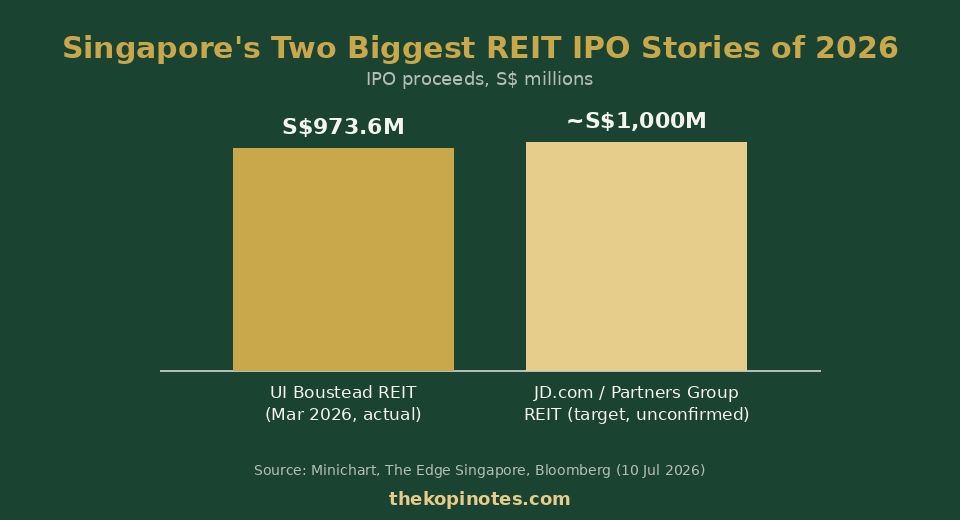
Why it matters for SG investors: Singapore’s IPO market has clearly rediscovered REITs as its go-to vehicle for raising large sums. For investors who already hold S-REITs, more large listings mean more sector choice — but also more competition for the same tenants, capital and analyst attention.
What This Means for S-REIT Retail Investors
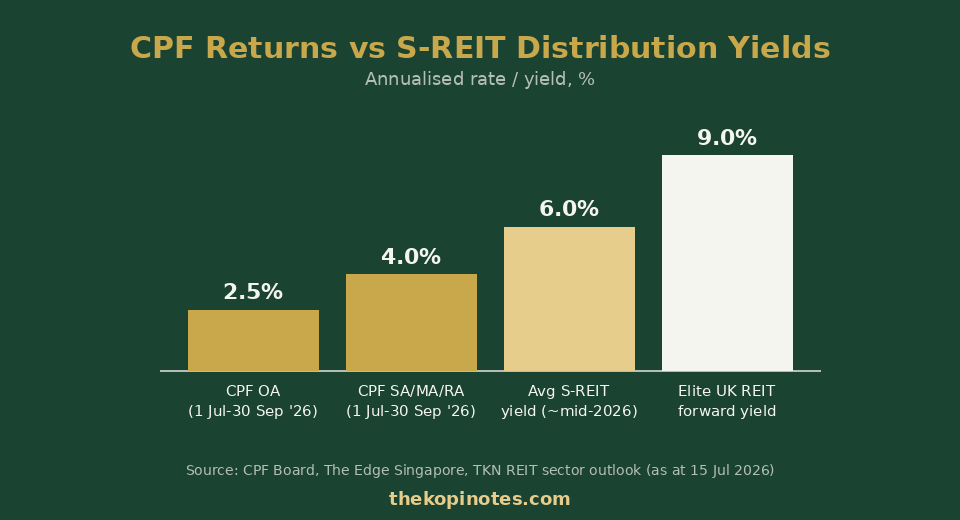
Retail investors have not been shy about REITs lately — inflows into S-REITs reportedly topped S$925 million up to late May 2026, alongside an average sector distribution yield of roughly 5.5–6.5% as tracked on TKN’s REIT sector outlook. A new, well-capitalised industrial player entering that mix has a few practical implications:
- More diversification within industrial/logistics — investors currently concentrated in CapitaLand Ascendas REIT or its dividend history would gain another pure-play option once the new REIT lists.
- Possible near-term share price pressure on incumbents — large IPOs can temporarily divert liquidity and investor attention away from existing industrial S-REITs.
- No actionable entry point yet — there is no prospectus, offer price or subscription date. Anyone acting now is trading on rumour, not disclosure.
CPF, Yield and the Bigger Picture
For CPF-linked investors, timing context matters. The CPF Ordinary Account (OA) interest rate stays at its floor of 2.5% per annum, and the Special, MediSave and Retirement Account (SMRA) rate stays at its floor of 4% per annum, both unchanged for 1 July to 30 September 2026, per the CPF Board.
That gap between guaranteed CPF returns and S-REIT distribution yields is exactly why products under the CPF Investment Scheme (CPFIS) attract attention. Elite UK REIT, for instance, had its SGD counter added to CPFIS-OA eligibility effective 9 June 2026 and currently carries a forward yield of around 9%, according to The Edge Singapore. Whether the new JD.com-backed REIT would eventually seek CPFIS status is unknown and typically takes time after a listing — but it illustrates the trade-off CPF-OA investors weigh: give up a guaranteed, principal-protected 2.5% for market-priced equity risk and a higher, non-guaranteed yield.
Why it matters for SG investors: don’t assume a new REIT will be CPFIS-eligible at listing. Most aren’t, at least initially — check the prospectus and any subsequent CPFIS announcement before assuming you can fund a subscription from your CPF-OA.
Risks and What to Watch Before the Prospectus Drops
Two things are worth remembering before getting excited about the headline size of this deal:
- Terms aren’t final. Bloomberg’s sourcing makes clear that portfolio composition, pricing and the exact IPO date could still change or be shelved entirely.
- Big doesn’t guarantee a strong debut. UI Boustead REIT — this year’s largest Singapore IPO before this one, with a forecast yield of 7.4% — still closed about 8.5% below its S$0.88 offer price on its first trading day. Investors should read gearing, weighted average lease expiry (WALE) and sponsor track record carefully once the prospectus is out; TKN’s REIT gearing ratio comparison is a useful starting checklist.
How to Track This IPO as It Develops
Because there is no confirmed prospectus yet, the most useful thing SG investors can do is watch the right checkpoints rather than the headlines:
- MAS/SGX filing. A formal, non-confidential lodgement with MAS and SGX — typically via a preliminary or final prospectus — is the first real signal the deal is proceeding on the terms reported so far.
- Sponsor and manager disclosure. Details on who manages the REIT day-to-day, fee structure, and whether Partners Group or EZA Hill retain a cornerstone stake matter as much as headline size — sponsor alignment has been a recurring theme in how recent S-REIT IPOs have traded post-listing.
- Indicative yield and gearing. Once a preliminary prospectus is out, compare the forecast distribution yield and gearing ratio against existing industrial S-REITs before deciding whether the new listing is priced attractively or simply large.
Why it matters for SG investors: IPO enthusiasm tends to peak before the prospectus, not after. Treating this stage as “monitor,” not “prepare to subscribe,” keeps expectations in line with how little is actually confirmed today.
Bottom Line for SG Investors
This is a REIT to watch, not yet one to act on. JD.com’s asset arm, Partners Group and Hillhouse-backed EZA Hill are moving toward a roughly S$1 billion industrial REIT IPO that would be one of Singapore’s largest listings of 2026, built partly on a premium-priced divestment from CapitaLand Ascendas REIT. Until MAS and SGX receive a formal filing with a price range and subscription dates, there’s nothing to subscribe to. In the meantime, investors can use the wait to review their existing industrial S-REIT holdings, compare yields against CPF OA/SA rates, and decide how much room a new listing should get in an already-diversified REIT portfolio.
Frequently Asked Questions
What REIT is JD.com and Partners Group planning to list in Singapore?
A group including JD.com’s asset management arm JD Property Inc., Switzerland’s Partners Group Holding AG, and Hillhouse-backed EZA Hill Property Management is preparing to file for an industrial-focused REIT IPO on the SGX, per Bloomberg’s 10 July 2026 report.
How much money is the IPO expected to raise?
Reports point to about S$1 billion (roughly US$775 million), though the amount is unconfirmed and could change before a formal filing is lodged.
Which properties will be in the new REIT’s portfolio?
Part of the Southeast Asian industrial portfolio includes four warehouses — 31 Ubi Road 1, 9 Changi South Street 3, 10 Toh Guan Road, and 19 & 21 Pandan Avenue — acquired from CapitaLand Ascendas REIT for S$306.0 million in December 2025.
When will the REIT list on the SGX?
No date has been set. A draft registration is expected to go to MAS and SGX soon, and a listing could happen as early as this year, but terms are not finalised.
Will the new REIT be eligible for CPF investment (CPFIS)?
Unknown at this stage. Most new REITs are not CPFIS-eligible at listing; eligibility is typically assessed and announced separately afterward, as happened with Elite UK REIT in June 2026.
How does this IPO compare to UI Boustead REIT’s March 2026 listing?
UI Boustead REIT raised S$973.6 million in March 2026, Singapore’s largest listing so far this year. The proposed JD.com-backed REIT, at a rumoured ~S$1 billion, would be similar in size or slightly larger, though its terms are still being finalised.
What should retail investors do now, before the prospectus is released?
Nothing actionable yet — there’s no offer price or subscription window. Investors can use the time to review existing industrial S-REIT holdings, check gearing and yield against CPF OA/SA benchmark rates, and wait for the official prospectus before making any decisions.
Update (31 July 2026): This REIT has since listed and reported strong operational progress. Read our full UI Boustead REIT (SGX: UIBU) 2026 investor guide for occupancy, DPU, gearing and analyst target price updates.
This article was researched with the help of AI. While we strive to keep all information accurate and up to date, there may be errors. If you notice any discrepancies, please contact us.