ISP Rider Changes 2026 Singapore: What Changed, What You Now Pay & What To Do
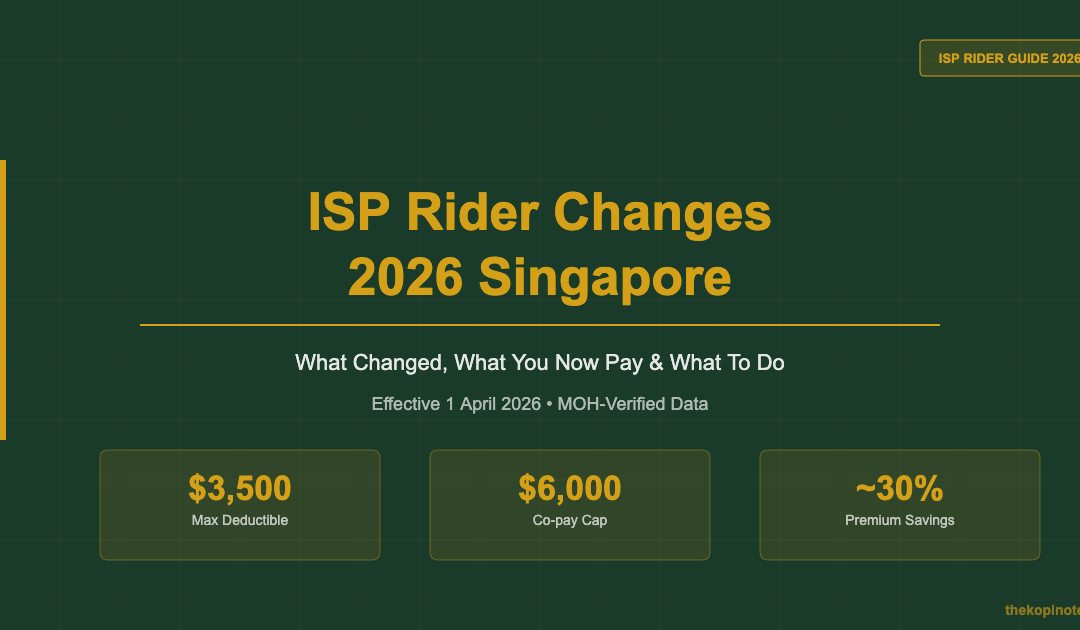
From 1 April 2026, Singapore’s Integrated Shield Plan (ISP) riders changed dramatically. New riders can no longer cover your deductible — which ranges from $1,500 to $3,500 depending on your ward. The co-payment cap also doubled to $6,000 per year. The upside: premiums drop by about 30%. Here’s exactly what changed, how much more you pay, and whether MediSave can absorb it.
Not financial advice. All figures are for educational reference only. Data verified against MOH official sources as at 30 August 2026.
- From 1 April 2026, new ISP riders cannot cover your deductible ($1,500–$3,500 by ward class)
- The co-payment cap rose from $3,000 to $6,000/year — but new rider premiums are ~30% cheaper (~$600/year savings for private hospital plans)
- MediSave can cover your deductible and co-payments; MOH projects 6 in 10 claimants won’t pay any cash at all
Table of Contents
- What Is an ISP Rider?
- What Changed on 1 April 2026
- New Minimum Deductibles by Ward Class
- The $6,000 Co-Payment Cap Explained
- Real Bill Examples: How Much More Will You Pay?
- MediSave to the Rescue
- The Silver Lining: ~30% Lower Premiums
- What Should Existing Policyholders Do Now?
- Should You Still Buy an ISP Rider in 2026?
- Frequently Asked Questions
What Is an ISP Rider?
An Integrated Shield Plan (ISP) is Singapore’s main private health insurance product. It sits on top of MediShield Life — the compulsory national health plan — to cover private hospitals, Class A, or Class B1 public wards. Five insurers offer ISPs here: AIA, Great Eastern, Income, Prudential, and Singlife.
A rider is an optional add-on alongside your ISP. Its job: cover your deductible (the first portion of your bill) and co-payment (your share of costs after the deductible). Before 2026, the best riders left you paying almost nothing out of pocket — even in a private hospital.
That near-zero coverage is exactly what MOH is now phasing out. For a full breakdown of how ISPs work, see our Shield Plan Singapore: Complete Guide (2026).
What Changed on 1 April 2026
MOH announced the changes on 26 November 2025. Two core changes took effect on 1 April 2026. Both apply to new riders sold from that date.
Change 1: Riders can no longer cover your deductible. Before 2026, your rider could absorb 100% of your minimum IP deductible. From 1 April 2026, new riders are not permitted to cover that deductible. You pay it yourself — from MediSave or cash.
Change 2: The co-payment cap more than doubled. The co-payment cap was set at a minimum of $3,000 per year in 2018. That cap is now raised to a minimum of $6,000 per year. The cap applies to co-payments excluding the deductible.
What stayed the same: the minimum 5% co-insurance rate is unchanged. You still pay at least 5% of each bill.
The rationale from MOH: policyholders with old full-coverage riders were 1.4x more likely to make a claim, with average claim sizes 1.4x higher than those without riders. Near-zero co-payment was driving over-consumption and pushing up premiums for everyone.
New Minimum Deductibles by Ward Class
Your deductible is the fixed amount you pay before your ISP starts covering the rest. You only pay it once per policy year — multiple hospitalisations in the same year all count toward the same threshold.
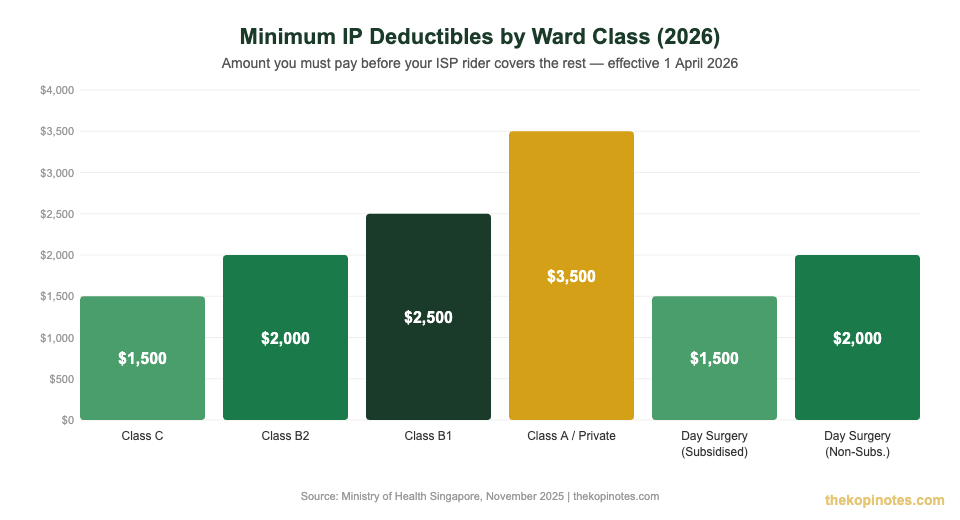
Here are the minimum deductibles set by MOH, effective 1 April 2026:
| Ward Class Utilised | Minimum Deductible (per policy year) |
|---|---|
| Class C (Subsidised) | $1,500 |
| Class B2 | $2,000 |
| Class B1 | $2,500 |
| Class A / Private Hospital | $3,500 |
| Day Surgery (Subsidised) | $1,500 |
| Day Surgery (Non-Subsidised) | $2,000 |
Source: Ministry of Health Singapore, Table 1, Annex A — New Requirements for IP Riders (26 November 2025)
Key rule: The deductible applied is the lower of your plan’s target ward class and the ward you actually use. For example: if your ISP targets Class B1 but you stay in a private hospital, you pay the B1 deductible of $2,500 — not $3,500.
The $6,000 Co-Payment Cap Explained
After you’ve paid your deductible, the rider kicks in — but not to cover 100% of the remaining bill. You still pay a minimum 5% co-insurance on the rest. For a $56,900 bill: after a $3,500 deductible, you owe 5% of $53,400 = $2,670 in co-payment.
The co-payment cap limits how much co-insurance you pay in a year. Under the new rules, that cap must be at least $6,000 per year. Once you’ve paid $6,000 in co-payments, your rider covers everything else — for panel or pre-authorised claims.
The cap is protection against catastrophic bills. On a $200,000 surgery, without the cap you’d owe 5% of $196,500 = $9,825 in co-insurance. With the $6,000 cap, you pay $6,000 then your rider covers the rest. That’s still meaningful protection for large bills.
For most people: a typical hospitalisation won’t push you near $6,000 in co-payments. MOH data shows the average Singaporean aged 40 is hospitalised about once or twice in 20 years. The cap matters most for rare, high-cost procedures.
Real Bill Examples: How Much More Will You Pay?
Let’s use MOH’s own published case examples (Annex B). These use median private hospital bill sizes from 2024.
| Case | Total Bill | Deductible + Co-pay | Cash After MediSave |
|---|---|---|---|
| 60yo, knee replacement (private hospital) — new rider | $56,900 | $6,170 | $0 (fully covered by MediSave) |
| 40yo, ACL surgery (private hospital) — new rider | $38,700 | $5,260 | $1,360 |
| 40yo, ACL surgery — no rider at all | $38,700 | $3,120 cash | $3,120 |
Source: MOH Annex B Case Examples. Bill sizes based on median private hospital bills in 2024. Actual bills vary.
The bottom line: for moderate bills, new riders still substantially reduce your out-of-pocket cost compared to having no rider. The math only gets better as bills get larger — and for the largest bills, the $6,000 cap kicks in to protect you.
MediSave to the Rescue — Using CPF to Cover Your Costs
Here’s the detail many people overlook: your deductible and co-payments can be paid from your MediSave account. You don’t always need cash.
MOH projects that six in ten rider claimants won’t need to pay any cash out-of-pocket after MediSave covers their deductible and co-payment. The 2026 MediSave Basic Healthcare Sum (BHS) is $79,000 — most working Singaporeans aged 40+ have a substantial balance.
In MOH’s own case example (60-year-old, $56,900 knee replacement), the entire $6,170 out-of-pocket was covered by MediSave. Zero cash required. That’s the story for most hospitalisations.
For a complete guide to what MediSave covers and the withdrawal rules, see our MediSave Singapore: Complete Guide (2026). For the latest BHS and contribution limits, see our MediSave Limit 2026 Singapore guide.
The Silver Lining: ~30% Lower Premiums
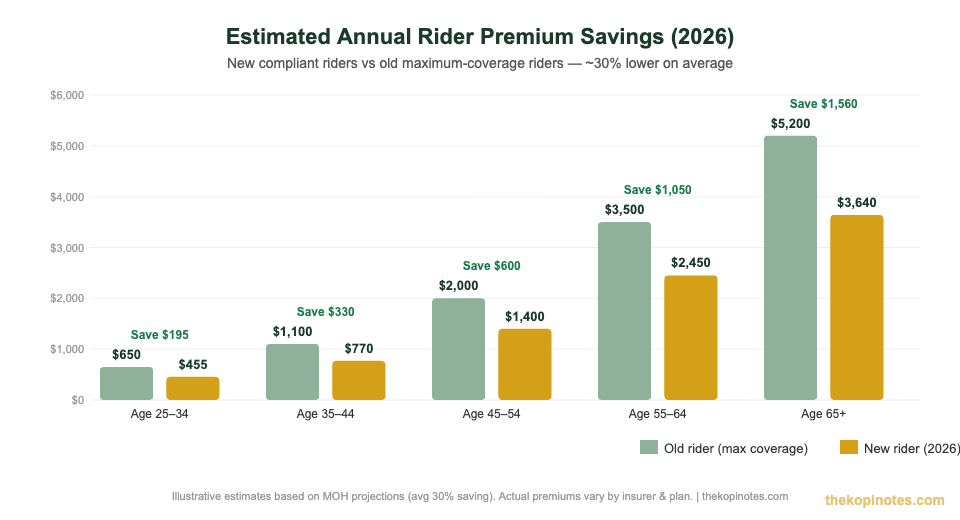
The trade-off for bearing more co-payment risk is a significantly cheaper rider. New private hospital riders are expected to be about 30% lower in premium than existing maximum-coverage riders.
In dollar terms, that’s roughly:
- ~$600/year saved for private hospital ISP rider policyholders (average)
- ~$200/year saved for public hospital ISP rider policyholders
Older policyholders save even more in absolute dollar terms. A 60-year-old switching to the new rider might save $1,600/year — enough to fully offset 3 years of higher co-payment from a major surgery.
What Should Existing Policyholders Do Now?
Your action depends on when you bought your rider.
Bought your rider before 27 November 2025? You can keep your old rider for now. Your insurer must transition you to a new compliant rider no later than your next renewal after 1 April 2028. You have time — use it to compare whether switching early makes financial sense.
Bought your rider on or after 27 November 2025? Your insurer must have told you at purchase that you’ll transition to a compliant rider at your next renewal after 1 April 2028. Check your policy documents.
Buying a rider now (after 1 April 2026)? Only new compliant riders are available. They cannot cover your deductible, and the co-payment cap is at least $6,000.
The key question to ask your financial advisor: does the 30% premium saving outweigh the higher future co-payment given your MediSave balance and hospitalisation risk? For most healthy Singaporeans with a reasonable MediSave balance, switching to the new rider makes sense. Use our Singapore retirement planning calculator to model your MediSave trajectory.
Should You Still Buy an ISP Rider in 2026?
For most private hospital ISP holders: yes, a rider still makes sense. Here’s the maths.
Without a rider on a $100,000 private hospital bill, you pay: $3,500 deductible + 5% of $96,500 = $8,325 out-of-pocket. With a new rider, you pay: $3,500 deductible + co-payments capped at $6,000 = max $9,500. But on smaller bills (say, $40,000), your co-payment is only 5% × $36,500 = $1,825 — the cap doesn’t even come into play, and your rider caps you well below uninsured cost.
Riders make most sense for:
- Private hospital ISP holders who want catastrophic cost protection
- Those with limited cash reserves who prefer MediSave to cover co-payments
- Older policyholders who face higher hospitalisation probability
Riders are less compelling for people who primarily stay in Class B1 public wards, rarely get hospitalised, and have a large MediSave balance as a self-insurance buffer.
For a comparison of the best ISPs for Class A ward coverage, see: Best Integrated Shield Plan for Class A Ward in Singapore (2026).
This article is for educational reference only. Consult a licensed financial advisor before making any changes to your insurance coverage.
Frequently Asked Questions
What exactly changed for ISP riders on 1 April 2026?
Do the new ISP rider rules apply to existing policyholders immediately?
Can I use MediSave to pay the new deductible and co-payment?
How much will my ISP rider premium change in 2026?
Should I switch from my old rider to a new compliant rider now?
What is the minimum deductible for a private hospital stay under the new rules?
Get Free Insurance Advice
Speak with a licensed insurance advisor. No obligation, no cost.
By submitting this form, you agree to our Privacy Policy.
This article was researched with the help of AI. While we strive to keep all information accurate and up to date, there may be errors. If you notice any discrepancies, please contact us.