Investment Insurance Guide · 2 Sep 2026
Endowment Plan Meaning: What It Is, How It Works & Who Should Buy
An endowment plan is a life insurance policy that also grows your savings to a guaranteed maturity sum. Here’s the plain-English breakdown — and whether one belongs in your portfolio.
What Is an Endowment Plan?
An endowment plan is a type of life insurance policy that combines a savings element with a protection component. You pay regular premiums over a fixed term — anywhere from 2 to 25 years — and at the end (the “maturity date”), you receive a guaranteed lump sum payout. If you pass away during the term, your beneficiaries receive a death benefit instead.
In Singapore, endowment plans are regulated by the Monetary Authority of Singapore (MAS) and sold by licensed insurers such as Singlife, Manulife, Prudential, AIA, Great Eastern, NTUC Income, and DBS/POSB.
The core appeal: guaranteed capital preservation with a modest yield — historically 1.5–2.5% p.a. for short-term plans — plus a small layer of life insurance. This makes them a middle ground between a savings account (no insurance, fully liquid) and a whole life policy (longer horizon, higher cover).
How Endowment Plans Work in Singapore
Here is the typical lifecycle of an endowment plan:
- Application & underwriting — You choose a plan, coverage amount, and premium tenure. A medical assessment may be required for larger sums assured.
- Premium payment period — You pay premiums monthly or annually. Some short-term plans require a single lump-sum premium.
- Policy in-force period — Your premiums grow inside the policy. Non-participating (non-par) plans credit a fixed guaranteed rate. Participating (par) plans invest in the insurer’s par fund and may pay non-guaranteed bonuses on top.
- Maturity payout — At the end of the policy term, you receive the guaranteed maturity value plus any accumulated bonuses (for par plans). This is typically paid as a lump sum, though some plans offer income-style payouts.
- Death benefit — If you die before maturity, your beneficiaries receive the sum assured (which may exceed premiums paid, depending on the plan).
Surrender charges apply if you exit early. In the first few years, surrendering an endowment plan often means receiving less than your total premiums — this is the single most important caveat for buyers.
Par vs Non-Par: Key Types Explained
Singapore endowment plans fall into two broad categories:
| Feature | Participating (Par) | Non-Participating (Non-Par) |
|---|---|---|
| Returns | Guaranteed + non-guaranteed bonuses | 100% guaranteed |
| Upside potential | Higher (bonuses can boost returns) | Fixed — no upside beyond locked rate |
| Typical tenure | 10–25 years | 2–5 years (short-term endowments) |
| Transparency | Lower — bonus depends on par fund performance | High — exact payout stated upfront |
| Best for | Long-horizon goal savings (education, retirement) | Short-term capital parking (2–3 years) |
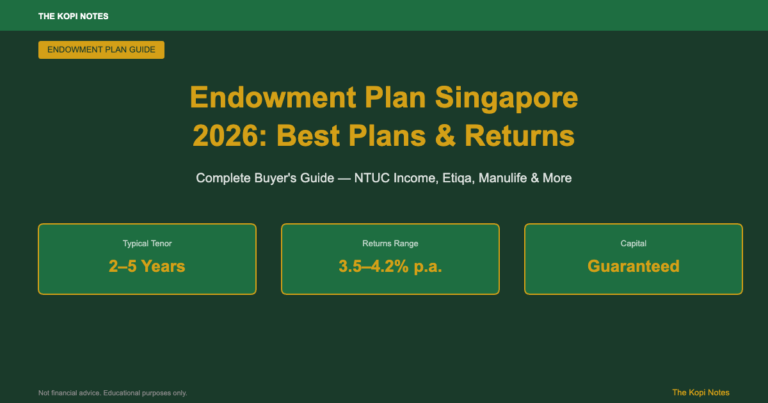
Short-term endowments (2–3 year non-par plans) are especially popular in Singapore as fixed-deposit alternatives offering guaranteed returns of 1.6–2.0% p.a. with MAS-regulated insurer backing.
Endowment vs Savings Account vs Whole Life
| Product | Endowment Plan | High-Yield Savings | Whole Life |
|---|---|---|---|
| Liquidity | Low (surrender penalty) | High (withdraw anytime) | Very low (long horizon) |
| Guaranteed return | Yes (locked in) | No (rate changes monthly) | Partial (guaranteed + bonuses) |
| Life cover | Yes (usually 105% of premiums) | No | Yes (substantial) |
| Typical return | 1.5–2.5% p.a. | 2–3% p.a. (promotional) | 3–4.5% p.a. (long-run illustrated) |
| SRS-eligible | Yes (most plans) | Yes (SRS savings) | Yes (some plans) |
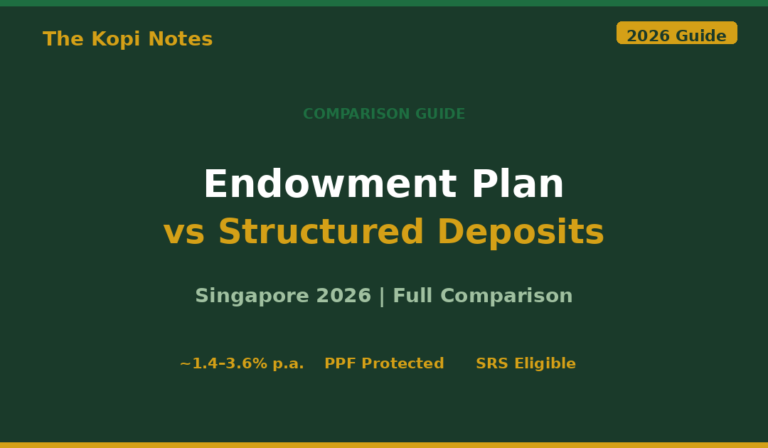
The key insight: endowment plans sacrifice liquidity for rate certainty. If you need flexibility, a high-yield savings account (Trust Bank, MariBank) may serve short-term needs better. If you want maximum long-run compounding with insurance, whole life plans generally outperform endowments over 20+ year horizons.
What Returns Can You Expect? (2026 Data)
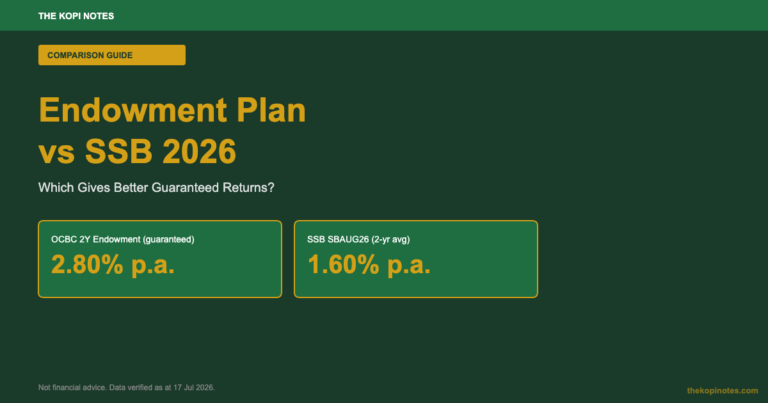
Singapore short-term endowment rates have moderated in 2026 as the US Federal Reserve held rates steady. Indicative 2-year non-par guaranteed rates from major insurers include:
| Plan | Insurer | Tenor | Guaranteed p.a. | Min. Premium |
|---|---|---|---|---|
| Max Saver II | Singlife | 2-year | 2.00% | S$5,000 |
| SavvyEndowment 22 | DBS/Manulife | 2-year | up to 1.88% | S$5,000 |
| PRUAssure Growth | Prudential | 3-year | 1.70% | S$5,000 |
| Goal 2026 (I) | Manulife | 2-year | up to 1.60% | S$5,000 |
Data verified Sep 2026. Short-term endowments are often launched in tranches and may close quickly. Always confirm availability directly with the insurer or a licensed adviser.
For long-term participating plans, the non-guaranteed illustrated returns typically range from 3.25–4.75% p.a. (MAS-mandated 3.25% and 4.75% illustration rates). Actual bonuses depend on the insurer’s par fund performance over the policy term.
Who Should Buy an Endowment Plan?
An endowment plan is likely a good fit if you:
- Have a specific savings goal with a defined timeline — children’s education fund, wedding savings, home renovation budget
- Want capital-guaranteed growth that beats typical bank savings rates without stock market risk
- Have surplus cash you won’t need for the full policy term (this is critical)
- Are SRS account holders looking to grow SRS funds with guaranteed returns and life coverage during the accumulation phase
- Want a disciplined savings vehicle — the surrender charge acts as a “commitment device” that prevents early withdrawal
An endowment plan is not the right product if you:
- Need a liquid emergency fund (keep 3–6 months expenses in a bank account first)
- Are seeking high returns — equity investments historically outperform endowment plans over 10+ year horizons
- Are unsure about committing premiums for the full term (a policy lapse can result in a net loss)
Red Flags to Watch Out For
Before signing any endowment policy, check for these common issues:
- Surrender value below premiums in Year 1–3: For most plans, the surrender value starts below total premiums paid and only crosses breakeven midway through the term. Know your breakeven year before committing.
- Confusing non-guaranteed bonuses with guaranteed returns: In participating plans, illustrations often show a higher “total projected return” that includes non-guaranteed bonuses. The only number that is contractually yours is the guaranteed maturity value.
- Buying more cover than you need: If you need substantial life coverage, a term life policy typically provides it far more cheaply than an endowment plan.
- Investing emergency funds: Never put money you might need urgently into an endowment plan — early surrender will cost you.
- Unverified “special rates”: Always verify current rates directly on the insurer’s official website or through MAS-registered advisers. Rates quoted by comparison sites can become stale quickly.
Ready to Compare Endowment Plans?
Platforms like Endowus and Syfe let you access curated, fee-transparent insurance-linked savings products. Use TKN referral codes for exclusive sign-up bonuses.
Frequently Asked Questions
What is the meaning of an endowment plan?
Is an endowment plan a good investment in Singapore?
What happens if I stop paying premiums?
Are endowment plans taxable in Singapore?
Can I use CPF to buy an endowment plan?
What is the difference between endowment and whole life insurance?
Is my endowment plan safe if the insurer fails?
How do I compare endowment plans in Singapore?
Can I buy an endowment plan with my SRS account?
Get Free Insurance Advice
Speak with a licensed insurance advisor. No obligation, no cost.
By submitting this form, you agree to our Privacy Policy.
This article was researched with the help of AI. While we strive to keep all information accurate and up to date, there may be errors. If you notice any discrepancies, please contact us.