S-REIT INVESTOR REVIEW · OCTOBER 2026
iREIT Global (SGX: UD1U) 2026 Investor Review: Portfolio Quality, DPU & Investment Verdict
Pan-European office REIT listed on SGX · Germany · Spain · Netherlands · Denmark
iREIT Global (SGX: UD1U) is a pan-European commercial REIT listed on the Singapore Exchange since 2014, offering Singapore investors exposure to freehold office properties across Germany, Spain, the Netherlands, Denmark, and France. With approximately 28 properties managed by Tikehau Capital and City Developments Limited, iREIT Global targets a distribution yield of 8–10% — funded by stable rental income from blue-chip European tenants including Deutsche Telekom and Spanish government agencies.
Not financial advice. All figures are for educational reference only. Data as at October 2026 unless noted.
What Is iREIT Global?
iREIT Global Group Pte. Ltd. manages iREIT Global — one of the few Singapore-listed REITs offering direct exposure to European commercial real estate. The REIT was established in 2014 and is jointly owned by two strategic sponsors: Tikehau Capital, the Paris-based alternative asset manager, and City Developments Limited (CDL), one of Singapore’s largest real estate conglomerates.
Unlike most S-REITs that focus on Asian markets, iREIT Global’s properties are concentrated in Western Europe — specifically freehold office and commercial buildings leased to large government-linked and corporate tenants on long master leases. This structure provides a degree of income stability but comes with the added complexity of EUR/SGD currency translation risk, which we cover in detail below.
| Item | Details |
|---|---|
| SGX Ticker | UD1U |
| REIT Type | Pan-European Office & Commercial |
| Listing Date | August 2014 |
| Sponsors | Tikehau Capital & City Developments Limited |
| Reporting Currency | Euro (EUR) |
| Market Cap (approx.) | SGD ~490–540 million |
| Distribution Frequency | Semi-annual (June & December) |
Source: iREIT Global SGX filings, October 2026
Portfolio Quality & Tenant Analysis
iREIT Global’s portfolio strength lies in its master lease structure with blue-chip European tenants. Unlike typical multi-tenanted office REITs where income depends on dozens of small tenants renewing leases, iREIT Global’s largest properties are leased in their entirety to single, financially strong tenants on long fixed terms.
Key Tenant Concentration
- Deutsche Telekom (~61% of GRI from German portfolio) — occupies multiple campuses across Germany under long-dated master leases. As Germany’s largest telco, the credit quality is extremely high.
- Spanish government agencies (~82% of Spanish GRI) — Telefónica and various Ministerio tenants occupy the REIT’s Spanish properties under government-backed lease structures.
- Crédit Agricole (France) — French bank occupying the REIT’s Parisian asset under a long-term lease.
This tenant quality profile is a core differentiator. A Singapore investor comparing iREIT Global to a retail or industrial REIT must weigh this stability against the FX risk and lower capital appreciation potential from European office assets in 2026.
Source: iREIT Global SGX filings and annual report 2026
Portfolio Geographical Spread
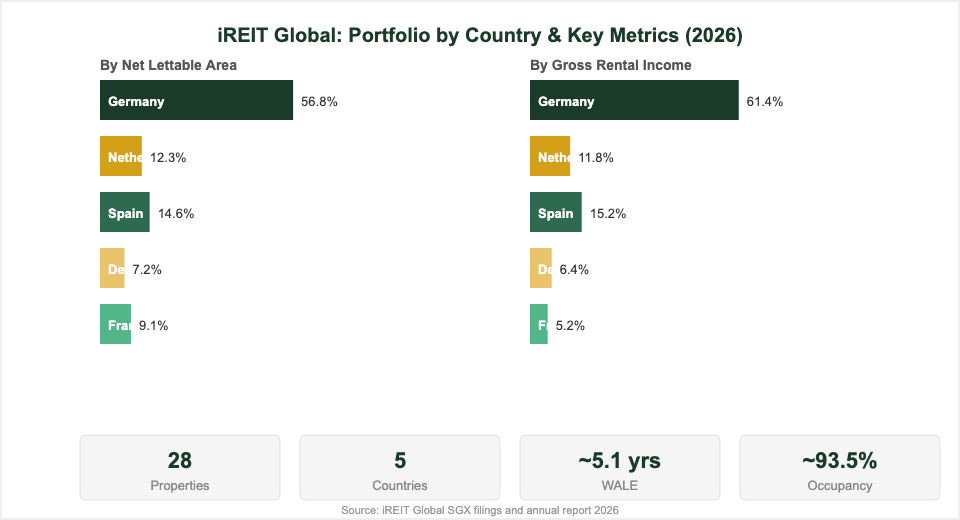
Germany remains the dominant market at approximately 57% of net lettable area (NLA), anchored by the Deutsche Telekom campuses in Berlin, Bonn, and Munich. Spain contributes around 15% of NLA through the T-Systems and government buildings in Barcelona and Madrid. The Netherlands, Denmark, and France round out the remaining 28% of the portfolio.
The all-freehold nature of the European portfolio is a quality signal — unlike leasehold Singapore properties, European office buildings are typically held in perpetuity, providing better long-term asset value stability. For a Singapore investor building a passive income portfolio in Singapore, iREIT Global offers a genuine diversification angle across geographies and tenant types.
Key Financial Metrics (2026)
Before deciding whether iREIT Global suits your portfolio, it’s important to stress-test its financial health across four key pillars: gearing, interest coverage, debt maturity, and WALE. Here’s where iREIT Global stands in October 2026:
| Metric | Value | Commentary |
|---|---|---|
| Aggregate Leverage (Gearing) | ~35.6% | Comfortably below MAS 50% limit; room for debt-funded acquisitions |
| Interest Coverage Ratio (ICR) | ~2.8× | Above MAS minimum; tighter than pre-2022 due to higher European interest rates |
| Weighted Average Lease Expiry (WALE) | ~5.1 years | Long-dated leases provide income visibility; Deutsche Telekom renewals key watch item |
| Portfolio Occupancy | ~93.5% | Slightly below peak; some vacancy in Netherlands & France |
| NAV per Unit | ~EUR 0.44 | Translated to ~SGD 0.315 at 1.43 EUR/SGD; share price trading at discount |
| P/NAV | ~0.84× | Trading below book — potential valuation upside if EUR strengthens or rates normalise |
Source: iREIT Global SGX filings, MAS Monetary Authority of Singapore guidance, October 2026
A gearing ratio of 35.6% means iREIT Global has meaningful debt capacity remaining — roughly EUR 150–170 million in additional borrowing headroom before approaching the MAS 50% limit. However, higher European interest rates since 2022 have squeezed the ICR, and this remains the key financial risk to monitor in 2026.
For Singapore investors comparing iREIT Global with local REITs like the best S-REITs in Singapore 2026, the trade-off is clear: higher yield and freehold assets, but more complex FX and geopolitical risk.
DPU History & Distribution Yield
iREIT Global’s distribution per unit (DPU) is denominated in Euro cents — a critical distinction for Singapore investors. When the EUR/SGD rate weakens, your SGD-equivalent income drops even if the EUR DPU is maintained. Conversely, a stronger Euro (as seen in early 2026) boosts your effective SGD yield.
Source: iREIT Global annual reports & SGX filings (2021–2026E). FY2026E is analyst consensus estimate.
DPU Trend Analysis
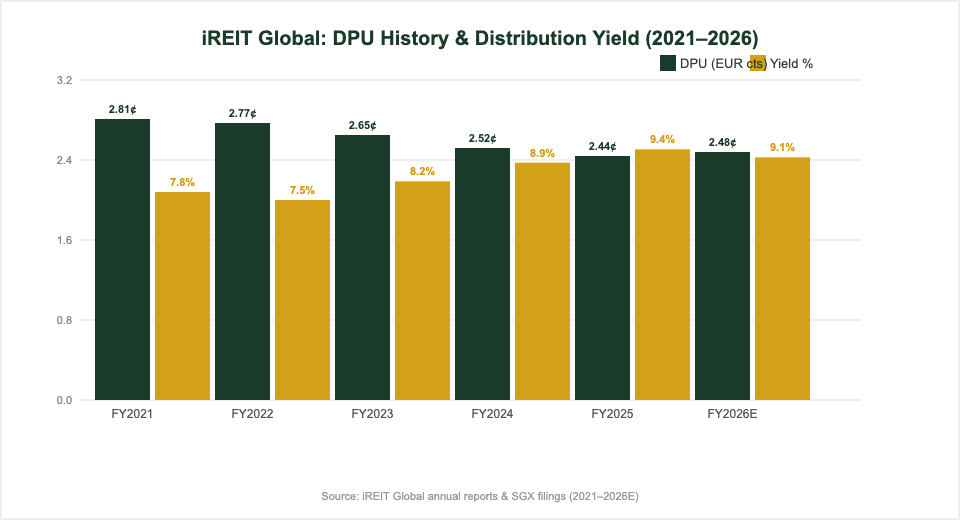
The chart above illustrates a gradual DPU compression from FY2021 to FY2024 — from approximately 2.81 EUR cents to 2.52 EUR cents. This decline reflects two primary pressures:
- Rising European interest rates (2022–2024): ECB rate hikes increased iREIT Global’s borrowing costs on variable-rate debt tranches, compressing net distributable income.
- Property divestments and redeployment timing gaps: The sale of certain German assets (including the Münster assets in 2023) temporarily reduced GRI until replacement acquisitions were completed.
FY2025 and FY2026 show signs of stabilisation around 2.44–2.48 EUR cents as European rates plateau and the ECB begins its rate normalisation cycle. If EUR/SGD remains above 1.40, Singapore investors would receive approximately SGD 3.43–3.55 cents per unit per year — translating to a yield of roughly 8.9–9.4% at the current share price of ~SGD 0.265.
To model this against your own retirement income needs, use our Singapore retirement calculator and input the expected DPU distribution as part of your passive income stream.
EUR/SGD Currency Risk: The Key Variable
Currency risk is the most important and often underappreciated risk for Singapore investors in iREIT Global. All rental income is collected in Euros, all property valuations are in Euros, and the DPU is denominated in Euro cents — but you hold units priced in Singapore dollars.
📊 Worked Example: EUR/SGD Impact on SGD Yield
Assume iREIT Global distributes 2.48 EUR cents per unit for FY2026E:
- At EUR/SGD 1.50 → SGD 3.72 cents/unit → ~14.0% yield at SGD 0.265
- At EUR/SGD 1.43 → SGD 3.55 cents/unit → ~13.4% yield at SGD 0.265
- At EUR/SGD 1.30 → SGD 3.22 cents/unit → ~12.2% yield at SGD 0.265
- At EUR/SGD 1.20 → SGD 2.98 cents/unit → ~11.2% yield at SGD 0.265
Note: Actual yield also depends on withholding taxes (0% for Singapore investors on REIT distributions) and brokerage transaction costs.
This worked example illustrates why EUR/SGD is the single biggest variable in iREIT Global’s investment case. A 15% EUR depreciation against SGD would reduce your effective yield by approximately 1.5–2 percentage points — making it potentially less competitive against local S-REITs yielding 6–7%.
The natural hedge available to Singapore investors is to pair iREIT Global with SGD-denominated income assets — such as Singapore Savings Bonds or CPF top-ups via our Endowus referral code (code: 2V343) — to balance the currency exposure in your overall portfolio.
iREIT Global vs European REIT Peers
Singapore investors who want European exposure can choose between iREIT Global and a handful of other SGX-listed or SG-accessible European-focused REITs. Here’s how iREIT Global stacks up against its closest peers in October 2026:
| REIT | Geography | Yield (est.) | Gearing | WALE | P/NAV |
|---|---|---|---|---|---|
| iREIT Global (UD1U) | Europe | ~9.1% | ~35.6% | ~5.1 yrs | ~0.84× |
| Elite Commercial REIT (MXNU) | UK | ~8.4% | ~43.2% | ~7.2 yrs | ~0.79× |
| Cromwell REIT (CWBU) | Europe | ~8.8% | ~38.4% | ~4.3 yrs | ~0.72× |
| Mapletree Pan Asia Commercial Trust (N2IU) | Asia-Pacific | ~7.2% | ~40.5% | ~3.8 yrs | ~0.82× |
Source: SGX filings, Bloomberg estimates, October 2026. Yields are trailing 12-month estimates and subject to change.
Compared to its European peer group, iREIT Global offers the highest yield at ~9.1%, lower gearing than Elite UK REIT, and a longer WALE than Cromwell — making it arguably the most defensively positioned of the three European office REITs listed on SGX. The discount to NAV (0.84×) also presents a potential rerating opportunity if European office sentiment improves or the EUR strengthens against SGD.
Investment Verdict: Buy, Hold or Sell?
iREIT Global occupies a distinctive niche in the S-REIT universe. It is not a REIT for everyone — but for the right investor profile, it offers a compelling risk-adjusted yield in October 2026.
✅ Reasons to Consider iREIT Global
- High distribution yield (~9.1%) — one of the highest in the S-REIT space for a non-hospitality, investment-grade tenant base
- Blue-chip tenant quality — Deutsche Telekom and government agencies provide near-sovereign credit backing for rental income
- Low gearing (35.6%) — significant capacity to acquire accretive assets if European cap rates normalise
- Freehold portfolio — unlike many Singapore REITs with 60-year leasehold properties, iREIT’s European assets are freehold
- ECB rate normalisation tailwind — falling European rates reduce refinancing costs and improve ICR headroom in 2026–2027
- Deep discount to NAV (0.84×) — potential re-rating as European office sentiment improves and rates decline
⚠️ Key Risks to Monitor
- EUR/SGD exchange rate risk — the single biggest variable; a sustained EUR weakness reduces SGD-equivalent DPU
- Lease expiry concentration — Deutsche Telekom master leases rolling in the next 3–5 years are the critical renewal risk; any early exit would structurally impair income
- European office structural demand trends — remote working has permanently reduced office demand in some European cities; tenant renewal risk beyond 2028 is real
- Liquidity risk — iREIT Global is a small-cap REIT with lower trading volume than Keppel DC or Mapletree REITs; bid-ask spreads can be wide during volatile periods
- Management track record — Tikehau’s European asset management expertise is strong, but distribution growth has been difficult to achieve in a rising rate environment
Our Take
iREIT Global is best suited for income-focused Singapore investors who want European diversification and are comfortable managing EUR/SGD FX exposure. At a ~9.1% yield and 0.84× P/NAV, the risk-reward is attractive relative to peers — but it is a speculative hold/accumulate for patient investors rather than a conviction buy at current prices. Position sizing is key: most Singapore income portfolios should limit European-currency REITs to 5–10% of total REIT allocation. Pair it with SGD-denominated income sources via Syfe (code: SRPRFFFCD) or FSMOne (P0544985) to balance currency risk.
Frequently Asked Questions
Common questions from Singapore investors about iREIT Global (SGX: UD1U).
What is iREIT Global and where is it listed?
What is iREIT Global's current distribution yield?
What is the risk of investing in iREIT Global?
How does iREIT Global compare to Elite Commercial REIT?
Is iREIT Global suitable for CPF or SRS investment?
Where can I buy iREIT Global shares in Singapore?
This article was researched with the help of AI. While we strive to keep all information accurate and up to date, there may be errors. If you notice any discrepancies, please contact us.