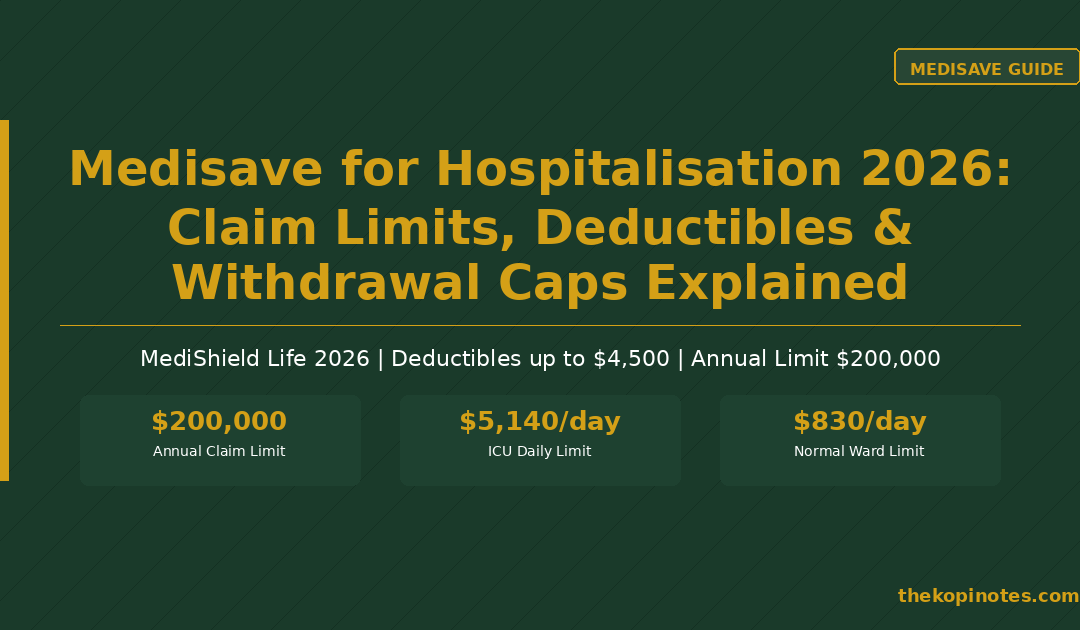
Medisave for Hospitalisation 2026: Claim Limits, Deductibles and Withdrawal Caps Explained
Updated September 2026 | Category: Integrated Shield Plans
📋 IN THIS GUIDE
- What does MediShield Life actually cover?
- MediShield Life deductibles by ward class (2026)
- Daily claim limits and annual cap
- Medisave withdrawal limits for hospitalisation
- How a hospital bill gets paid — worked example
- Co-insurance and how it scales
- Do you need an Integrated Shield Plan?
- Frequently asked questions
When you’re hospitalised in Singapore, your bill is paid in layers — MediShield Life covers the largest chunk, Medisave tops it up, and you (or your Integrated Shield Plan rider) pay the deductible and co-insurance. As of 1 June 2026, MediShield Life raised its deductibles (from $1,500–$3,000 to $1,500–$4,500 depending on ward class and age) while also significantly lifting daily claim limits and raising the annual cap to $200,000. This guide explains exactly what you’ll pay, ward by ward, step by step.
Not financial advice. All figures are for educational reference only. Data as at September 2026 unless noted.
What does MediShield Life actually cover?
MediShield Life is Singapore’s basic, mandatory health insurance scheme administered by the CPF Board. Every Singapore Citizen and Permanent Resident is automatically covered from birth. It pays for “large hospital bills and selected costly outpatient treatments” — but it is not designed to cover 100% of your bill. It is a catastrophic coverage layer, not a co-pay elimination tool.
MediShield Life pays after:
- The deductible — a fixed amount you pay first each policy year before MediShield Life kicks in (raised significantly from 1 June 2026).
- Co-insurance — a percentage of the remaining claimable bill that you share with MediShield Life (10% → 5% → 3% in tiers).
Medisave can be used to pay both the deductible and the co-insurance portion. If you hold an Integrated Shield Plan with a full rider, the rider pays the deductible and co-insurance on your behalf — leaving you with only truly non-claimable charges.
MediShield Life deductibles by ward class (2026)
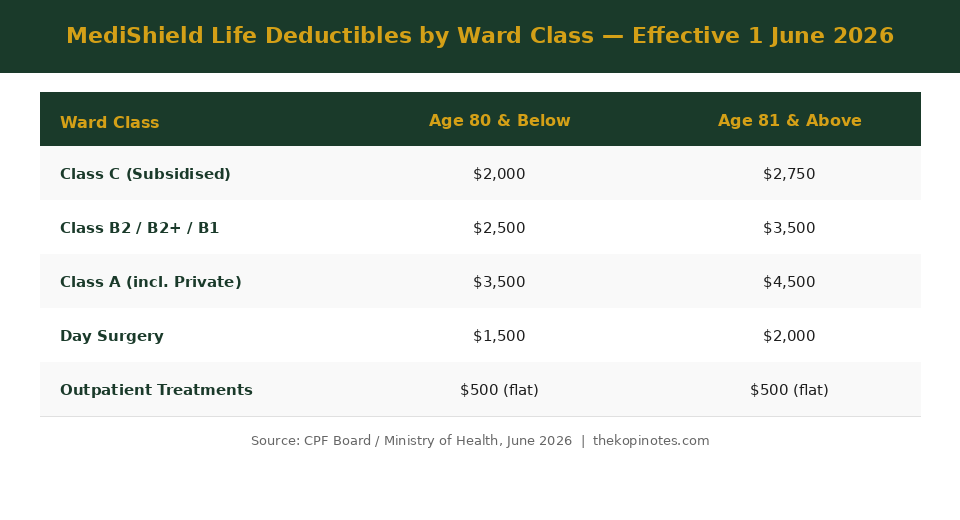
The deductible is the amount you pay out-of-pocket (or from Medisave) before MediShield Life begins to pay any claim. From 1 June 2026, deductibles were revised upward across all ward classes, with a higher deductible applying to patients aged 81 and above:
| Ward Class | Age 80 & Below | Age 81 & Above |
|---|---|---|
| Class C (Subsidised) | $2,000 | $2,750 |
| Class B2 / B2+ / B1 | $2,500 | $3,500 |
| Class A (incl. Private) | $3,500 | $4,500 |
| Day Surgery | $1,500 | $2,000 |
| Outpatient Treatments | $500 | $500 |
Source: CPF Board / Ministry of Health, effective 1 June 2026. Deductible applies once per policy year (April–March).
Key point: The deductible is per policy year (April to March), not per admission. If you are hospitalised twice in the same policy year and have already paid your deductible in the first admission, you will not pay it again in the second. This makes MediShield Life considerably more valuable for those who face repeated hospitalisations in a single year.
If you are wondering how ward class affects your overall bill, our guide to understanding ward classes and hospitalisation costs walks through the trade-offs in detail.
Daily claim limits and annual cap
In addition to the deductible, MediShield Life pays only up to certain per-day and per-procedure limits. From 1 June 2026, these were raised significantly compared to the pre-2026 schedule:
| Hospital / Care Type | Daily Limit | Notes |
|---|---|---|
| Normal ward | $830/day | +$800 first 2 days (MediShield add-on) |
| Intensive Care Unit (ICU) | $5,140/day | +$800 first 2 days |
| Psychiatric ward | $230/day | Max 60 days per year |
| Community hospital (rehabilitative) | $370/day | Sub-acute: $570/day |
| Palliative (general / specialised) | $460–$500/day | |
| Surgical procedures | $240–$3,900 | Tables 1–7 by complexity |
| Implants | Up to $7,000 | Per procedure |
| Annual claim limit | $200,000 | No lifetime limit |
Source: CPF Board / Ministry of Health, effective 1 June 2026. Annual limit is per policy year; there is no lifetime cap.
The removal of the lifetime limit (which previously stood at $300,000) is one of the most significant changes from the 2026 enhancement. Previously, a person who suffered from serious conditions requiring years of treatment could eventually exhaust their lifetime MediShield Life limit. That cap no longer exists.
Medisave withdrawal limits for hospitalisation
Your Medisave account — part of your CPF savings — can be used to pay hospital bills, including the deductible and co-insurance portions. However, Medisave also has its own withdrawal limits, independent of what MediShield Life pays:
- First 2 days as inpatient: Up to $550 per day from Medisave
- Subsequent inpatient days: Up to $400 per day
- Day surgery: Up to $300 per procedure
- Community hospital: Up to $250 per day (annual cap of $5,000)
These Medisave limits are separate from and additional to what MediShield Life reimburses. In a typical hospitalisation, MediShield Life pays the largest portion of the claimable bill first, and Medisave is then used to pay what remains — the deductible, co-insurance, and any shortfall from MediShield Life’s claim limits.
If you want to understand how to structure your CPF savings and Medisave balances to handle medical emergencies, our CPF investment strategy guide explains how to balance growth and liquidity across your OA, SA, and MA accounts.
How a hospital bill gets paid — worked example
To see how all these layers work together, let’s walk through a realistic example: a 45-year-old patient admitted to a Class B1 ward for 5 days following an emergency appendectomy, with a total bill of $20,000.
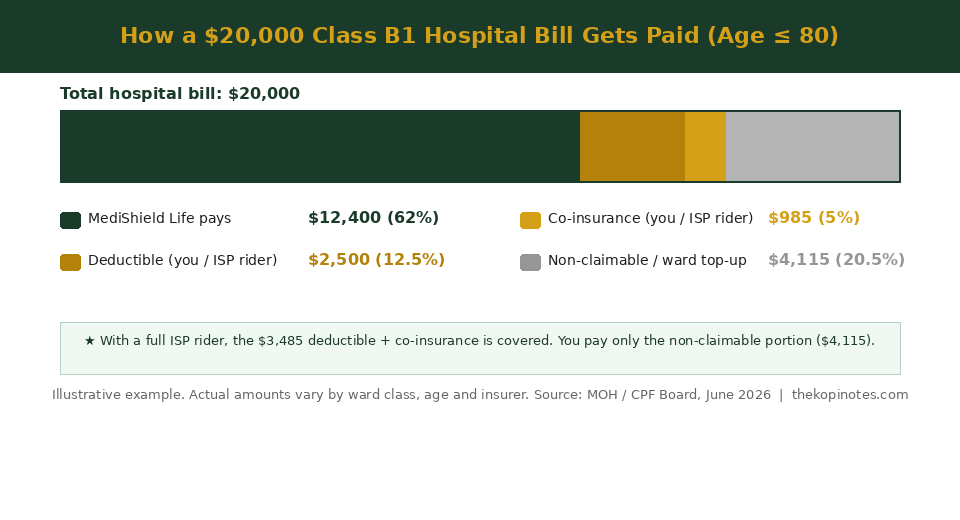
In this example (Class B1, age 45, total bill $20,000):
- Deductible (patient pays first): $2,500 — payable from Medisave or cash
- Remaining claimable amount: The claimable portion less the deductible is assessed against MediShield Life’s claim tables. After applying daily ward limits, surgical tables and other schedule limits, MediShield Life has a payable amount. Let’s say the claimable portion (before deductible) is $15,500.
- Co-insurance: On the $13,000 remaining after deductible: 10% on the first $5,000 = $500; 5% on the next $5,000 = $250; 3% on the remaining $3,000 = $90. Total co-insurance = $840 approximately.
- MediShield Life pays: $13,000 – $840 = approximately $12,160
- Non-claimable charges: ~$4,500 (ward top-up, specialist fees above schedule, items not covered)
- Patient pays: $2,500 (deductible) + $840 (co-insurance) + $4,500 (non-claimable) = $7,840 from Medisave / cash
With an Integrated Shield Plan rider, your deductible ($2,500) and co-insurance ($840) are covered by the rider, leaving you only with the non-claimable charges (~$4,500). This is the core value proposition of a full ISP rider — not that it reduces your premium, but that it caps your exposure to the deductible and co-insurance on any single admission.
You can read through the full step-by-step hospitalisation claim process in our Medisave hospitalisation step-by-step guide.
Co-insurance and how it scales
Co-insurance is the percentage of the claimable bill (after deductible) that you share with MediShield Life. The structure is tiered — you pay a higher percentage on smaller bills, and the percentage drops as the bill rises:
- First $5,000 of claimable amount (after deductible): 10% co-insurance
- Next $5,000 ($5,001–$10,000): 5% co-insurance
- Amount above $10,000: 3% co-insurance
This design means that for catastrophic bills — the scenario MediShield Life was designed for — your co-insurance burden stays manageable. On a $100,000 claimable bill (after deductible), your co-insurance is: (10% × $5,000) + (5% × $5,000) + (3% × $90,000) = $500 + $250 + $2,700 = $3,450. MediShield Life absorbs $96,550.
This is also why the co-insurance rider on an Integrated Shield Plan has genuine value for middle-income Singaporeans: while the dollar amounts are manageable at smaller bill sizes, a sudden large bill could strain any household. Removing the co-insurance and deductible risk entirely provides genuine peace of mind and liquidity protection.
Do you need an Integrated Shield Plan?
MediShield Life provides a reasonable safety net — particularly after the 2026 enhancements — but it has limitations that an Integrated Shield Plan (ISP) addresses:
- MediShield Life is designed around Class B2 / C subsidised ward rates. If you stay in Class A or a private hospital, a larger portion of your bill becomes “non-claimable” because charges exceed MediShield Life’s schedule limits.
- An ISP upgrades your coverage to the insurer’s own schedule limits, which are generally aligned to the ward class you choose (B1, A, or private).
- An ISP rider removes the deductible and co-insurance, giving you a more predictable total bill.
Whether an ISP makes financial sense depends on your savings buffer, your risk tolerance, your family medical history, and which ward class you prefer. A young, healthy individual with strong CPF balances and cash savings may reasonably rely on MediShield Life alone. As you age and your health risk profile increases, the value of comprehensive ISP coverage typically rises.
If you are comparing ISP options, platforms like Syfe offer insurance comparison tools alongside their investment products, while Endowus focuses primarily on investment but offers comprehensive guides on holistic financial planning.
For those planning long-term retirement finances that account for healthcare costs in later life, our Singapore retirement planning calculator can help you model how much you may need to set aside for hospitalisation and long-term care beyond what MediShield Life covers.
Key takeaways
- MediShield Life deductibles rose from 1 June 2026: Class B1 deductible is now $2,500 (age ≤80) or $3,500 (age 81+).
- The annual claim limit rose to $200,000, and the lifetime cap was eliminated — a major improvement for those with serious or chronic conditions.
- ICU coverage rose sharply to $5,140/day, up from the pre-2026 limit.
- Medisave can cover the deductible and co-insurance, subject to its own daily withdrawal limits.
- An Integrated Shield Plan rider covers the deductible and co-insurance, leaving you to pay only non-claimable charges.
- The deductible applies once per policy year (April–March), not per admission.
Frequently Asked Questions
What is the MediShield Life deductible in 2026?
Can I use Medisave to pay my MediShield Life deductible?
What is the annual claim limit for MediShield Life in 2026?
How does MediShield Life co-insurance work?
What does an Integrated Shield Plan rider cover that MediShield Life does not?
Is the MediShield Life deductible paid once a year or once per hospitalisation?
Disclaimer: This article is for general educational purposes only and does not constitute financial or insurance advice. CPF and MediShield Life rules change over time — always verify with the CPF Board or Ministry of Health directly before making decisions. Data as at September 2026.
Get Free Insurance Advice
Speak with a licensed insurance advisor. No obligation, no cost.
By submitting this form, you agree to our Privacy Policy.
This article was researched with the help of AI. While we strive to keep all information accurate and up to date, there may be errors. If you notice any discrepancies, please contact us.