MediSave for Integrated Shield Plan Riders 2026: How Much Can You Actually Use?
A plain-English breakdown of Additional Withdrawal Limits, deductibles, and co-payments under MOH’s new ISP rider rules.
Yes, MediSave can still pay for your Integrated Shield Plan (ISP) rider premium, deductible, and co-payment in 2026. But MOH’s new rider rules mean you carry more of the bill yourself. Your rider premium’s private insurance portion is capped by an Additional Withdrawal Limit of $300 to $900 a year, based on your age, while deductibles and co-payments draw from your MediSave hospitalisation withdrawal limits.
Not financial advice. All figures are for educational reference only. Data verified as at 30 July 2026 against MOH and CPF Board sources, unless otherwise noted.
- Your ISP rider premium is split into two parts. MediShield Life premiums are fully MediSave-payable; the private insurance top-up is capped by an Additional Withdrawal Limit (AWL) of $300–$900 a year depending on your age.
- From 1 April 2026, new riders no longer cover your deductible, and the co-payment cap has risen to a minimum of $6,000 a year. You can still use MediSave for both, subject to the usual hospitalisation withdrawal limits.
- Run the maths before you switch — the case studies below show how premium savings can outweigh (or fall short of) the extra cash you’ll pay at claim time.
Table of Contents
Contents — Click to expand
- What Changed for ISP Riders From 1 April 2026
- MediSave and Your ISP Premium: The AWL Explained
- Can You Use MediSave for the New Deductible and Co-Payment?
- Worked Example: What a Real Hospital Bill Looks Like Now
- How Much Have Insurers Actually Cut Premiums By?
- What You Should Do Now
- Frequently Asked Questions
What Changed for ISP Riders From 1 April 2026
MOH announced the new ISP rider rules on 26 November 2025. They took effect on 1 April 2026, and they change how much of your hospital bill your rider actually covers.
Two things changed. First, new riders sold from 1 April 2026 no longer cover your minimum IP deductible. You now pay this deductible yourself before your insurance kicks in. Second, the annual co-payment cap — the most you’d pay in cash-plus-MediSave co-insurance each year — rose from a minimum of $3,000 to a minimum of $6,000. This cap excludes the deductible. The minimum 5% co-payment rule hasn’t changed.
Why the change? MOH’s data showed private hospital policyholders with riders were 1.4 times as likely to make a claim, with claims 1.4 times larger on average, than those without riders. Full “first-dollar” coverage was driving up bill sizes and, in turn, premiums for everyone. The trade-off: new riders are around 30% cheaper on average, but you carry more of the bill when you do claim.
Minimum IP Deductibles by Ward Class
| Targeted Coverage / Ward Class | Minimum Deductible |
|---|---|
| Class A / Private | $3,500 |
| Class B1 | $2,500 |
| Class B2 / C | $2,000 / $1,500 |
| Day Surgery — Non-Subsidised | $2,000 |
| Day Surgery — Subsidised | $1,500 |
Source: MOH, “New requirements for Integrated Shield Plan riders”, 26 November 2025 (Annex A)
If you bought a rider before 27 November 2025, your existing terms are grandfathered — you keep them as-is unless your insurer says otherwise. If you bought a rider between 27 November 2025 and 31 March 2026, your insurer must transition you to a compliant rider by your first renewal on or after 1 April 2028.
MediSave and Your ISP Premium: The AWL Explained
Your ISP premium has two parts. The MediShield Life (MSL) portion is the compulsory base layer — you can pay this fully with MediSave. The rest is the private insurance top-up that gives you access to Class A wards or private hospitals, and this portion is capped by what CPF Board calls the Additional Withdrawal Limit, or AWL.
The AWL exists so you don’t drain your MediSave account on premiums alone, leaving nothing for actual hospital bills later in life. Whatever premium exceeds your AWL, your insurer collects from you in cash — usually via GIRO.
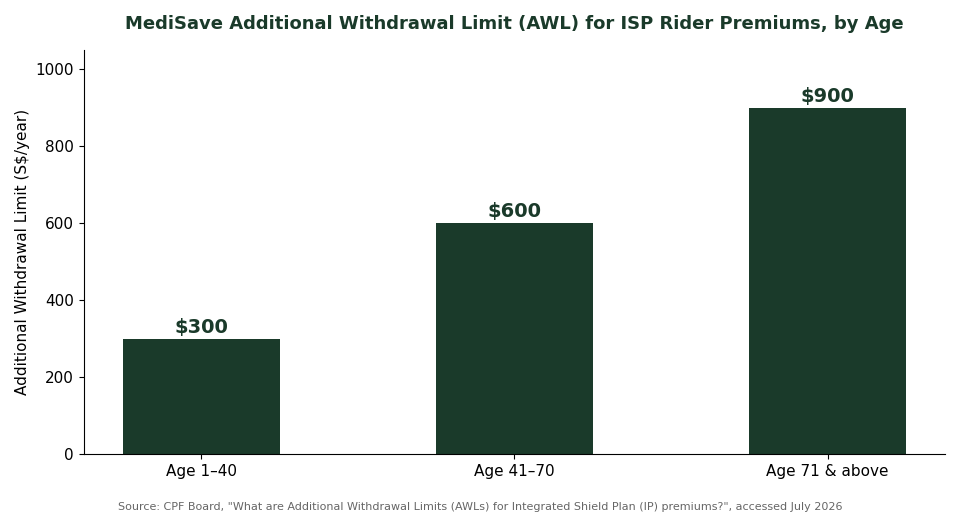
| Age Next Birthday | Additional Withdrawal Limit (AWL) |
|---|---|
| 1 – 40 | $300 per year |
| 41 – 70 | $600 per year |
| 71 and above | $900 per year |
Source: CPF Board, “What are Additional Withdrawal Limits (AWLs) for Integrated Shield Plan (IP) premiums?”, accessed July 2026
Here’s why this matters more in 2026: even though the new riders are cheaper, older policyholders on higher-tier plans may still have a private insurance premium that exceeds their AWL — especially close to renewal age brackets. If your rider premium’s private component is, say, $750 a year and you’re 45, your AWL only covers $600 of it. The remaining $150 comes out of your bank account, not MediSave.
Can You Use MediSave for the New Deductible and Co-Payment?
Yes. MOH has confirmed that the deductible and co-payments under the new rider rules can be paid using MediSave, subject to the usual MediSave hospitalisation withdrawal limits that already apply to any admission — these limits are separate from the AWL used for premiums.
In practice, this means the mechanics of paying a hospital bill haven’t changed. What’s changed is the size of the deductible and co-payment portion you’re now responsible for, because your rider no longer absorbs the deductible the way older riders did.
One number to keep in mind: the Basic Healthcare Sum (BHS) — the cap on how much you can hold in your MediSave Account — was raised to $79,000 for 2026, up from $75,500. This doesn’t change your withdrawal limits, but it does mean you can build up a slightly larger MediSave buffer for exactly this kind of co-payment exposure.
Worked Example: What a Real Hospital Bill Looks Like Now
Numbers help more than percentages. Here’s MOH’s own worked example, adapted for clarity.
Mr Tan, 60, switches from his old private hospital rider to a new compliant rider in April 2026. He immediately saves 30% on his premium — about $1,600 in cash that year. Three years later, he needs a knee joint replacement at a private hospital. The bill comes to $56,900.
| Item | Amount |
|---|---|
| Total bill (private hospital, knee replacement) | $56,900 |
| Deductible (Class A / Private) | $3,500 |
| 5% co-payment on remainder | $2,670 |
| Total payable by Mr Tan (via MediSave) | $6,170 |
| Rider premium saved over 3 years (cash) | $4,800 |
Source: MOH, “New requirements for Integrated Shield Plan riders”, 26 November 2025 (Annex B, Case Example 1), figures rounded
Mr Tan pays $3,330 more out of MediSave for this surgery than he would have under his old rider. But he’d already banked $4,800 in premium savings over the prior three years, and he’ll keep saving every year after that as premiums rise with age. His MediSave withdrawal for the bill stays within the applicable limits, so no cash top-up is needed for this claim.
The lesson: a single large claim usually doesn’t wipe out the premium savings — but it does mean holding a healthier MediSave (or cash) buffer than you might have under the old, more generous riders.
How Much Have Insurers Actually Cut Premiums By?
All seven ISP insurers relaunched their riders on 1 April 2026 to meet the new MOH requirements. The size of the premium cut varies quite a bit by insurer and plan — here’s a snapshot.
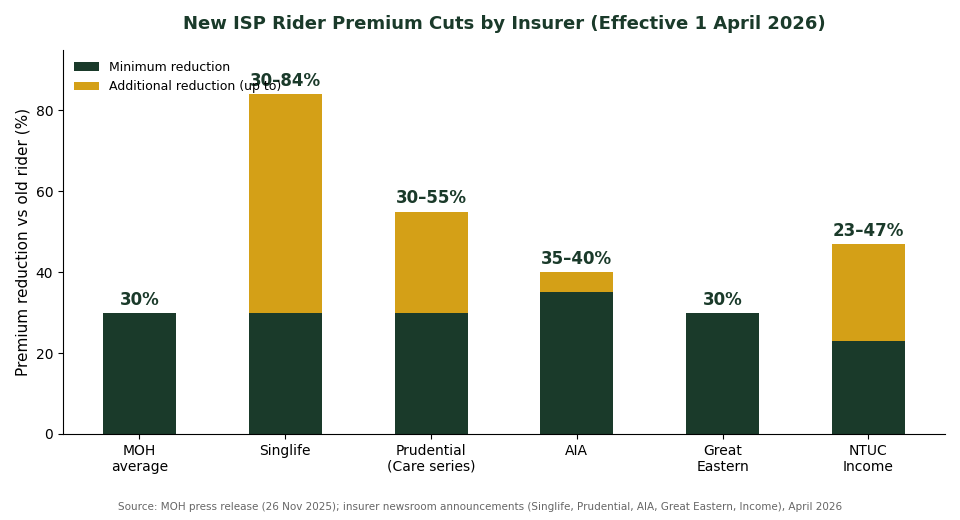
| Insurer | New Rider(s) | Premium Cut vs Old Rider |
|---|---|---|
| MOH industry average | — | ~30% |
| Singlife | Health Plus Private / Public | 30% – 84% |
| Prudential | PRUExtra Care series / Preferred Care | ≥30% (Preferred Care: ≥45%, up to 55%) |
| AIA | AIA Max VitalHealth | ~35% – 40% |
| Great Eastern | GREAT TotalCare 2 (incl. Prime) | ~30% (in line with MOH average) |
| NTUC Income | Optima Care / Essential Care | 23% – 47% (plus 15% first-year welcome discount to 31 Mar 2027) |
Source: MOH press release (26 Nov 2025); Singlife, Prudential, AIA and Income newsroom / product announcements, April 2026. Figures vary by age and plan tier — see each insurer’s own illustration for your exact premium.
For the full plan-by-plan breakdown, read our shield plan comparison of all 7 insurers’ new riders. If you’re specifically weighing whether to switch your existing rider, our ISP rider changes guide walks through the decision in more detail.
What You Should Do Now
Three practical steps, in order.
1. Check your AWL band. If you’re 41 or older, you can absorb a higher private insurance premium through MediSave before cash kicks in. If you’re younger, your $300 AWL fills up faster — budget for cash top-ups on richer plans.
2. Estimate your worst-case co-payment. Under the new rules, your maximum yearly out-of-pocket (excluding deductible) is capped at $6,000 if you use a panel or pre-authorised provider. Add your ward-class deductible on top, and you have your realistic worst-case bill exposure for the year.
3. Keep a MediSave or cash buffer sized to that worst case. Our MediSave limit 2026 guide covers how the $79,000 BHS and top-up rules work if you want to build this buffer through voluitary top-ups. For a full walkthrough of how MediSave interacts with your Shield Plan more broadly, see our CPF Shield Plan MediSave guide.
If you hold a rider bought before 27 November 2025, there’s no forced deadline yet — but it’s worth asking your financial advisor whether the new, cheaper rider suits you better, especially if your current premium is creeping up at each renewal.
Disclaimer: This article is for educational purposes only and does not constitute financial or insurance advice. Speak to a licensed financial adviser before switching or purchasing an Integrated Shield Plan rider. All figures are sourced from MOH, CPF Board, and insurer public disclosures as at 30 July 2026 and may change.
Frequently Asked Questions
Can I use MediSave to pay for my Integrated Shield Plan rider premium in 2026?
Yes. The MediShield Life portion of your premium is fully MediSave-payable. The private insurance top-up portion is capped by an Additional Withdrawal Limit (AWL) of $300 to $900 a year depending on your age — anything above that, your insurer collects in cash.
How much MediSave can I use for my ISP rider premium each year?
For the private insurance component specifically, the AWL is $300 a year if you’re 40 or younger, $600 a year if you’re 41 to 70, and $900 a year if you’re 71 or older. This is separate from the MediShield Life portion, which has no such cap.
Can I use MediSave to pay the new higher deductible and co-payment?
Yes. MOH has confirmed the deductible and co-payments under the new rider rules can be paid using MediSave, subject to the same hospitalisation withdrawal limits that already apply to any admission. These are separate from the AWL used for premiums.
What happens to my MediSave withdrawal limit if I switch to the new rider?
Switching riders doesn’t change your MediSave withdrawal limits — the AWL for premiums and the hospitalisation withdrawal limits for claims are set by CPF Board and apply regardless of which rider you hold. What changes is how much of the bill your new rider covers before you start using MediSave or cash.
Do I have to switch to the new ISP rider by a certain date?
If you bought your rider before 27 November 2025, there’s no MOH-mandated switch date — your terms are grandfathered, and individual insurers decide their own approach. If you bought between 27 November 2025 and 31 March 2026, your insurer must move you to a compliant rider by your first renewal on or after 1 April 2028.
What if my MediSave savings run low because of the new co-payment rules?
You can top up your MediSave Account voluntarily, up to the Basic Healthcare Sum of $79,000 for 2026. If your MediSave balance and AWL still aren’t enough to cover a large bill, the shortfall is payable in cash — most insurers allow instalment plans for this. Building a buffer ahead of time is the better option where possible.
Plan Your Healthcare Financing With Confidence
See how your MediSave, ISP rider, and retirement savings fit together.
Get Free Insurance Advice
Speak with a licensed insurance advisor. No obligation, no cost.
By submitting this form, you agree to our Privacy Policy.
This article was researched with the help of AI. While we strive to keep all information accurate and up to date, there may be errors. If you notice any discrepancies, please contact us.