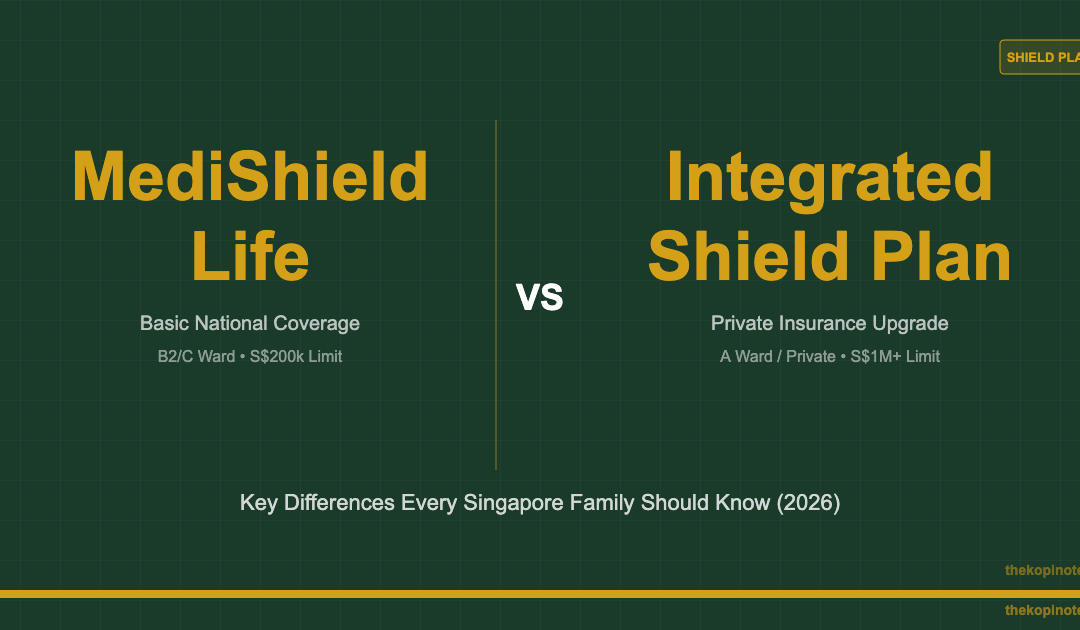
MediShield Life vs Integrated Shield Plan: What’s the Real Difference? (2026)
Singapore’s two-tier health insurance system explained — so you know exactly what you’re paying for.
MediShield Life is Singapore’s mandatory national health insurance that covers basic hospitalisation in B2 and C-class public hospital wards, with an annual claim limit of S$200,000. An Integrated Shield Plan (ISP) is an optional private insurance upgrade that sits on top of MediShield Life — letting you access A-class wards or private hospitals, with claim limits up to S$1 million or more. Every Singaporean already has MediShield Life; you choose whether to add an ISP.
Not financial advice. All figures are for educational reference only. Data as at July 2026 unless noted.
- MediShield Life = compulsory, covers B2/C wards, fully MediSave-payable, S$200k annual limit.
- Integrated Shield Plan = optional upgrade, covers A ward or private hospitals, up to S$1M+ limit, part-cash premium.
- Whether you need an ISP depends on your ward preference, budget, and how much out-of-pocket risk you can handle.
In This Guide
- What Is MediShield Life?
- What Is an Integrated Shield Plan?
- Key Differences: MediShield Life vs ISP
- Claim Limits and Coverage Compared
- Premium Costs: What You Actually Pay
- ISP Riders: What Changed in April 2026
- Do You Need an ISP? A Simple Framework
- The 5 MOH-Approved ISP Providers
- Frequently Asked Questions
What Is MediShield Life?
MediShield Life is a mandatory health insurance scheme run by the CPF Board. Every Singapore citizen and Permanent Resident is automatically enrolled at birth or upon receiving PR status. You cannot opt out — and that is by design.
It was launched in November 2015, replacing the older MediShield scheme. The key upgrade: it covers pre-existing conditions and provides lifelong protection, even into old age.
What MediShield Life Covers
MediShield Life pays for a range of hospitalisation and day surgery expenses. However, it is calibrated for subsidised treatment at restructured (public) hospitals in B2 or C-class wards. Here is what that means in practice:
- Ward coverage: B2 ward (4-6 beds, partial subsidies) and C ward (6-8 beds, highest subsidies)
- Daily ward charges: Up to S$1,630/day for the first 2 days, S$830/day from day 3 onwards
- Annual claim limit: S$200,000 per policy year (no lifetime cap)
- Outpatient chemotherapy and radiotherapy
- Renal dialysis
- Approved community hospital stays
How MediShield Life Works: Deductibles and Co-Insurance
Before MediShield Life pays out anything, you first pay the deductible — a fixed amount per policy year. Once you hit that deductible, MediShield Life covers a portion of the remaining bill. You then pay co-insurance (your share of the bill above the deductible).
| Component | How It Works | Amount |
|---|---|---|
| Deductible | You pay first, before MSL kicks in | S$1,500-S$3,000/year (varies by ward class) |
| Co-insurance | Your share of the bill above deductible | 3%-10% (decreases as bill increases) |
| Annual claim limit | Max MediShield Life pays per year | S$200,000 |
| Premium payment | Fully via MediSave | S$175-S$2,550+/year by age |
Source: CPF Board, MediShield Life scheme (2026)
The good news: your MediShield Life premium is 100% payable from your MediSave account. No cash outlay required. This makes it genuinely accessible to every Singaporean.
What Is an Integrated Shield Plan?
An Integrated Shield Plan (ISP) is a private health insurance policy that layers on top of MediShield Life. Think of it as an upgrade: MediShield Life covers the base, and your ISP fills in the gap between what MediShield Life pays and what your chosen ward class or hospital actually costs.
The Two-Component Structure
Every ISP has two parts:
- The MediShield Life component — administered by CPF Board, same as standalone MediShield Life
- The additional private insurance component — provided by a private insurer (AIA, Great Eastern, Income, Prudential, or Singlife), covering the gap above B2/C-ward rates
When you buy an ISP, you are not buying two separate policies. The insurer bundles both into one plan and bills you a single premium — though the MediShield Life portion is tracked separately by CPF.
What ISPs Actually Cover
Depending on the tier you choose, an ISP can cover:
- B1-class wards in restructured hospitals (2-bedded or 4-bedded, less subsidised)
- A-class wards in restructured hospitals (single-bedded, minimal subsidies)
- Private hospital stays (full private room, private specialist fees)
- Higher daily ward limits — often S$1,000-S$2,000+/day
- Annual claim limits up to S$1 million or more
Key Differences: MediShield Life vs Integrated Shield Plan
Here is the side-by-side you have been looking for. These are the five differences that actually matter for most Singaporeans:
| Feature | MediShield Life | Integrated Shield Plan |
|---|---|---|
| Compulsory? | Yes — auto-enrolled | No — optional upgrade |
| Ward class | B2 / C (subsidised) | B1 / A / Private (your choice) |
| Annual claim limit | S$200,000 | S$500k – S$1M+ |
| Premium payment | 100% MediSave | MediSave + cash top-up |
| Provider | CPF Board | 5 private insurers (MOH-approved) |
| Pre-existing conditions | Covered | May have exclusions |
| Riders available? | No | Yes (co-pay and deductible riders, with 2026 limits) |
Source: MOH Singapore, CPF Board (2026)
Claim Limits and Coverage Compared
This is where the gap really shows. MediShield Life’s S$200,000 annual limit sounds like a lot — and for most hospitalisations, it is. A typical appendix surgery at a B2 ward might cost S$5,000-S$12,000 total, well within the cap.
However, serious conditions change the maths fast. A cancer treatment course, an ICU stay, or complex surgery at a private hospital can easily hit S$300,000-S$800,000. At that point, MediShield Life’s limit leaves a very large gap.
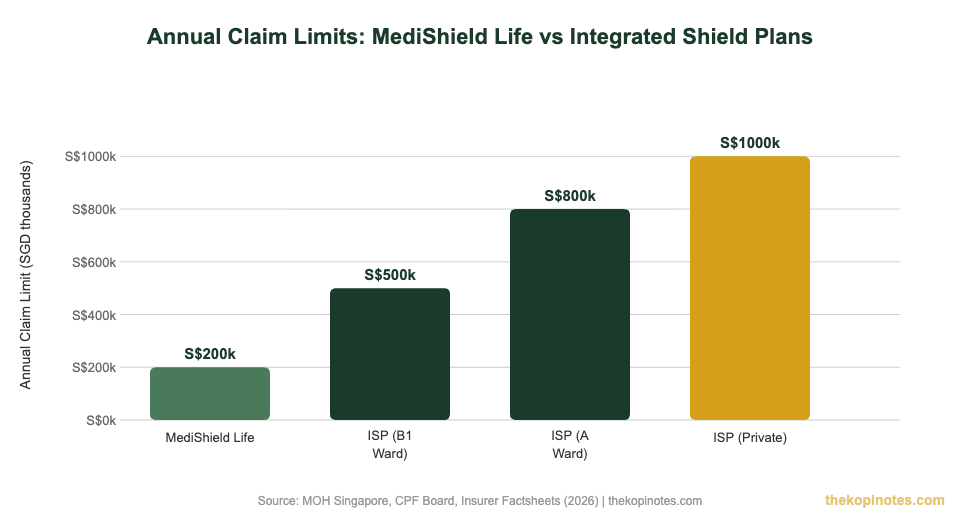
Annual claim limits by plan type. Source: MOH, CPF Board, insurer factsheets (2026)
If you stay in B2/C wards, MediShield Life’s S$200k limit is usually sufficient. But if you want the option of private care, you need an ISP with a higher ceiling — your peace of mind depends on it.
For a deeper look at what MediShield Life actually pays for, check our guide to what MediShield Life covers in Singapore.
Premium Costs: What You Actually Pay
Premiums differ dramatically between MediShield Life alone and an ISP. Here is the practical breakdown.
MediShield Life Premiums
MediShield Life premiums increase with age — the scheme uses age bands. The good news: every dollar of premium can be paid from MediSave. No cash required. Government subsidies also apply for lower-income Singaporeans and Pioneer / Merdeka Generation members.
Rough annual MediShield Life premium by age group (before subsidies):
- Age 20-25: approximately S$175/year
- Age 31-35: approximately S$295/year
- Age 41-45: approximately S$615/year
- Age 51-55: approximately S$1,190/year
- Age 61-65: approximately S$1,935/year
ISP Premiums and the MediSave Withdrawal Limit
An ISP’s total annual premium includes the MediShield Life component (fully MediSave-payable) plus the additional private insurance component. For the private component, MediSave can only cover up to the Additional Withdrawal Limit (AWL):
| Age Group | MediSave AWL (ISP add-on) | Cash Top-Up Required? |
|---|---|---|
| 40 and below | S$300/year | Likely yes, for A/private ward ISPs |
| 41 to 70 | S$600/year | Often yes for private hospital ISPs |
| 71 and above | S$900/year | Often yes for private hospital ISPs |
Source: CPF Board, Additional Withdrawal Limits 2026
In practice, if you are 35 years old with a private hospital ISP, your total annual premium might be S$1,000-S$1,500. Of that, roughly S$295 is covered by the MediShield Life component (MediSave), another S$300 from the AWL — leaving S$400-S$900 as a cash top-up. The exact amount depends on the insurer and plan tier.
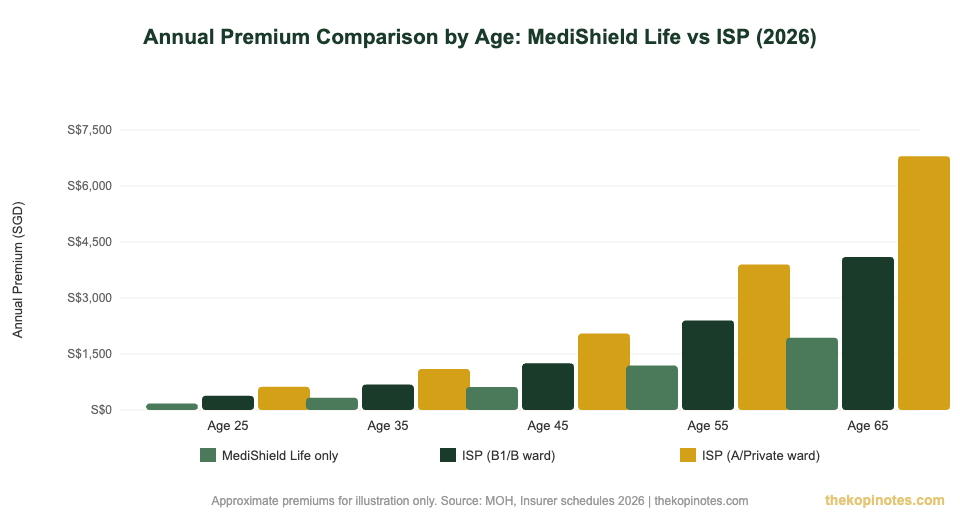
Approximate annual premiums for illustration. Source: MOH, insurer premium schedules 2026
ISP Riders: What Changed in April 2026
An ISP rider is an add-on you can buy to reduce your out-of-pocket costs further. Riders typically cover your co-payment — your share of the bill after the deductible. But MOH made significant changes effective 1 April 2026.
The Old System
Before April 2026, some ISP riders could cover nearly all out-of-pocket costs — including the deductible. This led to first-dollar coverage where patients paid nothing at all. The problem: it drove over-consumption of expensive private care, pushing premiums up for everyone.
What Changed from 1 April 2026
MOH introduced two major changes for new IP riders sold from 1 April 2026:
- No deductible coverage: New riders can no longer cover the minimum IP deductible set by MOH. You must pay the deductible out-of-pocket or from MediSave.
- Higher co-payment cap: The minimum co-payment is still 5% of your bill above the deductible, but the annual cap has risen from S$3,000 to S$6,000 per policy year.
The upside: premiums for new private hospital riders are expected to be about 30% lower on average, because MOH removed the unlimited first-dollar coverage that inflated prices. For detailed analysis of the rider rule changes, see our guide on the new ISP rider rules 2026.
Do You Need an ISP? A Simple Framework
Most financial advisers will tell you to get an ISP. But the right answer depends on your personal situation. Here is a simple framework to work through.
Stick with MediShield Life alone if:
- You are comfortable with B2/C ward treatment in a public hospital
- You prefer to save cash and top up MediSave for retirement instead
- You have very limited cash flow and the ISP cash component is a stretch
- You are young and healthy with minimal hospitalisation risk (though premiums are cheapest now — lock in before a health condition arises)
Get an ISP if:
- You want the option of B1 or A-ward in a restructured hospital (quieter, better doctor continuity)
- You want access to private hospitals or the specialist of your choice
- You have dependants and want certainty over care standards if something goes wrong
- You can comfortably pay the cash top-up (typically S$300-S$1,000/year when young)
If you are weighing costs, use our Singapore retirement planning calculator to model the long-term impact of ISP premiums on your retirement savings. The cash top-up is real money, but so is the peace of mind.
A Note on ISP Timing
The biggest mistake people make: waiting until they have a health condition before getting an ISP. Once you have a pre-existing condition, insurers can exclude it from coverage or decline your application. Buy your ISP while you are healthy, even if it feels unnecessary right now. Think of it like fire insurance — you do not buy it when the house is already burning.
The 5 MOH-Approved ISP Providers in Singapore
MOH has approved five private insurers to offer Integrated Shield Plans. Each has multiple tiers targeting different ward classes. Here is a quick snapshot:
| Insurer | ISP Name | Top Tier Coverage | Max Annual Limit |
|---|---|---|---|
| AIA | HealthShield Gold Max | Private hospital | S$1,000,000 |
| Great Eastern | SupremeHealth | Private hospital (P Plus) | S$1,500,000 |
| Income (NTUC) | Enhanced IncomeShield | Private hospital (Preferred) | S$1,200,000 |
| Prudential | PRUShield | Private hospital (Premier Plus) | S$1,000,000 |
| Singlife | Shield Plan | Private hospital (A Plus) | S$1,000,000 |
Source: MOH Singapore, Insurer product pages (2026). Limits vary by specific plan tier.
For detailed reviews of each plan, we have covered them all:
- AIA HealthShield Gold Max — complete review
- Great Eastern SupremeHealth — complete review
- Prudential PRUShield — complete review
- Singlife Shield Plan — complete review
- NTUC Income Enhanced IncomeShield — complete review
For a head-to-head comparison of all plans, see our Singapore shield plan comparison 2026.
If you are exploring ISPs as part of a broader financial plan, Endowus and Syfe referral code and sign-up bonus both offer tools and content to help you think through insurance alongside your investments.
Frequently Asked Questions
Can I have both MediShield Life and an Integrated Shield Plan?
Does MediShield Life cover pre-existing conditions?
Can I pay my ISP premium entirely from MediSave?
What is the ISP deductible and how does it work in 2026?
Which ISP is best in Singapore?
Can foreigners or PRs get an Integrated Shield Plan?
What happens if I downgrade from an ISP to MediShield Life only?
Disclaimer: This article is for general educational purposes only and does not constitute financial or insurance advice. Premium figures and coverage details are approximate and subject to change. Always refer to official MOH, CPF Board, and insurer documents for the most current information, and consult a licensed financial adviser before purchasing any insurance product. The Kopi Notes may earn referral fees from links to partner platforms.
Get Free Insurance Advice
Speak with a licensed insurance advisor. No obligation, no cost.
By submitting this form, you agree to our Privacy Policy.
This article was researched with the help of AI. While we strive to keep all information accurate and up to date, there may be errors. If you notice any discrepancies, please contact us.