CPF Shield Plan Singapore: Complete MediSave Guide (2026)
How much of your Integrated Shield Plan premium you can pay with MediSave — and how much you need in cash.
Your CPF MediSave pays for your Integrated Shield Plan (ISP) — but only up to a point. The MediShield Life base component is fully covered by MediSave. For the additional private insurance top-up, MediSave can cover up to $300–$900 per year depending on your age. Anything above that limit must be paid in cash. Here’s exactly how it works and what to budget for in 2026.
Not financial advice. All figures are for educational reference only. Data as at July 2026 unless noted.
- MediShield Life premiums are fully paid by MediSave — no cash needed.
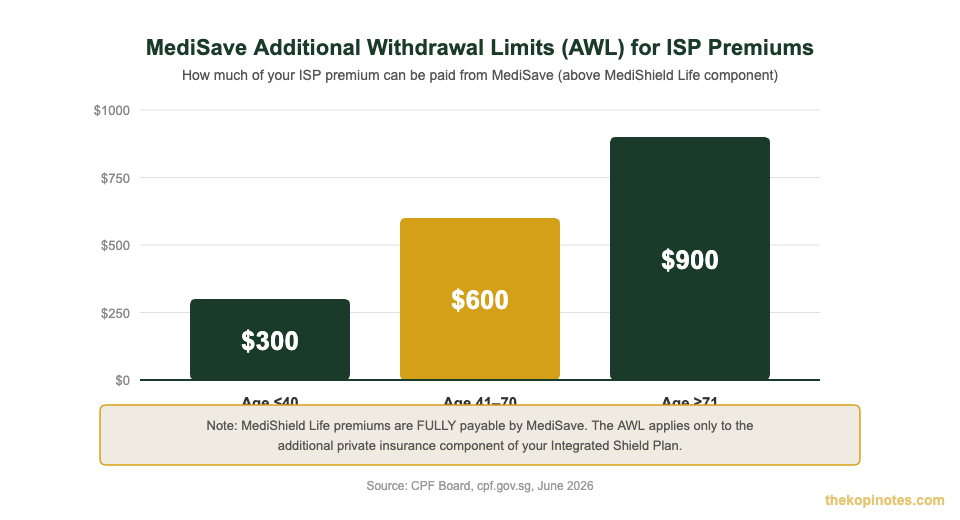
- Your ISP’s private top-up is covered by MediSave up to $300 (age ≤40), $600 (age 41–70), or $900 (age ≥71) per year.
- At younger ages, MediSave usually covers the full ISP premium. At 70+, expect a significant cash shortfall — plan ahead.
Table of Contents
Contents — Click to expand
What Is a CPF Shield Plan?
When most Singaporeans say “CPF shield plan”, they’re talking about an Integrated Shield Plan (ISP) — a hospitalisation insurance policy that sits on top of MediShield Life, the national health insurance scheme managed by the CPF Board.
Here’s how the two layers work together:
- MediShield Life (base layer): Compulsory for all Singapore Citizens and PRs. Covers hospitalisation in B2 and C class wards at public hospitals, with significant government subsidies. Premiums are automatically deducted from your MediSave account.
- Integrated Shield Plan (top-up layer): Optional private insurance from one of seven approved insurers (AIA, Singlife, Great Eastern, Prudential, NTUC Income, AXA, or Raffles Health). It extends your coverage to B1, A class wards or private hospitals. Premiums are partly paid by MediSave and partly in cash.
Think of it like this: MediShield Life is your foundation. Your ISP is the extension you build on top, paid for partly by CPF’s MediSave account and partly from your own wallet.
As of July 2026, roughly two in three Singaporeans have an ISP on top of MediShield Life, according to data from the Ministry of Health (MOH). The question most people ask is: “How much will CPF actually cover, and how much do I need to pay in cash?”
How MediSave Pays Your ISP Premium
Your annual ISP premium has two distinct components — and MediSave treats them very differently.
Component 1: MediShield Life Premium
The MediShield Life component of your ISP premium is fully payable from your MediSave account. You never need to top this up in cash. CPF Board deducts it directly. The amount depends on your age — from around $110 per year at age 20 to over $2,000 per year at age 80.
Component 2: Additional Private Insurance Premium
This is the extra amount your private insurer charges for the enhanced coverage — access to private hospitals, choice of doctors, shorter waiting times, and so on. MediSave can pay for this component too, but only up to a cap called the Additional Withdrawal Limit (AWL). Anything above the AWL must come from your own cash.
Private top-up = MediSave up to AWL + cash for the rest
Additional Withdrawal Limits (AWL) Explained
The AWL — set by the CPF Board — determines how much of your private insurance top-up MediSave can cover each year. The limit is tiered by age:
| Age Next Birthday | MediSave AWL (per year) | Who This Typically Covers in Full |
|---|---|---|
| 40 and below | $300 | Most B1 and A ward plans. Many private hospital plans at younger ages too. |
| 41 to 70 | $600 | Most B1 plans. Some private hospital plans at age 41–50. Cash needed for higher-tier plans at 60+. |
| 71 and above | $900 | Covers only part of most plans at this age. Significant cash outlay expected for private hospital coverage. |
Source: CPF Board, cpf.gov.sg, June 2026
Why are the limits so low compared to actual premiums? CPF Board deliberately keeps them modest to preserve your MediSave balance for future hospitalisation bills and retirement healthcare costs. MediSave is meant to last a lifetime — not be fully depleted on insurance premiums alone.
Your insurer handles the billing. They will automatically deduct what they can from your MediSave (up to the AWL), then issue a cash invoice for the remainder. You do not need to manually split the payment.
How Much Cash Will You Need?
The honest answer: it depends on your age and the plan tier you choose. Here’s a practical worked example for a 45-year-old on a mid-tier private hospital plan with an annual ISP premium of around $1,800 per year.
| Premium Component | Annual Amount | Paid By |
|---|---|---|
| MediShield Life component | ~$620 | MediSave (fully) |
| Additional private insurance (up to AWL) | $600 | MediSave (AWL, age 41–70) |
| Additional private insurance (above AWL) | $580 | Your cash |
Example: 45-year-old on a private hospital ward A plan, indicative 2026 premium. Actual figures vary by insurer and plan.
At 45, you might pay around $580 per year in cash — roughly $48 per month. That’s manageable for most working adults. But fast forward to age 72 with premiums of $4,500 per year and you’ll pay roughly $3,600 in cash annually — a much bigger commitment during retirement when you may not have regular income.
This is why CPF Board strongly encourages you to plan ahead and not assume MediSave will cover everything. Use the CPF Health Insurance Planner to model your long-term costs.
ISP Premium vs MediSave AWL: Plan-by-Plan Breakdown
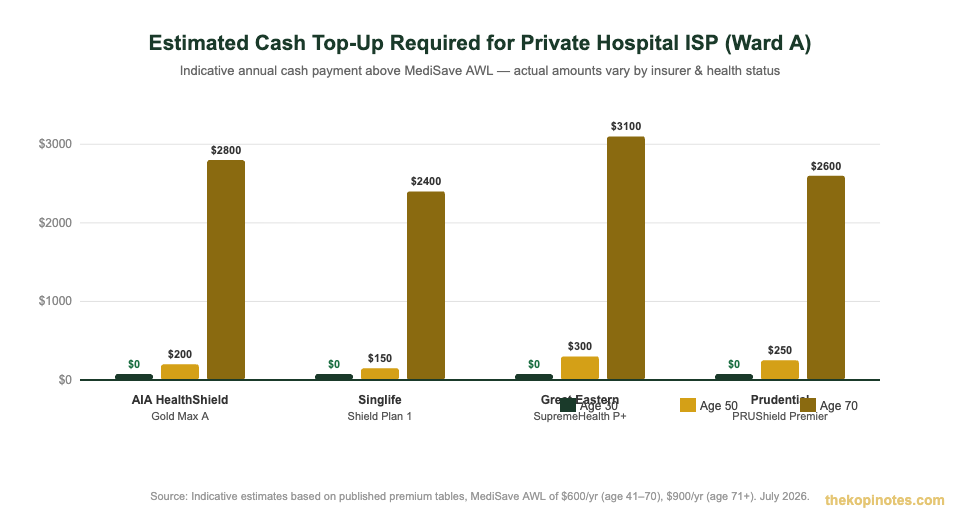
The question everyone really wants answered: “Will my MediSave cover my shield plan premium?” Here’s a breakdown across Singapore’s major insurers at different life stages. All figures are indicative based on published 2026 premium tables for private hospital (Ward A equivalent) coverage.
| Insurer & Plan | Age 30 Premium p.a. |
Age 30 Cash Needed |
Age 50 Premium p.a. |
Age 50 Cash Needed |
Age 70 Premium p.a. |
Age 70 Cash Needed |
|---|---|---|---|---|---|---|
| AIA HealthShield Gold Max A | ~$890 | $0 | ~$1,790 | ~$200 | ~$5,890 | ~$2,800 |
| Singlife Shield Plan 1 | ~$840 | $0 | ~$1,720 | ~$150 | ~$5,540 | ~$2,400 |
| Great Eastern SupremeHealth P Plus | ~$940 | $0 | ~$1,880 | ~$300 | ~$6,160 | ~$3,100 |
| Prudential PRUShield Premier | ~$910 | $0 | ~$1,840 | ~$250 | ~$5,760 | ~$2,600 |
Source: Indicative figures based on published premium tables from AIA, Singlife, Great Eastern, and Prudential (2026). MediShield Life component and applicable AWL deducted to arrive at cash figure. Actual premiums vary by health status and underwriting. Always check directly with your insurer.
The key insight from the table: at age 30, you likely pay zero cash for your shield plan. MediSave covers everything. By age 50 you might pay a few hundred dollars a year. But by age 70, you could be looking at $2,400–$3,100 in cash annually just for the base plan — before adding a rider.
This is the retirement planning problem that catches many Singaporeans off guard. If you’re reviewing your CPF investment strategy, building a buffer for rising ISP premiums in your later years is essential.
2026 Rider Changes: What Changed and What It Costs
From 1 April 2026, MOH reformed ISP riders significantly. This affects the cash component of your healthcare insurance — so it’s worth understanding.
Before April 2026, many riders covered your deductible and limited your co-payment to $3,000 per year. You essentially paid a fixed rider premium and had near-full coverage for hospitalisation bills.
From April 2026, new rider products no longer cover the deductible at all. Here’s the new structure:
- You pay the full deductible out of pocket (typically $3,500 for private hospitals)
- After the deductible: you pay 5% co-insurance on eligible bills
- Maximum annual co-payment cap: $6,000 (up from $3,000)
- Rider premiums are approximately 30% lower as a result
Trade-off: higher out-of-pocket when you actually claim
If you bought your rider before 27 November 2025, your existing terms are grandfathered. Your deductible is still covered and your co-payment cap remains $3,000. Do not switch — you lose these terms permanently if you do.
If you bought between 28 November 2025 and 31 March 2026, you will need to transition to the new rider terms by your first renewal after 1 April 2028.
Riders must always be paid in cash — MediSave cannot be used for riders. For a full breakdown of each insurer’s new rider products and pricing, see our ISP rider changes 2026 guide.
Tips for Managing Your ISP Costs
Here are practical steps to keep your shield plan affordable over your lifetime.
1. Keep your MediSave topped up
Your MediSave account earns a guaranteed 4–5% interest per year. Voluntary top-ups (up to the Basic Healthcare Sum of $79,000 in 2026) reduce your taxable income and ensure you can always cover the AWL portion of your ISP without cash stress.
2. Pick a plan tier you can sustain at 75, not just at 35
Many Singaporeans choose private hospital coverage in their 30s when premiums are low, then face sticker shock at 70 when the annual cash outlay hits $3,000+. Use the Singapore retirement calculator to model whether your retirement savings can absorb these rising costs.
3. Consider downgrading plan tier in your 60s
Switching from a private hospital plan (Ward A) to a B1 ward plan can slash your premiums by 40–60%. Many people find B1 ward quality perfectly acceptable — especially in Singapore’s restructured hospitals. You keep the same specialist access, just in a slightly different room.
4. Don’t hold a rider you no longer need
Riders make sense if you anticipate hospitalisation. But if you’re young and healthy with a strong emergency fund, the new post-2026 riders — with their higher deductibles — may not be cost-effective. Do the maths before automatically renewing.
5. Use referral platforms to compare
Before choosing or switching ISP, platforms like Endowus referral code and others can help you compare plans and apply. You can also use MOH’s ISP comparison page to see standardised plan breakdowns across all seven insurers.
Can I use MediSave to pay for a family member’s ISP?
Yes — CPF Board allows you to use your MediSave to pay for the ISP premiums of your immediate family members: spouse, children, parents, and grandparents. The AWL applies to each person’s policy based on their age, not yours. This is useful if a family member doesn’t have sufficient MediSave of their own.
For those interested in building long-term wealth alongside their healthcare planning, our guide to passive income in Singapore covers how to generate cash flow that can fund your future ISP top-ups.
Reminder: This article is for general educational purposes only. Speak with a licensed financial adviser before making any insurance decisions. Data as at July 2026.
Frequently Asked Questions
What is a CPF shield plan in Singapore?
A “CPF shield plan” refers to an Integrated Shield Plan (ISP) — a hospitalisation insurance policy that builds on top of MediShield Life, Singapore’s compulsory health insurance scheme. Your ISP premiums are partly paid from your CPF MediSave account (up to the Additional Withdrawal Limit) and partly from cash. All seven approved ISP insurers in Singapore allow MediSave payment for the base plan component.
How much of my shield plan premium can MediSave cover?
MediShield Life premiums (the base component of all ISPs) are fully payable from MediSave — no cash needed. For the additional private insurance component, MediSave covers up to $300 per year if you’re aged 40 and below, $600 per year if you’re aged 41 to 70, and $900 per year if you’re 71 and above. Any amount above these Additional Withdrawal Limits (AWLs) must be paid in cash. At younger ages, MediSave typically covers the full ISP premium. At older ages, a significant cash shortfall is common.
Do I need to pay cash for my Integrated Shield Plan every year?
Whether you pay cash depends on your age and plan tier. If you’re under 40 on a standard private hospital plan, MediSave usually covers the entire premium — no cash needed. Once you reach your 50s and 60s, most private hospital plans exceed the $600 AWL, so you’ll pay the difference in cash. By age 70+, expect annual cash payments of $1,500–$3,000+ for private hospital coverage. B1 ward plans tend to stay within the AWL longer, reducing your cash burden.
Can I use my MediSave to pay for my parents' shield plan?
Yes. CPF Board allows you to use your MediSave to pay ISP premiums for your immediate family members — including parents, grandparents, spouse, and children. The Additional Withdrawal Limit that applies is based on the family member’s age (not yours). So if your parent is 72, up to $900 per year can come from your MediSave for their plan. Any excess is still paid in cash, but this can be a helpful tool if your parent has a low MediSave balance.
Can MediSave be used to pay for ISP riders?
No. ISP riders — the optional add-ons that reduce your deductible and co-payment — must always be paid in cash. MediSave cannot be used for rider premiums. This is a key distinction: your base shield plan uses MediSave (up to AWL), but riders are a separate cash expense. After the April 2026 rider reforms, new riders have lower premiums (~30% cheaper) but no longer cover your deductible, so the tradeoff is more out-of-pocket when you claim.
What happens if I don't have enough MediSave to pay my shield plan?
If your MediSave balance is insufficient to cover your ISP premium (including the MediShield Life component), you’ll need to pay the shortfall in cash. Your insurer will notify you. To avoid this, ensure your MediSave is regularly topped up — voluntary top-ups earn 4–5% interest guaranteed, and cash top-ups qualify for income tax relief up to $8,000 per year. If your MediSave runs out entirely, your ISP coverage may lapse — which means reinstating it later could involve fresh underwriting and health declarations.
How have the 2026 ISP changes affected what I pay?
From 1 April 2026, new ISP riders no longer cover the deductible (typically $3,500 for private hospitals). Instead, you pay the deductible first, then 5% co-insurance up to a $6,000 annual cap. In exchange, new rider premiums are about 30% lower. If you bought your rider before 27 November 2025, your old terms are grandfathered — don’t switch. If you’re buying a new rider after April 2026, you’ll pay less in premiums but more when you actually need to claim. The base ISP plan (without a rider) is unaffected by these rider reforms.
Plan Your Healthcare Costs With the Right Tools
Compare ISP plans, model your retirement budget, and find the right shield plan for your needs.
Get Free Insurance Advice
Speak with a licensed insurance advisor. No obligation, no cost.
By submitting this form, you agree to our Privacy Policy.
This article was researched with the help of AI. While we strive to keep all information accurate and up to date, there may be errors. If you notice any discrepancies, please contact us.