Is Tiger Brokers Safe? A Singapore Investor’s Review (2026)
A complete guide to Tiger Brokers’ MAS regulation, fund safety, fees, and how it compares to moomoo and IBKR.
Yes, Tiger Brokers is safe for Singapore investors. Tiger Brokers (Singapore) Pte Ltd holds a Capital Markets Services (CMS) licence from the Monetary Authority of Singapore (MAS), licence number CMS100061-1. Client funds are kept in segregated accounts with DBS Bank as custodian, separate from Tiger’s own money. US securities are additionally protected by SIPC up to USD 500,000. It is not a fly-by-night platform — it is NASDAQ-listed and backed by Xiaomi and Interactive Brokers.
Not financial advice. All figures are for educational reference only. Data as at July 2026 unless noted.
- Tiger Brokers is MAS-regulated (CMS100061-1) — it is a fully licensed Singapore stockbroker, not an offshore app.
- Client funds are segregated at DBS Bank; US stocks are SIPC-covered up to USD 500,000. Your money is not pooled with Tiger’s own assets.
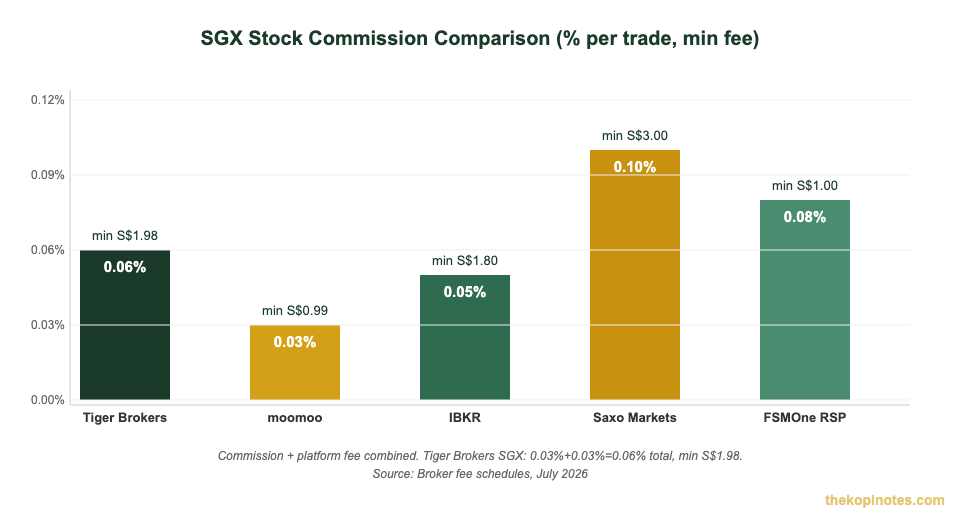
- Fees are competitive (0.06% total for SGX, min S$1.98) but moomoo often undercuts on US stocks. IBKR is better for large portfolios.
Table of Contents
Is Tiger Brokers MAS Regulated?
Yes — and this is the most important safety question you can ask about any broker.
Tiger Brokers (Singapore) Pte Ltd holds a Capital Markets Services (CMS) licence issued by the Monetary Authority of Singapore, with licence number CMS100061-1. You can verify this yourself on the MAS Financial Institutions Directory. The licence authorises Tiger Brokers to deal in capital markets products, including securities and futures, under the Securities and Futures Act.
What does MAS regulation actually mean for you in practice? It means Tiger Brokers must comply with strict rules on how it holds your money, what information it discloses, and how it handles client complaints. MAS can suspend or revoke the licence if Tiger Brokers breaches these rules — so there is a real regulatory backstop, unlike with unregulated offshore platforms.
Tiger Brokers also holds licences from multiple other top-tier regulators globally: ASIC (Australia, licence 505213), SFC (Hong Kong), FMA (New Zealand), and SEC/FINRA (United States). This multi-jurisdiction oversight is a meaningful safety signal — it means Tiger Brokers is subject to regulatory scrutiny across several major markets simultaneously.
How Are Your Funds Protected?
Regulation is necessary, but it is not the whole story. The key question is: what happens to your money and shares if Tiger Brokers goes bust?
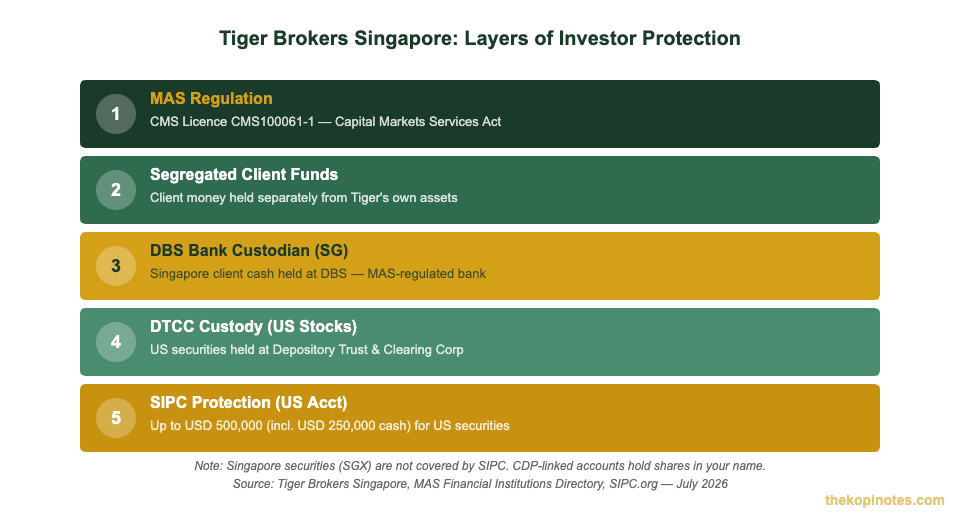
Here is how Tiger Brokers protects your assets, layer by layer:
1. Segregated Client Accounts
By law, Tiger Brokers must keep your cash completely separate from its own operating funds. Your money cannot be used to pay Tiger’s staff or settle Tiger’s own debts. This is a requirement under MAS rules for all CMS licence holders. In the event Tiger Brokers faces financial difficulty, your cash should not be at risk.
2. DBS Bank as Custodian (Singapore Cash)
Your cash balance in Singapore is held in a custodian account at DBS Bank — one of Singapore’s Big Three banks and itself MAS-regulated. This adds an institutional layer between your money and Tiger Brokers’ operations. Even if Tiger Brokers ceased operations tomorrow, your cash at DBS would remain accessible through the regulatory process.
3. CDP Option for SGX Shares
For Singapore-listed shares bought through Tiger Brokers, you can opt for a CDP-linked account. This means your shares are held in your own name at the Central Depository (CDP), not in Tiger’s name. CDP-linked holdings are the gold standard for safety in Singapore — your shares are registered to you directly, regardless of what happens to the broker. Not all digital brokers offer this; Tiger Brokers does.
4. DTCC for US Stocks
US-listed securities are held in custody at the Depository Trust and Clearing Corporation (DTCC) — the US market’s central securities depository, backed by the US financial system.
5. SIPC Protection for US Accounts
Tiger Brokers is a member of the Securities Investor Protection Corporation (SIPC). If Tiger Brokers’ US broker-dealer arm were to fail, SIPC covers your US securities account up to USD 500,000 (including up to USD 250,000 in cash). This is the same protection you get at most major US brokerages.
Important caveat: SIPC protection applies to your US brokerage account. Singapore securities (SGX shares held in custodian mode, not CDP) and cash in your Singapore cash account are not covered by SIPC. They are protected by MAS rules and the DBS custodian arrangement instead.
| Asset Type | Protection Mechanism | Coverage |
|---|---|---|
| Singapore cash balance | Segregated account at DBS Bank | MAS rules (no fixed S$ cap) |
| SGX shares (CDP-linked) | Held in your name at CDP | Full — shares are yours regardless |
| SGX shares (custodian mode) | Tiger’s custodian account, MAS rules | MAS rules (no fixed S$ cap) |
| US stocks / ETFs | DTCC + SIPC | Up to USD 500,000 (incl. USD 250k cash) |
| HK / A-share stocks | CCASS (Hong Kong Central Clearing) | HK SFC rules apply |
Source: Tiger Brokers Singapore Financial Security disclosure, MAS FID, SIPC.org — July 2026
Who Owns Tiger Brokers?
Tiger Brokers (Singapore) Pte Ltd is a subsidiary of UP Fintech Holding Limited, which trades on NASDAQ under the ticker symbol TIGR. Being a publicly listed company in the US means UP Fintech is subject to US SEC reporting requirements — quarterly earnings, audited accounts, disclosure of material events. This level of public accountability is a strong safety indicator.
Two notable backers add further credibility. Xiaomi — the Chinese electronics giant — holds a strategic stake in UP Fintech. And Interactive Brokers (IBKR), one of the world’s most reputable brokerages, is also a shareholder. Having IBKR as a backer is particularly meaningful because it signals that a highly reputable industry participant has done due diligence and invested in Tiger Brokers.
Tiger Brokers has been operating in Singapore since 2017 and serves over 2 million account holders globally as of 2026. It is not a startup. It has navigated multiple market cycles and regulatory reviews without major incidents.
Tiger Brokers Fee Structure (2026)
Safety is one dimension; cost is another. Here is a clear breakdown of what Tiger Brokers charges in 2026:
| Market | Commission | Platform Fee | Total (approx) | Minimum |
|---|---|---|---|---|
| SGX (Singapore) | 0.03% | 0.03% | 0.06% | S$1.98 |
| US stocks | US$0.005/share | US$0.005/share | US$0.01/share | US$1.99 |
| HK stocks | 0.03% | 0.03% | 0.06% | HK$10 |
| Custody fee | None | |||
| Inactivity fee | None | |||
| Deposit / Withdrawal | None (bank transfer) | |||
Source: Tiger Brokers Singapore pricing page (itiger.com/sg/commissions), July 2026
One thing to note: Tiger Brokers’ US stock fee is US$0.005 per share, not a flat percentage. If you are buying high-priced stocks (like a single NVDA share at USD 130+), this per-share fee works out to under 0.01% — excellent value. But for penny stocks or very small trades, the minimum US$1.99 kicks in and can erode returns.
Tiger Brokers vs Alternatives: How It Stacks Up
Tiger Brokers is not the only MAS-regulated digital broker in Singapore. Here is how it compares with the main alternatives — so you can make a genuinely informed choice rather than just taking marketing claims at face value.
| Feature | Tiger Brokers | moomoo SG | IBKR | Saxo Markets |
|---|---|---|---|---|
| MAS Regulated | ✓ Yes | ✓ Yes | ✓ Yes | ✓ Yes |
| SGX Commission | 0.06%, min S$1.98 | 0.03%, min S$0.99 | 0.05%, min ~S$1.80 | 0.10%, min S$3.00 |
| US Stock Fee | US$0.01/share, min US$1.99 | US$0 comm + US$0.99 platform | US$0.005/share, min US$1 | 0.10%, min US$10 |
| CDP-Linked SGX | ✓ Available | ✗ No | ✗ No | ✓ Available |
| Markets Offered | SG, US, HK, A-shares, AU | SG, US, HK, A-shares | 150+ markets globally | 71,000+ instruments |
| Fractional Shares (US) | ✓ Yes | ✓ Yes | ✓ Yes | ✗ No |
| Paper Trading | ✓ Yes | ✓ Yes | ✗ No | ✗ No |
| Best For | Multi-market, SG+US+HK, CDP available | Low-cost US stocks, beginners | Large portfolios, ETF investors | Sophisticated multi-asset traders |
Source: Broker fee schedules and product disclosures, July 2026. Always verify current fees on the broker’s official website before opening an account.
For investors building a CPF investment strategy focused on Singapore REITs and local dividend stocks, having the CDP-linked option available on Tiger Brokers is a meaningful advantage over moomoo. For a Singapore investor primarily buying US-listed ETFs like CSPX or VWRA on the LSE, however, moomoo Singapore or IBKR might work out cheaper depending on trade size.
Pros and Cons of Tiger Brokers
What Tiger Brokers Does Well
- Multi-market access: SG, US, HK, China A-shares, and Australian markets all from one account. Few Singapore digital brokers match this breadth.
- CDP-linked SGX accounts: You can hold Singapore shares in your own name at CDP — a safety advantage that moomoo does not offer.
- Paper trading: The Tiger Trade platform has a built-in paper trading mode, which is invaluable if you are new to stocks and want to practise without risking real money.
- No custody or inactivity fees: Holding shares long-term costs you nothing beyond the initial trade commission.
- Fractional US shares: You can buy a fraction of an expensive US stock for as little as USD 1, which is useful for beginners building a diversified portfolio without large capital.
- Strong institutional backing: NASDAQ-listed, with Xiaomi and IBKR as shareholders.
Limitations to Consider
- SGX fees are not the cheapest: At 0.06% (0.03%+0.03%), Tiger Brokers’ Singapore stock fees are double moomoo’s 0.03%. For regular SGX trades, this adds up. That said, if you are interested in a passive income Singapore strategy via dividend stocks, you are typically making fewer but larger trades, so the minimum fee matters more than the percentage.
- US stock per-share fee: The US$0.01 per share model is less transparent than a flat fee. For very high-share-count trades (buying hundreds of cheap shares), this can be more expensive than it appears.
- Customer service response times: Some users report slower-than-ideal support response during peak trading periods. This is a common complaint across most digital brokers.
- SGX custodian shares (non-CDP): If you hold SGX shares in custodian mode (not CDP-linked), those are not SIPC protected. They are covered by MAS rules and the DBS custodian arrangement, but you should be aware of this distinction.
Who Should Use Tiger Brokers?
Tiger Brokers is a good fit if you:
- Want access to SG, US, and HK markets from a single app without juggling multiple accounts
- Prefer to hold your Singapore shares in CDP-linked mode (i.e. in your own name) for maximum safety
- Are a beginner and want paper trading to practise before going live
- Invest primarily in higher-priced US stocks where the per-share fee works in your favour
- Want fractional US shares to build a diversified portfolio with a smaller starting amount
Consider alternatives if you:
- Trade SGX stocks frequently — moomoo’s 0.03% (min S$0.99) is cheaper for regular Singapore stock buys
- Are primarily buying LSE-listed ETFs (CSPX, VWRA) — IBKR has lower commissions for larger portfolio sizes and is the most cost-effective for serious ETF investors. Use our Singapore retirement calculator to model how fee differences compound over time
- Want the widest possible market access (150+ countries) — IBKR wins here comprehensively
- Prefer robo-advisor investing without picking individual stocks — check out the Syfe vs Endowus 2026 comparison instead
If you are building a long-term Singapore Savings Bonds and ETF portfolio alongside stocks, using Tiger Brokers for your SG stocks (in CDP mode) and IBKR for your LSE ETFs is a reasonable combination that many Singapore investors use.
Disclaimer: The Kopi Notes may earn referral fees if you sign up for brokerages via our referral links. This does not affect our editorial independence. All brokerage comparisons are based on publicly available fee schedules as at July 2026.
Frequently Asked Questions
Is Tiger Brokers safe for Singapore investors?
Yes. Tiger Brokers (Singapore) Pte Ltd is licensed by the Monetary Authority of Singapore (CMS licence CMS100061-1) under the Securities and Futures Act. Client funds are held in segregated accounts at DBS Bank, separate from Tiger’s own money. US securities are additionally protected by SIPC up to USD 500,000. You can verify Tiger Brokers’ MAS licence on the official MAS Financial Institutions Directory at eservices.mas.gov.sg.
What happens to my money if Tiger Brokers shuts down?
If Tiger Brokers were to cease operations, your assets would be handled by a court-appointed liquidator under MAS supervision. Because client funds are segregated at DBS Bank (and not co-mingled with Tiger’s own money), they are protected from Tiger’s creditors. For US securities, SIPC would step in to transfer your holdings to another broker, up to USD 500,000. For SGX shares held in CDP-linked mode, those are registered in your name directly and would remain yours regardless of what happens to Tiger Brokers.
Is Tiger Brokers better than moomoo for Singapore investors?
It depends on what you prioritise. moomoo has lower SGX commission (0.03%, min S$0.99 vs Tiger’s 0.06%, min S$1.98) and offers lifetime zero commission on US stocks. However, Tiger Brokers offers CDP-linked SGX accounts (moomoo does not), access to China A-shares, and a paper trading mode. If you mostly buy US stocks and want the cheapest fees, moomoo edges ahead. If you want your Singapore shares held at CDP and multi-market access including HK and A-shares, Tiger Brokers has an edge.
Can I use Tiger Brokers with my CPF or SRS funds?
Tiger Brokers does not currently support direct CPF investment (CPFIS). If you want to invest your CPF Ordinary Account funds in stocks or ETFs, you would need to use a CPFIS-approved broker such as FSMOne or Poems. For SRS (Supplementary Retirement Scheme) funds, Tiger Brokers does accept SRS — you can transfer SRS money and use it to invest in eligible SGX-listed securities and ETFs. Check Tiger Brokers’ official site for the latest SRS eligibility, as this can change.
Does Tiger Brokers charge a fee to hold shares or for inactivity?
No. Tiger Brokers does not charge custody fees, inactivity fees, account maintenance fees, deposit fees, or withdrawal fees (for bank transfers). The only charges are the trade commissions and platform fees when you buy or sell. This makes Tiger Brokers relatively economical for long-term buy-and-hold investors who make infrequent trades, as you are not penalised for not trading regularly.
Is Tiger Brokers regulated in Singapore — and by whom?
Yes. Tiger Brokers (Singapore) Pte Ltd holds a Capital Markets Services (CMS) licence issued by the Monetary Authority of Singapore, with licence number CMS100061-1. This authorises Tiger Brokers to deal in securities and futures under the Securities and Futures Act. The parent company, UP Fintech Holding Limited, is additionally regulated by ASIC (Australia), SFC (Hong Kong), FMA (New Zealand), and SEC/FINRA (United States), making Tiger Brokers one of the more comprehensively regulated digital brokers available in Singapore.
What is the minimum deposit for Tiger Brokers Singapore?
There is no minimum deposit requirement to open a Tiger Brokers Singapore account. However, you will need enough funds to cover the cost of the shares you want to buy, plus the applicable commission (minimum S$1.98 per SGX trade, or minimum US$1.99 per US stock trade). For beginners wanting to start small, Tiger Brokers’ fractional US share feature lets you invest from as little as USD 1 in major US stocks.
Ready to Start Investing in Singapore?
Compare brokers, use our referral links for sign-up bonuses, and grow your portfolio the smart way.
This article was researched with the help of AI. While we strive to keep all information accurate and up to date, there may be errors. If you notice any discrepancies, please contact us.