DPS Singapore Premiums by Age 2026: Full Cost Breakdown & Is It Worth Keeping?
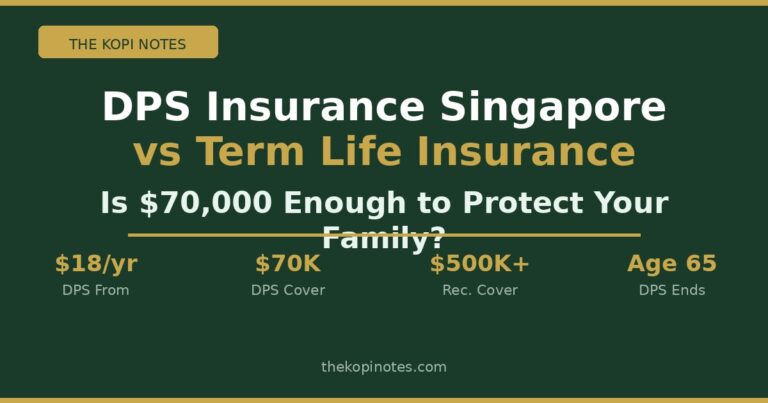
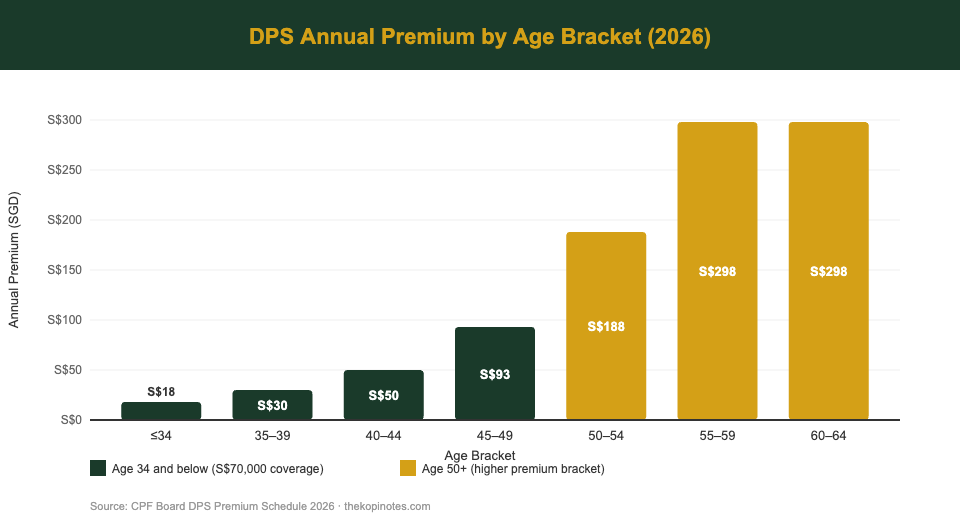
The Dependants’ Protection Scheme (DPS) is Singapore’s automatic group term life insurance, administered by Great Eastern Life on behalf of the CPF Board. It provides up to S$70,000 coverage for death, terminal illness, or total permanent disability (TPD). But DPS premiums rise steeply after age 50 — jumping from S$93 to S$188 per year at age 50–54, then to S$298 at 55–64 — raising an important question: is DPS still worth keeping as you grow older?
Not financial advice. All figures are for educational reference only. Data verified as at October 2026.
Table of Contents
Jump to Section
What Is DPS Singapore?
The Dependants’ Protection Scheme (DPS) is an opt-out term life insurance scheme automatically extended to Singapore Citizens and Permanent Residents aged 21 to 65 upon their first CPF working contribution. The scheme is administered by Great Eastern Life, whose contract with the CPF Board was extended to 30 September 2028.
DPS covers three events: death, terminal illness (certified life expectancy of 12 months or less), and total permanent disability (TPD). Coverage amounts are as follows:
- S$70,000 for insured persons up to age 59
- S$55,000 for insured persons aged 60–64
Coverage ceases automatically when you reach age 65, choose to opt out, or stop making CPF contributions. Premiums are deducted automatically from your CPF Ordinary Account (OA). If your OA balance is insufficient, the deduction comes from the Special Account (SA) — DPS premiums never reduce your take-home pay unless your CPF balance runs dry.
For a comprehensive introduction to DPS, see our full DPS Singapore guide for 2026.
DPS Premium Table 2026 by Age
The official CPF Board premium schedule sets DPS annual premiums as follows. All premiums are deducted from your CPF OA (or SA if OA is insufficient).
| Age Bracket | Annual Premium (S$) | Coverage Amount |
|---|---|---|
| 34 and below | S$18 | S$70,000 |
| 35–39 | S$30 | S$70,000 |
| 40–44 | S$50 | S$70,000 |
| 45–49 | S$93 | S$70,000 |
| 50–54 | S$188 | S$70,000 |
| 55–59 | S$298 | S$70,000 |
| 60–64 | S$298 | S$55,000 |
Source: CPF Board DPS Premium Schedule, October 2026. Premiums deducted from CPF Ordinary Account.
Note the significant jump at age 50: premiums rise 102% from S$93 to S$188, then a further 58% to S$298 at age 55. The monthly equivalent at 55–59 is approximately S$24.83 — still deducted entirely from CPF OA, not your bank account.
DPS Coverage-per-Dollar Analysis
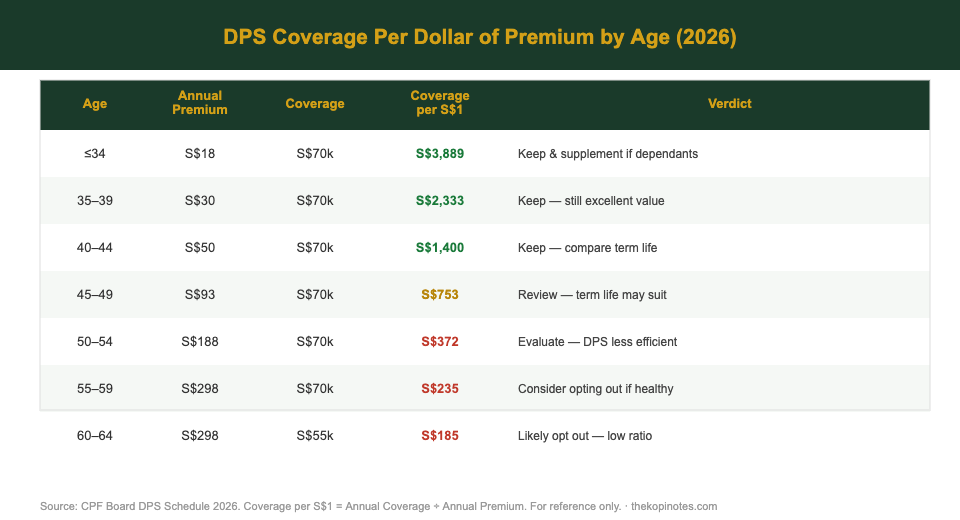
To understand whether DPS remains good value as you age, divide the coverage amount by the annual premium. This “coverage per dollar” ratio shows how much protection each dollar of premium buys you:
| Age Bracket | Annual Premium | Coverage per S$1 of Premium | Assessment |
|---|---|---|---|
| ≤34 | S$18 | S$3,889 | Exceptional value |
| 35–39 | S$30 | S$2,333 | Excellent value |
| 40–44 | S$50 | S$1,400 | Good value |
| 45–49 | S$93 | S$753 | Reasonable |
| 50–54 | S$188 | S$372 | Start evaluating |
| 55–59 | S$298 | S$235 | Low value — review |
| 60–64 | S$298 | S$185 | Consider opt-out |
Source: CPF Board DPS Premium Schedule, October 2026. Coverage per S$1 = Annual Coverage ÷ Annual Premium.
At age 34 and below, DPS delivers S$3,889 of coverage per premium dollar — among the best-value life insurance available in Singapore. By age 60–64, the ratio has fallen to S$185. This doesn’t make DPS a bad product at older ages (it remains government-backed and hassle-free), but it does signal that the cost-benefit warrants a regular review.
Should You Keep DPS at 50, 55 or 60?
Whether DPS remains worth keeping depends on three factors: whether you still have dependants relying on your income, whether you carry outstanding liabilities such as a home loan, and your current health status and insurability for private coverage.
Age ≤49: Keep DPS
The premium-to-coverage ratio is exceptional at younger ages, and premiums are deducted automatically from your CPF OA with zero administrative effort. S$70,000 is a meaningful baseline safety net. That said, most Singaporeans with a mortgage and young children need significantly more than S$70,000 — for a fuller picture, our analysis of whether DPS is enough life insurance for Singapore families walks through a practical coverage gap calculation.
Age 50–54: Evaluate Your Position
The annual premium rises to S$188. In absolute terms, that is still modest — roughly S$15.67 per month from your CPF OA. But the coverage-per-dollar ratio has declined to S$372. If you still have young dependants or an outstanding home loan, keep DPS and consider whether a short-duration supplementary term life policy fills the gap. If your children are grown and your mortgage is nearly paid off, begin assessing whether S$70,000 of coverage is still necessary.
Age 55–59: Review Carefully
At S$298 per year, DPS delivers only S$235 of coverage per premium dollar. For those with dependants or liabilities, the coverage remains a valid safety net. For those who are debt-free with financially independent children, the cost-benefit calculation becomes harder to justify. The Singapore retirement planning calculator can help you model whether your existing CPF and investments already provide adequate income replacement for your dependants.
Age 60–64: Likely Opt Out
DPS coverage drops to S$55,000 while the premium remains at S$298 — the lowest coverage-per-dollar ratio in the scheme at S$185. Most insured persons at this life stage no longer have young dependants or large outstanding debts. Redirecting S$298/year from your CPF OA toward retirement income is often the more rational choice. For the full opt-out process, see our guide on whether to opt out of DPS in Singapore.
Important: Once you opt out, re-enrolment is subject to health declaration requirements. Do not opt out unless you are confident the coverage is no longer needed.
DPS vs Private Term Life Insurance
DPS is automatic, government-backed, and paid entirely from CPF — but it has significant limitations. Coverage is capped at S$70,000, there are no rider options (such as critical illness or TPD enhancements), and the sum assured cannot be increased.
| Feature | DPS | Private Term Life |
|---|---|---|
| Coverage amount | Up to S$70,000 | S$100,000–S$5m+ |
| Premium payment | CPF OA / SA | Cash (select: CPF) |
| Medical underwriting | Not required | Required |
| Critical illness rider | Not available | Available |
| Flexibility | Fixed | Customisable |
| Administrator | Great Eastern Life | Multiple insurers |
Source: CPF Board; MAS-regulated insurer product brochures, October 2026.
The recommended approach for most working Singaporeans is to treat DPS as a base layer and supplement it with a private term life policy sized to your actual income replacement needs. A rule of thumb is 10× your annual income, or at minimum enough to clear your outstanding home loan and fund your dependants’ expenses for 5–10 years.
For Singaporeans building long-term wealth alongside their protection plans, Endowus (referral code: 2V343) offers CPF-OA investing in globally diversified portfolios — a way to grow your savings while your insurance provides the safety net.
How to Opt Out of DPS
To opt out of DPS, contact Great Eastern Life directly as the scheme administrator. You will need to complete a DPS termination request, after which premiums will no longer be deducted from your CPF OA from the next policy anniversary date.
CPF members who have opted out can apply to re-enrol if they are still within the eligible age range (21–65) and satisfy Great Eastern Life’s health declaration requirements at the time of application. If your health has deteriorated since opt-out, re-enrolment may be declined — so do not opt out unless you are certain the coverage is no longer needed.
For a full walkthrough of the opt-out process and its implications, see our detailed guide on opting out of DPS Singapore.
Frequently Asked Questions
What is the DPS Singapore coverage amount in 2026?
Who administers DPS Singapore in 2026?
How are DPS premiums paid in Singapore?
Can I opt back into DPS after opting out?
Is DPS enough life insurance coverage in Singapore?
What happens to DPS when I stop working in Singapore?
Get Free Insurance Advice
Speak with a licensed insurance advisor. No obligation, no cost.
By submitting this form, you agree to our Privacy Policy.
This article was researched with the help of AI. While we strive to keep all information accurate and up to date, there may be errors. If you notice any discrepancies, please contact us.