Should You Opt Out of DPS in Singapore? What Happens If You Cancel (2026)
DPS is not compulsory — here’s the real trade-off between cancelling it and keeping it, with 2026 premiums straight from CPF Board.
The Dependants’ Protection Scheme (DPS) is Singapore’s default CPF-linked term life insurance, but it is not compulsory. You can cancel it anytime by contacting Great Eastern Life, the sole administrator. Coverage runs from S$70,000 (below age 60) down to S$55,000 (ages 60-64), for premiums as low as S$18 a year. This guide explains who should keep DPS, who might not need it, and exactly what you lose if you opt out.
Not financial advice. All figures are for educational reference only. Data verified against official CPF Board sources, data as at 18 August 2026 unless otherwise noted.
- DPS is opt-out, not compulsory. You can cancel it anytime with a call to Great Eastern Life — but there’s no cash back.
- If you cancel and want back in later, you’ll need a fresh health declaration. Cover isn’t guaranteed if your health has changed.
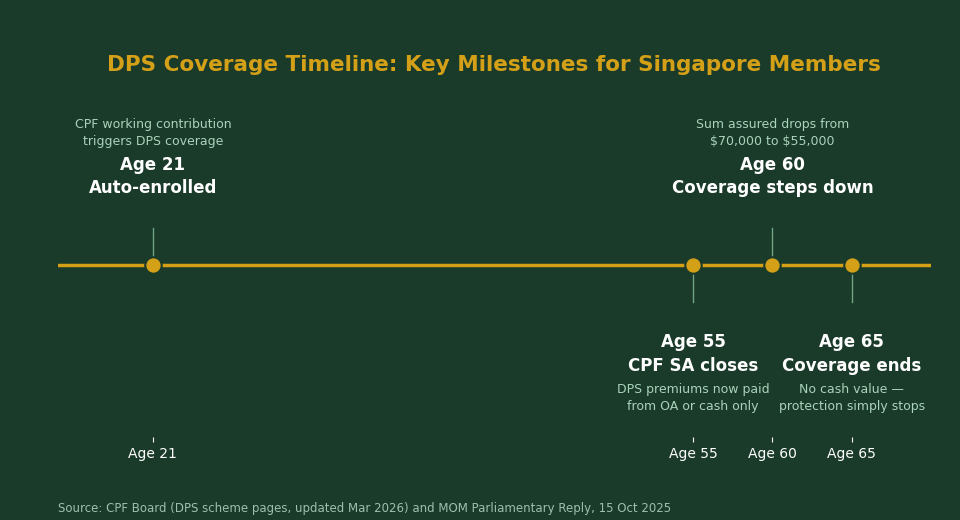
- Coverage steps down from S$70,000 to S$55,000 at age 60, then ends completely at 65 with zero cash value.
Table of Contents
Contents — Click to expand
- What Is DPS, Quickly?
- DPS Premium & Coverage Table (2026)
- Can You Actually Opt Out of DPS?
- Who Should Keep Their DPS Coverage
- Who Might Consider Opting Out
- How the CPF SA Closure at 55 Affects Your DPS Premiums
- The Real Risk: Rejoining Needs a New Health Check
- What Happens If You Miss a Payment
- How to Decide: A Practical Framework
- Frequently Asked Questions
What Is DPS, Quickly?
DPS stands for Dependants’ Protection Scheme. It’s a term life insurance plan that pays your family a lump sum if you pass away, are diagnosed with a terminal illness, or become totally and permanently disabled (TPD). It does not cover critical illness.
If you’re a Singapore Citizen or Permanent Resident aged 21 to 65 with a valid CPF working contribution, you’re automatically covered. No forms, no medical check — CPF Board and Great Eastern Life handle it in the background. If you’re between 16 and 65 and weren’t auto-enrolled, you can apply directly with Great Eastern Life.
DPS is solely administered by Great Eastern Life, according to CPF Board. Premiums are deducted once a year from your CPF Ordinary Account (OA) — or your Special Account (SA), before it closed at 55 for members reaching that age from 2025 onwards. More on that shortly.
For the full mechanics — how claims work, how coverage is calculated, and DPS versus buying your own term life plan — see our complete DPS Singapore guide. This article focuses on one decision: should you keep it, or cancel it?
DPS Premium & Coverage Table (2026)
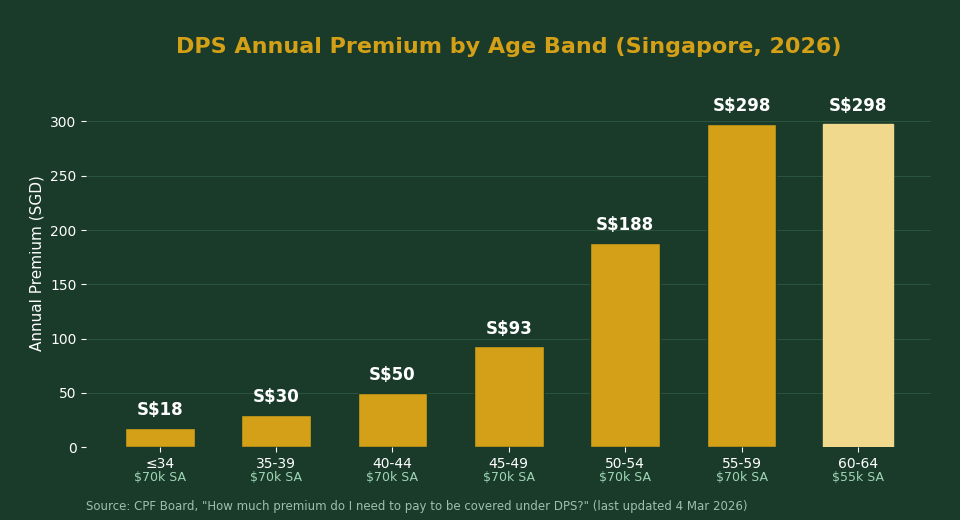
Here’s the official premium table, straight from CPF Board. Premiums rise with your age band. Coverage stays at S$70,000 until you turn 60, when it drops to S$55,000 — but the premium for that final band doesn’t fall to match. You pay the same S$298 a year for less protection.
| Age (at point of payment) | Yearly Premium | Sum Assured |
|---|---|---|
| 34 and below | S$18 | S$70,000 |
| 35 – 39 | S$30 | S$70,000 |
| 40 – 44 | S$50 | S$70,000 |
| 45 – 49 | S$93 | S$70,000 |
| 50 – 54 | S$188 | S$70,000 |
| 55 – 59 | S$298 | S$70,000 |
| 60 – 64 | S$298 | S$55,000 |
Source: CPF Board, “How much premium do I need to pay to be covered under DPS?” (last updated 4 March 2026)
Your policy is terminated once you reach the maximum coverage age of 65, as of your policy renewal date — Great Eastern Life sends a notification confirming this. There is no cash value or refund when it ends. DPS is designed to give you the most protection for the lowest premium while you’re working, not to build up savings.
Can You Actually Opt Out of DPS?
Yes. CPF Board states this plainly: “Coverage under the DPS is not compulsory.” There’s no lock-in period and no penalty for cancelling.
The process itself is straightforward. According to Great Eastern Life’s official DPS FAQ, you download and complete an Opt-Out Form, then email it to dps-sg@greateasternlife.com (or call their DPS hotline at 6839 4565). Once processed, your CPF Ordinary Account stops being debited for DPS premiums.
However, both CPF Board and Great Eastern Life flag the same caveat: consider the financial protection DPS offers your family before you sign that form. That’s the part most people skip. Cancelling takes minutes. Rebuilding equivalent protection later is not always possible on the same terms — see the next section.
Who Should Keep Their DPS Coverage
For most working Singaporeans with dependants, DPS is still worth keeping — the premium is genuinely low relative to the payout. You should probably hold onto it if:
You’re the sole or main income earner in your household. If something happens to you, DPS gives your family a S$55,000 to S$70,000 buffer while they sort out finances — on top of whatever else you’ve arranged.
You have young children, an ageing parent, or a spouse who isn’t working. These are the classic dependants DPS was built for. Losing your income suddenly hits them hardest.
You’re still paying off a home loan and don’t have a Mortgage Reducing Term Assurance (MRTA) or separate term life plan covering the outstanding amount.
You haven’t yet bought your own term life insurance. DPS at S$18 to S$188 a year (before 55) is far cheaper than most private plans for the same age band, even if the payout is smaller. It’s a floor, not a ceiling — see our guide on how much term life insurance you actually need to check if DPS alone is enough.
Who Might Consider Opting Out
Opting out makes more sense in a narrower set of situations. Consider it if:
Your dependants are grown up and financially independent — adult children with their own careers, for example — and nobody relies on your income anymore.
You already hold a private term life policy with coverage that fully replaces, or exceeds, what DPS provides. Paying for overlapping protection is rarely efficient.
You have substantial CPF or private savings that your family could draw on immediately if you passed away, covering at least the first few years of expenses without DPS’s payout.
You’re 55 or older, premiums have climbed to S$298 a year, and you’d rather redirect that toward retirement savings or a robo-advisor portfolio like Endowus or Syfe — provided you’ve genuinely confirmed your family doesn’t need the coverage first.
Even then, don’t cancel on a whim. Read the next two sections before you call Great Eastern Life.
How the CPF SA Closure at 55 Affects Your DPS Premiums
Here’s a change that’s easy to miss. With effect from 19 January 2025, your CPF Special Account (SA) closes once you turn 55 — your SA savings get transferred into your Retirement Account instead. If you were one of the members using SA to pay your DPS premiums, that payment source disappears.
Great Eastern Life’s own FAQ confirms the knock-on effect: “your DPS premiums can only be paid from your CPF Ordinary Account (OA), subject to available balance, or in cash directly to the appointed DPS insurer.” A notification is sent 30 days before you turn 55, warning that your premium deduction may be affected if you’re currently paying from CPF savings — you can switch to GIRO or another payment method ahead of time.
In practice: if you’re approaching 55, check which CPF account your DPS premium currently draws from. If it’s your SA, arrange the switch to OA or GIRO before your next renewal date so coverage doesn’t accidentally lapse. This detail isn’t widely publicised, but it directly affects anyone in the 50-54 or 55-59 premium bands shown in the table above.
The Real Risk: Rejoining Isn’t Always a New Health Check — But It Usually Is
This is the part that should make you pause before cancelling, and it’s more nuanced than most guides let on. Great Eastern Life’s FAQ lays out three tiers if you change your mind after opting out:
Within 30 days of your opt-out letter, you can simply complete the opt-back form attached to that letter — no fresh underwriting mentioned. Between 30 and 120 days after opting out, you’ll need a Reinstatement Form, and approval is “subject to satisfactory health underwriting.” After 120 days, you’ll need to submit an entirely new Proposal Form, again subject to health underwriting.
In plain terms — the 30-day window is a genuine grace period if you change your mind quickly. Miss it, and you’re back to declaring your health, same as applying for any new private insurance. If you develop diabetes, high blood pressure, or anything more serious in that window, Great Eastern Life could decline you, defer you, or accept you with exclusions.
DPS’s real advantage is that you’re already covered, guaranteed, with no medical check, for as long as you stay in the scheme. Give that up past the 30-day window, and you can’t automatically get it back on the same terms.
If your real goal is to free up cash rather than fully drop coverage, consider trimming your private term life sum assured instead of cancelling DPS — DPS is the cheaper, harder-to-replace layer of the two.
What Happens If You Miss a Payment
You don’t need to formally cancel for DPS to lapse — it can happen accidentally if your CPF OA balance runs too low to cover the premium. But the process is more forgiving than most people expect.
In an October 2025 parliamentary reply, the Ministry of Manpower confirmed that DPS lapse rates have “held steady and low at less than 0.2%” over the past three years. If your CPF balance is insufficient, you’ll be notified by both SMS and mail, and can opt to pay the premium in cash instead. Members who miss payment get at least 60 days of grace period, plus a final notice, before coverage is actually terminated.
Even after that, MOM notes you can still apply to rejoin with Great Eastern Life — subject, again, to the same health declaration risk covered above.
Separately, MOM also confirmed in that same reply that the DPS maximum coverage age was raised from 60 to 65 back in 2021, and that the government is not currently planning to raise it further. The reasoning: extending coverage age raises premiums (mortality risk climbs after 65) and would eat into members’ retirement savings — a trade-off MOM says it continues to review.
How to Decide: A Practical Framework
Before you contact Great Eastern Life to cancel, run through three questions:
1. Who currently depends on your income? If the honest answer is “nobody” — grown children, no mortgage, a working spouse with their own coverage — DPS matters less. If the answer includes young kids, a non-working spouse, or ageing parents, keep it.
2. Do you already have enough coverage elsewhere? Add up your existing private term life, MRTA, and other payouts. Compare that total against what your family would actually need — use the Insurance Gap Calculator to check your real number rather than guessing.
3. Can you truthfully pass a new health declaration today? If you cancel DPS now while in good health, you’re betting that you’ll still be insurable if you ever want it back. If you have any pre-existing conditions building up, or a family history that worries you, that bet gets riskier every year.
If you answer “yes, I’m covered elsewhere” and “no, nobody depends on me” to the first two questions, opting out is defensible — redirect that S$18 to S$298 a year toward your CPF investment strategy or retirement plan instead, and check your numbers with the Retirement Calculator. If you’re unsure on any of the three, the cheapest move is usually to keep DPS as-is and revisit the decision each time your circumstances change.
Frequently Asked Questions
Is DPS compulsory in Singapore?
No. DPS is automatically extended to Singapore Citizens and Permanent Residents aged 21-65 with a valid CPF working contribution, but CPF Board confirms it’s not compulsory. You can terminate your coverage at any time by contacting Great Eastern Life, the scheme’s sole administrator.
Can I opt out of DPS if I already have private life insurance?
You can, but check the numbers first. Add up your existing private term life and other payouts, then compare against what your dependants would actually need using the Insurance Gap Calculator. If your private coverage already exceeds DPS’s S$55,000 to S$70,000, dropping DPS avoids paying for overlapping protection.
What happens to my DPS premium payment when my CPF Special Account closes at 55?
From early 2025, your CPF Special Account closes at age 55 and its savings move to your Retirement Account. After that, CPF Board confirms your DPS premiums can only be paid from your CPF Ordinary Account, subject to available balance, or in cash directly to Great Eastern Life. Affected members are notified directly with the steps to take.
Can I rejoin DPS after opting out?
It depends on timing. Opt back in within 30 days of your opt-out letter using the attached opt-back form, and no fresh underwriting is mentioned. Between 30 and 120 days, you’ll need a Reinstatement Form subject to “satisfactory health underwriting.” After 120 days, you’ll need an entirely new Proposal Form, also subject to health underwriting — meaning cover isn’t guaranteed if your health has changed.
How much does DPS cost in 2026?
Premiums range from S$18 a year for members aged 34 and below, up to S$298 a year for the 55-59 and 60-64 age bands, according to CPF Board’s official 2026 rate table. Coverage is S$70,000 up to age 59, then steps down to S$55,000 for ages 60-64.
Does DPS cover critical illness?
No. DPS only pays out on death, terminal illness, or total permanent disability (TPD). It does not cover critical illnesses like early-stage cancer or heart conditions that don’t result in TPD — you’d need a separate critical illness plan for that gap.
What happens if I miss a DPS premium payment?
You’ll be notified by SMS and mail if your CPF balance can’t cover the premium, and can choose to pay in cash instead. You then get at least 60 days of grace period plus a final notice before coverage actually lapses. According to MOM, DPS lapse rates have stayed below 0.2% over the past three years, so this rarely happens in practice.
Not Sure If DPS Is Enough?
Work out your real coverage gap before you touch your DPS policy — then decide whether to keep it, top it up, or redirect the premium.
Get Free Insurance Advice
Speak with a licensed insurance advisor. No obligation, no cost.
By submitting this form, you agree to our Privacy Policy.
This article was researched with the help of AI. While we strive to keep all information accurate and up to date, there may be errors. If you notice any discrepancies, please contact us.