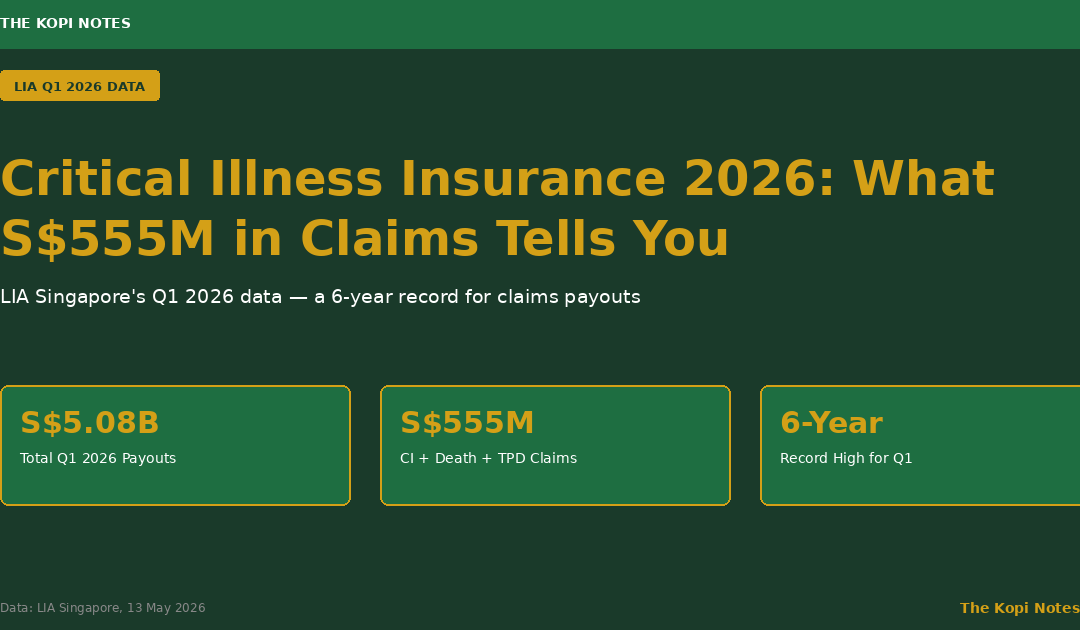
Critical Illness Insurance Singapore 2026: What S$555 Million in Claims Tells You
LIA Singapore’s Q1 2026 results reveal the highest first-quarter payout in six years — here’s what it means for your coverage
Singapore’s life insurers paid out S$555 million in critical illness, death and total permanent disability (TPD) claims in Q1 2026 alone — part of a record S$5.08 billion in total payouts, the highest first quarter since 2021. The data, released by the Life Insurance Association Singapore (LIA), shows real families relying on critical illness insurance every single day.
Not financial advice. All figures are for educational reference only. Data verified as at 22 July 2026 against LIA Singapore’s official Q1 2026 media release unless otherwise noted.
- Singapore life insurers paid out S$5.08 billion in Q1 2026 claims and maturity benefits — the highest first quarter since 2021.
- S$555 million of that was for critical illness, death and TPD claims, with 5,507 policies successfully claimed in just three months.
- If you don’t have critical illness or term life coverage, this data shows exactly why it matters — claims are rising, and so is protection awareness.
Table of Contents
Contents — Click to expand
- Singapore’s Life Insurers Paid Out a Record S$5.08 Billion in Q1 2026
- The S$555 Million Behind Critical Illness, Death & TPD Claims
- Why Health Claims Are Rising Too — And What Changed on 1 April 2026
- What the Record Claims Numbers Mean for Your Own Coverage
- How Much Does Critical Illness & Term Life Insurance Cost in 2026?
- Singapore’s Underinsurance Gap Is Still Real
- Frequently Asked Questions
Singapore’s Life Insurers Paid Out a Record S$5.08 Billion in Q1 2026
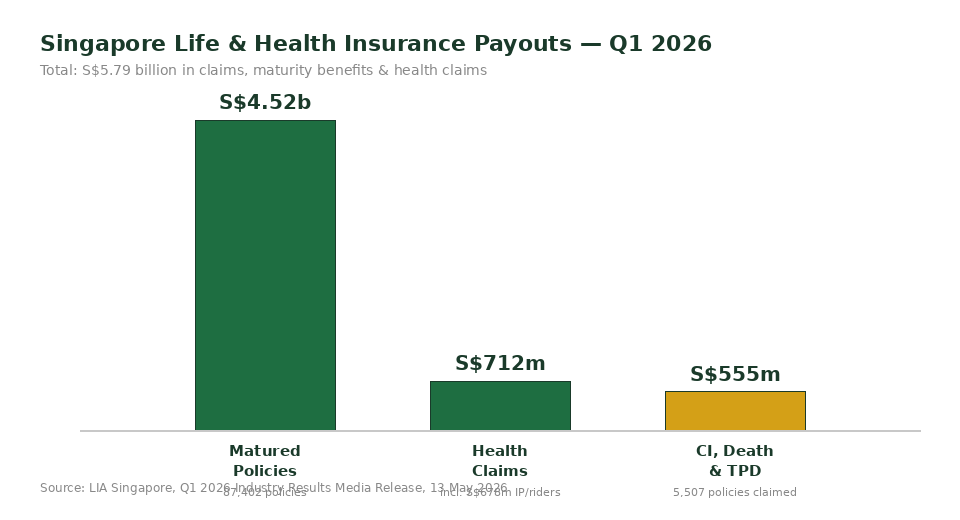
On 13 May 2026, the Life Insurance Association, Singapore (LIA Singapore) announced that the industry disbursed a significant S$5.79 billion in claims, maturity benefits and health claims combined in the first quarter of 2026. Of this, S$5.08 billion was paid out under life policies — claims and maturities — the highest amount recorded for a first quarter since 2021.
That’s not a small, one-off number. It covers three separate categories: policies that matured naturally, critical illness insurance and death claims, and health insurance claims. Here’s how the S$5.79 billion breaks down.
| Category | Amount Paid | Policies / Claims |
|---|---|---|
| Matured policies | S$4.52 billion | 87,402 policies |
| Critical illness, death & TPD | S$555 million | 5,507 policies |
| Health claims (incl. Integrated Shield Plans & riders) | S$712.1 million | — |
| Total | S$5.79 billion | — |
Source: Life Insurance Association, Singapore — Q1 2026 Industry Results Media Release, 13 May 2026.
You might be tempted to read “matured policies” as the big story here. But S$4.52 billion of that is money people already expected — endowment and savings plans reaching their payout date. The S$555 million for critical illness, death and TPD claims is different. Those are unplanned events. Someone got a serious diagnosis, had an accident, or passed away, and their insurer paid out.
The S$555 Million Behind Critical Illness, Death & TPD Claims
Break the S$555 million figure down further and you get a clearer picture. LIA Singapore reported 5,507 policies successfully claimed under individual life policies for critical illness, death and TPD in the first three months of 2026. Do the maths, and that works out to roughly S$100,780 per successful claim on average.
That average matters because it’s often used as a rough gauge for what a typical claim looks like — a serious diagnosis, a permanent disability, or a family losing their main income earner. It’s also a useful reality check against the common objection that “insurance never pays out.” In just one quarter, over 5,500 Singapore families received a payout when they needed it most.
This isn’t a one-off spike either. We recently covered how new Integrated Shield Plan (IP) rider rules taking effect from 1 April 2026 are reshaping how much you’ll need a critical illness lump sum to cover your own out-of-pocket medical costs. Rising claims and changing rider rules are two sides of the same story: healthcare and protection costs are both moving, and coverage that felt “enough” a few years ago may need a second look.
Why Health Claims Are Rising Too — And What Changed on 1 April 2026
The other big number in LIA’s report is S$712.1 million in individual health claims for Q1 2026. Of that, S$678 million came from Integrated Shield Plans (IPs) and IP riders — the private hospital add-ons that sit on top of MediShield Life. The remaining S$34.1 million came from other medical plans, mostly non-IP plans bought by non-locals.
Here’s why this quarter was unusual. Around 33,000 additional Singapore residents took up IPs and/or IP riders in Q1 2026, ahead of new MOH rider rules that kicked in on 1 April 2026. More than 7 in 10 Singapore residents are now covered under an IP. MOH’s reform tightened how much of your deductible an IP rider can cover, raised the minimum co-payment cap from S$3,000 to S$6,000 a year, and pushed insurers to cut rider premiums by roughly 30% on average.
We’ve already covered the mechanics of that rider reform in detail, including MOH’s own worked examples, in our critical illness insurance rider changes guide. The short version: your IP rider now covers less, so a bigger slice of any large medical bill lands on you — which is exactly the gap a critical illness lump sum is designed to fill.
What the Record Claims Numbers Mean for Your Own Coverage
Seeing S$555 million paid out doesn’t tell you how much coverage you personally need. But it’s a useful nudge to actually run the numbers instead of guessing. Two common benchmarks are worth knowing.
For critical illness insurance, a commonly cited (if dated) rule of thumb is roughly 3.9 times your annual income — enough to replace lost earnings while you recover, on top of medical costs. For term life insurance, many advisers use the DIME method: Debt, Income replacement, Mortgage, and Education costs for your children, added together.
Rather than eyeballing it, use our Insurance Gap Calculator to see how your existing coverage (including CPF Dependants’ Protection Scheme, or DPS) stacks up against your family’s actual needs, or our Life Insurance Needs Calculator for a DIME-based estimate. Both are free and take a few minutes.
If the gap between what you have and what you need looks large, that’s not a reason to panic-buy the biggest policy you can find. It’s a reason to compare plans properly — which is exactly what the next section walks through.
How Much Does Critical Illness & Term Life Insurance Cost in 2026?
Given how often claims are actually paid, it’s worth knowing what coverage costs before you write it off as “too expensive.” In our affordable term life insurance guide, we compared premiums across insurers for a healthy 30-year-old buying S$500,000 of term life coverage: Manulife’s ManuProtect Term (II) came in around S$26.81/month with a promotional discount, China Taiping’s i-Protect around S$41.50/month over 40 years, and FWD’s plans starting from as low as S$3/month for smaller sum assured. Market average for a 20-year term at that profile sits around S$20/month.
Critical illness coverage typically costs more than pure term life, since it pays out on diagnosis rather than death, but the same shopping-around principle applies. Our critical illness insurance comparison guide and term life insurance comparison guide break down current plans side by side if you want exact numbers for your age and sum assured.
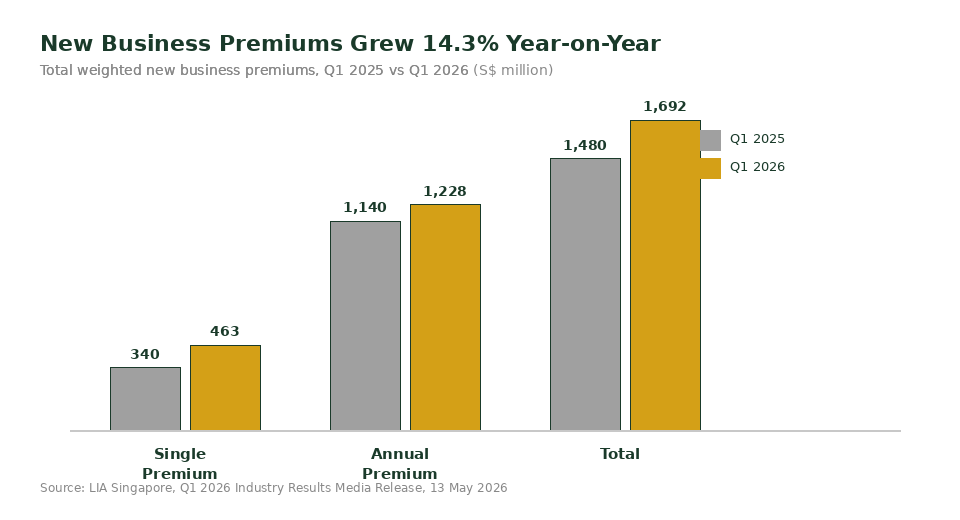
| Premium Type | Q1 2025 (S$m) | Q1 2026 (S$m) | YoY Change |
|---|---|---|---|
| Single Premium | 339.5 | 463.3 | +36.5% |
| Annual Premium | 1,140.0 | 1,228.5 | +7.8% |
| Total weighted new business premium | 1,479.5 | 1,691.8 | +14.3% |
Source: Life Insurance Association, Singapore — Q1 2026 Industry Results Media Release, 13 May 2026.
Singapore’s Underinsurance Gap Is Still Real
New business premiums grew 14.3% year-on-year in Q1 2026, totalling S$1.69 billion, up from S$1.48 billion in Q1 2025. Single premium policies — one-time payments, often used for wealth accumulation — jumped 36.5%, while annual premium policies (the kind most term life and CI plans use) grew a steadier 7.8%.
Financial Adviser (FA) Representatives and Tied Representatives remain the dominant way Singaporeans buy coverage. Together they accounted for 67.6% of the S$34.2 billion total sum assured taken up in Q1 2026, up from S$33.6 billion in the same period last year, and facilitated 241,629 new policies — 78.3% of everything sold in the quarter. Bank representatives made up 25.9% of sum assured, online direct channels just 5.7%, and unassisted purchases only 0.9%.
In other words: most people in Singapore still buy protection with an adviser’s help, not by clicking “buy” on a comparison site. If you’re not sure how much CI or term life coverage you actually need, that’s still the most common — and often most thorough — way to find out, alongside running your own numbers first with a calculator.
Frequently Asked Questions
How much was paid out in critical illness insurance claims in Singapore in Q1 2026?
What is the average critical illness insurance claim in Singapore?
Why did life insurance claims hit a 4-year high in Q1 2026?
How much critical illness coverage do I need in Singapore?
What changed with Integrated Shield Plan riders on 1 April 2026?
Is critical illness insurance worth it if most people never claim?
Should I buy critical illness insurance through a financial adviser or online?
Check Your Own Insurance Coverage Gap
See exactly how much critical illness and term life coverage your family needs — free, no sign-up required.
Get Free Insurance Advice
Speak with a licensed insurance advisor. No obligation, no cost.
By submitting this form, you agree to our Privacy Policy.
This article was researched with the help of AI. While we strive to keep all information accurate and up to date, there may be errors. If you notice any discrepancies, please contact us.