CI Insurance After Singapore’s Rate Hike: Term + Standalone vs Whole Life Rider (2026)
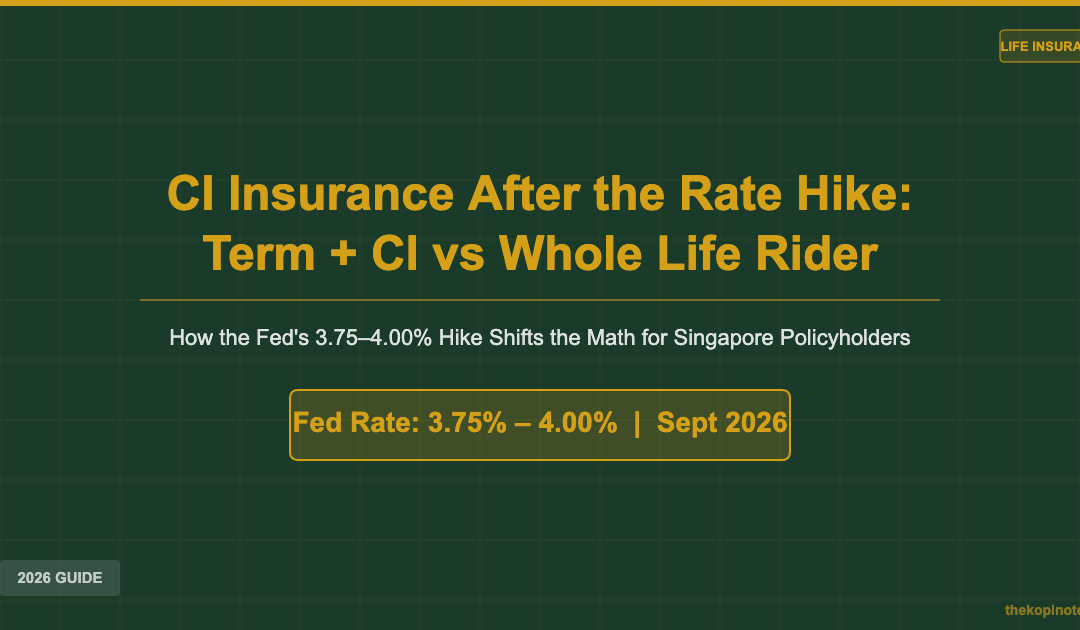
How the Fed’s 3.75–4.00% hike changes the financial math for Singapore policyholdersCritical illness insurance in Singapore pays a tax-free lump sum on diagnosis of one of the LIA’s 37 covered conditions. You can hold that coverage three ways: a standalone CI plan, a CI rider on term life, or a CI rider on whole life. With the US Federal Reserve hiking rates to 3.75–4.00% in September 2026, the financial math between these choices has shifted — and one approach now pulls clearly ahead for most Singaporeans.
Not financial advice. All figures are for educational reference only. Data verified as at 17 September 2026.
- Standalone CI on a term policy costs roughly 60–75% less annually than a whole life + CI rider bundle.
- With T-bills and SSBs now yielding near 3.75–4.00%, “buy term + invest the rest” accumulates significantly more wealth over 20–30 years.
- Whole life CI riders still suit those who want guaranteed cash value or need a forced savings structure — but the rate hike has made that trade-off much more expensive.
What Is Critical Illness Insurance in Singapore?
Critical illness insurance pays you a lump sum if you are diagnosed with a serious medical condition. In Singapore, the Life Insurance Association (LIA) has standardised a list of 37 critical illnesses that all participating insurers must cover using identical definitions.
The 37 conditions include major cancers, heart attack of specified severity, stroke with permanent neurological deficit, kidney failure requiring dialysis, major organ transplants, coma, and others. Because the definitions are standardised, you are comparing the same conditions across AIA, Great Eastern, Prudential, Manulife, Income, and Singlife.
The payout is designed to cover the income you lose while you cannot work, as well as out-of-pocket medical costs not covered by MediShield Life or your Integrated Shield Plan. A common rule of thumb is to hold at least five years of your annual income in CI coverage.
The Three Ways to Hold CI Coverage in Singapore
Most Singaporeans end up with CI coverage in one of three structures. Each has very different cost and flexibility implications.
1. Standalone CI policy (term-based): A separate policy that pays a lump sum on CI diagnosis. Your term life coverage remains untouched. When the policy term ends, the CI coverage expires — there is no cash value.
2. CI rider on a term life policy: An add-on to your term life plan. When you claim for CI, it reduces or eliminates your life sum assured depending on whether it is an “accelerated” or “additional” rider. Cheaper than whole life, but you lose some or all life coverage on CI payout.
3. CI rider on a whole life policy: Bundled into a whole life plan that builds cash value. Premiums are much higher, but the policy does not expire and accumulates a guaranteed sum that you can surrender. This is the option most heavily marketed by agents — and the one most affected by rising interest rates.
Standalone CI Insurance: Pros and Cons
A standalone CI plan keeps your CI and life coverage in separate buckets. If you claim for CI, your life insurance remains intact. You can also adjust each policy independently as your needs change.
The key advantage is price. A standalone CI plan typically covers the same 37 LIA conditions as a whole life CI rider at a fraction of the annual cost. For most plans, you are paying only for the risk — there is no savings or investment component bundled in.
The main downside is that standalone CI plans are term-based. When your policy term ends — usually at age 65 or 70 — your coverage stops. If you want lifetime coverage, you need to renew or hold a different structure.
Whole Life with CI Rider: The Hidden Costs
A whole life policy with a CI rider bundles three things into one premium: death benefit, CI payout, and a savings component (cash value). Agents often present this as getting “coverage for life plus savings.” That framing is accurate — but it obscures the cost.
For a 30-year-old non-smoker male purchasing S$200,000 of CI coverage:
| Structure | Approx. Annual Premium | Cash Value at 20 Yrs | CI Coverage |
|---|---|---|---|
| Term life + standalone CI | S$820 – S$1,000 | None (term expires) | S$200,000 |
| CI rider on term life | S$700 – S$900 | None (term expires) | S$200,000 (accelerated) |
| Whole life + CI rider | S$3,200 – S$4,500 | ~S$40,000 – S$60,000 | S$200,000 |
Source: Indicative market premiums, MAS-regulated insurers, Sep 2026. Actual premiums depend on health status and insurer. Not a quote.
The whole life policy’s S$40,000–S$60,000 cash value after 20 years sounds like a return. But you paid an extra S$2,400–S$3,500 per year for 20 years to get it — that is S$48,000–S$70,000 in additional premiums. When interest rates are near zero, the math is less clear-cut. At 3.75–4.00%, it is not.
How September 2026’s Fed Rate Hike Changes the Math
On 16 September 2026, the US Federal Reserve raised its benchmark rate to 3.75–4.00% — the first hike in over three years. Singapore’s risk-free rates have followed. Six-month T-bills now yield close to 3.75%, and Singapore Savings Bonds (SSBs) offer step-up returns averaging near that range over 10 years.
This matters because the “invest the rest” portion of the buy-term strategy now earns a competitive, near-risk-free return. You no longer have to take equity risk to outperform a whole life policy’s guaranteed returns.
Whole life + CI rider vs term life + standalone CI
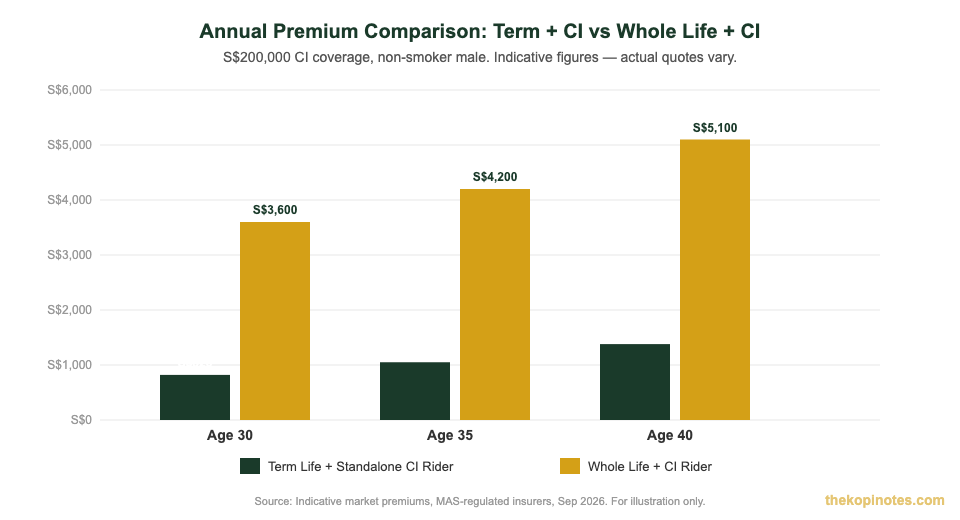
Source: Indicative market premiums, Sep 2026. For illustration only.
The chart above shows that the annual premium gap between term + standalone CI and whole life + CI rider widens from roughly S$2,780 at age 30 to S$3,720 at age 40. That gap is your “invest the rest” capital — the money you keep each year by choosing the cheaper structure.
The “Invest the Rest” Strategy at 3.75% p.a.
What happens if you take S$2,780 per year — the annual saving from choosing term + standalone CI over a whole life bundle — and invest it at 3.75% p.a.? The chart below shows the accumulated value over time.
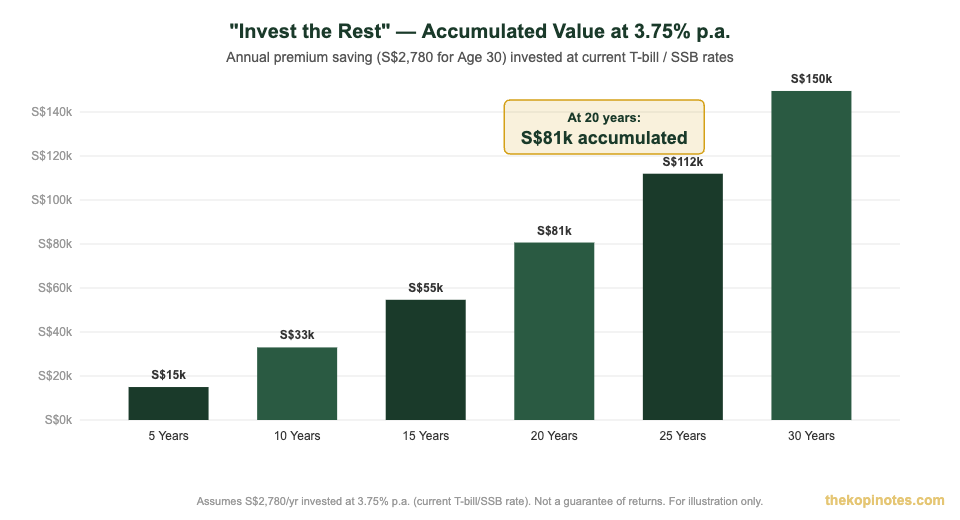
Source: Calculated at 3.75% p.a. on S$2,780 annual saving. Not a guarantee. T-bill and SSB rates fluctuate.
After 20 years, investing S$2,780 annually at 3.75% compounds to approximately S$83,000. That is meaningfully more than the S$40,000–S$60,000 cash value typically guaranteed by a whole life policy over the same period — without any equity risk, using only T-bills or SSBs.
You can also place this capital on platforms like Endowus (referral code: 2V343) to access CPF-eligible funds or cash management accounts that aim for slightly higher returns with controlled risk. Or use Syfe (referral code: SRPRFFFCD) for their Income+ portfolio. Both give more flexibility than a whole life policy.
For context on current Singapore risk-free rates, see our Singapore T-bills 2026 guide and Singapore Savings Bonds guide.
Which Should You Choose? A Simple Framework
There is no single right answer for every situation. But these questions help narrow it down quickly.
Choose term + standalone CI if: You are disciplined enough to actually invest the premium saving each month. You want flexibility to adjust your coverage amount independently. You are under 40 and comfortable with renewable term-based coverage. You have other assets building up (CPF, ETFs, property) and do not need a forced savings vehicle.
Choose a whole life + CI rider if: You need guaranteed lifetime coverage with no renewal risk. You want a forced savings structure and would otherwise spend the premium difference. You have dependants who need certainty of payout regardless of market conditions. Your financial adviser has shown you projections where the specific policy’s guaranteed returns outperform the current risk-free rate.
The September 2026 rate hike has raised the bar for whole life policies to justify their cost. At near-zero rates, a guaranteed 2.5–3.0% return inside a whole life policy looked competitive. At 3.75–4.00% risk-free, that same guaranteed return looks less attractive for most buyers.
You can use our Singapore retirement planning calculator to model how different premium levels affect your retirement savings trajectory.
Premium Comparison Table (2026)
The table below compares approximate annual premiums for S$200,000 CI coverage at three entry ages. These are indicative market ranges — always request an actual illustration from a licensed financial adviser before purchasing.
| Entry Age | Term + Standalone CI (p.a.) | Whole Life + CI Rider (p.a.) | Annual Saving | 20-yr Accumulated at 3.75% |
|---|---|---|---|---|
| Age 30 | ~S$820 | ~S$3,600 | ~S$2,780 | ~S$83,000 |
| Age 35 | ~S$1,050 | ~S$4,200 | ~S$3,150 | ~S$76,000 |
| Age 40 | ~S$1,380 | ~S$5,100 | ~S$3,720 | ~S$66,000 |
Source: Indicative market premiums, MAS-regulated insurers, Sep 2026. Non-smoker male, S$200,000 CI coverage. Accumulated value assumes constant 3.75% p.a. investment return. Actual premiums and returns will vary.
For more detail on choosing between CI plans, see our best critical illness insurance Singapore guide and our article on multi-pay CI insurance. You may also want to review our CPF investment strategy guide if you plan to channel the premium savings into CPF-related instruments.
Frequently Asked Questions
Does the Fed rate hike directly change my CI insurance premiums?
What are the LIA 37 critical illnesses covered in Singapore?
Is it better to get a CI rider on term life or a standalone CI policy?
How much CI coverage do I need in Singapore?
Can I claim CI insurance if I already have an Integrated Shield Plan?
Will CI insurance premiums increase when I renew?
Get Free Insurance Advice
Speak with a licensed insurance advisor. No obligation, no cost.
By submitting this form, you agree to our Privacy Policy.
This article was researched with the help of AI. While we strive to keep all information accurate and up to date, there may be errors. If you notice any discrepancies, please contact us.