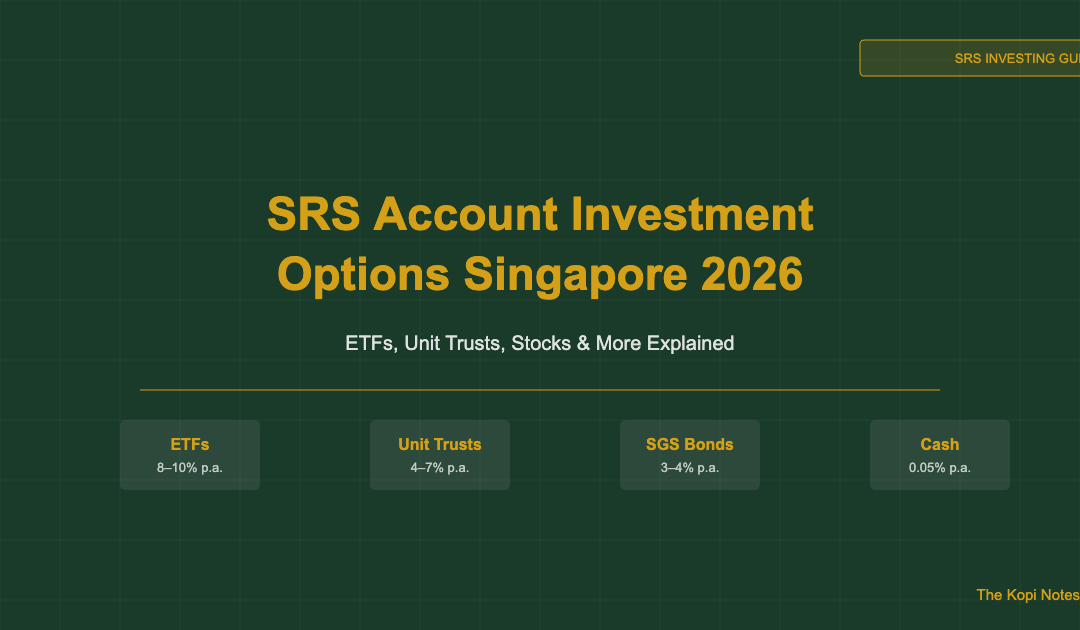
SRS Account Investment Options Singapore 2026: ETFs, Unit Trusts & Stocks
A complete guide to investing your SRS funds for maximum long-term returns — covering every eligible option, platform comparisons, and step-by-step instructions.
Your SRS account earns just 0.05% interest per year if left as cash — barely a rounding error against Singapore’s inflation rate. Singapore investors can use SRS funds to buy ETFs, unit trusts, SGX-listed stocks, Singapore Government Securities (SGS), and investment-linked insurance plans (ILPs). Platforms like FSMOne, Endowus, Syfe, DBS Vickers, and UOB Kay Hian all support SRS investing. This 2026 guide covers every eligible option, expected returns, and a step-by-step walkthrough for each platform.
Not financial advice. All figures are for educational reference only. Data as at October 2026 unless noted.
Table of Contents
Contents — Click to expand
Why You Must Invest Your SRS Funds (Not Leave as Cash)
The SRS account is one of Singapore’s most powerful tax deferral tools — every dollar you contribute reduces your taxable income for that year. But many Singaporeans make one critical mistake: they contribute to their SRS account and then leave the money sitting as cash earning 0.05% per year.
At 0.05%, a S$100,000 SRS balance earns just S$50 per year. Against Singapore’s average inflation of around 2–3%, this means your SRS funds are losing real purchasing power every single year. By contrast, a diversified ETF portfolio targeting 7–9% annual returns can potentially double your SRS balance every 8–10 years.
The tax saving from your SRS contribution already represents a guaranteed 7–22% return (depending on your tax bracket). Leaving the money as cash wastes that advantage entirely. According to the Ministry of Finance SRS guidelines, the scheme is explicitly designed to encourage Singaporeans to invest their SRS funds for retirement — not to park them.
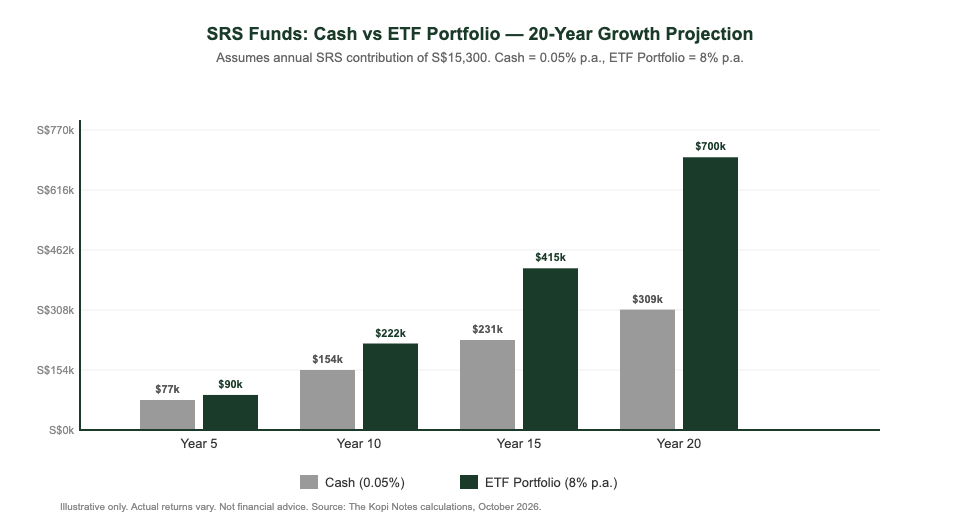
Consider the maths: if you use the Singapore retirement calculator and compare 20 years of S$15,300 annual contributions at 0.05% versus 8%, the difference is stark — roughly S$306,000 in cash value versus over S$700,000 invested. That gap is entirely avoidable.
Complete SRS Investment Options: ETFs, Unit Trusts, Stocks & More
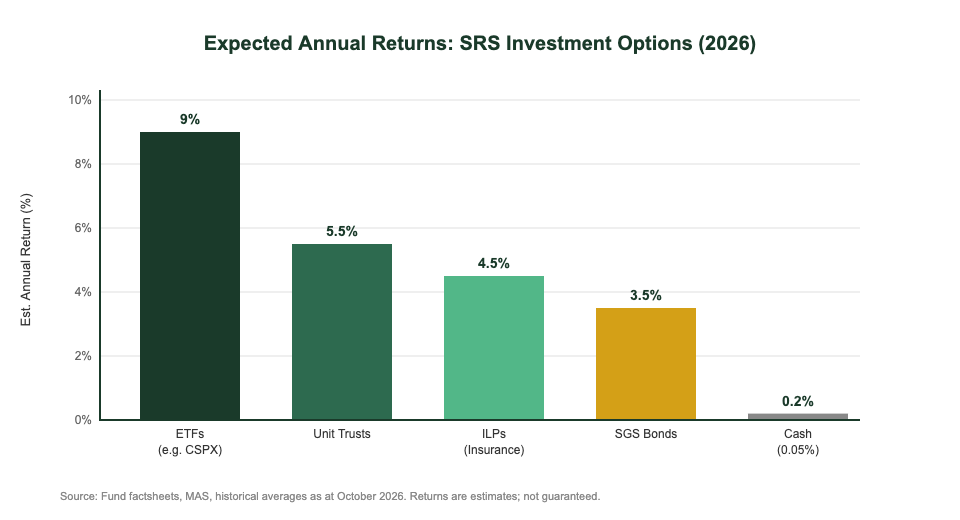
Under MAS regulations, SRS funds can be invested in a broad range of instruments. Here is a complete comparison of every eligible SRS investment option available to Singapore investors as at October 2026:
| Investment Option | Est. Annual Return | Risk Level | Min. Investment | Available Via |
|---|---|---|---|---|
| ETFs (LSE/SGX-listed) | 7–10% | Medium | ~S$200+ | FSMOne, DBS, UOB, Syfe |
| Unit Trusts / Robo-Advisors | 4–7% | Low-Med | S$100+ | Endowus, FSMOne, DBS |
| SGX-Listed Stocks / REITs | 5–9% | Medium-High | ~S$500+ | DBS, UOB, FSMOne |
| Singapore Savings Bonds (SSB) | 3.0–3.5% | Very Low | S$500 | DBS, UOB, OCBC |
| Singapore Government Securities | 3.2–3.8% | Very Low | S$1,000 | MAS, DBS, UOB |
| Investment-Linked Plans (ILPs) | 3–6% | Medium | S$100/mth | AIA, Prudential, Manulife |
| Cash (SRS account default) | 0.05% | None | — | All banks |
Source: MAS SRS guidelines; fund factsheets; broker platforms, October 2026. Returns are estimates based on historical averages; past performance is not indicative of future results.
For most Singaporeans with a retirement horizon of 10 years or more, ETFs and diversified unit trusts via robo-advisors offer the best risk-adjusted returns. The best SRS platforms comparison goes deeper on fees and minimums for each operator.
Best ETFs to Buy With SRS Funds in Singapore
ETFs are the preferred SRS investment vehicle for cost-conscious investors. They offer broad diversification, low ongoing fees (TER 0.07–0.20%), and no active management risk. Here are the top ETFs accessible via SRS accounts as at October 2026:
| ETF | Exchange | TER | Index Tracked | SRS Platform |
|---|---|---|---|---|
| CSPX | LSE (USD) | 0.07% | S&P 500 | FSMOne, DBS |
| VWRA | LSE (USD) | 0.22% | FTSE All-World | FSMOne, DBS |
| ES3 (STI ETF) | SGX (SGD) | 0.30% | Straits Times Index | All SRS-linked brokers |
| CLR (Lion-OCBC APAC ETF) | SGX (SGD) | 0.50% | Hang Seng TECH + MSCI | DBS, UOB, FSMOne |
| ABF Singapore Bond ETF | SGX (SGD) | 0.24% | Asia Bond Index | DBS, UOB |
Source: SGX, iShares, Vanguard fund factsheets. TER figures as at Q3 2026. SRS platform eligibility verified with individual brokers.
For LSE-listed ETFs like CSPX and VWRA, note that these are Ireland-domiciled UCITS ETFs — they carry a 15% US dividend withholding tax (versus 30% for US-domiciled ETFs), and no US estate tax exposure. This makes them superior for Singapore investors even within an SRS wrapper. You can check the full SRS contribution guide for how to structure annual top-ups to maximise your tax relief.
How to Invest SRS Funds Step-by-Step (By Platform)
The SRS account itself is opened with one of three operator banks — DBS, UOB, or OCBC. However, you can transfer your SRS funds to a wider range of investment platforms for access to ETFs, unit trusts, and other instruments.
Option A: FSMOne (ETFs + Unit Trusts)
FSMOne is the most cost-effective SRS platform for self-directed investors. It supports LSE-listed ETFs (CSPX, VWRA), SGX-listed ETFs, and over 1,000 unit trusts — all accessible via a linked SRS brokerage account. To start: open an FSMOne account, link your SRS account under Settings → SRS Account, fund via online banking, and place orders directly. The FSMOne referral code gives you a cashback bonus on your first trade. Commission is 0.08%, minimum S$10 per trade.
Option B: Endowus (Robo-Advisor for Unit Trusts)
Endowus specialises in SRS investing and offers pre-built diversified portfolios using institutional-class unit trusts at reduced annual fund fees. It is ideal for investors who prefer a hands-off approach. Portfolios range from 100% bond (for conservative investors near retirement) to 100% equity. The Endowus referral code grants S$20 access fee credit. Access fee: 0.25–0.60% p.a., plus underlying fund TER of ~0.3–0.8%.
Option C: Syfe (Robo-Advisor — ETF Portfolios)
Syfe’s Wealth Management and Core portfolios support SRS funds, giving access to diversified global ETF portfolios managed automatically. The Syfe referral code gets you fee-free management for your first 6 months. Management fee: 0.35–0.65% p.a. SRS transfer typically takes 3–5 business days from your bank.
Option D: DBS Vickers / UOB Kay Hian (SGX ETFs + Stocks)
Both DBS and UOB offer direct SRS brokerage access to SGX-listed stocks, REITs, and SGX-listed ETFs. This is the most flexible option if you want to build your own individual REIT or stock portfolio alongside ETFs. Commission: 0.18–0.28% depending on trade size. Note: these platforms do not support LSE-listed ETFs for SRS — for CSPX and VWRA, use FSMOne instead.
SRS Investment Rules and Restrictions to Know
Before investing your SRS funds, be aware of these key rules enforced by MAS as at October 2026:
- Withdrawal timing: SRS withdrawals before the statutory retirement age (63 for accounts opened after 1 July 2022) are subject to a 5% penalty plus full income tax on the withdrawn amount. Invest for the long term.
- At retirement: Only 50% of SRS withdrawals are taxable — a significant advantage over leaving money in a taxable savings account. Spread withdrawals over 10 years to minimise each year’s tax liability.
- Annual contribution cap: S$15,300 for Singapore Citizens and PRs; S$35,700 for foreigners (as at 2026).
- No CPF investments: SRS funds cannot be used for CPF Investment Scheme (CPFIS) instruments. They operate on completely separate platforms.
- Foreign currency risk: If you invest in USD-denominated ETFs (CSPX, VWRA) via SRS, you carry SGD/USD currency risk. Factor this into your overall portfolio construction.
For a holistic view of how SRS fits into your retirement plan, use the Singapore retirement planning calculator to model different scenarios including SRS investments alongside CPF and taxable savings.
Frequently Asked Questions
What are the best SRS account investment options in Singapore 2026?
The best SRS investment options for most Singapore investors in 2026 are globally diversified ETFs (such as CSPX or VWRA via FSMOne) for long-term growth, or low-cost unit trust portfolios via Endowus or Syfe for a more hands-off approach. Both outperform leaving SRS funds as cash (0.05% p.a.) by a significant margin. Singapore Savings Bonds are a conservative option for those within 5 years of retirement age.
Can I buy ETFs like CSPX or VWRA using my SRS account?
Yes. LSE-listed ETFs like CSPX (iShares Core S&P 500 UCITS ETF) and VWRA (Vanguard FTSE All-World UCITS ETF) are accessible via SRS through FSMOne and DBS Vickers. These Ireland-domiciled ETFs benefit from a 15% US dividend withholding tax rate (versus 30% for US-domiciled ETFs) and have no US estate tax exposure — making them particularly well-suited for Singapore investors using SRS for long-term retirement investing.
Which SRS platform is best for ETF investing in Singapore?
FSMOne is generally the best SRS platform for ETF investing due to its wide access to both SGX-listed and LSE-listed ETFs, low commissions (0.08%, min S$10), and no annual SRS account maintenance fees. Endowus is better for investors who prefer a fully managed, hands-off approach using institutional-class unit trusts. Syfe is good for beginners who want pre-built ETF portfolios. See the full platform comparison at the SRS account best platforms 2026 guide.
What happens to my SRS investments when I withdraw at retirement?
When you withdraw your SRS funds at or after the statutory retirement age (63 for accounts opened after 1 July 2022), only 50% of each withdrawal is taxable as income. This is a major advantage — if you withdraw S$40,000 per year over 10 years, only S$20,000 is added to your assessable income each year. This can result in zero or minimal income tax if your other income is low in retirement. Withdrawals before retirement age incur a 5% penalty plus full taxation of the withdrawn amount.
Is it better to invest SRS funds in ETFs or unit trusts?
For investors comfortable with self-directed investing, ETFs are generally superior due to lower total costs (TER 0.07–0.22% for index ETFs vs 0.5–1.5% for most unit trusts). Over 20 years, this cost difference can compound significantly. However, unit trusts via Endowus are structured to use institutional-class funds at reduced fee rates, narrowing the gap considerably. The right choice depends on your comfort level, investment horizon, and willingness to manage your own portfolio. Both options vastly outperform leaving SRS funds as cash.
Can foreigners working in Singapore invest SRS funds?
Yes. Foreigners working in Singapore are eligible to open an SRS account and contribute up to S$35,700 per year (versus S$15,300 for Singapore Citizens and PRs as at 2026). The tax relief applies against Singapore employment income, making SRS contributions especially valuable for foreigners in higher income tax brackets. The same range of investment options — ETFs, unit trusts, stocks, bonds — is available. Note that if you leave Singapore permanently before retirement age, early withdrawal penalties still apply.
Start Investing Your SRS Funds Today
Open an investment account and put your SRS funds to work. Use our referral links for sign-up bonuses.
This article was researched with the help of AI. While we strive to keep all information accurate and up to date, there may be errors. If you notice any discrepancies, please contact us.