Retirement Age in Singapore 2026: Complete Guide (RE65, CPF & Planning)
Everything Singaporeans need to know about the phased retirement age increases, re-employment rights, CPF withdrawal ages, and how to build a retirement income plan.
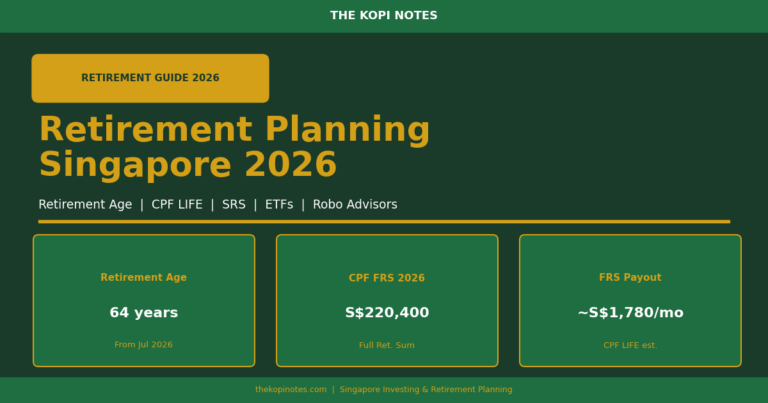
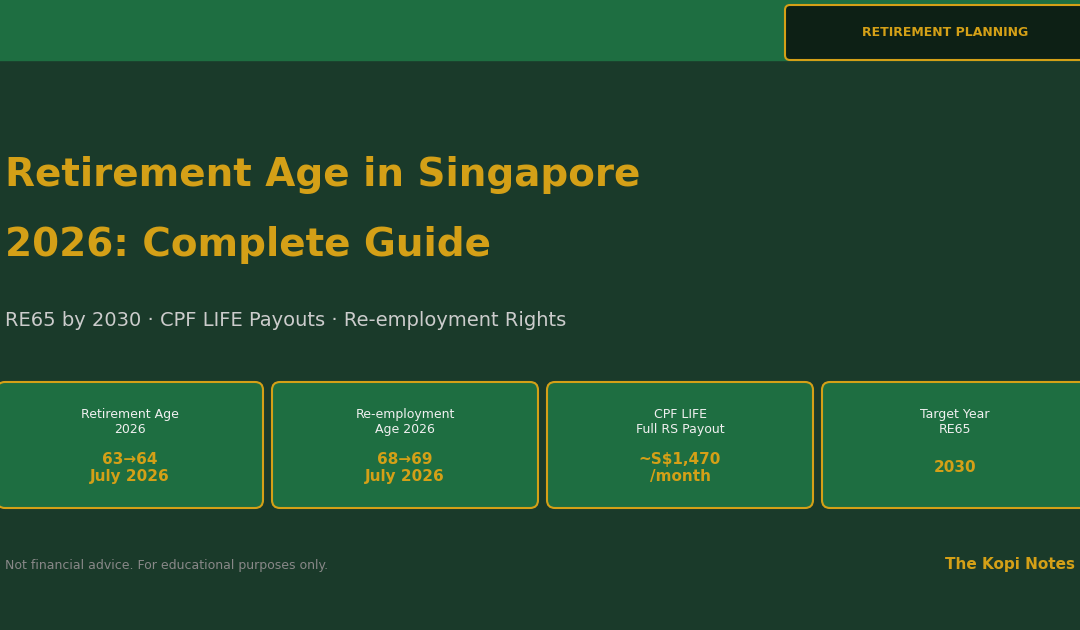
The retirement age in Singapore is 63 in 2026, with the re-employment age at 68. Both are scheduled to rise — retirement age to 64 on 1 July 2026, and to 65 by 2030, while re-employment age reaches 70 by 2030. These changes affect when you can draw CPF LIFE payouts, how long employers must offer you work, and how you should structure your retirement income. Here is everything you need to know.
Not financial advice. All figures are for educational reference only. Data as at May 2026 unless noted.
Table of Contents
Contents — Click to expand
- Current Retirement Age in Singapore (2026)
- Phased Increases to RE65 by 2030
- Re-Employment Age: What It Means for You
- CPF Withdrawal Age and Payout Eligibility
- CPF LIFE Payouts at Different Retirement Ages
- How to Plan Your Retirement in Singapore
- Investment Options to Supplement CPF
- Frequently Asked Questions
Current Retirement Age in Singapore (2026)
Singapore’s official retirement age in 2026 is 63 years old, having been raised from 62 on 1 July 2022. This means employers cannot dismiss an employee solely on the grounds of age before they turn 63. The Retirement and Re-employment Act (RRA) protects employees in this regard.
However, “retirement age” in Singapore does not mean you must stop working at 63. It simply defines the minimum age at which an employer may lawfully ask you to retire. In practice, most Singaporeans continue working beyond 63 under re-employment contracts.
Key dates for 2026:
| Age Threshold | Current (2026) | Target (2030) |
|---|---|---|
| Retirement Age | 63 (rising to 64 in July 2026) | 65 |
| Re-employment Age | 68 (rising to 69 in July 2026) | 70 |
| CPF Payout Eligibility Age | 65 | 65 (unchanged) |
| CPF Withdrawal Age (Lump Sum) | 55 | 55 (unchanged) |
Source: Ministry of Manpower (MOM), CPF Board — May 2026
Phased Increases to RE65 by 2030
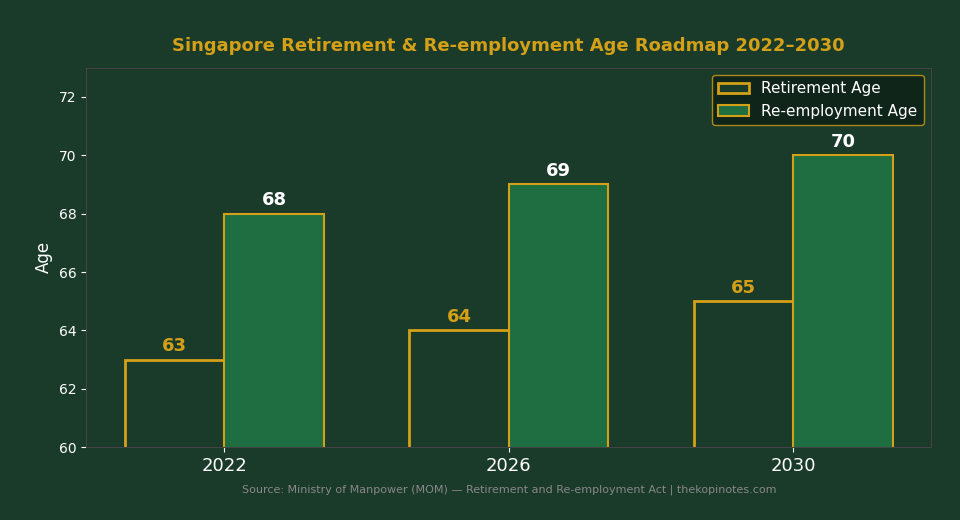
The Singapore government announced in Budget 2022 a phased roadmap to raise both the retirement age and re-employment age over the coming years. The increases are timed in two-year increments to give both employers and employees time to adapt.
Here is the confirmed phased schedule:
| Effective Date | Retirement Age | Re-employment Age |
|---|---|---|
| 1 July 2022 | 63 (raised from 62) | 68 (raised from 67) |
| 1 July 2026 | 64 | 69 |
| 1 July 2030 | 65 | 70 |
Source: Ministry of Manpower (MOM) — Retirement and Re-employment Act
The July 2026 increase to age 64 is imminent. If you are currently 63, your employer will be required to offer re-employment if you turn 64 on or after 1 July 2026 — unless they have a valid reason (e.g., poor performance or medical incapacity) to decline. Employees must also be medically fit and consent to re-employment terms.
The rationale behind these changes is Singapore’s rapidly ageing population. By 2030, one in four Singaporeans will be aged 65 and above. Extending working ages allows older Singaporeans to remain economically active, build larger CPF nest eggs, and reduce dependence on family support in retirement.
Re-Employment Age: What It Means for You
Singapore distinguishes between two age thresholds that often get conflated:
- Retirement Age: The age before which an employer cannot force you to retire. Currently 63, rising to 64 in July 2026 and 65 by 2030.
- Re-employment Age: The age up to which employers must offer eligible employees a re-employment contract after they reach the retirement age. Currently 68, rising to 69 in July 2026 and 70 by 2030.
Under the Retirement and Re-employment Act, employers must offer re-employment to eligible employees who reach the retirement age. Eligibility conditions include being a Singapore citizen or permanent resident, satisfactory work performance, and being medically fit to continue working.
If an employer is unable to offer re-employment (e.g., the position is made redundant), they must provide a one-off Employment Assistance Payment (EAP) of between S$3,500 and S$13,500, depending on years of service.
Re-employment contracts can be on different terms than before — employers may adjust salary, role, and hours. However, they cannot arbitrarily cut pay by more than is proportionate to changes in duties or hours. The Ministry of Manpower provides tripartite advisory guidelines on acceptable re-employment terms.
CPF Withdrawal Age and Payout Eligibility
It is important to distinguish between three separate CPF age milestones that often cause confusion:
1. CPF Withdrawal Age (55)
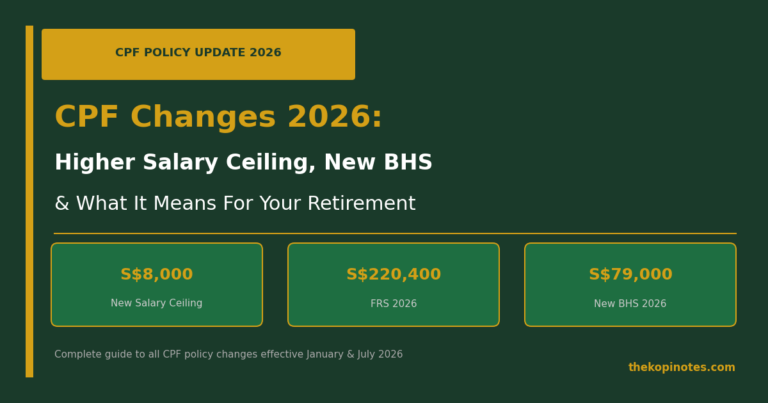
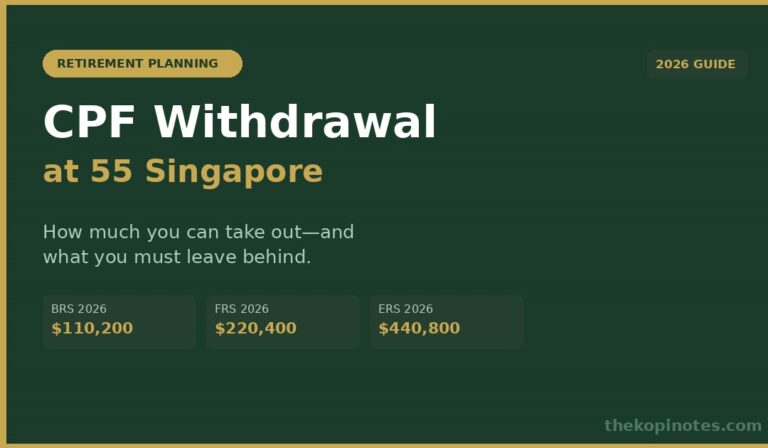
At age 55, CPF members can withdraw savings above the Full Retirement Sum (FRS) from their Ordinary and Special Accounts (now merged into the Retirement Account). This is a partial lump-sum option — not full withdrawal. As at 2026, the FRS stands at S$213,000. Members must set aside this amount before any excess can be withdrawn.
2. CPF LIFE Payout Eligibility Age (65)
Monthly CPF LIFE payouts begin at age 65, unless members opt to defer up to age 70. Each year of deferral increases monthly payouts by approximately 6–7%, which is a guaranteed, risk-free return far exceeding most fixed deposits or Singapore Savings Bonds.
3. CPF Retirement Account (RA) Creation at 55
The CPF Retirement Account (RA) is created automatically at age 55 by transferring savings from your Ordinary Account (OA) and Special Account (SA) — up to the Full Retirement Sum. This is not withdrawal; it simply consolidates your CPF for the payout phase.
For a detailed breakdown of how CPF works at each stage, see our CPF investment strategy guide.
CPF LIFE Payouts at Different Retirement Ages
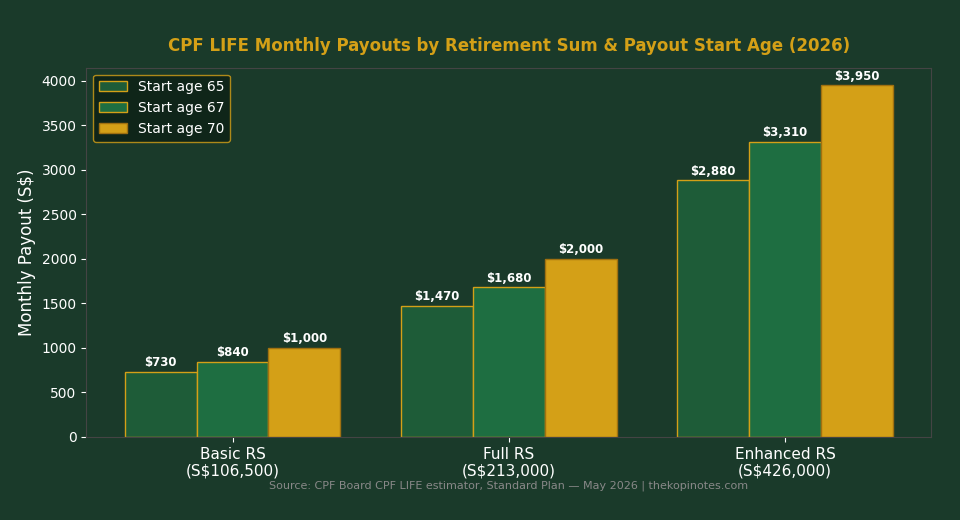
CPF LIFE (Lifelong Income For the Elderly) is Singapore’s national annuity scheme. It provides monthly payouts for as long as you live — an insurance against longevity risk. Here is how estimated monthly payouts compare across different payout start ages and retirement sum levels in 2026:
| Retirement Sum at 55 | Payout from Age 65 | Payout from Age 67 | Payout from Age 70 |
|---|---|---|---|
| Basic RS (S$106,500) | ~S$730/mo | ~S$840/mo | ~S$1,000/mo |
| Full RS (S$213,000) | ~S$1,470/mo | ~S$1,680/mo | ~S$2,000/mo |
| Enhanced RS (S$426,000) | ~S$2,880/mo | ~S$3,310/mo | ~S$3,950/mo |
Source: CPF Board CPF LIFE estimator, Standard Plan estimates — May 2026. Figures are indicative.
The decision of when to start CPF LIFE payouts is one of the most consequential retirement planning choices a Singapore investor makes. If you expect to live past 80 (the statistical average for Singaporeans is 83–85), deferring to age 70 is typically the highest expected-value choice. Use our Singapore retirement calculator to model your personal scenario.
How to Plan Your Retirement in Singapore
With the retirement age rising to 65 by 2030, Singaporeans have a longer working horizon — but that does not mean you should defer retirement planning. Here are the key pillars of a robust Singapore retirement plan:
1. Maximise CPF contributions before 55
Voluntary cash top-ups to your CPF Special Account earn 4% p.a. guaranteed interest (one of the highest risk-free rates available). After 55, top up your Retirement Account up to the Enhanced Retirement Sum (ERS) of S$426,000 to maximise CPF LIFE payouts. Cash top-ups also qualify for Retirement Sum Topping-Up Scheme (RSTU) tax relief of up to S$16,000 per year.
2. Build a dividend income portfolio
CPF LIFE alone is unlikely to cover full living costs for most retirees. A complementary portfolio of S-REITs and dividend stocks providing 4–6% annual yield can meaningfully supplement monthly income. Learn more in our guide to passive income Singapore strategies.
3. Understand your SRS account
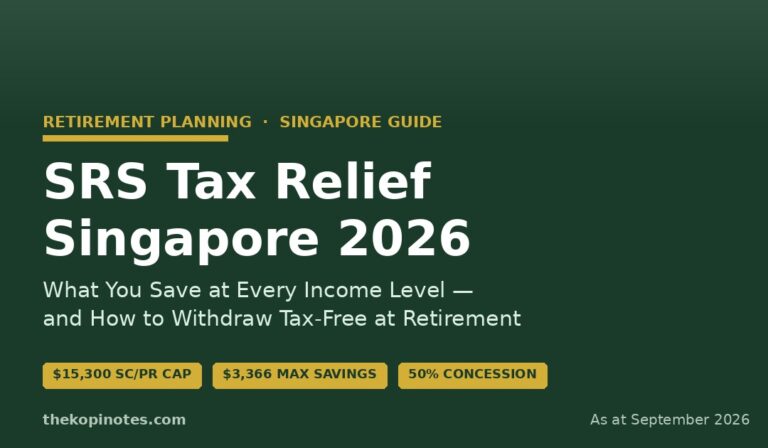
The Supplementary Retirement Scheme (SRS) allows contributions of up to S$15,300/year (for Singaporeans and PRs) with full tax deductibility. SRS withdrawals in retirement are 50% taxable — a powerful tax arbitrage if your income drops significantly after you stop working. Investments held in SRS (including REITs, ETFs, and Singapore Savings Bonds) also grow tax-free.
4. Consider low-cost ETFs for long-term growth
Singaporeans planning 20–30 year investment horizons benefit from the compounding power of broad market ETFs. UCITS-listed ETFs on the London Stock Exchange avoid US estate tax exposure. Our Singapore REIT ETF guide covers how to combine real-asset income with global equity growth.
5. Review your Medisave and MediShield Life coverage
Healthcare is the largest retirement wildcard. Singapore’s MediShield Life provides basic hospitalisation coverage, but Integrated Shield Plans (IPs) provide Class B1 and above ward coverage. Ensure your Medisave has sufficient balance and your IP premium is affordable into retirement — premiums rise steeply after age 65.
Investment Options to Supplement CPF in Retirement
Most financial planners in Singapore recommend a “3-bucket” approach to retirement income:
- Bucket 1 — Guaranteed income: CPF LIFE monthly payouts + Singapore Savings Bonds guide. These cover fixed living expenses.
- Bucket 2 — Semi-stable income: S-REITs, dividend stocks, and bond ETFs. These provide higher yield (5–7%) with moderate volatility. Distributions may vary with market conditions.
- Bucket 3 — Growth: Broad market ETFs (VWRA, CSPX) held for 10–15+ years. These grow your portfolio in real terms, combating inflation over a 20–30 year retirement.
For Bucket 2, the best S-REITs in Singapore 2026 offer distribution yields of 5–7.5% with the added protection of MAS regulation and SGX listing transparency. REITs held in SRS accounts generate distributions tax-free, making them particularly efficient for retirement income.
For T-bill-based liquidity in Bucket 1, our Singapore T-bills 2026 guide explains how 6-month T-bills currently yield around 2.8–3.0% p.a. and provide capital-safe short-term parking for funds you may need within 1–2 years.
To invest efficiently, robo-advisors and fund platforms like Syfe and Endowus offer low-cost CPF-OA investing, SRS portfolios, and managed income strategies. The Syfe referral code gives new investors bonus cash credits on sign-up. Alternatively, the Endowus referral code provides fee rebates for CPF and SRS investing.
Frequently Asked Questions
What is the retirement age in Singapore in 2026?
What is the re-employment age in Singapore 2026?
Can I still collect CPF at 55 even though the retirement age is 63?
When does Singapore retirement age become 65?
What happens if my employer refuses to re-employ me?
How much CPF LIFE payout will I get at 65?
Is the Singapore retirement age the same for all sectors?
Plan Your Retirement With The Right Tools
Use our free Singapore retirement calculator to model your CPF LIFE payouts, SRS withdrawals, and investment income at different retirement ages.
This article was researched with the help of AI. While we strive to keep all information accurate and up to date, there may be errors. If you notice any discrepancies, please contact us.