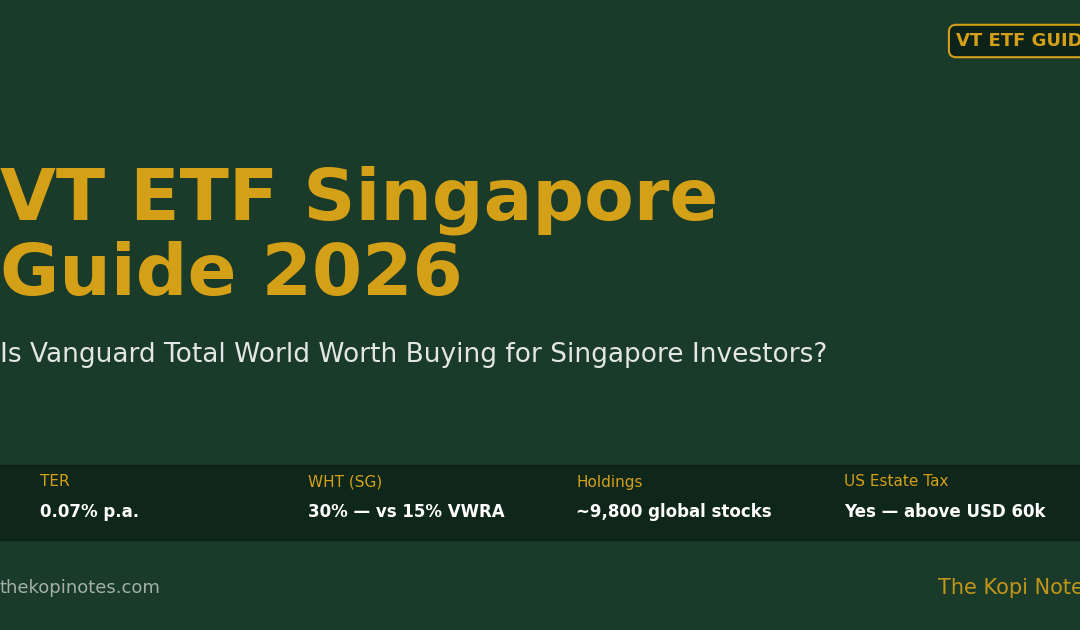
VT ETF Singapore Guide 2026: Should You Buy Vanguard Total World?
A complete guide for Singapore investors — tax risks, costs, and whether VWRA is a better alternative.
VT is Vanguard’s Total World Stock ETF, listed on NYSE Arca (USA). It tracks the FTSE Global All Cap Index and holds over 9,800 stocks across developed and emerging markets. Singapore investors can buy VT, but its US domicile means a 30% withholding tax on dividends and US estate tax exposure on holdings above USD 60,000 — making the Ireland-domiciled equivalent VWRA a more tax-efficient choice for most.
Not financial advice. All figures are for educational reference only. Data as at April 2026 unless noted.
What Is VT ETF?
VT — officially the Vanguard Total World Stock ETF — is one of the broadest ETFs available to retail investors. It tracks the FTSE Global All Cap Index, which covers large-, mid-, and small-cap stocks across developed and emerging market countries. As at April 2026, VT holds approximately 9,800 individual stocks, giving investors exposure to virtually the entire global equity market in a single fund.
VT is managed by Vanguard, one of the world’s largest asset managers, and has been listed on NYSE Arca since 2008. The ETF distributes dividends quarterly and has a Total Expense Ratio (TER) of just 0.07% per annum — one of the lowest in the world for a globally diversified fund.
For US-based investors, VT is an excellent product. For Singapore investors, however, the fund’s US domicile creates significant tax drag that needs to be understood before buying. The key issues — withholding tax and US estate tax — are explained in detail below.
Key Facts at a Glance
| Metric | Detail |
|---|---|
| Full Name | Vanguard Total World Stock ETF |
| Ticker (NYSE Arca) | VT |
| Index Tracked | FTSE Global All Cap Index |
| Domicile | United States |
| Structure | Distributing (quarterly dividends) |
| TER (Expense Ratio) | 0.07% p.a. |
| AUM | ~USD 38 billion (as at Q1 2026) |
| Number of Holdings | ~9,800 |
| Currency | USD |
| Exchange | NYSE Arca (USA) |
| Dividend Yield (approx.) | ~1.8–2.0% p.a. (as at Q1 2026) |
Source: Vanguard fund factsheet, April 2026
The Tax Problem for Singapore Investors
VT’s biggest disadvantage for Singapore investors is its US domicile. Unlike Ireland-domiciled ETFs such as VWRA (which trades on the London Stock Exchange), VT is subject to two significant tax costs that can meaningfully erode your long-term returns.
1. Withholding Tax on Dividends
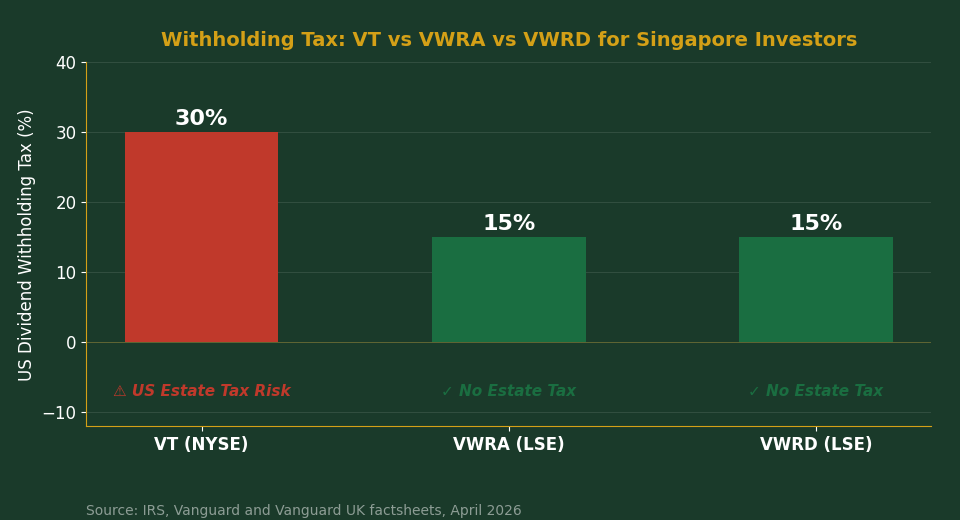
When VT pays dividends, the US government withholds 30% of the dividend at source before it reaches Singapore investors. This is because Singapore does not have a tax treaty with the US that reduces the withholding tax rate for non-resident individual investors.
By contrast, Ireland-domiciled ETFs like VWRA benefit from an Ireland–US tax treaty that reduces this withholding rate to 15% on US-sourced dividends held within the ETF. The ETF itself pays 15% WHT on its US dividends, and then passes the net dividend to investors with no further deduction.
The practical impact: on a SGD 100,000 portfolio with a 2% dividend yield, the annual dividend payout is approximately SGD 2,000. VT investors receive SGD 1,400 (after 30% WHT), while VWRA investors receive approximately SGD 1,700 (after an effective ~15% blended WHT on US-source dividends only, since non-US dividends are taxed at lower or zero rates within the fund).
2. US Estate Tax Exposure
This is the more serious risk. US federal estate tax applies to all assets held in US-domiciled funds if the investor dies with a US situs estate above USD 60,000. For non-US persons, the estate tax rate on the amount above USD 60,000 can reach up to 40%.
If you hold USD 200,000 of VT and you pass away, your estate could face a US estate tax bill of up to USD 56,000 (40% on USD 140,000 above the threshold). Ireland-domiciled ETFs like VWRA have no US estate tax exposure because the Irish fund — not the Singapore investor — is the legal owner of the US stocks.
For most Singapore investors building wealth for retirement or passing assets to their children, this estate tax risk is not worth taking — especially when a direct equivalent (VWRA) exists with lower WHT and zero estate tax risk.
| ETF | Domicile | US Dividend WHT | US Estate Tax Risk | Exchange |
|---|---|---|---|---|
| VT | USA | 30% | Yes (above USD 60k) | NYSE Arca |
| VWRA (LSE) | Ireland | 15% (blended) | None | LSE (London) |
| VWRD (LSE) | Ireland | 15% (blended) | None | LSE (London) |
Source: IRS Publication 515, Vanguard and iShares fund factsheets, April 2026
VT vs VWRA: Which Is Better for Singapore Investors?
VT and VWRA track essentially the same index (both use the FTSE Global All Cap/All-World family) and hold roughly the same global equity universe. The key differences are domicile, tax treatment, structure, and TER — all of which matter significantly for Singapore investors. If you are building a long-term passive portfolio and your goal is to access global equities in the most tax-efficient way, VWRA is the better choice for most Singapore residents.
That said, VT has one genuine advantage: its TER of 0.07% p.a. is cheaper than VWRA’s 0.22% p.a. However, the WHT difference — roughly 15 percentage points on US dividends — completely negates the TER advantage for any investor receiving dividends. For a SGD 100,000 portfolio, the extra WHT cost of VT at a 2% yield is approximately SGD 300 per year, versus a TER saving of only SGD 150 per year. VWRA wins on a net-cost basis for dividend investors.
For investors using the CPF investment strategy Singapore approach and prioritising total return (including reinvested dividends), VWRA’s accumulating structure also means no dividend leakage — the fund reinvests dividends automatically, compounding tax-efficiently.
| Feature | VT (NYSE Arca) | VWRA (LSE) |
|---|---|---|
| Index | FTSE Global All Cap | FTSE All-World |
| Domicile | USA | Ireland (UCITS) |
| TER | 0.07% p.a. | 0.22% p.a. |
| Structure | Distributing (quarterly) | Accumulating |
| US Dividend WHT | 30% | ~15% (blended) |
| US Estate Tax Risk | Yes (above USD 60k) | None |
| Number of Holdings | ~9,800 | ~3,700 |
| AUM | ~USD 38bn | ~USD 20bn |
| Currency | USD | USD |
Source: Vanguard and Vanguard UK fund factsheets, April 2026
One nuance worth noting: VT tracks the FTSE Global All Cap (which includes small-cap stocks), while VWRA tracks the FTSE All-World (large and mid-cap only). VT thus has broader diversification — around 9,800 holdings vs VWRA’s ~3,700. In practice, the performance difference attributable to small-cap inclusion has been minimal over most rolling 10-year periods, as small-cap stocks represent a relatively small share of global market cap.
Expense Ratio and Total Costs
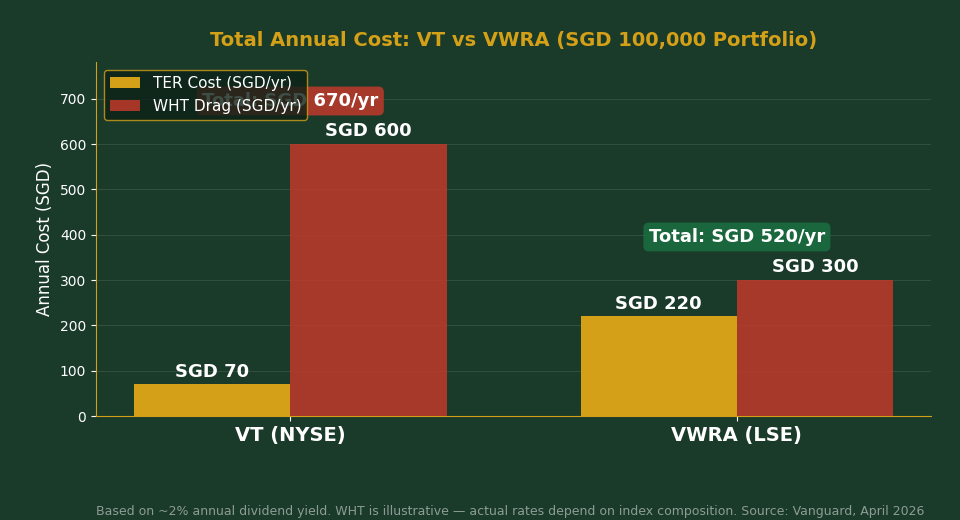
VT’s TER of 0.07% p.a. is genuinely one of the cheapest in the world. On a SGD 100,000 portfolio, VT’s annual management cost is only SGD 70 per year.
VWRA’s TER of 0.22% p.a. costs SGD 220 per year on the same SGD 100,000. That’s SGD 150 per year more — a real cost difference.
However, the withholding tax difference reverses this cost advantage for any investor receiving dividends:
Worked cost comparison — SGD 100,000 portfolio, 2% annual dividend yield:
| Cost Component | VT (per year) | VWRA (per year) |
|---|---|---|
| TER (management fee) | SGD 70 | SGD 220 |
| WHT on dividends (est.) | SGD 600 (30% × SGD 2,000) | SGD 300 (est. 15% blended) |
| Total Annual Cost Drag | SGD 670 | SGD 520 |
Illustration based on approximate 2% dividend yield. Actual WHT rates depend on index geographic composition. Source: Vanguard fund factsheets, April 2026
Note: VWRA is accumulating, so the WHT is paid inside the fund and reflected in slightly lower NAV growth — Singapore investors do not receive a direct dividend but still bear the effective cost. The comparison above illustrates the underlying tax drag. For long-term passive income strategies, as explored in our guide on passive income Singapore, reducing total cost drag matters enormously thanks to compounding. You can model the long-term impact using our Singapore retirement calculator.
How to Buy VT ETF in Singapore
VT is listed on NYSE Arca (USA) and trades in USD. Most Singapore brokers that offer US market access can execute VT orders. However, given the US estate tax consideration, many Singapore investors who research this topic choose VWRA instead. If you understand the tax risks and still wish to buy VT, here is how to do it:
Interactive Brokers (IBKR)
IBKR is the most cost-effective platform for buying US-listed ETFs for Singapore investors. Commission is very low under the IBKR Pro structure. Search for “VT” and select NYSE ARCA as the exchange. Fund your account in SGD and convert to USD, or fund directly in USD. IBKR charges very competitive FX conversion fees and is the preferred platform for larger portfolios.
Tiger Brokers / moomoo Singapore
Both Tiger Brokers and the moomoo Singapore review platform support US equity trading with zero-commission promos for new users. Search for “VT” on the NYSE/ARCA market. Note that FX spread costs apply when converting SGD to USD. Both platforms are MAS-regulated and suitable for retail investors.
Saxo Markets
Saxo offers US equity access but commissions are higher than IBKR for US stocks. Saxo is better suited for investors who want a multi-asset platform with access to bonds, options, and forex alongside ETFs.
Syfe Brokerage
Syfe’s brokerage arm supports US-listed ETFs. New users can use our Syfe referral code for sign-up bonuses. Syfe’s interface is simple and well-suited to beginner investors, though its commission structure is less competitive than IBKR for larger portfolios.
Can I buy VT with CPF or SRS?
No. VT is listed on a US exchange and is not eligible for CPF investment. SRS funds can be invested through some brokers in US-listed securities, but you should confirm with your broker and check the latest MAS/CPF Board guidelines. For CPF-compatible ETF options, consider SGX-listed ETFs such as the Nikko AM STI ETF or SPDR STI ETF, which are on the approved CPF investment list.
Who Should Buy VT ETF?
VT may be suitable if you:
- Are primarily a US-resident investor or plan to relocate to the US, where estate tax exemptions are far higher (USD 13.6 million for US persons in 2026)
- Hold VT in a tax-advantaged US account like a 401(k) or IRA, where WHT is either recapturable or irrelevant to your tax situation
- Have a strong preference for maximum diversification including global small-cap stocks and accept the tax trade-offs
- Are investing a relatively small amount (under USD 60,000) where the estate tax threshold is not yet a concern — though the WHT cost remains
Consider VWRA or VWRD instead if you:
- Are a Singapore resident or permanent resident building long-term wealth
- Hold or plan to hold more than USD 60,000 in global equities — essentially anyone serious about retirement investing
- Want to avoid the 30% WHT drag on dividends
- Prefer an accumulating fund that automatically reinvests dividends tax-efficiently
- Use Singapore Savings Bonds, T-bills and ETFs together as part of a broader portfolio (see our Singapore Savings Bonds guide for the fixed income component)
For further reading on how to build a tax-efficient ETF portfolio as a Singapore investor, our guide on why Singapore investors buy ETFs on the LSE covers the full rationale for choosing Ireland-domiciled UCITS ETFs over US-domiciled alternatives. If you are weighing up VWRA vs other global ETFs, our VWRA ETF Singapore guide compares it against VWRD, IWDA, and CSPX in detail.
Frequently Asked Questions
What is VT ETF and why do Singapore investors research it?
VT is the Vanguard Total World Stock ETF, listed on NYSE Arca in the USA. It tracks the FTSE Global All Cap Index and holds approximately 9,800 stocks across global developed and emerging markets. Singapore investors often discover VT when researching global ETFs because of Vanguard’s strong reputation and VT’s extremely low TER of 0.07% p.a. However, most Singapore-based investors ultimately prefer VWRA (the Ireland-domiciled equivalent on the London Stock Exchange) due to lower withholding tax and zero US estate tax exposure.
Is VT the same as VWRA?
VT and VWRA are similar but not identical. Both track FTSE global equity indices and give exposure to global markets, but VT tracks the FTSE Global All Cap Index (~9,800 holdings including small-caps), while VWRA tracks the FTSE All-World Index (~3,700 large and mid-cap holdings). The critical difference is domicile: VT is US-domiciled (30% WHT on dividends, US estate tax risk), whereas VWRA is Ireland-domiciled UCITS (approximately 15% blended WHT, no estate tax risk for Singapore investors). VWRA is also accumulating; VT is distributing.
Can Singapore investors buy VT ETF?
Yes, Singapore investors can buy VT through brokers with US market access, such as Interactive Brokers, Tiger Brokers, moomoo Singapore, or Saxo Markets. However, purchasing VT means accepting a 30% US withholding tax on dividends and US estate tax exposure on holdings above USD 60,000. For most Singapore residents building long-term wealth, the Ireland-domiciled VWRA (available on the London Stock Exchange) is a more tax-efficient choice.
What is the US estate tax risk for Singapore investors holding VT?
If a Singapore investor holds VT (a US-situs asset) and passes away with more than USD 60,000 in US assets, their estate may be liable to US federal estate tax of up to 40% on the amount above the USD 60,000 threshold. For example, a holding worth approximately USD 150,000 could result in a US estate tax bill of up to USD 36,000. Ireland-domiciled ETFs like VWRA are not subject to this tax because the Irish fund is the legal holder of the US securities, not the individual investor. Singapore has no estate tax treaty with the US for non-resident aliens.
Which broker is best for buying VT ETF in Singapore?
Interactive Brokers (IBKR) is generally the most cost-effective broker for buying US-listed ETFs like VT in Singapore, particularly for portfolios above SGD 30,000. Its commission structure is very competitive and FX conversion spreads are low. For beginners, moomoo Singapore and Tiger Brokers offer zero-commission promotions for new accounts. Syfe Brokerage is another MAS-regulated option with a user-friendly interface. All of these platforms support US market (NYSE Arca) access required to purchase VT.
Should I buy VT or VWRA as a Singapore investor?
For the vast majority of Singapore investors, VWRA is the better choice. VWRA is Ireland-domiciled (UCITS ETF), which means approximately 15% blended withholding tax on dividends (vs 30% for VT), no US estate tax risk, and an accumulating structure that reinvests dividends automatically. VWRA’s TER of 0.22% p.a. is higher than VT’s 0.07% p.a., but the WHT advantage more than compensates for the fee difference on any portfolio receiving dividends. VT is better suited to US-resident investors or those investing through US tax-advantaged accounts.
Ready to Start Investing in ETFs?
Open a brokerage account and start building your global ETF portfolio today. Use our referral links for exclusive sign-up bonuses.
This article was researched with the help of AI. While we strive to keep all information accurate and up to date, there may be errors. If you notice any discrepancies, please contact us.