Average S-REIT Dividend Yield 2026: Sector Data, Top Payers & Rate Cut Impact
Updated August 2026 — What Singapore investors need to know about S-REIT yields before the September FOMC
The average S-REIT dividend yield in August 2026 sits at approximately 6.0–6.5%, with individual REITs ranging from 4.2% (healthcare) to over 9% (UK-focused REITs). The yield spread over Singapore’s 10-year government bond remains wide at roughly 3.7 percentage points — well above the historical average — making S-REITs one of the most compelling yield opportunities on the SGX heading into the expected September 2026 Fed rate cut.
Not financial advice. All figures are indicative and for educational reference only. Data as at August 2026 unless noted. Always verify individual REIT yields from SGX announcements before making investment decisions.
- Sector-average S-REIT yield is ~6.0–6.5% as at August 2026, well above the SGS 10-year bond yield of ~2.3%
- Overseas and office sub-sectors offer the highest yields (8–9%), while healthcare and data centre REITs yield the least (4–5%) but carry lower risk
- A September 2026 Fed rate cut would reduce financing costs for REITs and is expected to drive DPU recovery and capital appreciation across the sector
What Is the Average S-REIT Dividend Yield in 2026?
The Singapore REIT (S-REIT) sector covers around 40+ trusts listed on the SGX, spanning asset classes from shopping malls and data centres to hospitals and overseas office buildings. Each distributes at least 90% of its taxable income to unitholders to maintain REIT tax status — which is why yields are typically higher than regular stocks.
As at August 2026, the sector-wide average Distribution Per Unit (DPU) yield — the annual cash payout divided by unit price — sits at approximately 6.0–6.5%. That’s well above what you’d earn from a Singapore Savings Bond (~2.1%) or a fixed deposit (~2.5–3.0%).
The yield spread — that is, the gap between the average S-REIT yield and the Singapore 10-year government bond (SGS) yield of ~2.3% — sits at roughly 3.7 percentage points. Historically, a spread above 3.5 pp has signalled that S-REITs are attractively valued relative to risk-free bonds. That said, yield alone is never the full picture: check the REIT’s gearing ratio, DPU coverage, and weighted average lease expiry (WALE) too.
If you’re looking for the best S-REITs in Singapore 2026 to add to your portfolio, the starting point is always comparing yields across sub-sectors — which we do in the next section.
S-REIT Yield by Sub-Sector
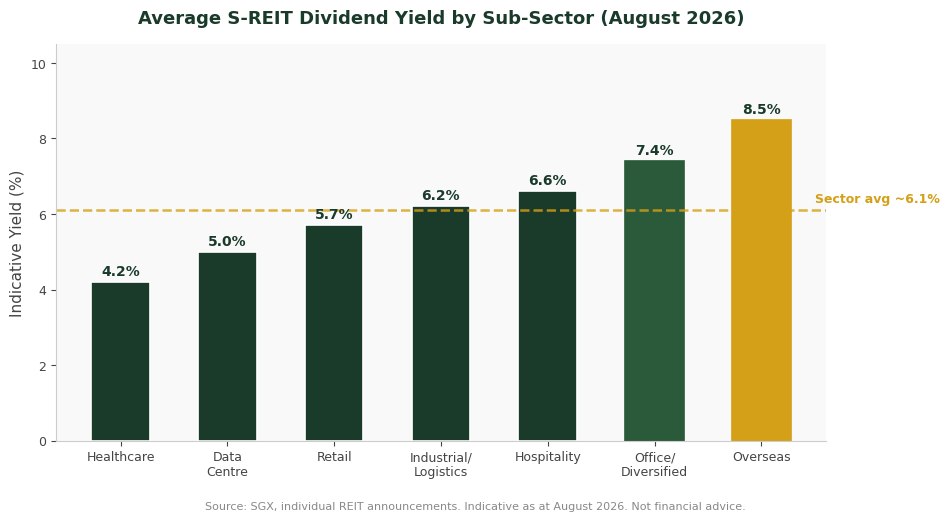
Not all S-REITs yield the same. Sub-sector matters enormously. Here’s a breakdown of indicative average yields across the main S-REIT sub-sectors as at August 2026:
| Sub-Sector | Example REITs | Avg Indicative Yield | Key Driver |
|---|---|---|---|
| Healthcare | PLife REIT, First REIT | 4.0–4.5% | Stable, long leases — premium priced |
| Data Centre | Keppel DC REIT, Digital Core | 4.8–5.5% | AI demand tailwind, growth premium |
| Retail | FCT, CICT, Starhill | 5.5–6.0% | Resilient malls, foot traffic recovery |
| Industrial / Logistics | MLT, MINT, CLAR, AIMS APAC | 6.0–6.5% | Diversified geographies, e-commerce |
| Hospitality | ART, FEHT, CDL HT | 6.5–7.0% | Travel recovery, RevPAR growth |
| Office / Diversified | Suntec, MPACT, OUE | 7.0–8.0% | Occupancy pressure; higher risk premium |
| Overseas-Focused | Elite UK, IREIT, CLAS | 8.0–9.5% | Currency risk + macro headwinds priced in |
Source: SGX REIT data, individual REIT 1H 2026 results announcements. Indicative only as at August 2026. Yields vary with unit price — check current prices before investing.
The clear pattern: higher yield = higher risk. Healthcare and data centre REITs command a premium because their cash flows are highly predictable. Overseas-focused REITs yield more because they carry FX exposure and typically face greater macro uncertainty.
Top 10 Highest-Yielding S-REITs (August 2026)
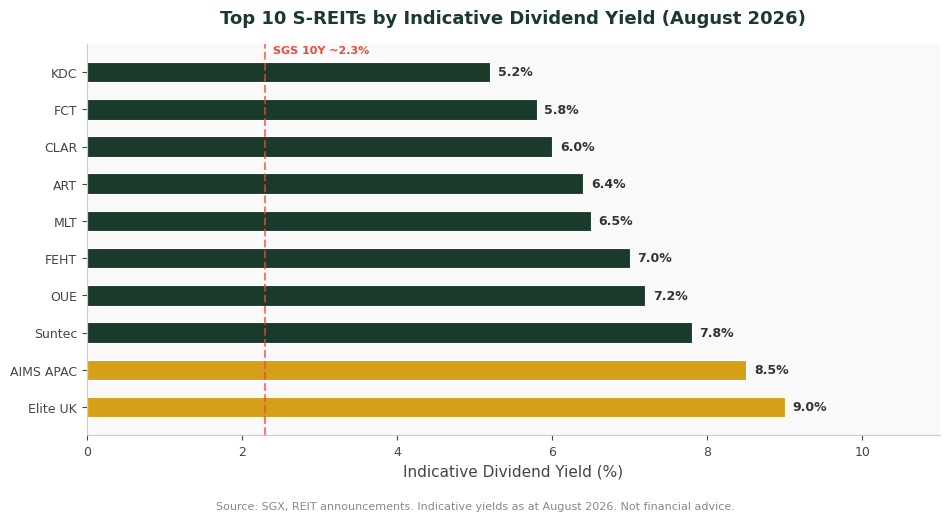
If you’re hunting for pure income, these are the S-REITs offering the highest indicative dividend yields as at August 2026. Note that high yield alone does not mean high quality — always cross-check gearing and DPU sustainability.
| REIT | Sub-Sector | Indicative Yield (Aug 2026) | Gearing (Approx.) |
|---|---|---|---|
| Elite UK REIT | Overseas Office | ~9.0% | ~43% |
| AIMS APAC REIT | Industrial | ~8.5% | ~27% |
| Suntec REIT | Office/Retail | ~7.8% | ~42% |
| OUE REIT | Office/Hospitality | ~7.2% | ~40% |
| Far East Hospitality Trust | Hospitality | ~7.0% | ~33% |
| Mapletree Logistics Trust | Industrial/Logistics | ~6.5% | ~39% |
| Ascott Residence Trust | Hospitality | ~6.4% | ~38% |
| CapitaLand Ascendas REIT | Industrial | ~6.0% | ~37% |
| Frasers Centrepoint Trust | Retail | ~5.8% | ~35% |
| Keppel DC REIT | Data Centre | ~5.2% | ~33% |
Source: SGX, individual 1H 2026 results announcements. Yields are indicative based on trailing DPU ÷ market price as at August 2026. Gearing from most recent quarterly filings. Always verify live data before investing.
Notice that AIMS APAC REIT stands out: it offers ~8.5% yield with one of the lowest gearing ratios (~27%) in the sector — making it both a high-income play and a relatively financially conservative one. Meanwhile, office REITs like Suntec and OUE offer higher yields but carry more balance sheet risk.
How Rate Cuts Affect S-REIT Yields
The September 2026 FOMC meeting (scheduled 16–17 September) is the most watched event in the S-REIT calendar right now. Markets are pricing in a 25–50 basis point cut. Here’s what that means for yields.
Why lower rates are good for S-REITs:
Most S-REITs borrow heavily to fund property acquisitions — the sector average gearing ratio is about 37%. Their borrowing costs are mostly floating-rate or periodically refinanced. When the Fed cuts rates, Singapore’s SORA (Singapore Overnight Rate Average) tends to follow. Lower SORA means lower interest expenses, which flows directly into higher DPU.
For a typical S-REIT with 38% gearing and S$3 billion of assets, a 50 basis point cut could reduce annual interest expenses by S$5–10 million — a material DPU uplift over time.
The price appreciation angle:
Rate cuts also push investors toward yield-generating assets as risk-free rates fall. When T-bill yields drop from 3.5% to 3.0%, an S-REIT yielding 6% looks even more attractive. This typically drives unit prices up — compressing the yield percentage even as absolute DPU stays flat or rises. So if you’re buying after the rate cut announcement, you may be buying at a higher price.
That said, not all REITs benefit equally. REITs with long-dated fixed-rate debt (like PLife REIT) benefit less in the short term. REITs with mostly floating-rate debt and high gearing (like Suntec) stand to gain the most from each 25 bps cut.
S-REIT Yield vs T-Bills and SGS Bonds
For an apples-to-apples comparison, here’s how S-REIT yields stack up against the main fixed-income alternatives as at August 2026:
| Instrument | Indicative Yield | Tenor / Frequency | Risk Level |
|---|---|---|---|
| Singapore T-bills (6-month) | ~3.3% | 6 months, bi-weekly | Risk-free |
| Singapore Savings Bond (SSB) | ~2.1% avg (10-yr) | Monthly, redeemable | Risk-free |
| SGS 10-year bond | ~2.3% | Semi-annual, 10 years | Risk-free |
| S-REIT (sector average) | ~6.0–6.5% | Quarterly / semi-annual | Moderate |
| High-yield S-REITs | ~8.5–9.0% | Quarterly / semi-annual | Higher |
Source: MAS, SGX data, August 2026. T-bill rate based on latest published cut-off yield. All figures indicative.
The key difference: T-bills are guaranteed — you know exactly what you’ll get. S-REITs distribute based on rental income and property valuations, which can fall. However, the extra yield (~2.7–3.2 percentage points over T-bills) is the market’s compensation for taking that risk.
If you want both income and flexibility, consider a barbell: put part of your liquid savings in Singapore T-bills 2026 (safe, short-duration) and part into S-REITs (higher income, growth potential). Our full S-REIT yield vs T-bill comparison breaks this down in detail.
You can also use our Singapore retirement calculator to model how different yield levels affect your retirement income target — useful for deciding how much REIT exposure makes sense for your situation.
Using S-REIT Yield as an Investment Signal
Dividend yield is a useful starting point — but it can mislead if you don’t read it carefully. Here’s how to use it correctly.
Yield compression vs yield expansion:
When the unit price rises (e.g. after a rate cut announcement), the yield falls — even if the DPU stays the same. A falling yield isn’t always bad: it can mean the market is more confident in the REIT’s future income. Conversely, a very high yield (above 9–10%) often signals that the market is pricing in risk — perhaps a DPU cut, high refinancing pressure, or asset quality concerns.
What to check alongside yield:
- DPU growth trend — Is distribution per unit rising or falling over the past 4 quarters?
- Gearing ratio — Above 40% gearing limits acquisition growth; above 45% (MAS limit is 50%) raises red flags
- WALE (Weighted Average Lease Expiry) — Longer WALE = more income certainty
- Occupancy rate — Look for 90%+ occupancy across the portfolio
- Interest coverage ratio (ICR) — Should be at least 2.0x; MAS requires REITs to meet ICR thresholds
For Singapore investors building long-term wealth, S-REITs are most powerful when held for their compounding income — especially when distributions are reinvested. Our passive income Singapore guide covers exactly how to structure a REIT portfolio for monthly or quarterly income in 2026.
If you’re new to REITs or want a broker to help you buy them cost-effectively, the Syfe referral code and sign-up bonus gives you access to Syfe’s managed REIT+ portfolio — an easy way to gain diversified S-REIT exposure with a single click.
Frequently Asked Questions
What is the average S-REIT dividend yield in Singapore in 2026?
Which S-REIT has the highest dividend yield in 2026?
Are S-REIT dividends taxable in Singapore?
How does a Fed rate cut in September 2026 affect S-REIT yields?
What is a good S-REIT yield spread vs the SGS 10-year bond?
Should I buy high-yield S-REITs or low-yield S-REITs?
What is the MAS gearing limit for S-REITs?
How often do S-REITs pay dividends?
Can I buy S-REITs in my CPF or SRS account?
This article was researched with the help of AI. While we strive to keep all information accurate and up to date, there may be errors. If you notice any discrepancies, please contact us.