Latin America ETF Singapore: LTAM vs ILF for Brazil & Mexico Exposure (2026 Guide)
How to access Brazil, Mexico and Chile through a single ETF — and the US estate tax trap most guides never mention.
Latin America ETFs give Singapore investors single-ticket exposure to Brazil, Mexico and Chile. The iShares MSCI EM Latin America UCITS ETF (LSE: LTAM) is the most tax-efficient route — domiciled in Ireland with a 0.20% TER and no US estate tax exposure — while the US-listed iShares Latin America 40 ETF (NYSE Arca: ILF) carries a higher 0.47% TER and sits inside the US estate tax regime for foreign holders. After a 54.7% total return in 2025, understanding this structural difference matters before buying either fund.
Not financial advice. All figures are for educational reference only. Data verified as at October 2026 unless otherwise noted.
Table of Contents
Contents -- Click to expand
What Is a Latin America ETF?
A Latin America ETF is an exchange-traded fund that bundles equities from the region’s largest listed companies — predominantly Brazil and Mexico, with smaller slices of Chile, Peru and Colombia — into a single tradeable ticker. Rather than opening a Brazilian B3 brokerage account or a Mexican BMV account directly, a Singapore investor buys one ETF share and gets diversified exposure across banks, miners, energy producers and consumer staples companies from the region.
The two practical routes for Singapore investors are the iShares MSCI EM Latin America UCITS ETF (LSE: LTAM), domiciled in Ireland and listed on the London Stock Exchange, and the iShares Latin America 40 ETF (NYSE Arca: ILF), domiciled in the United States. Both are managed by BlackRock and track broadly similar regional benchmarks, but their domicile — not their underlying holdings — is what determines the tax outcome for a Singapore-based investor.
Why Latin America ETFs Are Trending in 2026
Latin American equities had a standout 2025, with LTAM’s benchmark posting a 54.7% total return in USD — the index’s best year on record over the past decade — after a brutal -26.9% in 2024. (iShares LTAM factsheet, Oct 2026) The rally has continued into 2026, with the fund up 23.80% year-to-date as at 22 October 2026.
Three forces are driving the move. First, Brazil’s central bank cycle turned: as the US Federal Reserve cut rates through 2025-2026, emerging-market currencies and equities — Brazil’s real and Bovespa among them — became relatively more attractive to global capital flows chasing yield outside the US dollar. Second, Mexico’s nearshoring story remains intact: manufacturers continuing to relocate supply chains closer to the US market keep flowing investment into Mexican industrials, even as US-Mexico tariff negotiations create periodic volatility. Third, commodity-linked Brazilian names — iron ore, soybeans, oil — benefited from firm commodity prices and a weaker US dollar through the period.
This is a genuine macro re-rating, not a one-way bet — Latin American equities are known for sharp drawdowns (2024’s -26.9% is a recent reminder), which is exactly why the structural and tax mechanics covered in this guide matter before sizing a position.
LTAM vs ILF: Full Comparison
Both funds track the broad Latin American large-cap universe, but differ meaningfully in cost, domicile and tax treatment. Here’s the side-by-side as at October 2026:
| Feature | LTAM (iShares, LSE) | ILF (iShares, NYSE Arca) |
|---|---|---|
| Index Tracked | MSCI EM Latin America 10/40 | S&P Latin America 40 |
| Domicile | Ireland | United States |
| Total Expense Ratio (TER) | 0.20% | 0.47% |
| Net Assets (AUM) | ~USD 2.23 billion | ~USD 3.7-3.8 billion |
| Number of Holdings | 85 | ~40 |
| Inception Date | 15 Oct 2007 | 25 Oct 2001 |
| Distribution Policy | Distributing (semi-annual) | Distributing |
| Currency | GBP / USD lines on LSE | USD |
| 12-Month Trailing Yield | 3.12% | ~2.8-3.2% (varies by year) |
| US Estate Tax Exposure | None | Yes — US situs asset |
Source: iShares LTAM factsheet (23 Oct 2026); third-party aggregator data for ILF (TrackInsight, Pensions & Investments, Dividend.com, Oct 2026).
LTAM’s lower TER and larger holdings count (85 vs ILF’s roughly 40) reflect its broader MSCI index methodology, while ILF’s longer track record (launched in 2001, six years before LTAM) and larger AUM give it a slight liquidity edge on the US side. For a Singapore investor, the cost and tax gap matters more than the liquidity difference at typical retail trade sizes.
Country Mix: Brazil, Mexico and the Rest
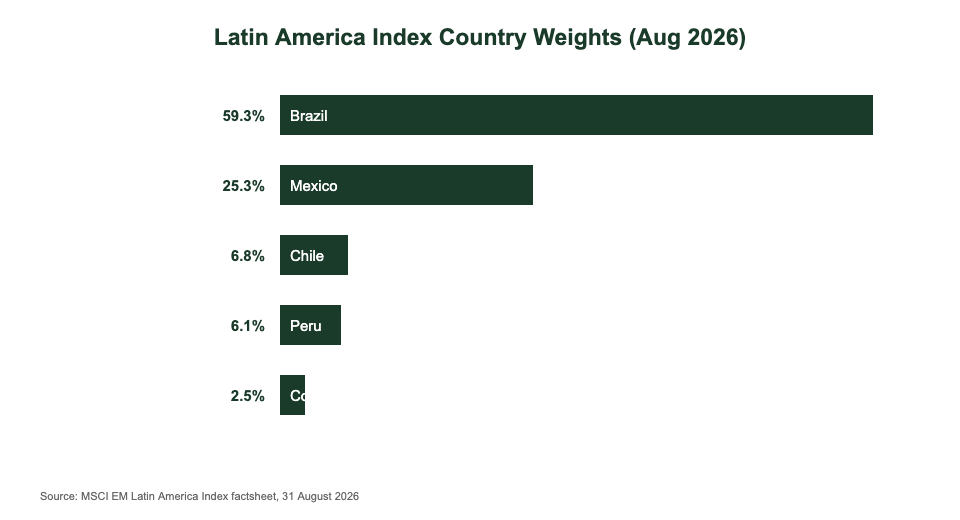
Both funds are heavily concentrated in two countries. Using the MSCI EM Latin America index weights (which LTAM’s 10/40-capped variant closely tracks) as at 31 August 2026:
| Country | Index Weight |
|---|---|
| Brazil | ~59.3% |
| Mexico | ~25.3% |
| Chile | ~6.8% |
| Peru | ~6.1% |
| Colombia | ~2.5% |
Source: MSCI EM Latin America Index factsheet, 31 August 2026. LTAM tracks the related 10/40-capped variant, which caps single-country concentration slightly below these figures; ILF’s S&P-based weights are broadly similar with Brazil near 55% and Mexico near 27%.
By sector, LTAM is dominated by Financials (42.7% — mostly Brazilian and Mexican banks), Materials (16.3% — miners like Vale), Consumer Staples (9.6%), Energy (8.6% — Petrobras and peers) and Industrials (7.7%). (iShares LTAM factsheet, 22 Oct 2026) This means a Latin America ETF is effectively a concentrated bet on Brazilian financials and commodity producers, plus Mexican industrials and consumer names — not a broad-based regional play across dozens of sub-sectors.
The US Estate Tax Trap With ILF
This is the single most important fact this guide can give you. ILF is a US-domiciled fund, which means its shares are classified as “US situs assets” for US estate tax purposes — regardless of the fact that the fund’s underlying holdings are Brazilian and Mexican companies, not American ones. A non-US investor (including a Singapore investor) holding ILF shares at death faces US estate tax exposure above a tiny USD 60,000 exemption threshold, with rates scaling up to 40%. (IRS, Estate Tax for Nonresidents)
LTAM, by contrast, is domiciled in Ireland. Irish-domiciled UCITS funds are not US situs assets, so a Singapore investor holding LTAM has no US estate tax exposure at all — the same structural advantage that applies to Ireland-domiciled funds like CSPX and VWRA covered elsewhere on this site. For a Latin America allocation of any meaningful size, this alone is usually reason enough to prefer LTAM over ILF.
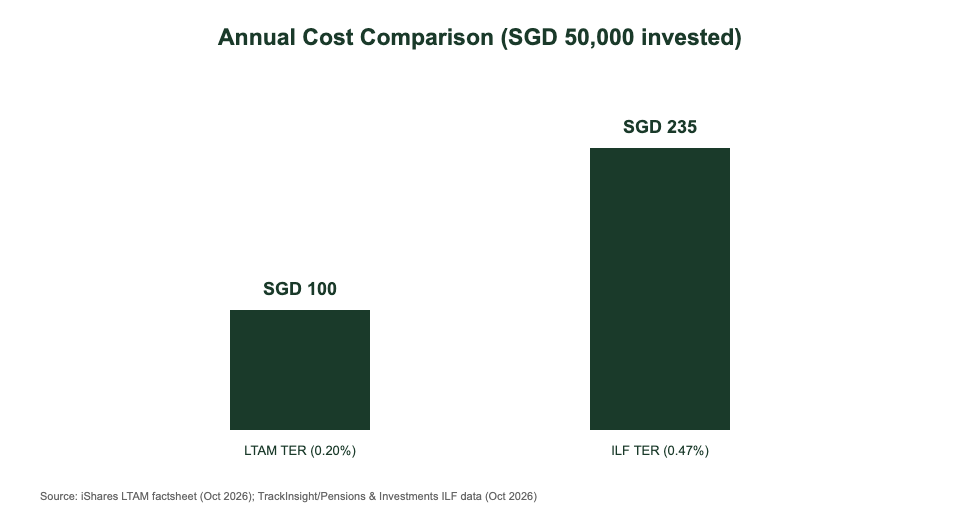
Separately, LTAM’s 0.20% TER is less than half of ILF’s 0.47% — on a SGD 50,000 position, that’s roughly SGD 100 a year saved in fees alone, before even factoring in the estate tax difference. The two advantages compound: lower ongoing cost, and the elimination of a tail-risk estate tax liability that most investors never think about until it’s too late.
- LTAM: ~SGD 100 TER cost, no US estate tax exposure
- ILF: ~SGD 235 TER cost, plus US estate tax exposure above USD 60,000 cumulative US situs assets
How to Buy a Latin America ETF in Singapore
Step 1: Choose a broker with LSE access. Since LTAM is the recommended choice for most Singapore investors, you need a broker offering London Stock Exchange trading. Syfe referral code and sign-up bonus offers zero-commission LSE access with automated rebalancing, while FSMOne referral code is a lower-cost option for larger lump-sum trades. Interactive Brokers also offers LSE access with the lowest per-trade commissions for frequent traders.
Step 2: Search for the ticker LTAM (full name: iShares MSCI EM Latin America UCITS ETF). Confirm you are buying the LSE-listed GBP line (ticker LTAM) or the USD line (ticker DLTM) depending on your broker’s offering and your currency preference.
Step 3: Place your order during London market hours (8am-4:30pm GMT, which is 4pm-12:30am Singapore time). Given LTAM’s roughly USD 2.2 billion AUM, liquidity is reasonable for retail-sized trades, though spreads can widen during periods of EM volatility — avoid trading in the first or last 15 minutes of the London session.
Step 4: Size the position modestly and hold long-term. Given the sector concentration and historical volatility (the fund fell -26.9% in 2024 just one year before its 54.7% rebound), a Latin America ETF works best as a 5-10% satellite allocation within a globally diversified portfolio such as one anchored by VWRA, rather than a core holding on its own.
Risks to Consider
Extreme volatility. Latin American equities swing hard in both directions — a -26.9% year followed by a +54.7% year is not unusual for this asset class. Investors need a long time horizon and the temperament to hold through drawdowns without panic-selling.
Currency risk. The Brazilian real and Mexican peso are both historically volatile against the US dollar and SGD. Currency swings can amplify or erase equity gains in SGD terms, and neither LTAM nor ILF hedges this exposure.
Single-country concentration. With Brazil alone making up roughly 59% of the index, this is not a diversified “Latin America” play so much as a Brazil-plus-Mexico play. A political or fiscal shock in either country has an outsized effect on fund performance.
Not CPF or SRS investable (in most cases). Neither LTAM nor ILF is on the CPF Investment Scheme approved list. Some brokers permit SRS funds for LSE or NYSE Arca trades — confirm directly with your broker before assuming eligibility.
Commodity and political sensitivity. A meaningful slice of the index (Materials and Energy sectors) moves with global commodity prices, while Brazilian and Mexican politics — elections, fiscal policy, central bank independence — can swing sentiment sharply in either direction.
Who Should Buy a Latin America ETF?
LTAM may suit you if you want tactical exposure to a Brazil-and-Mexico-led commodity and nearshoring theme, you already hold a globally diversified core like a broad Singapore ETF list allocation, and you want the lowest-cost, estate-tax-clean route into the region.
Consider alternatives if you want emerging markets exposure without single-region concentration — investors who prefer a globally diversified emerging markets sleeve, or who want exposure to Asian emerging markets instead, may prefer reviewing our India ETF Singapore guide or Taiwan ETF Singapore guide for a different emerging-markets angle with lower volatility profiles historically. For most Singapore investors, a Latin America ETF works best as a small satellite position — typically 5% of an equity portfolio — rather than a standalone emerging markets strategy.
Frequently Asked Questions
What is the best Latin America ETF for Singapore investors?
For most Singapore investors, the iShares MSCI EM Latin America UCITS ETF (LTAM) is the better choice. It has a lower TER (0.20% vs ILF’s 0.47%), is Ireland-domiciled so it carries no US estate tax exposure, and offers broader diversification with 85 holdings versus ILF’s roughly 40. ILF’s only real edge is a longer track record and slightly larger AUM.
Is LTAM the same as buying Brazilian and Mexican stocks directly?
LTAM gives you indirect exposure by holding a basket of the region’s largest listed companies — predominantly Brazilian and Mexican banks, miners, energy producers and consumer names — weighted according to the MSCI EM Latin America 10/40 Index. You are not buying individual Brazilian or Mexican shares directly; you’re buying a single fund that replicates the index through physical holdings using an optimised sampling methodology.
Why does ILF have US estate tax exposure if it holds Latin American stocks, not US stocks?
US estate tax exposure depends on where the fund itself is domiciled and listed, not what it invests in. ILF is organised and listed in the United States, which makes its shares a “US situs asset” for US estate tax purposes for any non-US holder — including a Singapore investor — regardless of the fact that its underlying portfolio is 100% Latin American companies. LTAM avoids this entirely because it is domiciled in Ireland.
Can I buy a Latin America ETF using my CPF or SRS funds?
Latin America ETFs are not on the CPF Investment Scheme (CPFIS) approved list, so they cannot be purchased with CPF Ordinary Account funds. Some brokers permit SRS funds to be used for LSE or NYSE Arca trades — this varies, so confirm directly with your broker (Syfe, FSMOne or Interactive Brokers) before assuming eligibility.
Is it too late to invest in Latin America after the 2025 rally?
Nobody can answer that with certainty, and this is not investment advice. What’s clear is that Latin American equities are historically volatile — the same index fell -26.9% in 2024, one year before its 54.7% rebound in 2025. Whether current levels represent a continuation of the rally or a point to take profits depends on your view of Brazilian fiscal policy, Fed rate direction and commodity prices, all of which are genuinely uncertain.
How concentrated is a Latin America ETF in Brazil?
Very concentrated. As at the MSCI EM Latin America Index factsheet dated 31 August 2026, Brazil made up approximately 59.3% of the index, with Mexico at 25.3%, Chile at 6.8%, Peru at 6.1% and Colombia at 2.5%. This means performance is driven overwhelmingly by what happens in Brazil and Mexico specifically, not a broad spread across the region.
Ready to Add Latin America Exposure to Your Portfolio?
Open a brokerage account with LSE access and size your position carefully — Latin America ETFs work best as a satellite allocation, not a core holding.
This article was researched with the help of AI. While we strive to keep all information accurate and up to date, there may be errors. If you notice any discrepancies, please contact us.