Blockchain ETF Singapore: BCHN vs BKCH vs DAPP Compared (2026 Guide)
A Singapore investor’s guide to UCITS blockchain-themed equity ETFs — fees, tax efficiency, and which fund fits your portfolio.
Blockchain ETFs let Singapore investors gain exposure to crypto-adjacent companies — exchanges, miners, custody providers — without buying tokens directly. Three Ireland-domiciled UCITS options exist: BCHN and BKCH trade on the London Stock Exchange, while DAPP trades on European exchanges. All three avoid the 30% US dividend withholding tax and US estate tax exposure that a US-domiciled equivalent like BLOK carries.
Not financial advice. All figures are for educational reference only. Data verified as at October 2026 unless otherwise noted.
What Is a Blockchain ETF?
A blockchain ETF is an equity fund that holds shares of companies with meaningful blockchain or crypto-adjacent revenue — cryptocurrency exchanges (Coinbase, Circle), Bitcoin miners and digital-infrastructure operators (IREN, Applied Digital), and technology firms building blockchain rails for payments and settlement. This is a different product from a spot crypto ETF, which holds Bitcoin or Ether directly. Spot crypto ETFs are not broadly available to retail Singapore investors through most local brokers, and carry a different risk profile (pure token-price exposure, no operating business).
Blockchain-themed equity ETFs instead track an index of listed companies — their share prices move with company fundamentals as well as crypto sentiment, so returns are highly correlated to crypto markets but not identical to the coin price itself. Three UCITS (Irish-domiciled, European-regulated) blockchain ETFs are accessible to Singapore investors through brokers with LSE or European market access: BCHN (Invesco CoinShares Global Blockchain UCITS ETF), BKCH (Global X Blockchain UCITS ETF), and DAPP (VanEck Crypto and Blockchain Innovators UCITS ETF).
Why Blockchain ETFs Are Trending in Singapore in 2026
Institutional blockchain adoption has accelerated through 2026. Singapore banks completed their first blockchain-based SGD transactions on a Swift tokenised deposit ledger this year, part of a broader push by local financial institutions into tokenisation infrastructure — a trend MAS has been actively encouraging through its asset-tokenisation initiatives. At the same time, crypto-adjacent equities (exchanges, miners, custody infrastructure) have seen renewed fund inflows as digital-asset market capitalisation recovered through 2026, lifting the earnings outlook for the operating companies these ETFs hold.
For a Singapore investor, this creates a specific appeal: exposure to the crypto theme through regulated, exchange-listed equity funds, without the custody, wallet-security, or direct-token-ownership complexity of holding Bitcoin or Ether. It also sidesteps the fact that few Singapore retail brokers currently offer spot crypto ETFs.
Best Blockchain ETFs for Singapore Investors
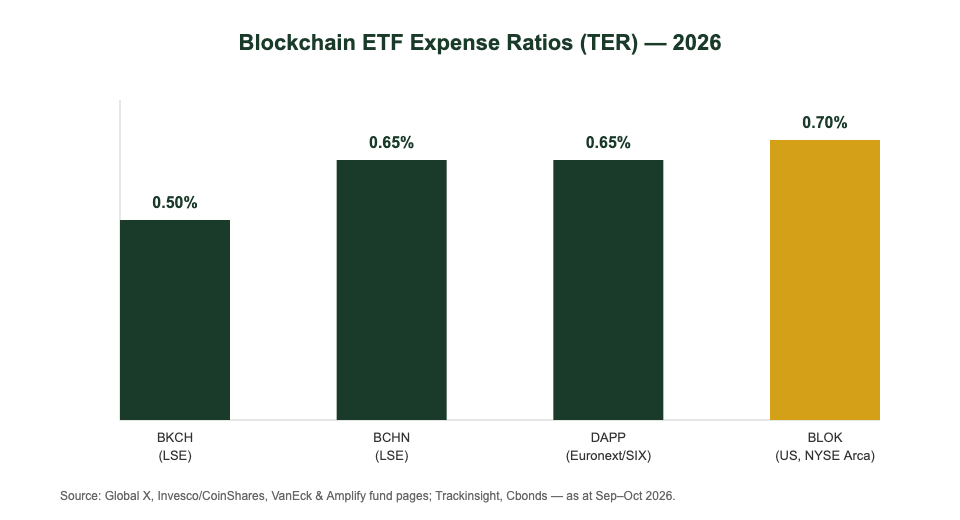
All three UCITS options below are accumulating (they reinvest any income rather than paying it out) and domiciled in Ireland. The table includes a US-domiciled comparison fund, BLOK, to illustrate the domicile trade-off covered in the next section.
| ETF | Exchange | Domicile | TER | Index Tracked | AUM (approx.) |
|---|---|---|---|---|---|
| BKCH | London Stock Exchange | Ireland | 0.50% | Solactive Blockchain v2 Index | ~US$113 million |
| BCHN | London Stock Exchange | Ireland | 0.65% | CoinShares Blockchain Global Equity Index | ~US$1.0 billion |
| DAPP | Euronext / Borsa Italiana / SIX | Ireland | 0.65% | MVIS Global Digital Assets Equity Index | ~US$500–595 million |
| BLOK (US comparison) | NYSE Arca | United States | 0.70% | Actively managed (Amplify Blockchain Technology ETF) | ~US$1.1 billion |
Source: Global X (globalxetfs.eu), Invesco/CoinShares and VanEck fund pages, Amplify ETFs; Trackinsight and Cbonds aggregator data. Figures as at September–October 2026 and will drift — verify current AUM and TER against the issuer’s factsheet before investing.
Between the two LSE-listed options, BKCH has the lower TER at 0.50% versus BCHN’s 0.65%, but BCHN’s roughly US$1 billion AUM is nearly ten times larger than BKCH’s — larger funds typically mean tighter bid-ask spreads and less liquidity risk on the exchange. DAPP, VanEck’s offering, sits outside the LSE on Euronext, Borsa Italiana and SIX, so it needs a broker with European (not just UK) market access.
Tax & Domicile Comparison (UCITS vs US)
The TER differences above are small in absolute terms — on a SGD 20,000 (roughly USD 14,800) position, the gap between BKCH’s 0.50% and BLOK’s 0.70% works out to about USD 30 a year. The more significant difference for a Singapore investor is domicile, which determines withholding tax on underlying dividends and, more importantly, US estate tax exposure.
Ireland has a tax treaty with the US that caps withholding tax on US-sourced dividends flowing into the fund at 15%, versus 30% for a fund with no treaty benefit. In practice this matters less here than for a broad-market ETF like CSPX or VWRA, because blockchain-themed holdings — exchanges, miners, infrastructure names — are mostly growth companies that pay little or no dividend. The withholding tax drag on BCHN, BKCH or DAPP is therefore small in dollar terms in most years.
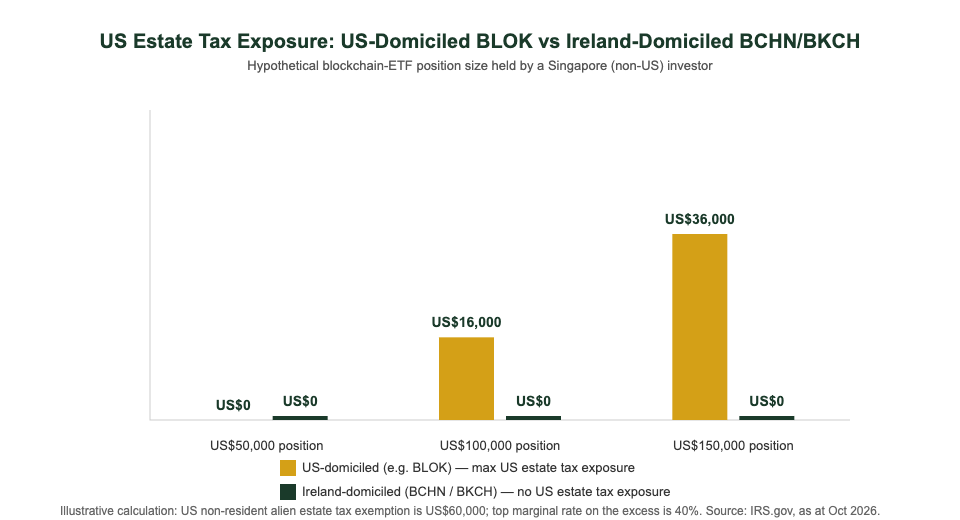
The bigger issue is US estate tax. A US-domiciled ETF like BLOK is a US-situs asset. Under US estate tax rules, a non-resident alien’s worldwide US-situs assets above USD 60,000 are exposed to US federal estate tax at rates up to 40% on the excess if the investor passes away while still holding the position. An Ireland-domiciled fund such as BCHN or BKCH is not a US-situs asset, so it carries no US estate tax exposure at all, regardless of position size.
| Position Size (USD) | US-Domiciled (e.g. BLOK) — Est. Max Estate Tax | Ireland-Domiciled (BCHN / BKCH / DAPP) |
|---|---|---|
| USD 50,000 | US$0 (below USD 60k exemption) | US$0 |
| USD 100,000 | Up to US$16,000 | US$0 |
| USD 150,000 | Up to US$36,000 | US$0 |
Source: IRS.gov (non-resident alien estate tax exemption of USD 60,000; top marginal rate 40% on the taxable excess), as at October 2026. Illustrative calculation only — actual estate tax depends on total US-situs assets, treaty relief, and individual circumstances; consult a cross-border estate planning professional.
This is the main reason Singapore investors building a crypto-equity position tend to prefer BCHN or BKCH over a US-listed equivalent: the estate tax exposure disappears entirely, not just shrinks.
How to Buy BCHN, BKCH or DAPP in Singapore
BCHN and BKCH both trade on the London Stock Exchange, so any broker with UK market access can place an order. DAPP trades on Euronext, Borsa Italiana and SIX, so it needs a broker with European (not just UK) market data and routing — Interactive Brokers is the most reliable option for this.
Interactive Brokers (IBKR): fund your account, subscribe to UK or European market data (one-time, low-cost), search the ticker (BCHN, BKCH, or DAPP), confirm the correct exchange and currency in the order ticket, and place a limit order. IBKR tends to be the most cost-effective for larger positions due to tiered commission pricing.
Saxo Markets: similar process — search by ticker or ISIN, confirm the LSE (or relevant European exchange) listing, and place the order in GBP or EUR depending on the share class. Saxo’s platform fee structure suits investors who also hold other LSE-listed ETFs like CSPX or VWRA in the same account.
moomoo Singapore: UK market access covers BCHN and BKCH; European-exchange access for DAPP may be more limited, so check moomoo’s current market list before assuming DAPP is available.
Across all three brokers, orders are typically filled in whole shares with no minimum beyond the price of one unit, which for these ETFs runs from roughly USD 15 to USD 40 depending on the fund and date. None of the three ETFs in this guide are CPF-investable; they can be held in a cash brokerage account, and depending on your broker, in an SRS account if the platform supports SRS-funded international trades.
Risks to Consider
Blockchain ETFs carry meaningfully more risk than a broad-market fund like CSPX or VWRA, and this guide would be incomplete without naming it plainly:
Concentration and volatility. These funds hold a narrow set of companies — often 30 to 55 names — concentrated in one theme. Several of the largest holdings across BCHN, BKCH and DAPP are small- or mid-cap miners and infrastructure names whose share prices move sharply with crypto market sentiment, sometimes more sharply than Bitcoin or Ether itself.
Liquidity risk on smaller funds. BKCH’s roughly US$113 million AUM is small relative to BCHN’s circa US$1 billion. Smaller AUM can mean wider bid-ask spreads on the exchange, particularly outside London trading hours, so market orders on thinly traded days can execute at worse prices than expected. Always use limit orders.
Regulatory and sector risk. Crypto-adjacent regulation continues to evolve globally; a change in exchange licensing rules, mining energy policy, or custody regulation in a major market can move the whole sector at once, regardless of any individual holding’s fundamentals.
Not a substitute for core holdings. A blockchain ETF is a satellite, thematic position, not a core portfolio holding. Most of the thematic ETFs Singapore investors use for sector exposure, including this one, work best as a small allocation (commonly cited guidance is 5–10% of a portfolio) sitting alongside a broad-market core such as CSPX or VWRA.
Given this risk profile, sizing matters more than fund selection. A Singapore investor topping up a long-term CPF investment strategy or running retirement projections through a Singapore retirement calculator should treat a blockchain ETF allocation as a satellite position layered on top of that core plan, not a replacement for it. Investors who want crypto-theme exposure with less single-sector concentration risk may prefer to keep the bulk of new contributions in lower-volatility instruments like a Singapore T-bill ladder or a diversified core ETF, and treat the blockchain allocation strictly as a small, bounded bet.
Frequently Asked Questions
What is a blockchain ETF and why do Singapore investors buy it?
A blockchain ETF is an equity fund holding shares of crypto-adjacent companies such as exchanges, miners and digital-infrastructure operators, rather than Bitcoin or Ether directly. Singapore investors buy Ireland-domiciled, LSE-listed versions like BCHN and BKCH because they avoid the 30% US dividend withholding tax and the US estate tax exposure that a US-listed equivalent carries, while still giving crypto-theme exposure through a regulated, exchange-traded fund.
Is a blockchain ETF the same as a spot Bitcoin or crypto ETF?
No. A blockchain ETF holds equity in companies with blockchain-related business operations, so its value is driven by company earnings as well as crypto sentiment. A spot crypto ETF holds the underlying token (Bitcoin or Ether) directly and tracks the coin price almost exactly. Spot crypto ETFs are not broadly available to retail Singapore investors through most local brokers, which is part of why blockchain equity ETFs like BCHN, BKCH and DAPP are the more accessible option.
Which has lower fees — BCHN or BKCH?
BKCH has the lower total expense ratio at 0.50% per year, versus BCHN at 0.65%. However, BCHN’s roughly US$1 billion AUM is far larger than BKCH’s roughly US$113 million, which can translate into tighter bid-ask spreads and a smaller liquidity-risk premium when trading — a cost that doesn’t show up in the TER figure.
Can I buy BCHN or BKCH using my CPF or SRS funds?
BCHN, BKCH and DAPP are not on the CPF Investment Scheme’s approved list, so they cannot be bought with CPF Ordinary Account funds. SRS funds can potentially be used if your SRS-linked broker supports international equity and ETF trades through that account — check with your specific broker, as SRS trading permissions vary by platform.
Which broker is best for buying blockchain ETFs in Singapore?
Interactive Brokers (IBKR) offers the broadest market access, covering the London Stock Exchange for BCHN and BKCH as well as Euronext, Borsa Italiana and SIX for DAPP, making it the most flexible single-broker option. Saxo Markets is a strong alternative for LSE-listed BCHN and BKCH. moomoo Singapore covers UK market access for BCHN and BKCH, but European-exchange access for DAPP may be more limited, so confirm current coverage before assuming it’s available.
How risky is a blockchain ETF compared to a broad-market ETF like CSPX or VWRA?
Considerably riskier. Blockchain ETFs concentrate in 30 to 55 crypto-adjacent companies, many of them small- or mid-cap miners and infrastructure names whose share prices swing sharply with crypto market sentiment. A broad-market ETF like CSPX or VWRA spreads risk across hundreds or thousands of companies and sectors. Most Singapore investors treat a blockchain ETF as a small satellite allocation — commonly cited guidance is around 5–10% of a portfolio — layered on top of a diversified core, not as a primary holding.
Ready to Add Thematic ETF Exposure?
Open a brokerage account that supports LSE and European market access, and size any thematic position carefully alongside your core portfolio.
This article was researched with the help of AI. While we strive to keep all information accurate and up to date, there may be errors. If you notice any discrepancies, please contact us.