Medisave Limit 2026: When Your Child Is Hospitalised
Costs, ISP Coverage & What Parents Need to Know
If your child needs to be hospitalised in Singapore, your Integrated Shield Plan (ISP) is your primary safety net — but since 1 April 2026, new ISP rider rules have changed how much you pay out of pocket. Under the updated framework, riders can no longer cover the minimum deductible ($1,500–$3,500 depending on ward class), and a 5% co-payment applies to all bills. The good news: parents can use their own Medisave to pay the deductible and co-payment for their child’s bill. Data verified as at 22 October 2026.
Not financial advice. All figures are for educational reference only. Consult a licensed financial adviser before making insurance decisions.
What Does an Integrated Shield Plan Cover for Children?
An Integrated Shield Plan is a combination of MediShield Life (the mandatory government hospitalisation scheme) plus a private insurer’s top-up layer. For children, the ISP works the same way as for adults: it pays for inpatient hospital stays, day surgeries, and certain outpatient treatments after the deductible and co-payment thresholds are met.
Singapore’s seven ISP providers — AIA, Great Eastern, Income, NTUC Income, Prudential, AXA Shield, and Raffles Shield — all offer plans covering children from as young as 15 days old. Parents typically insure children under a plan that matches the ward class they expect to use: Class B1 in a restructured hospital, Class A, or a private hospital plan.
Children are approved dependants under CPF Medisave rules, which means a parent can use their own Medisave account to pay for a child’s hospitalisation bill — including the ISP deductible and co-payment. This is a significant advantage for families managing cash flow during a stressful admission.
For a deeper dive into how the full Integrated Shield Plan framework works, including all ward classes and insurer options, see our ISP pillar guide on The Kopi Notes.
New ISP Rider Rules From 1 April 2026: What Changed?
The Ministry of Health (MOH) introduced significant changes to how Integrated Shield Plan riders work, effective 1 April 2026. These changes affect new riders purchased on or after 1 April 2026. If you bought a rider before this date, you are on a legacy rider and different rules may apply.
The three core changes for new 2026 riders are:
1. Riders can no longer cover the minimum deductible. Previously, some riders paid the full deductible so policyholders had zero upfront cost. Under the new rules, the minimum deductible — $1,500 for Class B2/C, $2,500 for Class B1, and $3,500 for Class A and private hospital plans — must be borne by the patient. You can pay this from Medisave or cash, but your rider will not cover it.
2. The co-payment annual cap was raised from $3,000 to $6,000. The 5% co-payment (your share of the bill above the deductible) remains unchanged. However, the annual cap on this co-payment has doubled, from $3,000 to $6,000. This cap resets every policy year.
3. Rider premiums cannot be paid from Medisave. The base ISP premium can still use your Medisave up to the Additional Withdrawal Limit (AWL). But the additional rider premium — the amount you pay to get coverage on top of the base plan — must now be paid in cash only. This is a key practical point for family budgeting.
On the positive side, new 2026 riders cost approximately 30% less than legacy riders. The lower premium reflects the reduced coverage scope (since you’re now paying more at the point of claim).
If you are planning a child’s elective procedure, our guide on Medisave limits for planned surgery in 2026 covers the pre-authorisation process in detail.
Using Medisave for Your Child’s Hospital Bill
When your child is admitted to hospital, the bill is typically settled in two layers: MediShield Life / ISP pays the bulk, and you pay the deductible plus co-payment. For approved dependants — which includes your children regardless of citizenship — you can use your own Medisave to cover these out-of-pocket amounts.
This is a common source of confusion among parents: many assume Medisave can only be used for the account holder’s own bills. That is not the case. CPF rules allow Medisave to be used for the hospitalisation bills of your spouse, children, parents, parents-in-law, grandparents, grandparents-in-law, and siblings. Children face no citizenship requirement, unlike some of the other dependant categories.
The table below shows the minimum deductible by ward class under 2026 ISP plans:
| Ward Class / Hospital Type | Minimum Deductible (2026) | 5% Co-payment Cap (per year) | Rider Covers Deductible? |
|---|---|---|---|
| Private Hospital / Class A | $3,500 | $6,000 | No (new riders) |
| Class B1 (Restructured Hospital) | $2,500 | $6,000 | No (new riders) |
| Class B2 / C (Restructured Hospital) | $1,500 | $6,000 | No (new riders) |
Source: Ministry of Health — Integrated Shield Plans: Riders (April 2026). New riders purchased on or after 1 April 2026.
Important: You must apply to use Medisave before the patient is discharged. If you miss this window, you will need to pay in cash and apply for Medisave reimbursement within a set period. Applying at the hospital’s billing counter on the day of discharge is the most convenient approach.
How Much Will You Actually Pay? A Worked Example
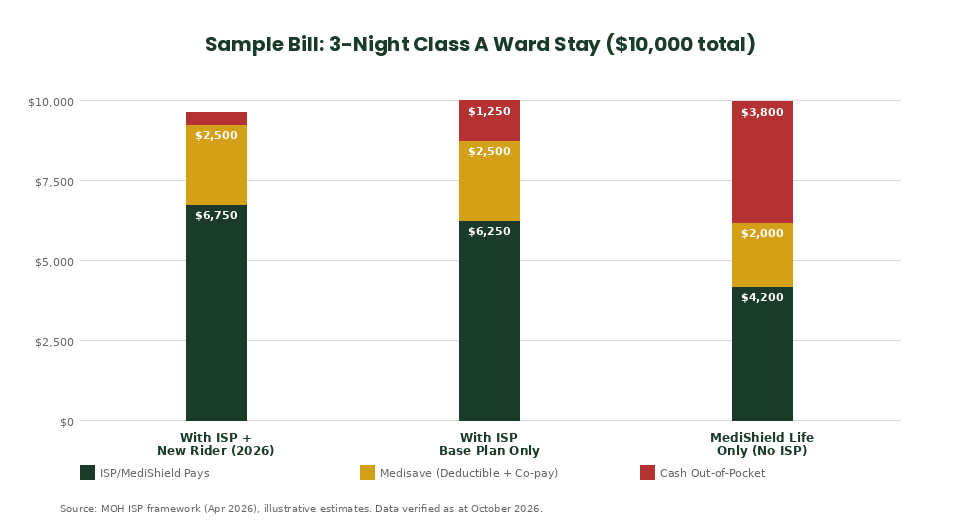
Let’s take a realistic scenario: a 7-year-old child is admitted to a restructured hospital in a Class A single-bedder ward for a 3-night stay. Total bill: $10,000.
Under a 2026 ISP with a new rider:
- Deductible (Class A): $3,500 — paid by parent (Medisave or cash). Rider cannot cover this.
- Remaining bill above deductible: $6,500
- ISP pays 95% of $6,500 = $6,175
- 5% co-payment: $325 — paid by parent (Medisave or cash)
- Total out-of-pocket: $3,825 (deductible + co-payment)
Both the $3,500 deductible and the $325 co-payment can be paid from a parent’s Medisave account, provided the balance is sufficient. If your child also has an ISP, the ISP pays the insurer’s share directly — you only settle the deductible and co-payment at the hospital counter.
Without an ISP (MediShield Life only), the same $10,000 Class A ward bill would result in significantly higher out-of-pocket costs because MediShield Life claim limits for private wards are lower, and the co-insurance rate above the deductible is 10% rather than 5% from a rider-equipped plan.
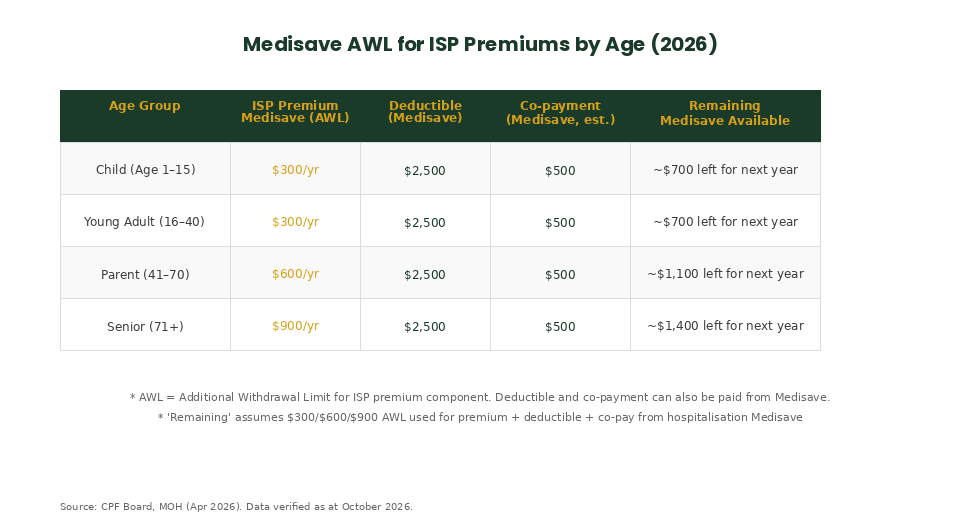
Medisave AWL for ISP Premiums by Age (2026)
Every Singaporean and PR holds a Medisave account with CPF. The Additional Withdrawal Limit (AWL) is the maximum amount you can withdraw from your own Medisave each year to pay the base ISP premium. This is on top of what you pay for MediShield Life, which is deducted automatically.
As of 2026, the Medisave AWL for ISP premiums is:
| Age of Insured | Medisave AWL for ISP Base Premium | Rider Premium (New 2026) |
|---|---|---|
| Age 1 – 40 | $300 / year | Cash only |
| Age 41 – 70 | $600 / year | Cash only |
| Age 71 and above | $900 / year | Cash only |
Source: CPF Board — Medisave for Integrated Shield Plans (2026).
For a child aged 1–15, the AWL is $300/year. In practice, most children’s ISP base premiums cost less than $300/year, so Medisave typically covers the entire base premium. If you are the parent paying the ISP premium for your child, you can use your own Medisave (not your child’s) to pay up to the AWL for your child’s age band. The total Medisave you withdraw for your child’s ISP across all your dependants cannot exceed your own Medisave balance, subject to the Basic Healthcare Sum (BHS) floor of $79,000 in 2026.
Remember: the rider premium for new 2026 riders must be paid in cash regardless of the policyholder’s age. Only the base ISP premium qualifies for Medisave withdrawal.
Step-by-Step: Settling Your Child’s Hospital Bill with Medisave
Here’s the process most parents will follow when their child is discharged from a Singapore hospital:
Step 1: Confirm the ISP is active and ward class matches. Check that your child’s ISP is in force and that the ward class they are admitted to is covered. If your child is in a higher ward class than their plan covers, you may need to pay the difference yourself.
Step 2: At the billing counter, inform staff you want to use Medisave. Bring your IC. The hospital’s billing team will process the Medisave withdrawal using the Government-approved e-Claims system. You do not need to submit a separate form to CPF — the hospital handles this electronically.
Step 3: Confirm the deductible and co-payment amounts. Ask for an itemised breakdown. The deductible is the first amount you pay; the co-payment is 5% of the balance after the deductible. Both can be charged to your Medisave (as parent) for your child’s bill.
Step 4: Pay any outstanding rider premium if you have a new 2026 rider. As noted above, the rider premium must be paid by GIRO or cash — it cannot be charged to Medisave from 1 April 2026 for new riders. This is a separate payment from the hospitalisation bill.
Step 5: Obtain a receipt and check the EOB (Explanation of Benefits). Your ISP insurer will send you an EOB showing what the plan paid and what your out-of-pocket was. Keep this for your records, especially if you have multiple admissions in a policy year, since the co-payment cap ($6,000) resets annually.
If you are building a broader financial safety net — including CPF investment and long-term savings — our Singapore retirement planning calculator can help you map out how Medisave fits into your overall picture alongside OA and SA savings.
Frequently Asked Questions
Can I use my own Medisave to pay for my child's hospital bill?
Yes. Singapore parents can use their own Medisave account to pay for a child’s inpatient hospitalisation bill, including the ISP deductible and co-payment. Children are classified as approved dependants with no citizenship restriction — so regardless of whether your child is Singaporean, PR or non-resident, you can use your Medisave for their hospitalisation bill, subject to normal Medisave hospitalisation withdrawal limits.
What is the Medisave limit for my child's ISP premium in 2026?
For a child aged 1–40 (which covers all school-age children), the Medisave Additional Withdrawal Limit (AWL) for the base ISP premium is $300 per year. This applies to the base plan component only. The rider premium for new 2026 riders (purchased on or after 1 April 2026) must be paid in cash and cannot be charged to Medisave.
Do new 2026 ISP riders change how much I pay when my child is hospitalised?
Yes, significantly. Under new riders (from 1 April 2026), the minimum deductible ($1,500–$3,500 depending on ward class) cannot be covered by the rider. You must pay it yourself, though you can use Medisave. Previously, some riders waived the deductible entirely. The 5% co-payment remains unchanged, and the annual co-payment cap has risen from $3,000 to $6,000. New riders cost approximately 30% less than legacy riders to compensate for the reduced coverage at point of claim.
Can I put my child on a higher-tier ISP if they are already hospitalised?
No. ISP coverage must be in place before a hospitalisation occurs. You cannot purchase or upgrade an ISP after an admission has begun to cover that specific stay. Applications for a new ISP or upgrading an existing one are subject to underwriting and can be declined or restricted if the child has pre-existing conditions. It is advisable to review your child’s ISP coverage during annual renewal rather than after a health event.
What is the Basic Healthcare Sum (BHS) and does it affect my Medisave withdrawals for my child?
The Basic Healthcare Sum (BHS) is the target amount CPF wants you to hold in your Medisave account. In 2026, the BHS is $79,000. There is no annual ceiling on Medisave withdrawals for hospitalisation — your child’s deductible and co-payment can be fully paid from your Medisave regardless of how large the bill is, subject to your account balance. The BHS is relevant only in the sense that Medisave contributions above the BHS flow to your OA/SA instead. It does not restrict withdrawals for medical bills.
Is the rider premium for my child's ISP still tax-deductible after the 2026 changes?
Life insurance and Medisave-related tax relief rules are separate from the ISP rider premium rules. ISP premiums themselves are not directly tax-deductible in Singapore as personal income tax relief. However, the Medisave contributions that fund your ISP base premium go in pre-tax, which is an indirect tax benefit. For specific tax advice relating to your insurance expenses, consult a tax professional or IRAS’s e-Tax guide on insurance-related deductions.
Review Your Child’s ISP Coverage Today
The 2026 ISP changes mean higher out-of-pocket costs at the point of claim. Make sure your child’s plan and ward class match your family’s budget — and that you know exactly how to use Medisave when it matters most.
Not financial advice. Data verified as at 22 October 2026. Sources: MOH, CPF Board.
Get Free Insurance Advice
Speak with a licensed insurance advisor. No obligation, no cost.
By submitting this form, you agree to our Privacy Policy.
This article was researched with the help of AI. While we strive to keep all information accurate and up to date, there may be errors. If you notice any discrepancies, please contact us.