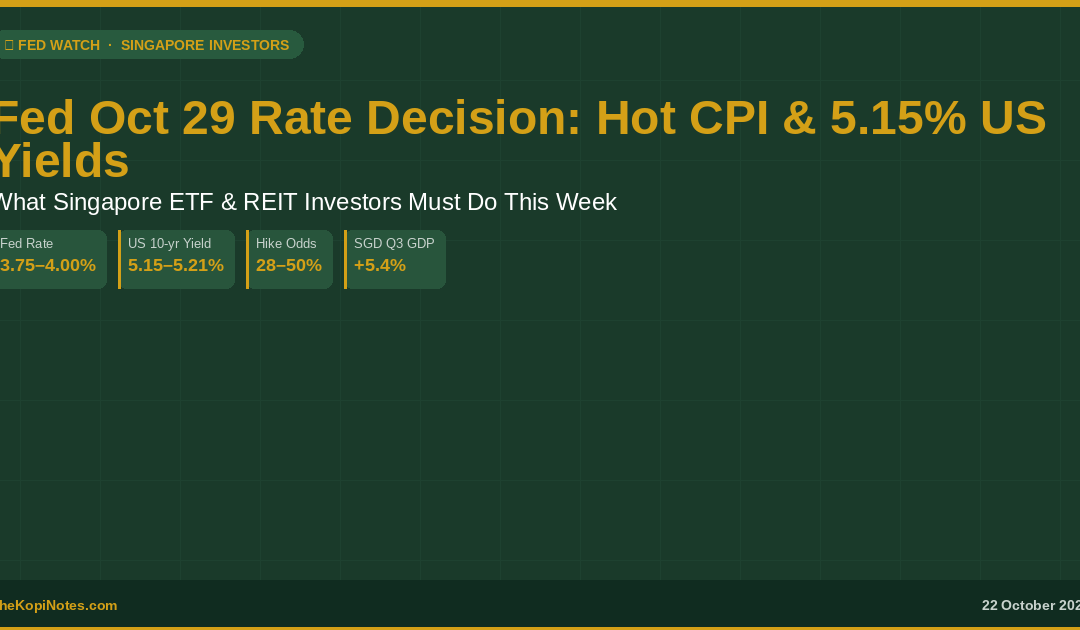
On 29 October 2026, the US Federal Reserve will announce its latest interest rate decision — and for Singapore investors, the stakes couldn’t be higher. With US inflation running hotter than expected, Treasury yields at multi-year highs, and the Monetary Authority of Singapore surprising markets with a hold at its October meeting, this FOMC is a pivotal moment. Whether you hold Singapore Savings Bonds, T-bills, REITs, or broad equity ETFs, here is exactly what you need to know — and what to do — before the decision lands.
Disclaimer: This article is for informational purposes only and does not constitute financial advice. All investment decisions should be made in consultation with a licensed financial adviser and in line with your personal risk tolerance and financial objectives. Past performance is not indicative of future results.
Why This October FOMC Is Different
The Federal Open Market Committee (FOMC) holds eight scheduled meetings a year, but not all of them move markets equally. The October 29 meeting comes on the back of a string of data releases that have complicated the Fed’s path back to its 2% inflation target.
The September CPI print came in at 3.7% year-on-year — stubbornly above the target — while Core CPI (which strips out food and energy) held at 2.6%. Producer Price Index (PPI) inflation, a leading indicator for consumer prices, settled at 1.3% annually. Meanwhile, the US unemployment rate is hovering around 4.0%, and GDP growth has remained resilient through the third quarter. In other words, the US economy is not in the kind of distress that would prompt the Fed to cut rates, and inflation has not retreated far enough to justify standing completely pat.
The result: markets are genuinely split. Implied probabilities from Fed Funds futures, depending on the date polled, have placed the odds of a 25-basis-point hike at anywhere from 28% to 50%. The Fed itself, under Chair Powell, has been deliberately vague — emphasising “data dependence” and signalling that it will respond to evolving conditions rather than commit to a preset path.
For Singapore investors, the uncertainty itself is consequential. A surprise hike would likely push US Treasury yields higher, strengthen the US dollar against the Singapore dollar, and reprice risk assets across the board. A hold would give markets temporary relief — but if inflation stays elevated into early 2027, the reprieve may be short-lived.
What The Market Is Pricing Right Now
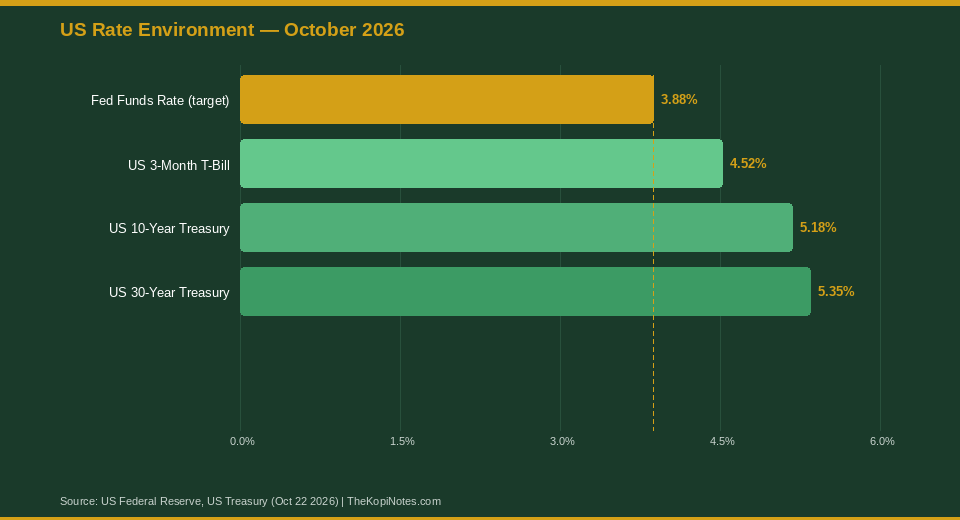
The clearest signal of the market’s anxiety is the US 10-year Treasury yield. As of 22 October 2026, the 10-year benchmark is trading between 5.15% and 5.21% — levels not seen since the 2007 pre-Global Financial Crisis period. The US 30-year Treasury is even higher, around 5.35%. Meanwhile, short-term T-bills (3-month) sit at 4.52%, reflecting the current Fed Funds target range of 3.75% to 4.00%.
This “higher-for-longer” regime is not new, but it is intensifying. The yield curve, which spent much of 2024–2025 deeply inverted, has now bear-steepened — meaning long-term rates are rising faster than short-term rates. That is a particular warning sign for duration-sensitive assets like REITs and long-term bond funds.
For Singapore-based investors, the SGD/USD exchange rate adds another dimension. With the USD strengthening as US yields rise, the SGD has softened to around SGD 1.26 per USD. A further rate hike — or even sustained elevated US rates — could put additional pressure on the Singapore dollar, eroding unhedged USD returns when converted back to SGD. Singapore’s strong Q3 GDP growth of +5.4% provides some cushion to the SGD, but the MAS’s surprise hold in October (more on this below) limits upside for the local currency.
Singapore’s Yield Ladder — Where Does It Stand?
With US yields soaring, you might expect Singapore’s own fixed-income instruments to have followed. In reality, Singapore’s yield ladder looks quite different — and that gap has real implications for how you should allocate your cash.
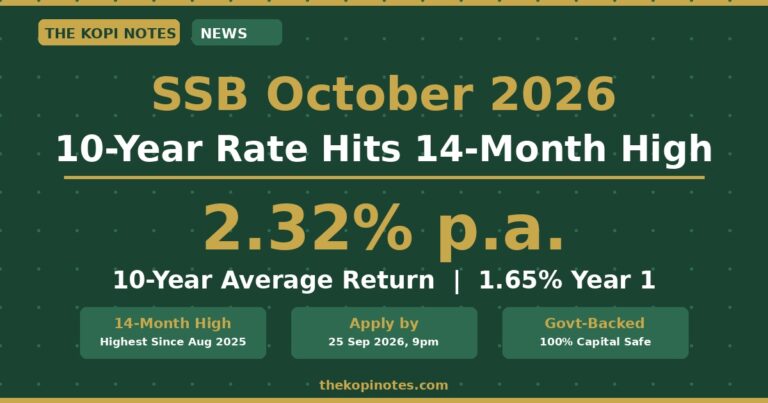
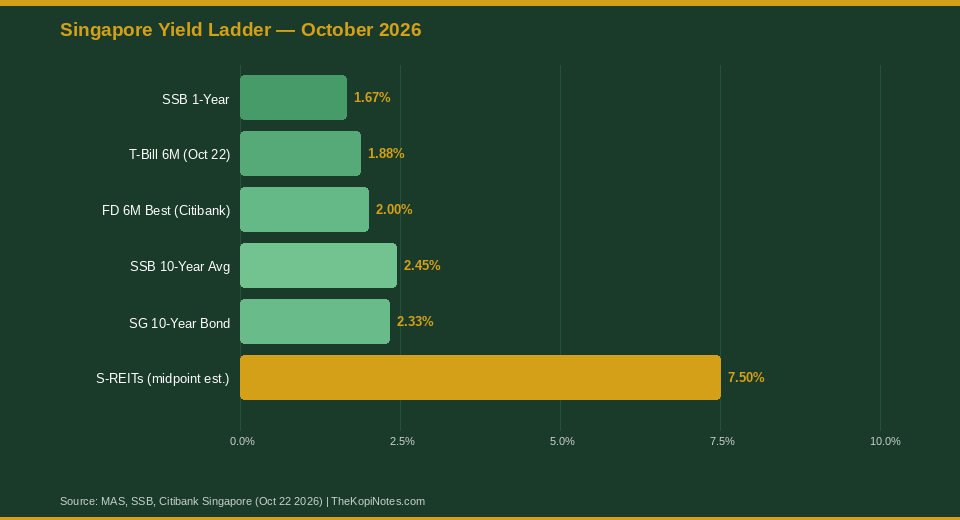
The latest 6-month Singapore T-bill cut-off yield is 1.88%, while the most recent Singapore Savings Bond (SSB) November 2026 issue offers a 1-year return of 1.67% and a 10-year average return of 2.45%. The best available 6-month SGD fixed deposit rate — from Citibank — stands at 2.00%. At the longer end, the Singapore 10-year government bond yields approximately 2.33%.
Compare that to US equivalents: the US 10-year at 5.18% dwarfs Singapore’s 2.33%. This yield differential is driven by Singapore’s structurally lower inflation, the MAS’s exchange-rate-based monetary policy framework, and the perceived safe-haven status of SGD assets.
For cash management, Singapore’s instruments remain attractive on a risk-adjusted basis for SGD investors — particularly given the exchange rate risk of holding USD instruments unhedged. If you want to compare T-bills, SSBs, and fixed deposits side by side, our full guide has the current numbers and a step-by-step breakdown. You can also check the latest SGD fixed deposit rates to see which bank is offering the best return right now.
Singapore vs US Yield Comparison (October 2026)
| Instrument | Yield / Return | Currency |
|---|---|---|
| US Fed Funds Rate | 3.75–4.00% | USD |
| US 3-Month T-Bill | 4.52% | USD |
| US 10-Year Treasury | 5.15–5.21% | USD |
| Singapore T-Bill (6M) | 1.88% | SGD |
| SSB 1-Year Return | 1.67% | SGD |
| SSB 10-Year Avg Return | 2.45% | SGD |
| Best FD 6M (Citibank SGD) | 2.00% | SGD |
| SG 10-Year Government Bond | 2.33% | SGD |
| S-REITs (estimated midpoint) | 6–9%+ | SGD |
Sources: US Federal Reserve, US Treasury, MAS, Singapore Exchange (SGX), Citibank Singapore. Data as at 22 October 2026. All figures are indicative and subject to change.
What This Means For MAS Policy And The SGD
The MAS uses the Singapore Dollar Nominal Effective Exchange Rate (S$NEER) — rather than interest rates — as its primary monetary policy tool. At its July 2026 meeting, the MAS tightened policy by steepening the slope of the S$NEER band, responding to elevated domestic inflation. Markets widely expected a further tightening at the October 2026 meeting — but the MAS held firm, citing moderating core inflation and resilient but slowing growth. That decision was a genuine surprise.
You can read our full breakdown of what the MAS October 2026 hold means for Singapore investors — including the implications for the SGD, local borrowing costs, and property.
The MAS hold, combined with the Fed’s potential hike, narrows the policy divergence between the two central banks but does not eliminate it. As long as the Fed remains in a tightening (or on-hold) posture while the MAS steps back, the SGD may face modest depreciation pressure against the USD. Investors with unhedged USD exposure in their portfolios — through USD-denominated ETFs or US equity funds — may see some short-term tailwind on currency translation, but should not rely on this as a return driver.
S-REITs: The Rate Sensitivity Everyone Is Watching
Singapore REITs (S-REITs) are among the most directly rate-sensitive assets in the local market. When US yields rise, S-REIT yields must also rise to remain competitive — and since REIT yields move inversely to price, rising benchmark rates typically put downward pressure on REIT unit prices.
The current estimated midpoint distribution yield for S-REITs is around 7.5%, though top-tier names trade closer to 6% and more leveraged or niche REITs can yield 9% or higher. That spread over Singapore government bonds (at 2.33%) is now quite wide by historical standards — suggesting that the market has already priced in significant risk. Whether that is sufficient compensation depends heavily on what the Fed does next.
Key risk factors for S-REITs heading into October 29 include: the interest coverage ratio on existing floating-rate debt (many S-REITs refinanced at low rates in 2021–2022 and face higher refinancing costs now), currency risk for REITs with overseas assets (particularly those with USD, AUD, or CNY income streams), and occupancy trends in each subsector — logistics and data centres have held up better than retail and hospitality in the current cycle.
For those building a diversified income portfolio, consider a T-bill laddering strategy for Q4 2026 that pairs T-bills with select S-REITs to balance capital safety and yield pickup.
Singapore Equity ETFs — Hold Or Hedge?
For investors in STI ETFs (Straits Times Index) or broader Asia-Pacific equity funds, the Fed’s decision feeds through via several channels: sentiment risk (a surprise hike triggers global risk-off selling), currency translation (SGD/USD moves affect unhedged USD-denominated fund returns), and sector exposure (Singapore’s STI is heavily weighted toward banks and REITs, both of which are rate-sensitive in different directions — banks may benefit from wider net interest margins, while REITs face headwinds).
Singapore’s Q3 2026 GDP growth of +5.4% is a strong fundamental backdrop for local equities, but it does not insulate Singapore from global risk-off moves driven by US monetary tightening. If you are long Singapore equities through an ETF and are concerned about short-term volatility around the FOMC announcement, consider whether your time horizon and risk tolerance align with the current uncertainty — not as a reason to sell, but as a reason to be informed before the data hits.
Bottom Line — What Singapore Investors Should Do This Week
With the Fed’s October 29 decision less than a week away, here is a practical action plan for each type of Singapore investor:
Cash and fixed income holders: If you have idle cash sitting in a savings account earning below 1.88%, consider applying for the upcoming T-bill or locking in the best available SGD fixed deposit rate now, before any potential post-FOMC repricing. The November 2026 SSB issue is another option for those who want capital flexibility. Do not chase the yield on short-duration USD instruments unless you have a specific need for USD and are comfortable with the exchange rate risk.
S-REIT investors: If you hold S-REITs for income, review the leverage and refinancing schedule of your holdings. Highly leveraged REITs with debt due for refinancing in 2026–2027 face the most headwind. Higher-quality names with strong sponsor backing and diversified income streams are better positioned to weather a prolonged higher-rate environment. Avoid knee-jerk selling on the announcement day — price moves on FOMC days are often reversed within a week once markets digest the nuances of the statement and press conference.
Equity ETF investors: Maintain your regular investment plan (dollar-cost averaging) if you are investing for the long term. The current period of uncertainty is exactly the kind of environment where lump-sum timing is difficult and potentially counterproductive. If you have a significant cash position earmarked for equities and are waiting for a better entry point, a phased deployment over the next 2–3 months reduces your timing risk around the FOMC cycle.
All investors: Revisit your portfolio’s overall asset allocation. If the proportion of rate-sensitive assets (REITs, long-duration bonds) has grown relative to your risk budget, October 29 is a natural checkpoint to rebalance — not because of the FOMC alone, but because a disciplined review is always appropriate when market conditions shift.
Frequently Asked Questions
Will the Fed raise rates on October 29, 2026?
As of 22 October 2026, market-implied probabilities put the chance of a 25-basis-point hike at between 28% and 50%. The outcome depends heavily on any last-minute economic data before the blackout period ends. A hike is possible but not certain — which is why markets are volatile going into the meeting.
How does a US rate hike affect Singapore T-bill yields?
Singapore T-bill yields are influenced primarily by MAS policy, domestic liquidity conditions, and the level of investor demand at each auction — not directly by the US Fed Funds rate. However, sustained high US rates can put upward pressure on global short-term rates over time, and have indirectly contributed to the elevated T-bill yields Singapore investors enjoyed through 2023–2025. With the MAS holding in October 2026, any further T-bill yield movement will depend on auction demand and liquidity conditions in the local banking system.
Should I sell my S-REITs before the FOMC announcement?
Market timing around FOMC announcements is notoriously difficult — prices can move sharply in either direction, and the initial reaction is often reversed once investors digest the full statement and press conference. For long-term income investors, the more relevant questions are the quality of the REIT’s underlying assets, its refinancing schedule, and whether the distribution yield still meets your income needs at today’s price. Panic-selling based on a single announcement is rarely the right move.
How does the MAS’s October hold affect Singapore investors?
The MAS’s decision to hold the slope and width of the S$NEER band at its October 2026 meeting — after tightening in July — signals that the central bank believes domestic inflation is moderating sufficiently to pause further tightening. For borrowers, this means mortgage rates and business loan rates are unlikely to rise further in the near term due to MAS action alone. For SGD holders, the hold may allow some modest softening of the currency against the USD if the Fed tightens while the MAS stays pat. Read our full analysis of the MAS October 2026 decision for more detail.
What is the best way to protect my Singapore portfolio against Fed rate uncertainty?
Diversification remains the most robust defence. Within your fixed income allocation, laddering maturities across T-bills, SSBs, and fixed deposits ensures you have liquidity at different points and can reinvest at prevailing rates as they evolve. Within equities, maintaining exposure to defensive sectors (financials, healthcare, consumer staples) alongside growth reduces overall volatility. And if you have significant unhedged USD exposure, consider whether the currency risk is being adequately compensated by the return differential — especially with the SGD under mild depreciation pressure.
This article was researched with the help of AI. While we strive to keep all information accurate and up to date, there may be errors. If you notice any discrepancies, please contact us.