CREDIT CARDS · SINGAPORE 2026
Best Credit Card Singapore 2026: Top Picks for Cashback, Miles & Everyday Spend
Fact-checked against bank official sites & MoneySmart · Updated October 2026
Choosing the best credit card in Singapore comes down to one question: how do you spend? For flat unlimited cashback, the Citi Cash Back+ returns 1.6% on every dollar with no minimum spend or monthly cap. For air miles, the HSBC TravelOne earns 2.4 mpd overseas — among the highest available. For dining, Trust Cashback gives up to 15% at partnered restaurants with zero annual fee. This guide compares the top 10+ cards across every spending profile so you can stop overpaying.
Not financial advice. All figures are for educational reference only. Data as at October 2026 unless otherwise noted.
Quick Answer: Best Credit Cards Singapore 2026 at a Glance
Not sure where to start? Here are The Kopi Notes’ top picks by spending profile:
| Spending Profile | Best Card | Key Reward | Annual Fee |
|---|---|---|---|
| Flat cashback (no fuss) | Citi Cash Back+ | 1.6% on all spend, uncapped | $196.20 (1st yr free) |
| Flat cashback (no annual fee) | SC Simply Cash | 1.5% on all spend, uncapped | $196.20 (1st yr free) |
| Online / contactless spenders | UOB EVOL | Up to 10% cashback (select) | No annual fee |
| Dining & petrol | OCBC 365 | 5% dining, 6% fuel | $196.20 (1st yr free) |
| Miles — overseas spend | HSBC TravelOne | 2.4 mpd FCY, 1.2 mpd local | $196.20 (1st yr free) |
| Miles — everyday local spend | HSBC Revolution | 4 mpd online & contactless | No annual fee |
| Dining (no annual fee) | Trust Cashback | Up to 15% dining (capped) | No annual fee |
Source: Bank official websites, MoneySmart.sg, October 2026. Rates subject to change; check issuer terms before applying.
How to Choose the Best Credit Card in Singapore
The biggest mistake Singaporeans make is applying for the highest-headline-rate card without checking whether they’ll actually qualify. A card advertising “up to 10% cashback” might cap rewards at $100 per month and require a minimum spend of $600 — limiting its real-world value to a fraction of the headline figure.
Here’s the framework The Kopi Notes uses to evaluate every credit card:
1. Effective Cashback / Miles Rate — Divide the maximum monthly reward by the minimum spend required. A card with $50 cap and $500 minimum spend gives an effective rate of 10%, but only on that $500 — spend more and the effective rate drops. Cards with no minimum spend and no cap, like the Citi Cash Back+, are far more predictable.
2. Annual Fee vs Benefit — Most premium cards charge $196.20/year. Check whether your expected annual reward exceeds this. A flat-rate cashback card giving 1.6% returns $160 on $10,000 annual spend — this barely covers the fee, making it more compelling only with a fee waiver or first-year free offer.
3. Cashback vs Miles — Cashback is immediate, predictable, and flexible. Miles deliver better value when redeemed for business class flights — typically 2-4 cents per mile vs 1 cent face value — but require patience and planning. If you fly Business or First Class at least once a year, miles cards win decisively. Otherwise, cashback is simpler.
4. Category Fit — The best card for a taxi-and-Grab commuter looks very different from the best card for an overseas-travelling consultant. Match your dominant spending category to the card’s highest-earning category before anything else.
Once you’ve picked your card type, use a Singapore retirement calculator to model how your credit card rewards compound when reinvested into savings or investments — the marginal gains matter more than many realise over a decade.
Best Cashback Credit Cards Singapore 2026
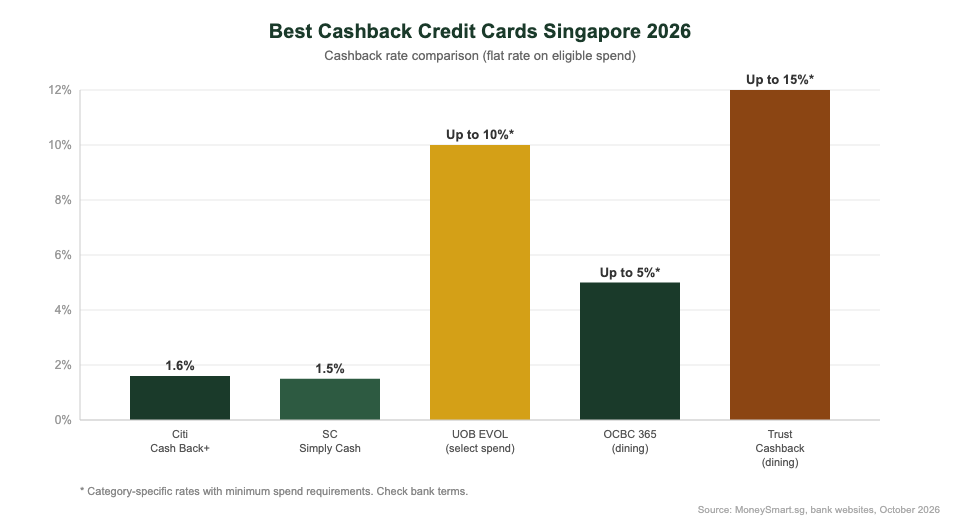
Cashback cards fall into two camps: flat-rate cards that reward every dollar equally, and category cards that give elevated rates on specific spend types. Here’s our breakdown of the best in each.
Citi Cash Back+ — Best Flat-Rate Cashback Card
The Citi Cash Back+ is the most straightforward cashback card in Singapore. It pays 1.6% on all eligible spend with no minimum spend requirement, no monthly cashback cap, and no need to track spending categories. For cardholders who spend across multiple merchants or simply want one card for everything, this is the most reliable earner.
Annual fee is $196.20, waived in the first year. As at August 2026, Citi removed the automatic fee waiver offered in prior years — so factor in whether your annual cashback (1.6% × your yearly spend) exceeds $196.20. On $12,500 annual spend, you break even.
Standard Chartered Simply Cash — Best No-Fuss Runner-Up
The SC Simply Cash pays 1.5% unlimited cashback on all eligible transactions. Like the Citi Cash Back+, there is no minimum spend, no spending category, and no monthly cap. The rate is 0.1 percentage points lower, but SC Sometimes runs sign-up promotions that bridge or exceed this gap. Annual fee is $196.20 (first year free).
UOB EVOL — Best for Digital-First Spenders
If the majority of your spending is online or via contactless payment, the UOB EVOL card is compelling. It earns up to 10% cashback on online transactions, contactless payments, and subscriptions — but the terms matter. You need to make at least 3 eligible transactions per month to qualify, and the monthly cashback is capped. No annual fee makes this a strong complementary card alongside a flat-rate card. Check UOB’s latest T&Cs for the current cap and eligible transaction definitions, as these change periodically.
OCBC 365 — Best for Dining and Petrol
The OCBC 365 earns 5% on dining (local and overseas) and 6% on fuel — two of the highest category rates among mainstream cards. It also earns 3% on groceries, utilities, and land transport. Annual fee is $196.20, waived in the first year. Minimum spend of $800/month is required to unlock the elevated rates; below this threshold it reverts to 0.3%.
For a family spending $400+ per month on dining and petrol, the OCBC 365 can easily return $600-900 per year in cashback — well above the annual fee.
UOB One — Best for McDonald’s, Grab, Shopee Devotees
The UOB One card is engineered around specific merchant categories. It earns up to 10% cashback at McDonald’s, Grab (transport and food delivery), Shopee, and SimplyGo, and up to 8% at supermarkets (FairPrice, Cold Storage, Giant). Maximum cashback is $2,240/year, spread across quarterly caps. Requires $500+ monthly spend to unlock the base tier — but if you’re a regular across these merchants, the effective rate is exceptional.
Trust Cashback — Best Dining Card with No Annual Fee
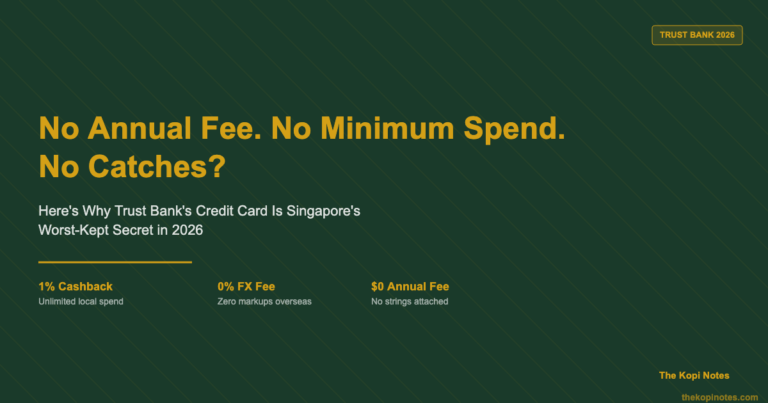
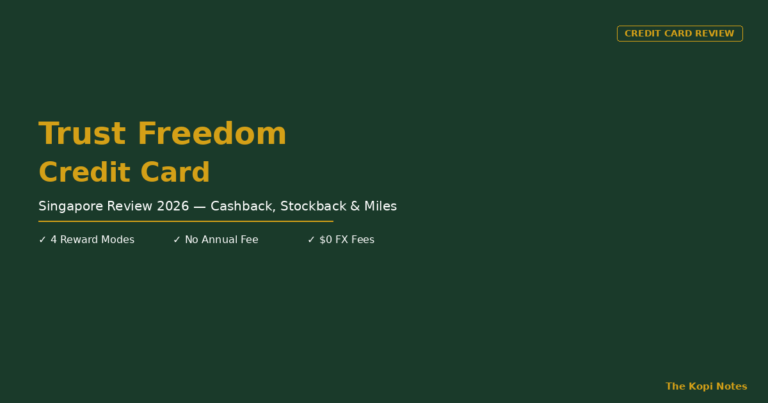
The Trust Cashback Mastercard, issued by Trust Bank (a digital bank backed by Standard Chartered and FairPrice Group), earns up to 15% cashback on dining at partnered restaurants with no annual fee. The 15% dining rate is capped at $250 per quarter. Outside dining partners, it earns a flat 0.5% on all spend. For Singaporeans who primarily eat out at partnered merchants, the Trust Cashback can be extraordinarily valuable for a no-fee card. Use referral code HTWYQP95 when signing up to unlock any current welcome bonus.
Cashback Card Comparison Table
| Card | Base Rate | Best Category Rate | Min Spend | Annual Fee |
|---|---|---|---|---|
| Citi Cash Back+ | 1.6% (all) | 1.6% (no cap) | None | $196.20 |
| SC Simply Cash | 1.5% (all) | 1.5% (no cap) | None | $196.20 |
| UOB EVOL | 0.3% | Up to 10% (online/contactless) | 3 txns/mo | No fee |
| OCBC 365 | 0.3% | 6% fuel, 5% dining | $800/mo | $196.20 |
| UOB One | 0.3% | 10% McDonald’s/Grab/Shopee | $500/mo | $196.20 |
| Trust Cashback | 0.5% | 15% dining (partners, capped $250/qtr) | None | No fee |
Source: Bank official sites, MoneySmart.sg, October 2026. Annual fees shown before GST where applicable. First-year fee waivers excluded from fee column; check current promotions.
Best Miles Credit Cards Singapore 2026
Miles cards reward every dollar of spend with air miles (or points convertible to miles). The right card depends on whether your primary spending is local everyday purchases or overseas travel.
A key metric to watch is miles per dollar (mpd). One mile is generally worth around 1.5–2 Singapore cents when redeemed for economy flights, but can be worth 3–5 cents for Business or First Class redemptions. A card earning 2 mpd is therefore worth the equivalent of 3–4% cashback when used strategically for premium cabin travel.
HSBC TravelOne — Best Overall Miles Card 2026
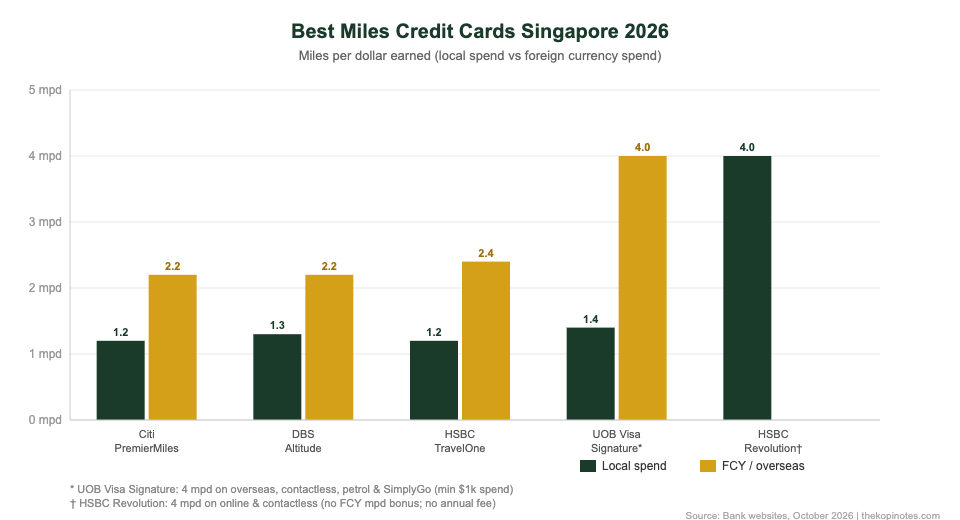
The HSBC TravelOne Visa Infinite earns 2.4 mpd on foreign currency spend (up from 2.0 mpd previously) and 1.2 mpd locally. Miles can be transferred instantly to 18+ airline and hotel loyalty programmes, including Singapore Airlines KrisFlyer, Cathay Asia Miles, and Marriott Bonvoy. Annual fee is $196.20 (first year free). The free first-year offer and competitive FCY rate make this the best starter miles card in 2026.
DBS Altitude — Best for KrisFlyer Accumulation
The DBS Altitude Visa Signature earns 1.3 mpd locally and 2.2 mpd on overseas spend in foreign currency. Miles transfer to KrisFlyer, Asia Miles, and other partners. Annual fee is $196.20 — fee waiver was removed in August 2026, with only the first year remaining free. A strong card for Singapore Airlines loyalists who spend heavily overseas or on travel bookings.
Citi PremierMiles — Best for Miles That Never Expire
The Citi PremierMiles Visa is the only major miles card where miles never expire — a significant advantage for infrequent travellers who accumulate slowly. It earns 1.2 mpd locally and up to 2.2 mpd on overseas FCY spend. Annual fee is $196.20 (first year free). Citi miles transfer to KrisFlyer, Asia Miles, British Airways Avios, and others.
HSBC Revolution — Best Free Miles Card
The HSBC Revolution Mastercard has no annual fee and earns a remarkable 4 mpd on online and contactless spend (equivalent to 10 HSBC Reward Points per dollar). This is one of the highest local earn rates available on a no-fee card in Singapore. The enhanced 4 mpd rate is available for up to 10,000 base points per month. HSBC’s Elevate programme can further boost rates for eligible HSBC banking customers.
UOB Visa Signature — Best for Overseas and Petrol
The UOB Visa Signature earns 4 mpd on overseas spend, contactless payments, petrol, and SimplyGo — one of the highest FCY miles rates in Singapore. Minimum $1,000 spend per month is required to unlock the 4 mpd rate. Annual fee is $196.20. Ideal for frequent overseas travellers or commuters who tap their card for transit and petrol.
For investors who prefer to put rewards to work rather than fly, combining a miles card with a Syfe referral code or an Endowus referral code can amplify your overall returns — even a 1% cashback card, when invested, compounds meaningfully alongside passive income strategies.
Miles Card Earn Rates Comparison Table
| Card | Local mpd | FCY/Overseas mpd | Miles Expiry | Annual Fee |
|---|---|---|---|---|
| HSBC TravelOne | 1.2 mpd | 2.4 mpd | 3 years | $196.20 |
| DBS Altitude | 1.3 mpd | 2.2 mpd | 3 years | $196.20 |
| Citi PremierMiles | 1.2 mpd | 2.2 mpd | Never | $196.20 |
| HSBC Revolution | 4 mpd (online/tap) | — | — | No fee |
| UOB Visa Signature | 1.4 mpd | 4 mpd (overseas/petrol/SimplyGo) | 2 years | $196.20 |
Source: Bank official websites, October 2026. FCY = Foreign Currency spend. Miles expiry counted from earning date. UOB Visa Signature 4 mpd requires $1,000+ monthly spend.
Best No Annual Fee Credit Cards Singapore 2026
Annual fee-free cards are ideal as a primary card for value-focused spenders, or as a supplementary card stacked with a premium card for specific categories. Here are the standouts:
HSBC Revolution — 4 mpd on online and contactless spend with zero annual fee. Best no-fee miles card in Singapore.
UOB EVOL — Up to 10% cashback on online, contactless, and subscription transactions with zero annual fee. Best for digital-first spenders.
Trust Cashback — Up to 15% dining cashback at partnered restaurants with no annual fee. Best for frequent diners at Trust partner merchants.
One often-overlooked benefit of digital bank cards like Trust Cashback and GXS FlexiCard is that they can be obtained without income requirements in many cases, making them accessible to students, freelancers, and those with variable income. Use referral code GXS YONG477 when signing up for GXS Bank, and MariBank 2DCT80WQ for MariBank savings and card products.
When building your passive income in Singapore, the first step is optimising every dollar you spend — and a no-annual-fee card ensures you’re earning rewards without any cost drag.
Who Should Pick Which Card — Summary Guide
Use this decision guide to quickly match your spending profile to the right card:
Pick the Citi Cash Back+ if: You want one card for everything, hate tracking categories, and spend across a wide variety of merchants. Its 1.6% uncapped rate simplifies your financial life.
Pick the UOB EVOL if: Most of your spending is online (Lazada, Shopee, streaming), contactless, or on digital subscriptions. The 10% rate (with caps) far exceeds flat-rate cards on eligible spend.
Pick the HSBC TravelOne if: You travel internationally 1-2+ times per year and want to accumulate miles for redemptions. The 2.4 mpd FCY rate with instant transfer to 18+ programmes is the best overall miles proposition in 2026.
Pick the HSBC Revolution if: You want miles without paying an annual fee, and most of your spend is online or tap-to-pay. Stack it with a premium FCY card for complete coverage.
Pick the Trust Cashback if: You regularly dine at Trust Bank’s partnered restaurants. The 15% return (within quarterly caps) is unmatched in Singapore’s no-fee category.
Pick the OCBC 365 if: You drive and eat out often, and can hit the $800/month minimum spend. The 5% dining and 6% fuel rates are among the best available.
Stack two cards if: Use HSBC Revolution for online/contactless (4 mpd, no fee) + HSBC TravelOne for overseas FCY spend (2.4 mpd). This two-card setup maximises miles earning with minimal annual fees.
Frequently Asked Questions
What is the best credit card in Singapore for 2026?
Is the Citi Cash Back+ still the best cashback card in 2026?
Should I choose cashback or miles in Singapore?
What is the minimum income to apply for credit cards in Singapore?
How many credit cards should a Singaporean hold?
Do credit card sign-up bonuses affect my credit score in Singapore?
Which credit cards work best with digital wallets like Apple Pay and Google Pay?
Ready to Apply? Our Top Picks for 2026
Here’s the short version: for most Singaporeans, the Citi Cash Back+ (1.6% flat) or SC Simply Cash (1.5% flat) are the safest first choice — simple, uncapped, and predictable. Frequent travellers should look at HSBC TravelOne (2.4 mpd FCY) or the HSBC Revolution (4 mpd online/contactless, no fee).
For digital bank sign-ups, use these referral codes to unlock welcome bonuses where available:
- Trust Bank referral code: HTWYQP95
- MariBank referral code: 2DCT80WQ
- GXS Bank referral code: YONG477
Not financial advice. Always verify current rates, fees, and promotions on the issuing bank’s official website before applying. Terms and conditions apply. The Kopi Notes may earn referral compensation when you use our referral codes.
This article was researched with the help of AI. While we strive to keep all information accurate and up to date, there may be errors. If you notice any discrepancies, please contact us.