Global Aggregate Bond ETFs for Singapore Investors: AGGG vs VAGU vs BNDW (2026 Guide)
A global aggregate bond ETF holds thousands of investment-grade government, corporate, and securitised bonds from more than 40 countries in one fund. For Singapore investors, iShares’ AGGG (LSE-listed, Irish-domiciled, unhedged) is the only true single-fund way to get that exposure without US estate tax risk — Vanguard’s UCITS version, VAGU, only comes USD-hedged, and the US-listed alternative (BNDW) exposes your capital to US estate tax above USD 60,000.
Not financial advice. All figures are for educational reference only. Data verified as at 26 September 2026 unless otherwise noted.
Table of Contents
What Is a Global Aggregate Bond ETF?
AGGG vs VAGU vs BNDW: Key Facts
The Vanguard Gap: Why There's No Unhedged VAGU
Hedged vs Unhedged: Which Should You Choose?
Historical Performance and Duration Risk
UCITS vs US-Domiciled: Tax Comparison
How to Buy AGGG or VAGU From Singapore
Who Should (and Shouldn't) Hold This ETF
FAQ
What Is a Global Aggregate Bond ETF?
A global aggregate bond ETF tracks a broad-market bond index — almost always the Bloomberg Global Aggregate Bond Index — that pools together government bonds (US Treasuries, JGBs, Bunds, Gilts), government-related and supranational debt, investment-grade corporate bonds, and securitised debt (mortgage- and asset-backed securities) from more than 40 developed and emerging markets. It is the fixed-income equivalent of VWRA: one fund, thousands of holdings, one ticker.
The flagship version most Singapore investors would consider is iShares Core Global Aggregate Bond UCITS ETF (AGGG), listed on the London Stock Exchange. As at 25 September 2026, AGGG held 19,977 individual bonds with a weighted average yield-to-maturity of 4.43% and an effective duration of 5.97 years, according to the iShares.com factsheet. Roughly 53% of the portfolio sits in government treasuries, with the remainder spread across agency, corporate, mortgage, and supranational debt.
The appeal for Singapore investors is diversification with a single trade: rather than buying separate US Treasury, corporate bond, and emerging-market bond ETFs (see our US Treasury ETF guide and USD corporate bond ETF guide for the standalone versions), one global aggregate bond ETF gives instant exposure to all of it, rebalanced monthly.
AGGG vs VAGU vs BNDW: Key Facts
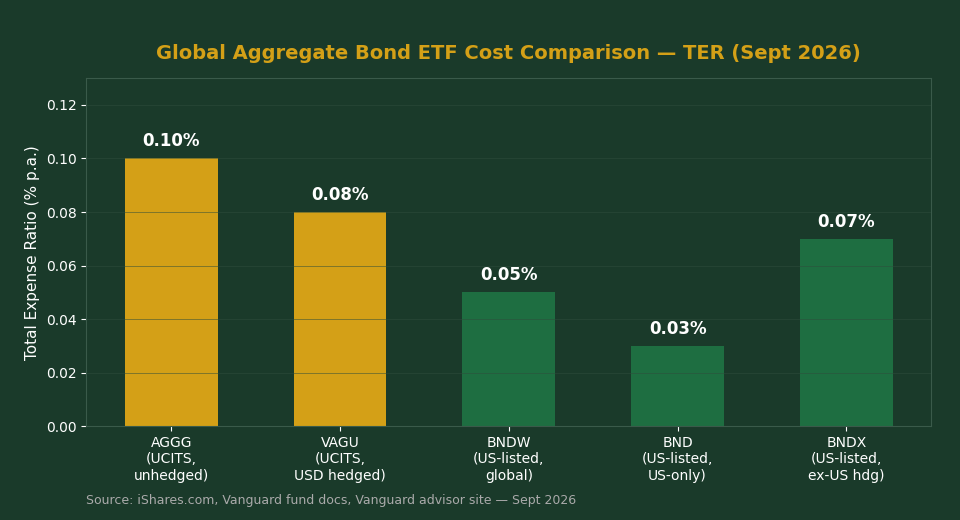
Here is how the three main global aggregate bond options compare, alongside their narrower US-listed cousins BND and BNDX:
| Fund | Exchange | ISIN / Domicile | TER | AUM | Currency |
|---|---|---|---|---|---|
| AGGG (iShares) | LSE | IE00B3F81409 / Ireland | 0.10% | ~USD 14.2bn (fund), ~USD 2.66bn (this share class) | USD, unhedged |
| VAGU (Vanguard) | LSE | IE00BG47KJ78 / Ireland | 0.08% | ~EUR 642m | USD Hedged, Acc |
| BNDW (Vanguard) | NASDAQ | US-listed / USA | 0.05% | ~USD 1.9bn | USD (blends hedged BNDX) |
| BND (Vanguard) | NASDAQ | US-listed / USA | 0.03% | ~USD 163.3bn | US-only, not global |
| BNDX (Vanguard) | NASDAQ | US-listed / USA | 0.07% | ~USD 83.4bn | Ex-US, hedged |
Source: iShares.com factsheet (25 Sept 2026), Vanguard fund documentation and advisor product pages (Aug-Sept 2026).
The Vanguard Gap: Why There’s No Unhedged VAGU
This is the detail most comparison articles skip. iShares offers AGGG in a genuinely unhedged USD (Distributing) share class — the currency exposure matches whatever the underlying bonds are denominated in (largely USD, EUR, JPY, and GBP in proportion to the index). Vanguard’s equivalent product, the Global Aggregate Bond UCITS ETF, is only available as currency-hedged share classes: VAGU (USD Hedged Acc), VAGF (EUR Hedged Acc), and VAGS (GBP Hedged Acc). There is no unhedged Vanguard share class on any exchange.
Practically, this means a Singapore investor who wants Vanguard’s razor-thin 0.08% TER but also wants the index’s natural, unhedged currency mix has no single-fund way to get both from Vanguard — they must either accept VAGU’s hedging (and its embedded hedging cost/tracking difference) or switch to iShares’ AGGG at a slightly higher 0.10% TER for the unhedged version. This is a genuine structural gap in Vanguard’s UCITS bond lineup, not a matter of opinion or fund quality.
For investors who specifically want currency-hedged exposure — useful if you’re worried about USD weakness eroding your SGD-denominated returns — VAGU’s 0.08% TER undercuts AGGG’s hedged share classes (AGGU/AGGH, also 0.10%) only marginally, so the two are close substitutes there.
Hedged vs Unhedged: Which Should Singapore Investors Choose?
Bonds are already a lower-volatility asset class than equities, so unhedged currency risk matters more here, proportionally, than it does in a global equity ETF like VWRA. A Singapore investor holding SGD 50,000 in unhedged AGGG is taking on USD/SGD, EUR/SGD, JPY/SGD, and GBP/SGD exposure roughly in line with each currency’s weight in the Bloomberg Global Aggregate index — and currency swings can easily outweigh the bond portfolio’s own price movements in a given year.
Hedged share classes (VAGU, or AGGG’s own hedged variants AGGU/AGGH) strip out that currency noise so the fund behaves more like a “pure” bond return, but hedging isn’t free — it costs a small ongoing amount (roughly the interest rate differential between currencies) that isn’t always visible in the headline TER. For most Singapore investors already holding unhedged equity ETFs like VWRA and CSPX, adding an unhedged bond ETF on top simply concentrates currency risk further; a hedged share class is arguably the more defensible default for the bond sleeve of a portfolio, precisely because bonds are meant to dampen volatility, not add another layer of it.
Historical Performance and Duration Risk
Global aggregate bond ETFs are not immune to the same duration risk that hit every bond fund during the 2022 global rate-hiking cycle. AGGG’s calendar-year total return was -16.3% in 2022, according to the iShares.com factsheet — its worst year since the fund’s Bloomberg Global Aggregate benchmark began being tracked in this share class, and a reminder that “diversified” does not mean “low volatility” when every major central bank is hiking rates simultaneously. As at 24 September 2026, AGGG’s year-to-date total return sat at -2.56%, reflecting the renewed rate-hike pressure discussed in our US Treasury ETF guide.
This matters because a 5.97-year effective duration means AGGG’s price is roughly 6% more sensitive to a 1 percentage point move in global interest rates than a zero-duration instrument like a T-bill. For Singapore investors who already hold a large allocation to Singapore T-bills or SSBs, adding a global aggregate bond ETF introduces genuine duration risk that a pure T-bill ladder does not carry — a trade-off for the diversification and slightly higher long-run yield potential.
The flip side is that this same duration exposure is what lets bond ETFs rally sharply when rates eventually fall — the 2019-2021 period (a falling/low-rate stretch) saw AGGG post several years of mid-single-digit to high-single-digit gains per the same factsheet data. Investors should think of a global aggregate bond ETF as a multi-year rate-cycle bet, not a cash substitute.
UCITS vs US-Domiciled: Withholding Tax and Estate Tax
The choice between AGGG/VAGU and the cheaper US-listed BND/BNDX/BNDW isn’t really about withholding tax — it’s about estate tax. US-domiciled bond ETFs like BND and BNDX are structured as Regulated Investment Companies (RICs), and under IRC Section 871(k), a large share of their distributions can qualify as “interest-related dividends” that are exempt from the usual 30% US withholding tax non-resident aliens pay on equity dividends. This is a nuance most generic bond-ETF guides get wrong by assuming all US-fund distributions face the same 30% haircut as CSPX or VOO dividends.
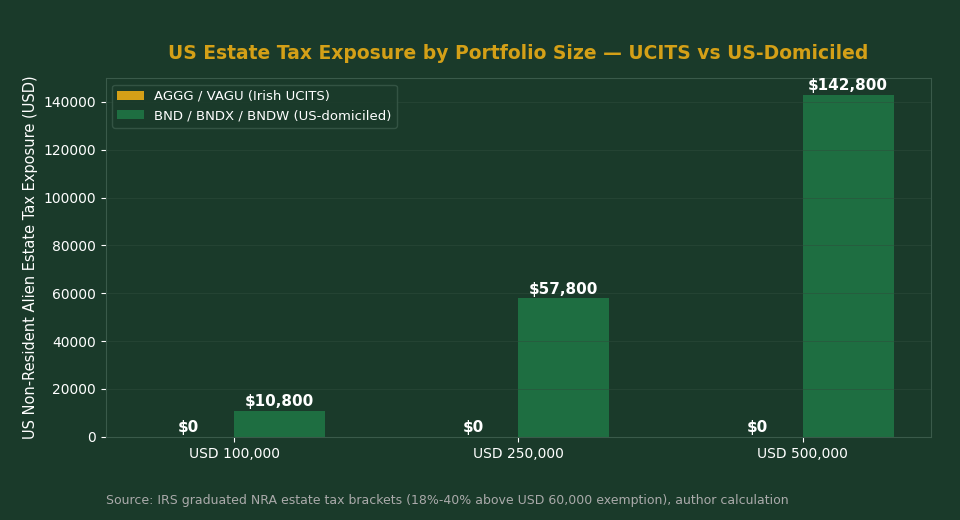
The real risk with US-domiciled bond ETFs is that the ETF shares themselves are a US-situs asset for estate tax purposes. If you die holding more than USD 60,000 in BND, BNDX, or BNDW (and other US-situs assets), your estate faces graduated US non-resident-alien estate tax of 18%–40% on the value above that exemption — a risk that simply does not exist with Irish-domiciled UCITS funds like AGGG or VAGU, which sit entirely outside the US estate tax net.
| Portfolio Size (USD) | AGGG / VAGU (UCITS) Estate Tax | BND / BNDX / BNDW (US-Domiciled) Estate Tax |
|---|---|---|
| $100,000 | $0 | ~$10,800 |
| $250,000 | $0 | ~$57,800 |
| $500,000 | $0 | ~$142,800 |
Source: IRS graduated non-resident-alien estate tax brackets (18%-40% above the USD 60,000 exemption), author calculation.
How to Buy AGGG or VAGU From Singapore
Both AGGG and VAGU trade on the London Stock Exchange in USD, so the buying process is the same as for VWRA or IWDA:
- Open a brokerage account that offers LSE access — most Singapore brokers covering the UK market will list both tickers. Compare platforms via our Syfe referral code and sign-up bonus if you’d rather use a robo/managed portfolio route instead of picking individual ETFs.
- Fund your account in SGD or USD — check FX conversion fees, since these compound over regular top-ups.
- Search the ticker (AGGG or VAGU) and confirm the LSE listing and correct ISIN before placing your order.
- Decide position sizing relative to your equity holdings — a global aggregate bond ETF is typically a portfolio’s ballast, not its growth engine. Our Singapore retirement calculator can help you model how a bond allocation shifts your overall glide path.
If you already hold Singapore-specific fixed income like T-bills or SSBs, read our Singapore T-bills 2026 guide to see how a global aggregate bond ETF complements (rather than duplicates) that exposure — T-bills are SGD-denominated and short-duration, while AGGG/VAGU are multi-currency and intermediate-duration.
Who Should (and Shouldn’t) Hold This ETF
Good fit for: investors who already have a solid equity core (VWRA/CSPX) and want a single, diversified fixed-income sleeve without buying separate Treasury, corporate, and EM bond ETFs individually (our EM corporate bond ETF guide covers that narrower alternative). It also suits investors nearing retirement who want to dial down portfolio volatility gradually rather than sitting entirely in cash or T-bills.
Poor fit for: investors chasing high yield — AGGG’s investment-grade-only mandate means its 12-month trailing distribution yield (3.38% as at 24 Sept 2026) trails what dedicated high-yield or EM corporate bond ETFs pay. It’s also a poor fit for investors with a very short time horizon who are better served by T-bills or fixed deposits, since duration risk (5.97 years for AGGG) means the fund’s price will still move noticeably when rates shift, unlike a maturing T-bill.
Every investment carries risk, and past performance and current yields are not guarantees of future results — bond prices fall when rates rise, and currency movements can add or subtract several percentage points from unhedged returns in any given year.
Frequently Asked Questions
What is the difference between AGGG and VAGU?
Can Singapore investors buy AGGG and VAGU?
Is a US-listed fund like BNDW cheaper than AGGG or VAGU?
Do global aggregate bond ETFs pay a lot of withholding tax?
Should I choose the hedged or unhedged share class?
What is AGGG's current yield and duration?
A global aggregate bond ETF is a one-ticket way to diversify your fixed income across currencies, issuers, and maturities — just be deliberate about which domicile and share class fits your tax exposure and currency risk appetite. For a broker comparison to fund your LSE purchases, check out our Syfe referral code and sign-up bonus.
This article was researched with the help of AI. While we strive to keep all information accurate and up to date, there may be errors. If you notice any discrepancies, please contact us.