Passive Income Singapore: How to Build Wealth with ETFs in 2026
Your complete guide to dividend ETFs, REIT ETFs, and tax-free income strategies for Singapore investors
📋 Table of Contents
- What Is Passive Income and Why ETFs?
- Best Dividend ETFs for Singapore Investors (2026)
- ETF Comparison: TER vs Estimated Yield
- How to Start Earning Passive Income with ETFs
- How Much Passive Income Can You Earn?
- Tax Advantages for Singapore Investors
- Where to Buy Dividend ETFs in Singapore
- Frequently Asked Questions
Passive income in Singapore is achievable for everyday investors through dividend-paying Exchange Traded Funds (ETFs). Unlike individual stocks, ETFs spread risk across hundreds of companies while delivering quarterly or semi-annual dividend payouts — with Singapore investors paying 0% tax on dividends received. A portfolio of SGD 100,000 in a diversified dividend ETF earning 4–5% annually can generate SGD 333–417 per month in truly passive income, automatically deposited to your brokerage account.
Not financial advice. All figures are for educational reference only. Data as at October 2026 unless noted.
What Is Passive Income and Why ETFs?
Passive income is money earned with minimal ongoing effort — dividends, rental income, interest, and capital gains. For most Singaporeans, the most accessible route to genuine passive income is through dividend-paying ETFs: low-cost funds that hold dozens or hundreds of stocks, automatically collecting and distributing dividends on your behalf.
ETFs beat individual stock-picking for passive income for three key reasons:
- Instant diversification — A single ETF like VHYD holds 400+ dividend-paying companies globally, reducing the risk any one company cuts its dividend.
- Extremely low cost — Total Expense Ratios (TERs) of 0.20%–0.50% vs 1.5%+ for unit trusts or ILPs, meaning more of your returns stay with you.
- Tax efficiency — Singapore has zero dividend withholding tax on Singapore-listed ETFs and S-REITs. Even for foreign ETFs listed on the London Stock Exchange (LSE), UCITS-structured funds reduce US withholding tax to 15% vs 30% for US-domiciled ETFs.
Compared to alternatives like Singapore T-bills (one-off short-term instruments) or fixed deposits (locked up, non-compounding), ETFs offer liquidity, compound growth, and the ability to reinvest dividends for long-term wealth accumulation. For investors building toward a retirement income target, ETFs are the workhorse of any well-built passive income strategy.
Best Dividend ETFs for Singapore Investors (2026)
Not all dividend ETFs are created equal. Singapore investors face specific constraints: US-domiciled ETFs (like VYM or SCHD) carry a 30% withholding tax on dividends and are subject to US estate tax above USD 60,000. The smarter play is UCITS ETFs listed on the London Stock Exchange or SGX-listed ETFs.
Here is a comparison of the leading options accessible to Singapore investors in 2026:
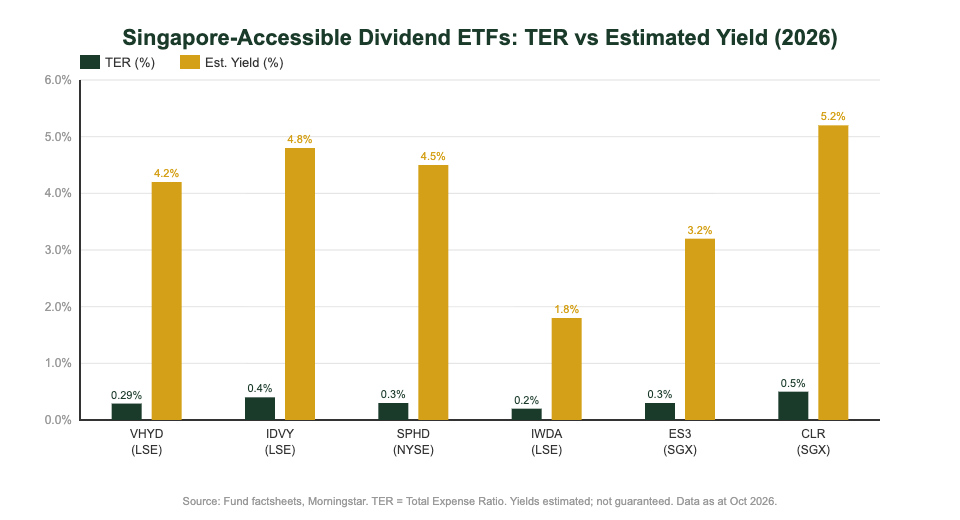
| ETF | Exchange | Focus | TER | Est. Yield | WHT on Divs |
|---|---|---|---|---|---|
| VHYD (Vanguard FTSE All-World High Div) | LSE (USD) | Global high dividend | 0.29% | ~4.2% | 15% (UCITS) |
| IDVY (iShares Euro Dividend) | LSE (GBP) | European dividend | 0.40% | ~4.8% | 15–20% |
| ES3 (SPDR STI ETF) | SGX | SG blue chips (STI) | 0.30% | ~3.2% | 0% (SG) |
| CLR (Lion-Phillip S-REIT ETF) | SGX | Singapore REITs | 0.50% | ~5.2% | 0% (SG) |
| IWDA (iShares Core MSCI World) | LSE (USD) | Global growth (acc.) | 0.20% | ~1.8% | 15% (UCITS) |
Source: Vanguard, iShares, SGX fund factsheets. TER = Total Expense Ratio. Yields estimated based on trailing 12-month distributions; past yields do not guarantee future payouts. WHT = withholding tax on dividends. Data as at October 2026.
The S-REIT ETF angle: For Singapore-focused passive income, the Lion-Phillip S-REIT ETF (CLR) and the Phillip SGX APAC Dividend Leaders REIT ETF (BYI) offer yields of 4–6% with zero dividend withholding tax. This makes them among the most tax-efficient passive income vehicles available in Singapore. Learn more in our Singapore REIT ETF guide.
Dividend ETF Comparison: TER vs Yield
The chart below visualises the trade-off between cost (TER) and income yield across the main dividend ETFs available to Singapore investors. Lower TER means more of your returns compound over time; higher yield means more cash in your pocket now.
How to Start Earning Passive Income with ETFs in Singapore
Building a passive income stream from ETFs is a four-step process that any Singaporean investor can complete in under an hour:
Step 1: Choose Your Income Goal and Risk Tolerance
Decide whether you want current income (high-yield dividend ETFs, 4–6%) or total return with some income (growth ETFs with modest dividends, 1.5–3%). Most Singaporeans planning for retirement benefit from a blend — growth ETFs like IWDA for compounding in your 30s and 40s, shifting toward dividend ETFs like VHYD or CLR as you approach retirement age.
Step 2: Open a Brokerage Account
To buy LSE-listed ETFs like VHYD or IWDA, you need a broker with London Stock Exchange access. The two most popular platforms among Singapore ETF investors in 2026 are:
- Interactive Brokers (IBKR) — Lowest commissions (USD 1.70 per LSE trade), direct LSE access, excellent for larger portfolios. Use referral code jianxiong368 for a welcome bonus.
- Syfe Trade — Singapore-regulated, no custody fee for ETFs above SGD 20k, good for beginners. Use Syfe referral code SRPRFFFCD for up to SGD 100 bonus.
For SGX-listed ETFs (ES3, CLR), any local broker including DBS Vickers, OCBC Securities, or FSMOne (referral P0544985) works well. FSMOne also offers Regular Savings Plans for automatic monthly ETF purchases.
Step 3: Buy Your First Dividend ETF
For a beginner Singapore investor looking purely for passive income in 2026, our recommended starting portfolio is:
| ETF | Allocation | Role | Est. Yield |
|---|---|---|---|
| CLR (Lion-Phillip S-REIT ETF) | 40% | High income, 0% WHT | ~5.2% |
| VHYD (Vanguard High Div) | 40% | Global diversification | ~4.2% |
| ES3 (SPDR STI ETF) | 20% | SG anchor, low cost | ~3.2% |
Blended portfolio yield estimate: ~4.5% annually. Not financial advice. Past yields do not guarantee future performance. October 2026.
This blended portfolio targets approximately 4.5% annual yield — SGD 375/month on a SGD 100,000 portfolio — with strong Singapore-law investor protections, 0% SG dividend tax on the CLR and ES3 holdings, and UCITS tax efficiency on the VHYD position.
Step 4: Automate and Reinvest
Set up a Regular Savings Plan (RSP) through Endowus (referral 2V343) or FSMOne to automatically invest a fixed sum monthly. Endowus is particularly powerful for using your CPF Ordinary Account and SRS funds to buy ETFs — effectively earning passive income inside your CPF wrapper, entirely tax-free. This is one of the most overlooked passive income hacks for Singapore investors.
How Much Passive Income Can You Earn?
The chart below shows estimated monthly passive income at different portfolio sizes across four common passive income strategies in Singapore. All figures are after ETF fees, before personal income tax (Singapore has 0% dividend tax).
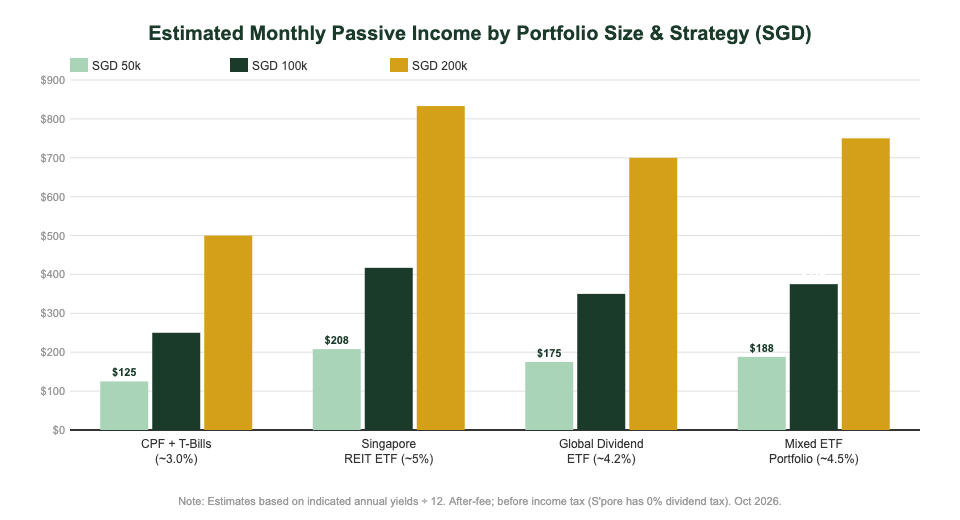
The takeaway is clear: a Singapore REIT ETF strategy delivers the highest monthly income at every portfolio level, thanks to the combination of higher dividend yields and zero withholding tax. At SGD 200,000, a REIT ETF allocation could generate approximately SGD 833/month — enough to meaningfully supplement your CPF Life payout in retirement.
For investors who want to model their own retirement income target, try our Singapore retirement planning calculator — it factors in CPF, investment income, and inflation together.
The path to financial independence (sometimes called FIRE — Financial Independence, Retire Early) in Singapore often runs through a combination of S-REITs and ETFs. We explore the FIRE number concept and how to achieve it in Singapore in our dedicated best S-REITs in Singapore 2026 analysis.
Tax Advantages for Singapore ETF Investors
Singapore is one of the world’s most tax-friendly jurisdictions for passive income investors. Here is what you need to know:
- 0% dividend tax — Singapore does not impose personal income tax on dividends received from Singapore companies, REITs, or ETFs listed on SGX. You keep every cent of your ETF dividend payout.
- 0% capital gains tax — Profits from selling ETFs are not taxed in Singapore. This dramatically accelerates compounding compared to countries like the US (20% CGT) or UK (18–24% CGT).
- CPF and SRS double-dip — Investing through your SRS account in dividend ETFs via Endowus means: (1) tax deduction on your contribution (up to SGD 15,300/year for SG citizens), and (2) tax-free dividend income inside the account. This is the most powerful legal tax optimisation available to Singapore salary earners. See our guide on CPF investment strategy for full details.
- UCITS vs US ETF WHT — Choosing LSE-listed UCITS ETFs (like VHYD or IWDA) instead of their US equivalents (VYM, VTI) cuts withholding tax on US stock dividends from 30% to 15%, improving your net yield by 0.5–1.0 percentage points annually.
One risk area: if you buy US-domiciled ETFs (e.g. tickers ending in US: VYM, SCHD) and your total US-sited assets exceed USD 60,000, your estate becomes subject to US estate tax at 40% on the excess. UK/Irish-domiciled UCITS ETFs are not subject to this rule. For most Singapore ETF investors, this is a compelling reason to stick to LSE-listed UCITS funds.
Where to Buy Dividend ETFs in Singapore
Your choice of brokerage significantly affects your net passive income — commissions, FX spreads, and custody fees all eat into returns. Here is a comparison of the top platforms for Singapore ETF investors in 2026:
| Platform | Best For | LSE Access | Min. Commission | Referral Bonus |
|---|---|---|---|---|
| Syfe | Beginners, automation | Yes (via Syfe Trade) | 0.06% (no min) | SRPRFFFCD |
| Endowus | CPF/SRS investors | Via fund access | 0.25%–0.60% p.a. | 2V343 |
| IBKR | Active traders, low cost | Yes (direct) | USD 1.70/trade | jianxiong368 |
| FSMOne | RSP investors, SGX | Limited | SGD 8.80/trade | P0544985 |
Source: Platform fee schedules as at October 2026. Fees subject to change. TKN may earn referral fees from these platforms.
Our recommendation: For most Singapore investors targeting passive income through ETFs, Syfe Trade + Endowus is the optimal combination — Syfe Trade for LSE-listed UCITS ETFs, and Endowus for deploying CPF and SRS savings into passive income funds.
Frequently Asked Questions
What is the best ETF for passive income in Singapore?
For Singapore investors, the Lion-Phillip S-REIT ETF (CLR) and Vanguard FTSE All-World High Dividend Yield ETF (VHYD) are the top picks for passive income in 2026. CLR offers ~5.2% yield with 0% Singapore dividend tax; VHYD provides global diversification at ~4.2% yield via UCITS structure on the LSE. A 60/40 blend gives approximately 4.8% blended yield with strong diversification.
How much money do I need to start earning passive income from ETFs in Singapore?
There is no minimum investment — you can start with as little as SGD 100 per month via a Regular Savings Plan on FSMOne or Endowus. However, to generate meaningful passive income (e.g. SGD 500/month), you need approximately SGD 133,000 invested at a 4.5% annual yield. Building this through monthly contributions of SGD 1,000–2,000 typically takes 8–10 years, assuming dividend reinvestment and modest portfolio growth.
Is passive income from ETFs taxable in Singapore?
No. Singapore does not tax dividend income received by individual investors. Whether you receive dividends from SGX-listed ETFs, S-REITs, or foreign ETFs held through a local brokerage, you pay 0% personal income tax on those dividends. Capital gains from selling ETFs are also 0% tax. This makes Singapore one of the world’s most tax-efficient places to build a passive income portfolio.
Can I use CPF to buy dividend ETFs in Singapore?
Yes, via two routes. First, your CPF Ordinary Account (OA) funds can be invested in selected ETFs through the CPF Investment Scheme (CPFIS) — eligible ETFs include STI ETFs and a few others. Second, your SRS (Supplementary Retirement Scheme) funds can be invested through Endowus in a broader range of ETFs including global dividend funds. SRS contributions also earn you a tax deduction of up to SGD 15,300/year, making this a powerful passive income plus tax saving strategy.
What is the difference between accumulating and distributing ETFs for passive income?
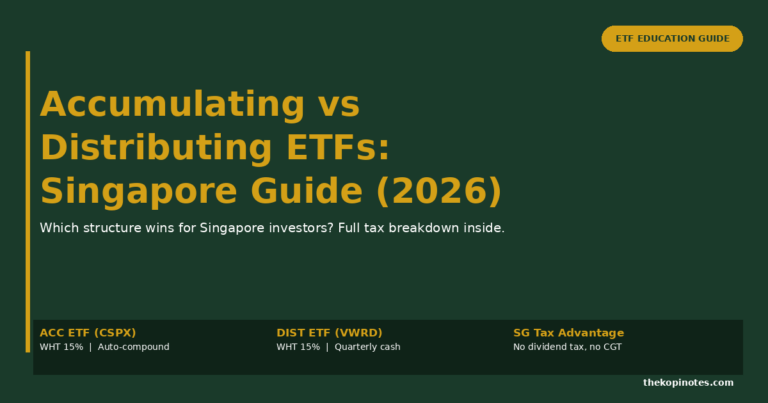
Distributing ETFs pay out dividends as cash to your brokerage account — ideal if you want actual passive income now. Accumulating ETFs automatically reinvest dividends back into the fund, compounding growth without a cash payout. For passive income investors who want monthly or quarterly cash, choose distributing (dist.) share classes. If you are still in the wealth accumulation phase, accumulating (acc.) ETFs compound more efficiently. Examples: VWRA = accumulating VWRA, VWRD = distributing version of the same fund.
Which platform is best for buying ETFs for passive income in Singapore?
For most Singapore investors in 2026, the best combination is Syfe Trade (for LSE ETFs with competitive commissions) plus Endowus (for CPF/SRS ETF investing). Syfe Trade’s referral code is SRPRFFFCD, Endowus referral code is 2V343, and FSMOne’s referral code is P0544985. If you plan to invest more than SGD 50,000 and want the lowest possible trading fees, Interactive Brokers (IBKR) offers the cheapest access to LSE at USD 1.70 per trade.
This article was researched with the help of AI. While we strive to keep all information accurate and up to date, there may be errors. If you notice any discrepancies, please contact us.