Best Brokerage Singapore 2026: Complete Comparison Guide
Choose the right broker for ETF investing — compare fees, platforms, and features to find the best fit for your portfolio.
Choosing the right brokerage account is one of the most important decisions for Singapore investors buying ETFs. The best broker for you depends on your portfolio size, trading frequency, and preferred asset classes. Interactive Brokers dominates for larger portfolios thanks to rock-bottom fees (as low as SGD 1 per trade plus USD 1 commission). Saxo Markets offers the widest selection of international ETFs and excellent platform features. For beginners, Syfe provides a simplified, commission-free experience with guided investing. MooMoo sits in the middle — competitive fees, strong mobile app, and easy account setup. This guide compares the four leading brokers on fees, features, and suitability for different investor profiles.
Not financial advice. All figures are for educational reference only. Data as at June 2026 unless noted.
- Best for large portfolios (SGD 100k+): Interactive Brokers — lowest total costs with commission rates as low as 0% + USD 1
- Best all-rounder: Saxo Markets — widest ETF selection, excellent platform, good customer service
- Best for beginners: Syfe or MooMoo — simple setup, zero or low commissions, strong mobile apps
- Best international access: Saxo Markets — ~2,000 global ETFs, competitive spreads
Table of Contents
What Is a Brokerage Account?
A brokerage account is a custodian account that allows you to buy and sell securities — stocks, ETFs, bonds, and other investments. In Singapore, brokerage accounts are regulated by the Monetary Authority of Singapore (MAS). When you open an account with a broker, you’re establishing a relationship with that firm to execute your trades on exchanges like the London Stock Exchange (LSE), NASDAQ, or the New York Stock Exchange (NYSE).
Unlike a bank savings account, a brokerage account doesn’t pay interest on cash held in it. Instead, it’s purely a platform for investing. Your investments are held in your name (or in your nominee name with some brokers), and the broker acts as an intermediary — they execute your buy and sell orders, settle trades, and provide reporting.
The key variables between brokers are: commission per trade, account minimum, trading platform quality, customer support, and the range of assets available to buy. For Singapore investors interested in ETFs, the best brokers offer low commissions, access to global exchanges (especially the LSE for Irish-domiciled ETFs), and robust trading platforms.
The Four Best Brokers in Singapore
Hundreds of online brokers operate globally, but for Singapore residents buying ETFs, four stand out for their low fees, regulatory standing, and suitability for long-term portfolio building.
1. Interactive Brokers (IBKR) — Best for Larger Portfolios
Interactive Brokers is the world’s largest discount broker by assets under administration. The Singapore presence operates under MAS regulation. IBKR’s biggest advantage: commission rates drop dramatically with account size.
On a typical SGD 50,000 portfolio of LSE-listed ETFs, you’d pay roughly SGD 2–5 per trade in commissions plus FX conversion costs (roughly 0.1–0.2%). For larger portfolios (SGD 100,000+), IBKR becomes even more cost-effective because their tiered pricing kicks in. IBKR also provides margin lending, options trading, and access to over 8 million global instruments.
Downsides: the platform is complex, not beginner-friendly, and customer support is email-only (no live chat). Minimum account is SGD 1,000.
2. Saxo Markets (formerly Saxo Bank) — Best All-Rounder
Saxo Markets is a Danish investment bank with a Singapore subsidiary regulated by MAS. They stand out for platform quality and breadth of offerings. Saxo provides access to roughly 2,000 ETFs globally, including all major LSE-listed Irish-domiciled ETFs.
Commissions: SGD 3–12 per trade depending on trade size. Minimum account: SGD 2,000. Saxo offers 24/5 customer support via chat, excellent educational content, and one of the best web-based trading platforms available. For a Singapore investor wanting international diversification without the learning curve of IBKR, Saxo is the premium choice.
3. MooMoo Singapore — Best Mobile Experience
MooMoo is a young, user-friendly brokerage backed by Nasdaq-listed Futu Holdings. It launched in Singapore in 2023 and has grown rapidly. MooMoo’s strength is its mobile app — arguably the best user experience among Singapore brokers. Commissions are low: SGD 0 per trade (rebate-based commission), so you actually earn rebates on some trades. No minimum account required, though you must fund at least a small amount (SGD 100) to activate.
Downsides: fewer ETF offerings (~1,500 listed products) compared to Saxo, and customer support is via chat during SG business hours (9am–6pm). Also, MooMoo doesn’t yet offer options or margin trading.
4. Syfe — Best for Robo-Advised or Hands-Off Investing
Syfe is a Singapore fintech company offering both a robo-advisor service and a self-directed brokerage (Syfe Brokerage). The brokerage gives you zero-commission trading on ETFs with a curated selection of ~800 global ETFs focused on passive strategies. Minimum account: SGD 5,000 (though this can be funded gradually through regular savings plans).
Syfe is ideal if you want simplicity and don’t mind a smaller ETF menu. No commission trades and a beautiful mobile interface make it very beginner-friendly. Customer support is available via chat during business hours.
Fee Comparison: Which Broker Costs Least?
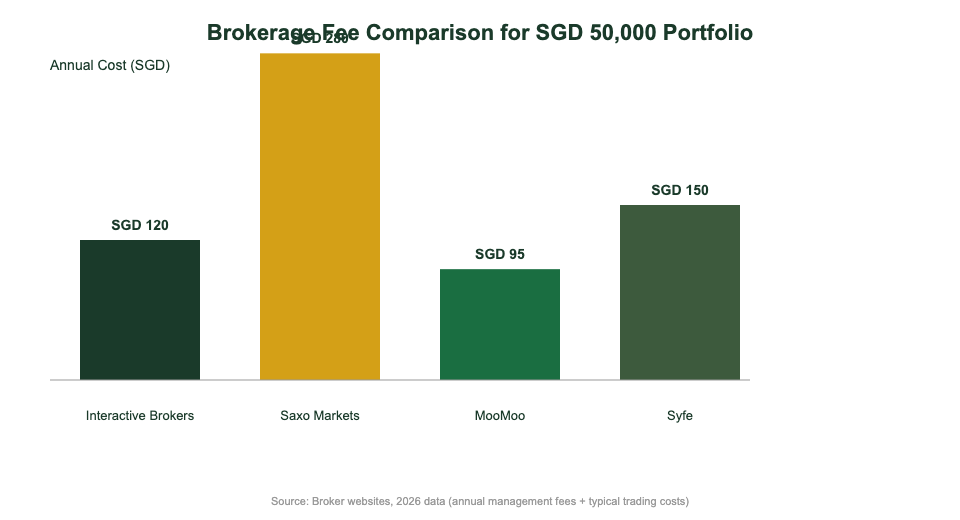
Raw commission per trade is just one cost. A true cost comparison must factor in FX conversion spreads, account maintenance fees, and minimum trade sizes. Let me work through a real scenario:
| Broker | Commission/Trade | FX Spread | Annual Cost* |
|---|---|---|---|
| Interactive Brokers | USD 1 (~SGD 1.35) | 0.05% | ~SGD 120 |
| Saxo Markets | SGD 5–8 | 0.15% | ~SGD 280 |
| MooMoo | SGD 0 (rebate) | 0.2% | ~SGD 95 |
| Syfe | SGD 0 | 0.25% | ~SGD 150 |
*Estimated annual costs assuming quarterly ETF purchases of SGD 12,500 each in USD/GBP-denominated ETFs. Actual costs vary based on trade size, asset chosen, and FX rates.
Features Comparison: Platform & Support
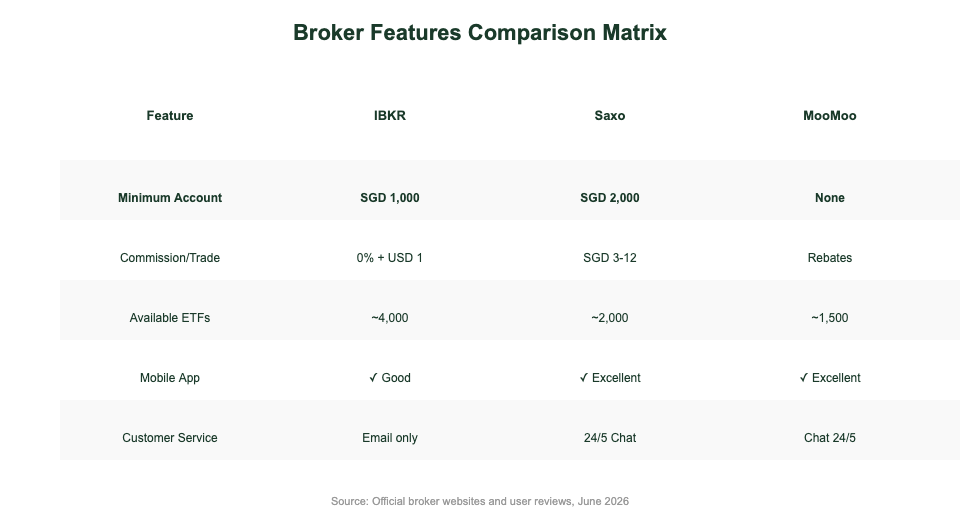
Platform quality matters because you’ll be using it regularly. Saxo and MooMoo lead in user experience. Saxo’s web platform is feature-rich and intuitive. MooMoo’s mobile app is beautifully designed and fast. Interactive Brokers’ platform is powerful but steep for beginners. Syfe’s platform is simple and works best if you’re buying whole ETF portfolios rather than individual securities.
Customer support varies too. Saxo offers 24/5 live chat in English. MooMoo and Syfe offer chat during Singapore business hours (9am–6pm weekdays). Interactive Brokers relies on email support, which can take 24–48 hours for responses.
Minimum Account Size & Funding
Interactive Brokers has the lowest minimum (SGD 1,000), which is accessible to most Singaporeans. Saxo requires SGD 2,000. Syfe sets the bar higher at SGD 5,000 (though you can fund this gradually via their savings plan feature). MooMoo has no strict minimum but requires at least a token deposit (SGD 100) to activate the account.
Funding is easy with all four brokers — you can transfer SGD directly from your DBS, OCBC, or UOB bank account. Saxo and Interactive Brokers also accept international wire transfers if you hold USD or other currencies.
Which Broker Is Right for You?
Choose Interactive Brokers (Referral: jianxiong368) if:
- Your portfolio is SGD 50,000+ and you’re buying regularly
- You’re comfortable with a technical platform and don’t need hand-holding
- You want access to options, margin, or other advanced trading features
- You’re a frequent trader and can benefit from rock-bottom per-trade fees
Choose Saxo Markets if:
- You want the widest selection of global ETFs (~2,000 available)
- You prefer a beautiful, intuitive platform
- You value responsive customer support (24/5 live chat)
- Your portfolio is SGD 5,000–100,000
- You want access to international stocks, bonds, and other assets alongside ETFs
Choose MooMoo if:
- You’re a beginner or first-time investor in Singapore
- You prefer a mobile-first experience (the app is exceptional)
- You want zero commission trading without complexity
- You’re primarily buying ETFs, not individual stocks
Choose Syfe if:
- You want automated, guided investing (robo-advisor service)
- You prefer zero commission and a curated, simple ETF menu
- You have SGD 5,000+ to start and prefer recurring investments
- You’re looking for a fully local Singapore fintech experience
How to Open a Brokerage Account
Opening a brokerage account takes 10–15 minutes online. Here’s the standard process:
- Visit the broker’s website: Navigate to Interactive Brokers, Saxo Markets, MooMoo, or Syfe’s Singapore site.
- Click “Open Account” or “Sign Up”: You’ll be asked for basic information: name, email, NRIC number, employment status, and investment experience.
- Complete identity verification: Most brokers now use video verification (you’ll hold your passport to a camera for 2–3 minutes). Some accept NRIC scan.
- Fund your account: Once approved (typically same-day), transfer SGD from your bank to the broker’s Singapore DBS or OCBC account. The money arrives within 1–2 business days.
- Start trading: Search for the ETF you want (e.g., “CSPX” for the iShares CSPX ETF), check it’s listed on the LSE or NYSE, place your order in the currency it trades in (usually GBP or USD), and you’re done.
Pro tip: Before opening a live account, most brokers let you paper-trade (simulate trades with fake money) to get familiar with the platform. Do this first if you’re new to investing.
Singapore-Specific Considerations
Singapore has no capital gains tax on investments, which means your ETF gains aren’t taxed (unlike dividends, which face 5% withholding tax if your ETF distributes). This is a major advantage over many other countries and means all four brokers here offer the same tax treatment — the differentiator is purely fees and platform quality.
One important note: ETFs listed on the London Stock Exchange are not CPF-eligible (you can’t buy them with your CPF savings). If you want to invest CPF funds, you’re limited to Singapore or Australian-listed ETFs, or stocks in your approved CPF investment scheme. For SRS (Supplementary Retirement Scheme) contributions, LSE-listed ETFs ARE allowed if bought through eligible brokers like Interactive Brokers or Saxo.
Frequently Asked Questions
Which broker is cheapest for buying ETFs as a Singapore investor?
For most investors, MooMoo is cheapest due to zero commissions plus rebates. However, if you have a large portfolio (SGD 100,000+) and trade frequently, Interactive Brokers becomes cheaper due to tiered commission rates. For mid-size portfolios (SGD 20k–50k), MooMoo or Syfe typically cost less annually than Saxo or IBKR.
Can I buy LSE ETFs like CSPX and VWRA on all these brokers?
Yes. All four brokers (IBKR, Saxo, MooMoo, and Syfe) provide access to major LSE-listed ETFs. However, Syfe’s selection is more limited — they curate a smaller menu of ~800 ETFs rather than offering every listing. If you want maximum choice, Saxo (~2,000 ETFs) or IBKR (~8 million instruments) are better.
Is my money safe with these brokers?
All four are regulated by Singapore’s Monetary Authority of Singapore (MAS) or equivalent regulators. Your cash and investments are segregated from the broker’s own funds. Interactive Brokers has over USD 200 billion in client assets and has operated for 40 years. Saxo, MooMoo, and Syfe are also well-capitalized and insured. Your biggest risk is not the broker, but your own trading decisions.
Can I invest CPF money through these brokers?
No. None of these brokers are CPF-approved for LSE ETF purchases. You can only invest CPF funds through official CPF investment schemes (buying Singapore or Australian-listed ETFs, or specific approved stocks). However, you CAN use CPF for stocks and other assets on these platforms if they’re in your approved list. For ETF investing, use your own cash (non-CPF funds).
What's the difference between commission and spread?
Commission is a flat fee the broker charges per trade. Spread is the difference between the bid price (what buyers offer) and ask price (what sellers want) — this is taken by the market maker, not the broker. With ETFs on major exchanges like LSE, spreads are usually 0.02–0.1%, which is tiny. Commission is the bigger cost for frequent traders.
How long does it take to open an account and start trading?
Most brokers approve accounts same-day after you complete identity verification (2–3 minute video call). Funding your account from your Singapore bank takes 1–2 business days. So total time: 2–3 days from application to first trade. Express approvals are sometimes available within a few hours.
Ready to Open Your Brokerage Account?
Use our referral links to sign up and unlock exclusive bonuses on each platform.
This article was researched with the help of AI. While we strive to keep all information accurate and up to date, there may be errors. If you notice any discrepancies, please contact us.