Nikko AM STI ETF Singapore: Complete Guide (2026)
Dividends, expense ratio, how to buy G3B & ES3, and comparison with SPDR STI ETF — everything Singapore investors need to know.
The Nikko AM STI ETF (ticker: G3B on SGX) is a Singapore-domiciled ETF that tracks the Straits Times Index (STI), giving investors exposure to Singapore's top 30 listed companies in a single low-cost fund. With a Total Expense Ratio (TER) of 0.30% p.a. and a history of twice-yearly dividend payouts, it is one of the most popular ETFs for Singapore retail investors seeking local equity exposure and passive income.
Not financial advice. All figures are for educational reference only. Data as at April 2026 unless noted.
What Is the Nikko AM STI ETF?
The Nikko AM STI ETF is an exchange-traded fund managed by Nikko Asset Management Asia Limited and listed on the Singapore Exchange (SGX) under the ticker symbol G3B. It is designed to replicate the performance of the Straits Times Index (STI) — Singapore's flagship stock market benchmark — as closely as possible, before fees.
The STI comprises the top 30 companies by market capitalisation listed on the SGX, spanning sectors including banking (DBS, OCBC, UOB), real estate investment trusts (CapitaLand Integrated Commercial Trust, Mapletree), telecommunications (Singtel), and industrials (Keppel). By holding the Nikko AM STI ETF, a Singapore investor gains a diversified slice of Singapore's blue-chip equity market in a single, low-cost transaction.
The fund was launched in February 2009 and is Singapore-domiciled, meaning it is subject to MAS regulations and is eligible for investment through the CPF Investment Scheme (CPFIS) and the Supplementary Retirement Scheme (SRS). This is a key distinction from London Stock Exchange-listed ETFs such as CSPX or VWRA, which are not CPFIS-eligible.
The ETF distributes dividends twice a year (typically in June and December), passing on the dividends collected from its underlying STI holdings to unitholders. Unlike accumulating ETFs such as CSPX, the Nikko AM STI ETF does not automatically reinvest dividends — investors who want compound growth must reinvest manually or use a platform like FSMOne's Regular Savings Plan (RSP).
As at April 2026, the fund has an Assets Under Management (AUM) of approximately SGD 650 million, making it one of the largest locally-listed ETFs by AUM, according to SGX data.
Key Facts at a Glance
| Metric | Detail |
|---|---|
| Full Name | Nikko AM Singapore STI ETF |
| Ticker (SGX) | G3B (SGD counter) / G3B.SI |
| Index Tracked | Straits Times Index (STI) |
| Domicile | Singapore |
| Structure | Distributing (dividends paid out twice yearly) |
| TER (Expense Ratio) | 0.30% p.a. |
| AUM | ~SGD 650 million (as at April 2026) |
| Number of Holdings | 30 (full replication of STI) |
| Currency | SGD |
| Launch Date | February 2009 |
| CPFIS Eligible | Yes (CPFIS-OA & CPFIS-SA) |
| SRS Eligible | Yes |
Source: Nikko AM fund factsheet, SGX, April 2026
Dividends and Yield
One of the primary reasons Singapore retail investors choose the Nikko AM STI ETF over an accumulating global ETF is its regular dividend income. The fund distributes dividends twice a year — historically in June and December — reflecting the underlying STI constituents' dividend payouts. Singapore's dividend income is not subject to personal income tax for individual investors, making this an attractive passive income vehicle.
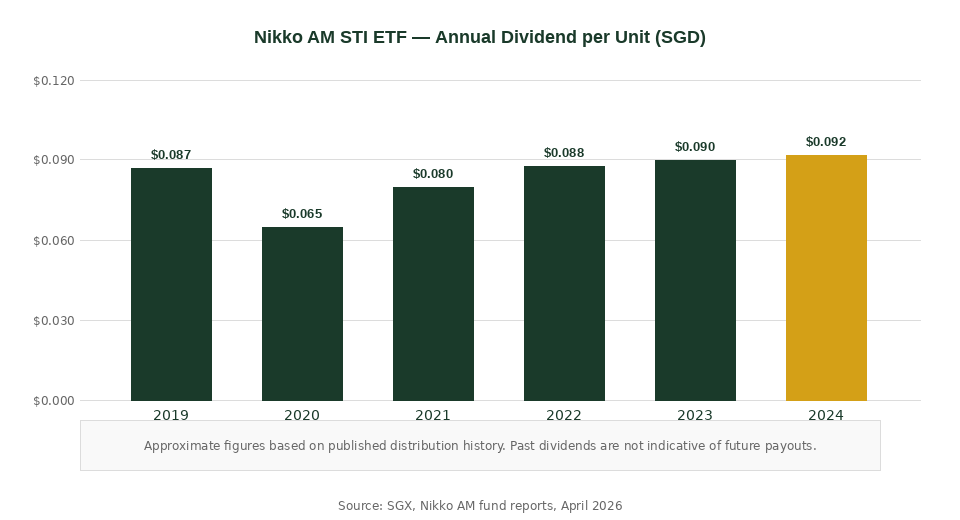
The approximate dividend per unit over recent years is shown in the chart below. As a rough guide, the Nikko AM STI ETF has historically delivered a dividend yield of approximately 3.0%–3.5% per annum, though this varies with STI constituent earnings and the ETF's NAV at the time of distribution.
For a Singapore investor holding SGD 20,000 worth of G3B (approximately 6,000 units at a unit price of ~SGD 3.35 as at April 2026), the estimated annual dividend income would be approximately SGD 600–700 before any platform fees — a meaningful passive income contribution, especially when combined with other dividend-paying assets like the best S-REITs in Singapore 2026.
Important caveat: Past dividend distributions are not indicative of future payouts. The STI yield can fall during economic downturns (as seen in 2020 during COVID-19) and rise when constituent companies post strong earnings. Always treat dividend projections as estimates, not guarantees.
| Year | Approx. Dividend per Unit (SGD) | Estimated Yield (NAV basis) |
|---|---|---|
| 2020 | $0.065 | ~2.3% (COVID impact) |
| 2021 | $0.080 | ~2.8% |
| 2022 | $0.088 | ~3.0% |
| 2023 | $0.090 | ~3.1% |
| 2024 | $0.092 | ~3.2% |
Source: SGX, Nikko AM fund reports, April 2026. Past performance is not indicative of future results.
Expense Ratio and Total Costs
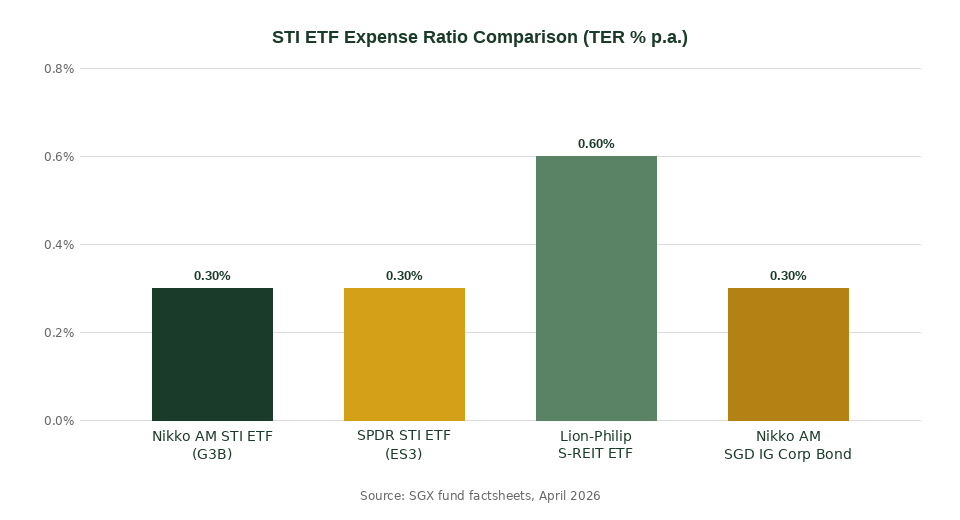
The Nikko AM STI ETF charges a Total Expense Ratio (TER) of 0.30% per annum. This fee is deducted from the fund's net asset value automatically — you do not receive a separate bill. For a Singapore investor holding SGD 10,000 in G3B, the annual cost is just SGD 30. At SGD 50,000, it is SGD 150 per year.
The TER covers the fund management fee, trustee fees, audit fees, and other operational costs. It does not cover brokerage commissions when you buy or sell units on SGX, which depend on your broker of choice.
In addition to the TER, consider the following total cost components:
- Brokerage commission: Typically 0.05%–0.28% per trade depending on broker (see How to Buy section below)
- Bid-ask spread: Usually SGD 0.005–0.01 per unit for G3B — small but real cost on every trade
- Platform fees (if using RSP): FSMOne charges 0.08% per RSP instalment (min SGD 1); Syfe Trade has no commission for US-listed ETFs but standard fees apply for SGX trades
Compared to actively managed Singapore equity unit trusts (which can charge 1.0%–1.5% p.a. in management fees), the Nikko AM STI ETF's 0.30% TER represents a significant cost saving over a long investment horizon. To build passive income in Singapore, keeping costs low is one of the most controllable variables.
How to Buy the Nikko AM STI ETF in Singapore (Step-by-Step)
The Nikko AM STI ETF (G3B) is listed on the SGX and can be purchased through any Singapore-regulated brokerage with SGX access. Here is how to buy it through the most popular platforms:
Option 1: Interactive Brokers (IBKR) — Best for Cost-Conscious Investors
IBKR offers among the lowest commissions for SGX trades at 0.05% per trade (min SGD 1.50). For investors putting SGD 10,000 or more to work, this is typically the most cost-effective option.
- Open and fund your IBKR account (minimum SGD 0 to open, but need funds to trade)
- In the IBKR Trader Workstation or mobile app, search for ticker G3B
- Select the SGX exchange and SGD currency
- Place a limit order at or near the current ask price — market orders on SGX ETFs can have wider spreads during off-peak hours
- Confirm and submit. Settlement is T+2 (two business days)
Option 2: moomoo Singapore — Best for Beginners with Promotions
The moomoo Singapore review 2026 details its competitive fee structure: 0.03% per SGX trade (min SGD 0.99) under its standard plan, making it one of the cheapest for smaller trades. New users often qualify for welcome promotions including free shares or commission-free trades.
- Download the moomoo app and complete SingPass/MyInfo verification
- Fund your account via FAST transfer (min SGD 100)
- Search for G3B in the SGX section
- Tap “Trade” → “Buy” and enter your quantity (minimum 1 lot = 100 units)
Option 3: FSMOne Regular Savings Plan (RSP) — Best for Dollar-Cost Averaging
FSMOne offers a Regular Savings Plan specifically for Singapore-listed ETFs, including G3B. You can invest from as little as SGD 50 per month, automatically buying units regardless of price — a disciplined dollar-cost averaging approach. The FSMOne referral code page has the latest sign-up offers. Commission is 0.08% per instalment (min SGD 1).
Option 4: Syfe Trade — Best for Integrated Portfolio Management
Syfe Trade supports SGX-listed ETFs and integrates with Syfe's broader portfolio tools. For investors already using Syfe's robo-advisor for their core portfolio, adding G3B via Syfe referral code keeps all holdings on one dashboard. Standard SGX commission rates apply.
CPFIS Route — Investing with CPF Ordinary Account
The Nikko AM STI ETF is one of the few ETFs approved under the CPF Investment Scheme (CPFIS-OA). This means you can invest CPF Ordinary Account savings into G3B through a CPFIS-approved agent bank or broker. To do this:
- Open a CPF Investment Account with an approved agent (DBS, OCBC, UOB, or selected brokers)
- Ensure you have at least SGD 20,000 in your OA (only funds above the first SGD 20,000 can be invested)
- Place your buy order for G3B through the CPFIS account
Note: While CPFIS investing is possible, the CPF OA currently earns a guaranteed 2.5% p.a. This is the benchmark your G3B investment must beat net of fees and after accounting for market risk. Review your Singapore retirement calculator projections before deploying CPF funds into equities.
Nikko AM STI ETF vs SPDR STI ETF (G3B vs ES3)
Singapore investors often compare the Nikko AM STI ETF (G3B) with the SPDR Straits Times Index ETF (ES3), managed by State Street Global Advisors. Both track the same index — the STI — and both are listed on SGX. So which should you choose?
In practice, the two ETFs are nearly identical in performance because they track the same index with the same full-replication methodology. The differences are marginal and operational rather than fundamental.
| Feature | Nikko AM STI ETF (G3B) | SPDR STI ETF (ES3) |
|---|---|---|
| Manager | Nikko Asset Management Asia | State Street Global Advisors |
| Ticker (SGX) | G3B | ES3 |
| Index | Straits Times Index (STI) | Straits Times Index (STI) |
| TER | 0.30% p.a. | 0.30% p.a. |
| AUM | ~SGD 650M | ~SGD 1.5B |
| Unit Price (approx) | ~SGD 3.35 | ~SGD 3.38 |
| Min. Investment (1 lot) | ~SGD 335 (100 units) | ~SGD 338 (100 units) |
| Dividend Frequency | Twice yearly | Twice yearly |
| CPFIS Eligible | Yes (OA & SA) | Yes (OA & SA) |
| Liquidity (avg daily vol) | Lower than ES3 | Higher (larger AUM, more active) |
Source: SGX, Nikko AM, State Street Global Advisors factsheets, April 2026
The verdict: For most Singapore investors, the choice between G3B and ES3 comes down to liquidity and platform availability. ES3 has higher trading volume and AUM, making it marginally easier to execute large trades without moving the market. G3B is equally valid and may be preferred on platforms where it is featured or where RSP plans are available. Long-term performance will be virtually identical since both track the same index. Also consider the Singapore REIT ETF guide if you want additional yield beyond the STI's ~3% dividend.
Who Should Buy the Nikko AM STI ETF?
The Nikko AM STI ETF is a core building block for Singapore investors seeking local market exposure. However, it is not the right fit for everyone. Here is a clear breakdown:
G3B is ideal if you:
- Want broad Singapore blue-chip exposure in a single SGX-listed ETF
- Want to invest CPF OA or SRS savings in equities (one of few CPFIS-eligible ETFs)
- Prefer SGD-denominated investments with no currency risk to your home currency
- Value regular dividend income (twice-yearly payouts, ~3–3.5% yield)
- Are a beginner investor who wants a simple, well-understood product tied to Singapore's top companies
- Want to dollar-cost average via an RSP plan through FSMOne or a similar platform
Consider alternatives if you:
- Want global diversification — the STI gives you only Singapore equity exposure; for global exposure, consider VWRA (all-world) or CSPX (US S&P 500), reviewed in our Syfe vs Endowus 2026 comparison
- Prefer an accumulating ETF that reinvests dividends automatically to maximise compounding
- Are focused on income above 4% — S-REITs typically yield 5–7%, which is higher than the STI's ~3%, as detailed in our guide to the best S-REITs in Singapore 2026
- Are concerned about concentration risk — the STI is heavily weighted to Singapore banks (DBS, OCBC, UOB make up ~40% of the index)
Use the Singapore retirement calculator to model how a 3% dividend yield from G3B combined with CPF LIFE and other income sources could support your retirement income target.
Important: The above is for general educational purposes only and does not constitute financial advice. ETF investments carry market risk — the value of your investment and any income from it may go down as well as up. Singapore investors should consider their own risk tolerance, investment horizon, and financial goals before investing. Consult a licensed financial adviser if in doubt.
Frequently Asked Questions
What is the Nikko AM STI ETF and why do Singapore investors buy it?
The Nikko AM STI ETF (ticker: G3B) is a Singapore-listed exchange-traded fund that tracks the Straits Times Index — Singapore’s top 30 companies by market capitalisation. Singapore investors buy it because it offers low-cost (0.30% TER), broad local market exposure in a single trade, with regular dividend income and eligibility for CPF and SRS investment. It is one of the most straightforward ways to invest in Singapore’s blue-chip equities.
What is the Nikko AM STI ETF dividend yield?
The Nikko AM STI ETF has historically delivered an annual dividend yield of approximately 3.0%–3.5%, with dividends distributed twice a year (typically June and December). For example, in 2024 the fund distributed approximately SGD 0.092 per unit. However, dividends are not guaranteed and depend on the underlying STI constituents’ earnings. Past yields are not indicative of future payouts.
What is the difference between Nikko AM STI ETF (G3B) and SPDR STI ETF (ES3)?
Both G3B and ES3 track the same Straits Times Index using full replication, and both charge a TER of 0.30% p.a. The main differences are manager (Nikko AM vs State Street), AUM (G3B ~SGD 650M vs ES3 ~SGD 1.5B), and daily trading liquidity (ES3 is more liquid due to higher AUM). Long-term performance is effectively identical. Most investors can choose either — some prefer ES3 for its slightly higher liquidity, while others choose G3B based on platform availability or RSP options.
Can I buy the Nikko AM STI ETF using my CPF or SRS funds?
Yes. The Nikko AM STI ETF is one of the few ETFs approved under the CPF Investment Scheme (CPFIS) for both Ordinary Account (OA) and Special Account (SA) funds. You can also use SRS funds to purchase G3B through a SRS-approved broker. Note that only CPF OA funds above the first SGD 20,000 (and SA funds above the first SGD 40,000) are eligible for CPFIS investment. Ensure you understand the risk that equity returns may underperform the guaranteed CPF interest rate before investing CPF funds.
What is the minimum investment for the Nikko AM STI ETF?
If buying on SGX through a regular broker, the minimum purchase is 1 lot = 100 units. At an approximate price of SGD 3.35 per unit as at April 2026, the minimum investment is around SGD 335 plus brokerage commission. If using FSMOne’s Regular Savings Plan, you can invest from as little as SGD 50 per month, buying fractional lots — a more accessible entry point for beginners or those dollar-cost averaging.
Is the Nikko AM STI ETF safe? What are the risks?
The Nikko AM STI ETF is a regulated product managed by a reputable asset manager and listed on SGX, making it a transparent and liquid investment — but it is not risk-free. Key risks include: (1) Market risk — if Singapore blue-chip stocks fall, so does the ETF’s NAV; (2) Concentration risk — the STI is heavily weighted to Singapore banks (~40%), so banking sector downturns have an outsized impact; (3) Income risk — dividends can be cut if constituent companies reduce payouts; (4) Currency risk is minimal since the ETF trades in SGD. For a globally diversified portfolio, many Singapore investors pair G3B with a global ETF like VWRA and REIT income from the best S-REITs in Singapore.
Ready to Start Investing in ETFs?
Open a brokerage account today and buy your first ETF. Use our referral links for exclusive sign-up bonuses.
This article was researched with the help of AI. While we strive to keep all information accurate and up to date, there may be errors. If you notice any discrepancies, please contact us.