Singapore ETF List 2026: The Complete Guide to Every ETF Type You Can Buy
STI, global equity, S-REIT, gold, bond, and thematic ETFs — categorised in one place, with TER, CPF/SRS eligibility, and links to the full guide for each.
Singapore investors can buy ETFs across five main categories: SGX-listed STI and REIT ETFs, LSE-listed global equity ETFs like CSPX and VWRA, gold and bond ETFs, and dozens of thematic funds covering AI, semiconductors, and defence. Each category has different tax treatment, CPFIS eligibility, and cost structures. This guide sorts every ETF type available in 2026 into one place so you know exactly where to start.
Not financial advice. All figures are for educational reference only. Data verified as at August 2026 unless otherwise noted.
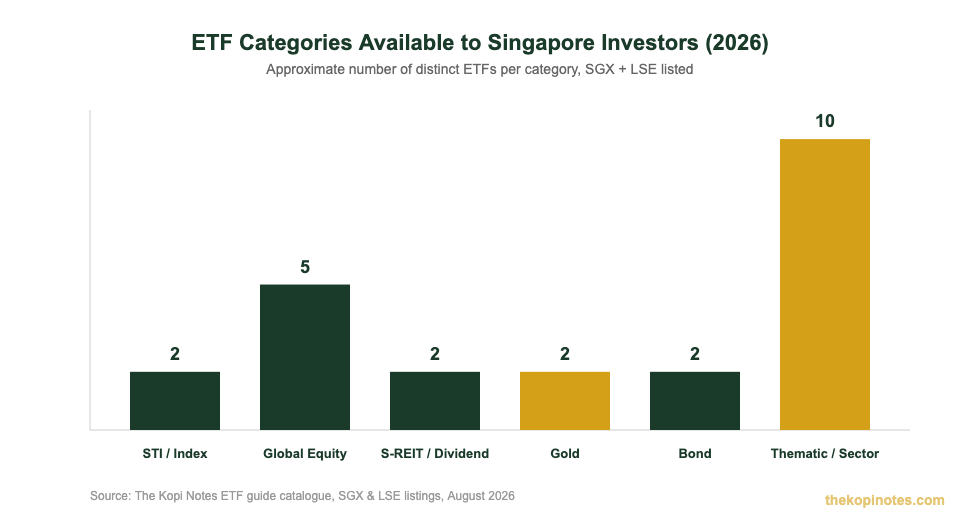
- Singapore investors can access around 15 SGX-listed ETFs (STI, REIT, gold, bond) plus dozens of UCITS ETFs on the London Stock Exchange (global equity, thematic).
- Only a handful of funds — mainly ES3, G3B, ABF Singapore Bond Index Fund, and a couple of gold and corporate bond ETFs — are CPFIS-approved. Most global and thematic ETFs are cash or SRS only.
- Pick your category by goal first (growth, income, diversification, or tactical tilt), then compare TER and exchange within that category.
What Counts as an ETF for Singapore Investors?
An ETF, or exchange-traded fund, is a basket of stocks, bonds, or commodities that trades on a stock exchange just like a single share. You buy ETFs for one simple reason: instant diversification without picking individual stocks yourself.
You have three main places to buy ETFs from Singapore. First, the Singapore Exchange (SGX) lists around 15 ETFs covering the Straits Times Index (STI), Singapore REITs, gold, and government bonds. Second, the London Stock Exchange (LSE) lists dozens of UCITS ETFs — Ireland-domiciled funds like CSPX and VWRA that track global and US markets. Third, US exchanges like NYSE and NASDAQ list thousands of ETFs, including familiar names like VOO and QQQ.
Here’s why that third option matters less than you’d think. US-listed ETFs charge non-resident investors a 30% withholding tax on dividends, and expose your estate to US estate tax above USD 60,000 if you pass away while holding them. LSE-listed UCITS ETFs cut that withholding tax to 15% and remove US estate tax exposure entirely, because they’re domiciled in Ireland instead. That’s why almost every serious guide for Singapore investors — including this one — points you toward SGX or LSE listings, not US ones.
For the full breakdown of why this matters and how much it can cost you, read our guide to why Singapore investors buy ETFs on the London Stock Exchange. This guide sorts every ETF category available to you in 2026 into one place: what it is, roughly what it costs, whether your CPF or SRS money can go into it, and where to read the full guide.
Why does a “list” article matter here? Most guides jump straight into “how to buy CSPX” without first mapping out what else exists. If you only read the CSPX guide, you might never realise a CPFIS-eligible bond ETF could round out your portfolio, or that a dedicated defence ETF exists for the geopolitics-driven part of your thesis. This page is the map, not the destination — use it to find the category you need, then click through to the deep-dive guide.
SGX-Listed ETFs: The Full List
If you want to invest using CPF or SRS funds, SGX-listed ETFs are your starting point. Trades settle in Singapore dollars, and most of the CPFIS-approved fund list sits on this exchange. As a Singapore investor with, say, SGD 20,000 in your CPF Ordinary Account, this is the shelf you’d shop from first.
The table below covers the main SGX ETF categories as at August 2026: STI index-tracking, S-REIT dividend, gold, and government bond funds.
| ETF | Category | TER (2026) | CPF / SRS | Full Guide |
|---|---|---|---|---|
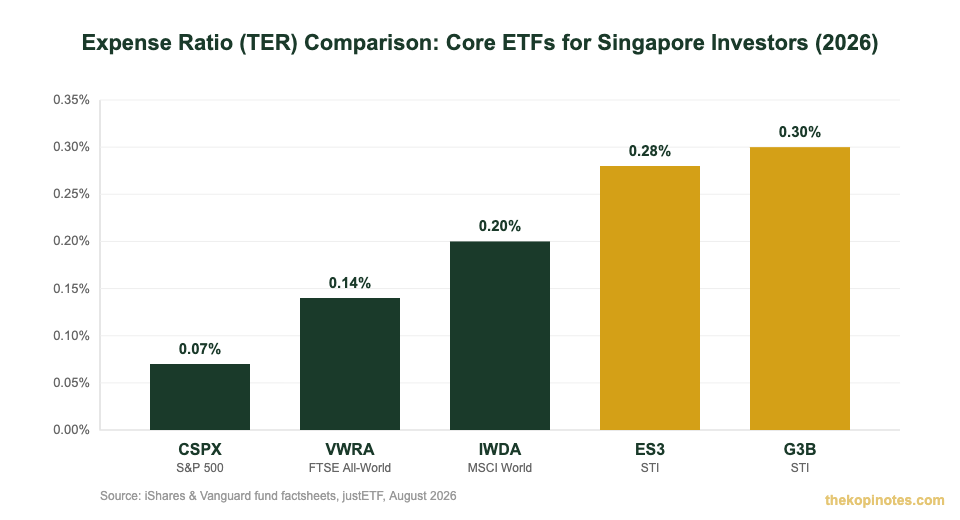
| Nikko AM STI ETF (G3B) | STI / Index | 0.30% p.a. | CPFIS-OA & SA | STI ETF Singapore guide |
| SPDR STI ETF (ES3) | STI / Index | 0.28% p.a. | CPFIS-OA & SA | ES3 vs G3B comparison |
| Lion-Phillip S-REIT ETF (CLR) | S-REIT / Dividend | 0.60% p.a. | SRS only | Singapore REIT ETF guide |
| LionGlobal Physical Gold ETF | Gold | 0.39% p.a. | Cash & SRS | LionGlobal Gold ETF guide |
| ABF Singapore Bond Index Fund (A35) | Bond | ~0.20% p.a. | CPFIS-OA & SA | CPF Board CPFIS list |
| Nikko AM SGD Investment Grade Corp Bond ETF (MBH) | Bond | See factsheet | CPFIS-OA | SGX ETF listing |
Source: SGX, Lion Global Investors & Amova AM (formerly Nikko AM) fund factsheets; CPF Board CPFIS product list, August 2026.
Here’s a worked example. Say you split SGD 30,000 of SRS money evenly between SPDR STI ETF and Lion-Phillip S-REIT ETF — SGD 15,000 each. At 0.28% and 0.60% TER respectively, you’d pay roughly SGD 42 and SGD 90 a year in fund fees, or about SGD 132 combined. That’s the cost of the diversification across index and REIT exposure, before brokerage commissions.
Notice something? Only two of these six are true CPFIS-OA-and-SA-eligible index funds — the STI pair. If you’re building a globally diversified portfolio with CPF money, SGX-listed options alone won’t get you there. That’s a real limitation, and one reason many investors pair CPF-held STI/bond ETFs with cash-funded global ETFs on the LSE.
LSE-Listed Global ETFs: The Full List
The London Stock Exchange is where you go for globally diversified, low-cost core holdings. These are UCITS ETFs — funds domiciled in Ireland and regulated under EU rules, which is exactly what gives them the lower 15% US withholding tax rate over 30% for US-domiciled funds.
Most of these are accumulating share classes, meaning dividends are reinvested automatically inside the fund instead of paid out to you. That matters for Singapore investors because reinvested dividends aren’t taxed here the way a cash payout might trigger reporting elsewhere. If you’re unsure which structure suits you, our guide to accumulating vs distributing ETFs breaks down the difference.
| ETF | Index Tracked | TER (2026) | Structure | Full Guide |
|---|---|---|---|---|
| CSPX | S&P 500 | 0.07% p.a. | Accumulating | How to buy CSPX in Singapore |
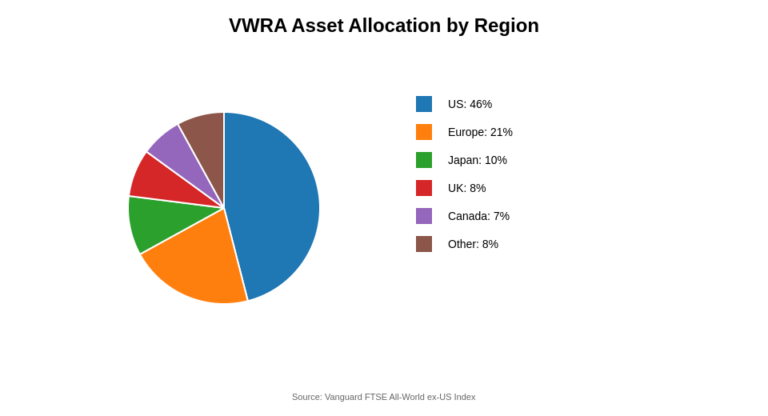
| VWRA | FTSE All-World | 0.14% p.a. | Accumulating | VWRA ETF Singapore guide |
| IWDA | MSCI World | 0.20% p.a. | Accumulating | IWDA ETF Singapore guide |
Source: iShares & Vanguard fund factsheets, justETF, August 2026.
Here’s the trade-off, though. CSPX’s razor-thin fee comes with 100% US large-cap exposure, while VWRA and IWDA spread your money across dozens of countries. A Singapore investor holding SGD 50,000 in VWRA at 0.14% TER pays roughly SGD 70 a year in fund fees — cheap for the diversification you get.
Thematic and Sector ETFs
Thematic ETFs let you tilt part of your portfolio toward a specific trend — AI, semiconductors, defence spending — without picking individual stocks. Think of these as the satellite around your core CSPX or VWRA holding, not a replacement for it. They carry higher TER and higher concentration risk, so most guides (including ours) suggest capping thematic exposure at 5–10% of your total portfolio.
Here’s the full list of thematic and sector categories we’ve covered, each with its own dedicated guide and comparison of the actual funds available:
| Theme | Why It’s Trending in 2026 | Full Guide |
|---|---|---|
| AI & Robotics | Continued AI capex and automation spending | AI-powered ETFs guide & Robotics ETF guide |
| Semiconductors | Chip demand from AI data centres | Semiconductor ETF guide |
| Healthcare & Biotech | Defensive earnings, aging demographics | Healthcare ETF guide |
| Cybersecurity | Rising enterprise security spend | Cybersecurity ETF guide |
| Bitcoin & Crypto | Spot crypto ETF approvals widening access | Bitcoin ETF guide |
| Defence | NATO and Asia-Pacific rearmament budgets | Defence ETF guide |
| Nuclear Energy | AI data-centre power demand reviving nuclear | Nuclear ETF guide |
| Clean Energy | Grid upgrades and renewables build-out | Clean Energy ETF guide |
| Covered Call (Income) | Investors chasing monthly income in a high-rate world | Covered Call ETF guide |
| Defensive / Low-Volatility | Rotation out of richly-valued growth stocks | Defensive ETF guide |
Source: The Kopi Notes ETF guide catalogue, fund provider factsheets, August 2026.
How to Choose the Right ETF Category
Don’t start by picking a ticker. Start by picking a goal, then narrow down to the category that fits it.
Retirement income first? Lean on CPFIS-eligible STI and bond ETFs alongside your existing CPF savings. Read our CPF investment strategy guide before committing OA or SA funds, and run your numbers through our retirement calculator to see if you’re on track.
Long-term growth first? CSPX, VWRA, or IWDA as your core — pick one, not all three, since they overlap heavily. VWRA gives you the broadest single-fund diversification.
Diversification or inflation hedge? A small gold ETF allocation, typically 5–10% of your portfolio, smooths out equity drawdowns without dragging down long-term returns too much.
Tactical tilt or higher risk tolerance? Thematic ETFs — AI, semiconductors, defence — as a satellite position, capped at 5–10% of your total portfolio so a sector downturn doesn’t sink your whole plan.
How to Buy Any ETF on This List
The mechanics are the same whether you’re buying ES3 on SGX or CSPX on the LSE — fund your account, search the ticker, select the right exchange, and place your order.
For SGX-listed ETFs (STI, S-REIT, gold, bond), most Singapore brokers work fine, including MooMoo, Tiger Brokers, and DBS Vickers. If you’re funding through CPF or SRS, check with your broker that the specific fund is CPFIS or SRS-approved before you transfer money in.
For LSE-listed ETFs (CSPX, VWRA, IWDA, and most thematic funds), you’ll need a broker with UK market access. Interactive Brokers (IBKR) is the most cost-effective for larger portfolios thanks to low FX spreads. Syfe and FSMOne are simpler starting points if you’re newer to investing and want a more guided interface, though check their fee schedules against your expected trade size first. See our full broker comparison for ETF investing for a side-by-side breakdown of fees.
Not financial advice. Every broker and fund carries fees, risks, and eligibility rules that can change — always check the current factsheet and your broker’s platform before you invest.
Frequently Asked Questions
How many ETFs can Singapore investors buy in 2026?
Around 15 ETFs are listed directly on SGX, covering STI, S-REIT, gold, and bond categories. Add in the London Stock Exchange’s UCITS ETFs — global equity and thematic funds like CSPX, VWRA, and dozens of sector funds — and Singapore investors realistically have well over 50 ETFs to choose from.
What is the difference between SGX-listed and LSE-listed ETFs?
SGX-listed ETFs trade in SGD, settle locally, and include the CPFIS-eligible funds. LSE-listed ETFs are UCITS funds domiciled in Ireland, giving Singapore investors a lower 15% US dividend withholding tax and no US estate tax exposure, but they’re generally not CPFIS-eligible and require a broker with UK market access.
Which ETFs are CPFIS-approved?
The core CPFIS-OA and SA-eligible ETFs are the two STI funds — SPDR STI ETF (ES3) and Nikko AM STI ETF (G3B) — plus the ABF Singapore Bond Index Fund and a small number of gold and corporate bond ETFs. Most global and thematic ETFs are not CPFIS-eligible. Always confirm current status on the CPF Board’s official list before transferring funds.
Can I buy US-listed ETFs like VOO or QQQ from Singapore?
Yes, technically, through brokers like IBKR or MooMoo. But most guides recommend against it: US-listed ETFs carry a 30% dividend withholding tax for non-residents and expose your estate to US estate tax above USD 60,000. The LSE-listed equivalents, like CSPX for VOO or similar S&P 500 exposure, avoid both issues.
What is the best ETF for a beginner investor in Singapore?
For most beginners, a single globally diversified fund like VWRA (FTSE All-World) or IWDA (MSCI World) as a core holding is simpler than juggling multiple funds. Add a CPFIS-eligible STI ETF if you want to also use CPF money, and skip thematic funds until you have a core position established.
Are thematic ETFs like AI or semiconductor funds a good addition to a core portfolio?
They can be, in moderation. Thematic ETFs concentrate your money in a single trend, which raises both potential upside and downside risk. Most Singapore investor guides suggest capping thematic exposure at 5–10% of your total portfolio, on top of a diversified core like VWRA or IWDA.
Do I need CPFIS to invest in ETFs at all?
No. CPFIS only matters if you want to use CPF Ordinary or Special Account savings to buy ETFs. Most Singapore investors fund their ETF purchases with cash or SRS instead, which opens up the full range of SGX and LSE-listed ETFs without CPFIS eligibility restrictions.
Ready to Start Investing in ETFs?
Pick your category, open a brokerage account, and buy your first ETF today. Use our referral links for exclusive sign-up bonuses.
This article was researched with the help of AI. While we strive to keep all information accurate and up to date, there may be errors. If you notice any discrepancies, please contact us.