Robotics ETF Singapore: RBOT vs IROB Compared (2026)
Two UCITS-listed robotics & automation ETFs you can actually buy from Singapore — fees, performance, holdings, and which one wins.
The two robotics ETFs Singapore investors can actually buy are RBOT (iShares Automation & Robotics UCITS ETF, 0.40% TER) and IROB (L&G ROBO Global Robotics and Automation UCITS ETF, 0.80% TER) — both listed on the London Stock Exchange and domiciled in Ireland, so neither exposes you to US estate tax. RBOT is cheaper and semiconductor-heavy; IROB is pricier but a purer robotics-and-automation play.
Not financial advice. All figures are for educational reference only. Data verified as at 1 August 2026 unless otherwise noted.
- RBOT (0.40% TER, US$4.4B fund) has returned +31.39% over the past year. It’s semiconductor-heavy (Intel, AMD, NVIDIA in the top 10).
- IROB (0.80% TER, US$1.5B fund) has returned +27.78% over the past year. It’s more diversified across pure robotics and automation names.
- Both are Ireland-domiciled UCITS funds on the LSE, so you avoid the US estate tax trap that hits US-listed robotics ETFs like BOTZ.
Table of Contents
Contents — Click to expand
- Why Robotics ETFs Are Having a Moment in 2026
- RBOT vs IROB: The Two UCITS Options You Can Buy
- Performance & Risk Compared
- Top Holdings & Country Exposure
- The TER Cost Drag: What 0.40% vs 0.80% Really Costs You
- Why LSE-Listed UCITS Beats US-Listed Robotics ETFs for SG Investors
- How to Buy RBOT or IROB From Singapore
- Risks to Weigh Before You Buy
- Our Verdict: Which One Should You Buy?
- Frequently Asked Questions
Why Robotics ETFs Are Having a Moment in 2026
Robotics and automation stocks have quietly outrun the broader market this year. Humanoid robots, warehouse automation, and AI-driven manufacturing are no longer sci-fi pitches — they’re showing up in earnings calls at Nvidia, Intel, FANUC, and Rockwell Automation.
That’s pulled robotics-themed ETFs sharply higher. RBOT is up +26.05% year-to-date. IROB is up +16.58%. Both numbers beat a plain MSCI World tracker over the same stretch.
Here’s why this matters for you. Robotics investing used to mean picking individual stocks in Japan, Germany, and the US — a research headache for most retail investors. A single UCITS ETF now gives you that whole basket in one trade, settled in USD or GBX on the London Stock Exchange.
But “robotics ETF” isn’t one product. There are exactly two UCITS-domiciled options that Singapore investors can realistically buy on the LSE today: RBOT and IROB. They track different indices, hold different stocks, and charge different fees. Below, we break down exactly how they differ.
RBOT vs IROB: The Two UCITS Options You Can Buy
RBOT (iShares Automation & Robotics UCITS ETF, ISIN IE00BYZK4552) tracks the iSTOXX® FactSet Automation & Robotics Index. It’s run by BlackRock, domiciled in Ireland, and structured as an accumulating share class — meaning dividends are reinvested automatically rather than paid out to you as cash.
IROB (L&G ROBO Global Robotics and Automation UCITS ETF, ISIN IE00BMW3QX54) tracks the ROBO-STOX® Global Robotics and Automation Index. It’s run by Legal & General, also Ireland-domiciled and accumulating.
The key difference isn’t just the fee. RBOT’s index leans heavily into semiconductor and chip-equipment names — think Intel, AMD, and Advantest — because it defines “automation” broadly to include the hardware that powers robots. IROB’s index is a purer play on companies whose core business is robotics and automation itself, spread across a smaller number of more specialised names.
| Fund | RBOT | IROB |
|---|---|---|
| Full name | iShares Automation & Robotics UCITS ETF | L&G ROBO Global Robotics and Automation UCITS ETF |
| ISIN | IE00BYZK4552 | IE00BMW3QX54 |
| LSE ticker (USD) | RBOT | ROBO |
| LSE ticker (GBX) | RBTX | ROBG |
| TER | 0.40% p.a. | 0.80% p.a. |
| Fund size (AUM) | €4,062m | €1,437m |
| Holdings | 133 | 78 |
| Replication | Physical (sampling) | Physical (full replication) |
| Distribution | Accumulating | Accumulating |
| Domicile / Inception | Ireland / 8 Sep 2016 | Ireland / 27 Oct 2014 |
Source: justETF, RBOT fund profile and justETF, IROB fund profile, data as at 30 June 2026.
Performance & Risk Compared
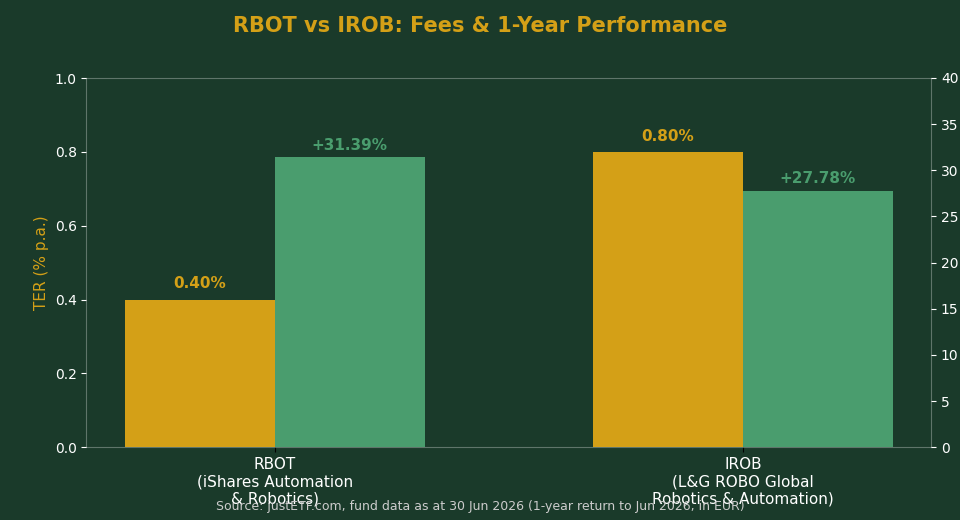
Here’s how the two funds have actually performed. RBOT’s cheaper fee and heavier semiconductor tilt have translated into stronger returns across every time frame shown below.
| Metric | RBOT | IROB |
|---|---|---|
| YTD 2026 | +26.05% | +16.58% |
| 1-year | +31.39% | +27.78% |
| 3-year (cumulative) | +60.68% | +32.10% |
| 5-year (cumulative) | +56.21% | +26.50% |
| 1-year volatility | 21.54% | 21.30% |
| Max drawdown (5-year) | -35.70% | -34.78% |
Source: justETF, returns in EUR, data as at 30 June 2026. Past performance does not predict future returns.
Notice something important here: both funds carry near-identical volatility (around 21%) and similar maximum drawdowns (around -35%). RBOT’s better returns haven’t come from taking on materially more risk — they’ve come from a fee that’s half the size and a bigger allocation to chipmakers that rallied hard through 2025 and 2026.
Top Holdings & Country Exposure
This is where the two funds really diverge. RBOT’s top 10 holdings make up 45.32% of the fund — a fairly concentrated bet. IROB’s top 10 make up just 20.36%, spread much more thinly across smaller robotics specialists.
| RBOT Top 5 | Weight | IROB Top 5 | Weight |
|---|---|---|---|
| Intel | 9.88% | Harmonic Drive Systems | 2.45% |
| AMD | 8.02% | Infineon Technologies | 2.24% |
| Advantest Corp | 5.28% | Ambarella | 2.18% |
| KLA Corp | 4.30% | HIWIN Technologies | 2.18% |
| Teradyne | 3.54% | Qualcomm | 1.96% |
Country exposure tells a similar story. RBOT is 55.76% US, 15.80% Japan, and 5.96% Switzerland. IROB is more globally spread: 35.84% US, 22.66% Japan, 9.24% Germany, and 6.96% Taiwan — picking up names like HIWIN and Yaskawa that RBOT doesn’t hold in size.
Source: justETF, holdings data as at 29 May 2026 (RBOT) and 26 May 2026 (IROB).
The TER Cost Drag: What 0.40% vs 0.80% Really Costs You
A 0.40 percentage point fee gap sounds tiny. Over decades, it isn’t. Here’s a worked example so you can see the real dollar impact.
Say you invest a US$10,000 lump sum today, then add US$500 every month for 20 years. Assume — purely for illustration — both funds grow at the same 8% gross annual return before fees.
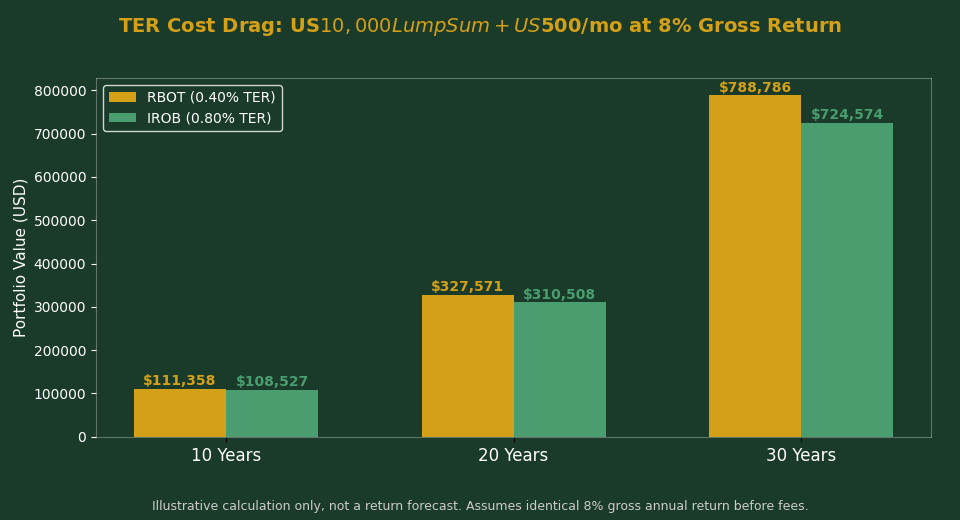
At 10 years, the gap is US$2,831. By 30 years, it widens to US$64,212 — purely from the extra 0.40% IROB charges every year, compounding against you the whole time.
That doesn’t automatically make RBOT the better fund. IROB’s more diversified, less semiconductor-concentrated portfolio might be exactly what you want if you’re worried about a chip-sector correction. But you should go in with your eyes open about what that diversification costs you in pure fee terms.
Why LSE-Listed UCITS Beats US-Listed Robotics ETFs for SG Investors
You’ve probably seen US-listed robotics ETFs mentioned online — names like BOTZ (Global X Robotics & Artificial Intelligence ETF) or the US-domiciled ROBO fund. Here’s why you should think twice before buying them directly on a US exchange.
US-domiciled securities count as “US-situs assets” for estate tax purposes. If you’re not a US citizen or resident — which covers almost every Singapore investor — the IRS only exempts the first US$60,000 of US-situs assets from estate tax. Everything above that is taxed at rates from 18% up to 40% on your death, payable before your family can inherit the assets.
RBOT and IROB sidestep this entirely. Both are domiciled in Ireland, not the US. Ireland has no equivalent estate tax treaty exposure for Singapore residents, so your holdings in either fund fall outside the US estate tax net — regardless of how large your position grows.
We’ve covered this in more depth in our US estate tax guide for Singapore investors, including how the same logic applies to any US-listed stock or ETF you hold directly.
Source: IRS: Estate Tax for Nonresidents not Citizens of the United States, accessed August 2026.
How to Buy RBOT or IROB From Singapore
Not every broker Singaporeans use gives you access to the London Stock Exchange. Among the platforms most SG investors already have accounts with, IBKR and Saxo are the two that let you trade LSE-listed UCITS ETFs like RBOT and IROB directly. moomoo, Syfe, and FSMOne focus mainly on SGX, US, and Hong Kong markets, and don’t currently offer LSE access.
Here’s the basic process once you’re set up on a broker with LSE access:
1. Fund your account in USD or GBP (avoid unnecessary FX conversion fees by holding the right currency).
2. Search for the ticker — “RBOT” for the USD line, or “RBTX” for the GBX-denominated line, on the London Stock Exchange.
3. Place a limit order rather than a market order — LSE-listed thematic ETFs can have wider spreads than large index trackers like VWRA or CSPX.
4. Hold in your brokerage account; both funds are accumulating, so you don’t need to manually reinvest dividends.
For a full breakdown of trading fees, FX spreads, and minimum funding across brokers, see our IBKR vs Saxo vs moomoo vs Syfe broker comparison. And if you’re new to LSE investing generally, our guide to why Singapore investors buy ETFs on the London Stock Exchange covers the mechanics in full.
Risks to Weigh Before You Buy
Robotics ETFs are not a substitute for a core global equity holding like VWRA or CSPX. Here’s what to watch for.
Concentration risk. RBOT’s top 10 holdings make up 45% of the fund, and three of those (Intel, AMD, NVIDIA) are cyclical semiconductor names that move with the broader chip cycle, not just robotics demand specifically.
Drawdown risk. Both funds have seen maximum 5-year drawdowns of around -35%. If you’d bought at the wrong point in 2022, you’d have watched more than a third of your investment disappear on paper before recovering.
Thematic concentration. Unlike a broad-market fund such as VWRA, these ETFs bet on one theme playing out. If robotics adoption stalls or capital rotates into a different theme, both funds could underperform the wider market for years.
Small relative size. IROB’s €1,437m AUM is respectable but far smaller than a mainstream fund like CSPX. Thinner liquidity can mean wider bid-ask spreads, especially outside London trading hours.
The bottom line: treat a robotics ETF as a satellite position, not your core holding. Most SG investors keep thematic ETFs like RBOT or IROB to 5–10% of their total equity allocation, with the bulk still in a broad global tracker.
Our Verdict: Which One Should You Buy?
Choose RBOT if you want the cheaper fee, don’t mind a heavier semiconductor tilt, and are comfortable that a big chunk of your “robotics” exposure is really a chip-sector bet dressed in a robotics label.
Choose IROB if you specifically want exposure to companies whose core business is robotics and automation hardware — not chipmakers — and you’re willing to pay double the fee for that purity.
Whichever you pick, keep it as a smaller satellite position alongside a core global tracker like our AI ETF Singapore guide covers, or a broad-market fund. Log your progress against your overall retirement plan using our Singapore retirement calculator, and if you’re setting up a new brokerage account to trade LSE ETFs, check our Syfe referral code and sign-up bonus for your cash-management sleeve alongside your LSE broker.
Frequently Asked Questions
What is the best robotics ETF for Singapore investors?
RBOT (iShares Automation & Robotics UCITS ETF) and IROB (L&G ROBO Global Robotics and Automation UCITS ETF) are the two UCITS-domiciled robotics ETFs accessible from Singapore via LSE brokers like IBKR and Saxo. RBOT charges a lower 0.40% TER and has delivered stronger recent returns; IROB charges 0.80% but offers purer, less semiconductor-concentrated robotics exposure.
Can I buy RBOT or IROB through moomoo or Syfe?
Not currently. moomoo, Syfe, and FSMOne focus on SGX, US, and Hong Kong-listed products and don’t offer direct London Stock Exchange access. You’ll need a broker with LSE access, such as IBKR or Saxo, to buy RBOT or IROB.
Does US estate tax apply to RBOT or IROB?
No. Both RBOT and IROB are domiciled in Ireland, not the US, so they are not US-situs assets. This means they fall outside the US estate tax exposure that applies to non-resident aliens holding US-listed securities, where only the first US$60,000 is exempt.
What's the difference between RBOT and IROB's holdings?
RBOT’s top 10 holdings (45.32% of the fund) lean heavily into semiconductor names like Intel, AMD, and Advantest. IROB’s top 10 (just 20.36% of the fund) are more spread out across specialist robotics and automation companies like Harmonic Drive Systems and HIWIN Technologies.
Are RBOT and IROB accumulating or distributing?
Both are accumulating share classes. Dividends from underlying holdings are reinvested automatically inside the fund rather than paid out to you in cash, which increases the fund’s share price over time instead of generating a distribution you’d need to manually reinvest.
How much of my portfolio should be in a robotics ETF?
Most Singapore investors treat thematic ETFs like RBOT or IROB as a satellite position — typically 5–10% of total equity allocation — rather than a core holding, given the higher concentration and volatility compared to a broad global tracker like VWRA or CSPX.
Is a robotics ETF riskier than a broad market ETF like VWRA?
Yes. Both RBOT and IROB have seen maximum 5-year drawdowns of around -35%, notably steeper than a globally diversified fund. Their returns are also more concentrated in specific sectors (technology and industrials), so they carry higher thematic and concentration risk than a broad-market ETF.
Ready to start investing?
Set up your LSE-capable brokerage account, then park your cash sleeve where it earns while you decide. TKN may earn a referral fee if you sign up through our links below — at no extra cost to you.
This article was researched with the help of AI. While we strive to keep all information accurate and up to date, there may be errors. If you notice any discrepancies, please contact us.