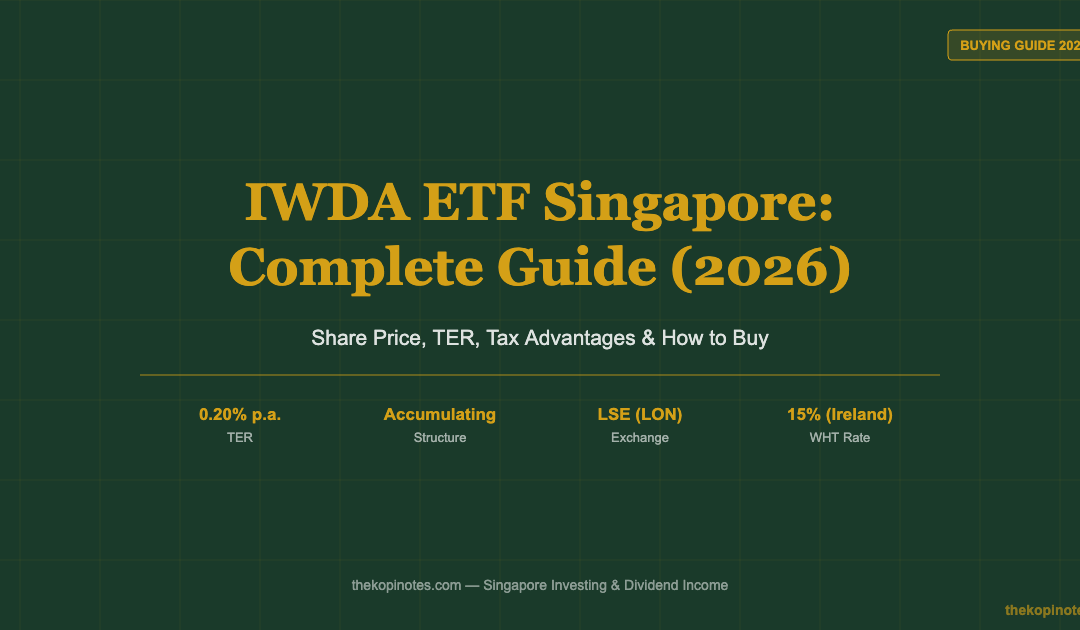
IWDA ETF Singapore: Complete Guide (2026)
Share price, TER, tax advantages and step-by-step buying guide for Singapore investors.
IWDA is the iShares Core MSCI World UCITS ETF, listed on the London Stock Exchange (LSE) under ticker IWDA. It tracks the MSCI World Index — around 1,400 large- and mid-cap stocks across 23 developed markets. Singapore investors favour it over US-domiciled alternatives like VT or URTH because it is Ireland-domiciled, attracting only 15% withholding tax on US dividends versus 30%, and carries zero US estate tax exposure.
Not financial advice. All figures are for educational reference only. Data as at June 2026 unless noted.
What Is IWDA?
IWDA — the iShares Core MSCI World UCITS ETF — is one of the most widely held passive index funds among retail investors globally, and particularly popular with Singapore investors seeking broad developed-market exposure at low cost.
The fund tracks the MSCI World Index, which covers approximately 1,400 large- and mid-cap equities across 23 developed-market countries including the US (~70%), Japan (~6%), UK (~4%), France (~3%), and others. It does not include emerging markets — that is the key distinction from a global all-world fund like VWRA.
IWDA is Ireland-domiciled, structured as a UCITS ETF, and listed on the London Stock Exchange. It is an accumulating fund — dividends received from underlying holdings are automatically reinvested rather than paid out. For Singapore investors who do not need immediate income, this is advantageous as there is no dividend to withhold Singapore-side, and compound growth is not interrupted by distribution cycles.
BlackRock (iShares) launched IWDA in 2009. As at Q1 2026, it manages approximately USD 80 billion in AUM, making it one of the largest UCITS ETFs in the world. Its scale translates to tight bid-ask spreads and high daily liquidity on the LSE — typically trading millions of USD in volume per day.
Key Facts at a Glance
| Metric | Detail |
|---|---|
| Full Name | iShares Core MSCI World UCITS ETF |
| Ticker (LSE) | IWDA (USD-denominated) / IWDG (GBP-hedged) |
| Index Tracked | MSCI World Index (~1,400 stocks, 23 developed markets) |
| Domicile | Ireland (UCITS) |
| Structure | Accumulating (dividends reinvested) |
| TER (Expense Ratio) | 0.20% p.a. |
| AUM | ~USD 80 billion (as at Q1 2026) |
| Number of Holdings | ~1,400 |
| Currency | USD (traded in USD on LSE) |
| Exchange | London Stock Exchange (LON) |
| Launch Date | September 2009 |
Source: iShares IWDA fund factsheet, Q1 2026
IWDA Share Price: What Drives It
The IWDA share price (also called its NAV or net asset value per unit) moves in line with the collective performance of the ~1,400 companies in the MSCI World Index. As at June 2026, IWDA trades at approximately USD 98–105 per unit on the LSE, depending on market conditions — though the exact price changes every trading day.
Because IWDA is accumulating, there are no dividend distributions that reduce the share price on ex-dividend dates. Instead, the value of dividends received from underlying holdings is rolled back into the fund’s NAV, contributing to share price appreciation over time. This is an important distinction for Singapore investors accustomed to REITs or distributing ETFs: IWDA’s “return” shows up entirely in price growth, not distributions.
Key factors that move the IWDA share price:
The biggest driver is US equity performance — because the US accounts for roughly 70% of the MSCI World Index, moves in the S&P 500 and Nasdaq broadly translate into IWDA price moves. Other drivers include JPY/USD fluctuations (affecting the Japan allocation), GBP/USD rates (the UK and European components), and risk-off sentiment that affects developed-market equities broadly.
For Singapore investors, there is an additional layer: IWDA trades in USD on the LSE. You will need SGD converted to USD at your broker’s exchange rate, which adds a small FX cost (typically 0.1–0.5% depending on the broker). Interactive Brokers charges among the lowest FX spreads (~0.1%), while bank-linked brokers can charge 0.5–1.0% or more. Over a 20-year accumulating period, this FX cost difference is worth paying attention to.
Why Singapore Investors Buy ETFs on the London Stock Exchange
The core reason is tax efficiency. When a Singapore investor buys a US-domiciled ETF like VT (Vanguard Total World) or URTH (iShares MSCI World, US version) via the NYSE, they face two major structural tax disadvantages that do not apply when buying Ireland-domiciled equivalents like IWDA on the LSE.
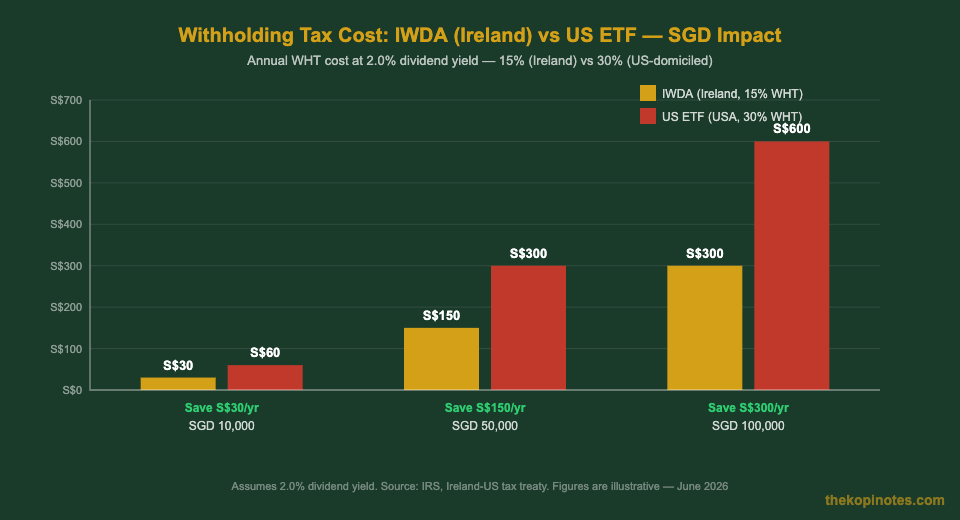
1. Withholding Tax (WHT) on US dividends: US companies pay dividends to ETF funds, which are then credited to unit holders. For US-domiciled ETFs, the IRS withholds 30% of these US-source dividends before they reach the fund. For Ireland-domiciled funds, the Ireland–US tax treaty reduces this to 15%. Over a long holding period, this 15% differential compounds meaningfully.
2. US Estate Tax: Non-US residents holding more than USD 60,000 in US-sited assets (which includes NYSE-listed US ETFs) are potentially subject to US estate tax of 18–40% on the value above the threshold upon death. Ireland-domiciled UCITS ETFs like IWDA are NOT considered US-sited assets, so this risk does not apply — an important structural advantage for Singapore investors with growing portfolios.
| ETF | Domicile | US Dividend WHT | US Estate Tax Risk |
|---|---|---|---|
| IWDA (LSE) | Ireland | 15% | None |
| URTH / VT (NYSE) | USA | 30% | Yes (above USD 60k) |
| MSCI World SGX ETF | Varies | Varies | Depends on domicile |
Source: IRS Publication 515; Ireland–US Double Taxation Convention; as at June 2026
Expense Ratio and Total Costs
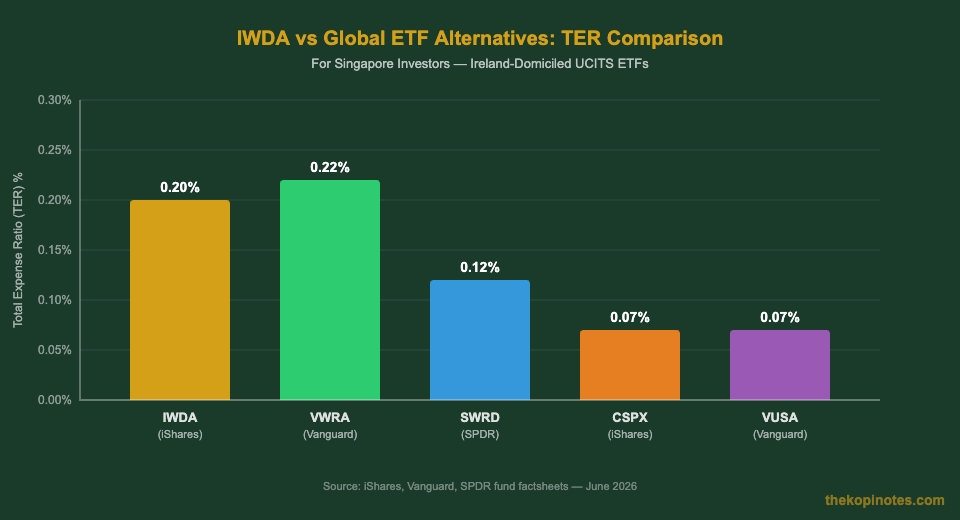
IWDA’s Total Expense Ratio (TER) is 0.20% per annum. This is charged daily as a fraction of the fund’s NAV — there is no separate invoice; it simply reduces the fund’s gross return before the NAV is calculated.
For a Singapore investor holding SGD 50,000 (approximately USD 37,000 at 1.35 SGD/USD) in IWDA, the annual management cost is approximately SGD 100 per year (0.20% × SGD 50,000). On a SGD 200,000 portfolio, that is SGD 400 per year — comparable to a single IBKR monthly inactivity fee (which is waived for active traders).
IWDA’s TER of 0.20% is higher than some US-domiciled global ETFs (for example, Vanguard’s VT charges 0.07%), but this comparison is misleading without accounting for WHT. A Singapore investor in IWDA pays 15% WHT on the US-source portion of MSCI World dividends, versus 30% for a US-domiciled equivalent. At a ~1.5% US dividend yield, this saves approximately 0.225% in annual WHT drag — more than offsetting the TER difference.
Total effective cost for a Singapore investor in IWDA (TER + adjusted WHT) is typically lower than equivalent US-domiciled options, making it the more cost-efficient choice despite the higher stated TER.
How to Buy IWDA in Singapore (Step-by-Step)
IWDA can be purchased through any broker that provides access to the London Stock Exchange. Below is a step-by-step guide for the four main platforms used by Singapore investors.
Option 1: Interactive Brokers (IBKR) — Best for low-cost investors
IBKR is widely regarded as the most cost-efficient platform for buying LSE-listed ETFs in Singapore. Steps: (1) Open and fund a USD account at IBKR Singapore; (2) Search for “IWDA” in the trading platform or TWS; (3) Select the LSE exchange listing; (4) Place a limit order in USD. IBKR charges USD 1.00–1.50 per trade for LSE securities with no custody fee, and the FX conversion from SGD to USD costs approximately 0.1%. For portfolio sizes above SGD 30,000, IBKR typically offers the lowest total cost. You can also use the Syfe referral code if you prefer a robo-advisory wrapper with IBKR custody behind it.
Option 2: Saxo Markets Singapore
Saxo provides a clean web and mobile interface for LSE ETFs. Commission is USD 5–8 per trade with a minimum platform fee of SGD 6.50 per month for the Classic account. More suitable for investors who prefer a local, MAS-regulated broker with a Singapore dollar account. Search “IWDA” and select the “LSE/USD” exchange when placing the order.
Option 3: MooMoo Singapore
MooMoo (Futu Holdings) supports LSE ETF trading and is popular for its real-time data and clean UI. Commission is typically USD 2.99 per trade for LSE securities. Open an account, complete the SRS or cash funding, search “IWDA” in the market selector under “London,” and place your order. For cash accounts, you can fund in SGD and convert to USD within the app. Read the moomoo Singapore review for full details on fees and account setup.
Option 4: Syfe Brokerage
Syfe Brokerage allows direct ETF purchases (not just managed portfolios). IWDA is available on LSE. Syfe’s strength is its simplicity — ideal for first-time ETF investors. Commission is 0.08% per trade (minimum USD 1.99). Visit the Syfe referral code page to get the latest sign-up bonus before opening an account.
Note on CPF and SRS: IWDA is not eligible for CPF Investment Scheme (CPFIS) — it is not listed on SGX. However, it may be purchased using your Supplementary Retirement Scheme (SRS) funds through eligible SRS operators (DBS, OCBC, UOB) connected to your broker. Check with your SRS operator before transacting. For CPF-eligible alternatives, see the CPF investment strategy Singapore guide.
IWDA vs VWRA: Key Differences
The most common question from Singapore investors choosing a core global equity ETF is: IWDA or VWRA? Both are Ireland-domiciled, accumulating, LSE-listed UCITS ETFs with similar tax profiles. The critical difference is the universe of markets covered.
IWDA tracks the MSCI World Index — developed markets only (~1,400 stocks, 23 countries). VWRA tracks the FTSE All-World Index — developed and emerging markets (~3,600 stocks, 47 countries). The emerging market component in VWRA adds China (~4%), India (~2%), Taiwan (~2%), South Korea (~1%), and Brazil (~1%) — together around 10–12% of the fund.
| Feature | IWDA (iShares) | VWRA (Vanguard) |
|---|---|---|
| Index | MSCI World | FTSE All-World |
| Markets | Developed only (23) | Dev + Emerging (47) |
| Holdings | ~1,400 | ~3,600 |
| TER | 0.20% p.a. | 0.22% p.a. |
| AUM | ~USD 80 billion | ~USD 20 billion |
| Domicile | Ireland | Ireland |
| Structure | Accumulating | Accumulating |
| Exchange | LSE (LON) | LSE (LON) |
| Best For | Developed-market focus, lower EM risk | True global diversification inc. EM |
Source: iShares, Vanguard fund factsheets — Q1 2026
In terms of long-run returns, VWRA has slightly underperformed IWDA over the past decade — primarily because developed-market equities (especially US tech) have significantly outperformed emerging markets since 2010. Whether this persists is unknown, but investors who want EM exposure (China, India, SE Asia) should choose VWRA, while those preferring pure developed-market efficiency may prefer IWDA.
Both are excellent choices for a Singapore investor’s core equity holding. If you’re building a long-term retirement portfolio, you can use the Singapore retirement calculator to model how either fund might grow alongside your CPF and other assets.
Who Should Buy IWDA?
IWDA is ideal for Singapore investors who: want broad exposure to 23 developed economies in a single fund; prefer the simplicity of an accumulating ETF without dividend distributions to reinvest manually; want a well-established, highly liquid fund with tight spreads; value the structural tax advantages of an Ireland-domiciled UCITS over US-listed alternatives; and are comfortable holding USD-denominated assets on the LSE.
It is particularly well-suited to passive income Singapore strategies where the accumulating structure compounds returns without the friction of reinvesting distributions — especially effective inside an SRS account where deferred tax applies to withdrawals.
Consider alternatives if: you want emerging market exposure (choose VWRA instead); you need a CPF-investable ETF (look at SGX-listed options via CPFIS); you specifically want US market exposure at the lowest TER (CSPX at 0.07% p.a. is more cost-effective for US-only exposure); or you’re planning for income in retirement and need regular dividend payments (consider distributing ETFs like VWRD or VHYL).
For those building a diversified portfolio that balances ETFs with Singapore-listed income assets, pairing IWDA with best S-REITs in Singapore 2026 offers both global growth and local income — a popular hybrid approach among Singaporean retail investors.
Disclaimer: This article is for educational purposes only and does not constitute financial advice. All data cited is as at June 2026 and subject to change. Always conduct your own research or consult a licensed financial adviser before investing.
Frequently Asked Questions
What is IWDA and why do Singapore investors buy it?
IWDA (iShares Core MSCI World UCITS ETF) is an Ireland-domiciled, accumulating ETF listed on the London Stock Exchange that tracks the MSCI World Index — covering ~1,400 large- and mid-cap stocks across 23 developed markets. Singapore investors buy it primarily for its tax efficiency: as an Ireland-domiciled fund, it attracts only 15% withholding tax on US-source dividends (versus 30% for US-domiciled alternatives) and carries no US estate tax exposure.
What is the IWDA share price today?
The IWDA share price changes daily based on the performance of the MSCI World Index. As at June 2026, IWDA trades at approximately USD 98–105 per unit on the LSE, though the exact price updates throughout each trading day. You can check the live IWDA share price on your broker platform (IBKR, MooMoo, Saxo) or on Bloomberg or Yahoo Finance by searching “IWDA:LN”.
Is IWDA better than VWRA for Singapore investors?
IWDA and VWRA are both excellent choices, and the decision comes down to one question: do you want emerging market exposure? IWDA covers only developed markets (23 countries); VWRA adds emerging markets including China, India, and Taiwan (~10–12% of the fund). Both are Ireland-domiciled with identical tax profiles. VWRA’s TER is marginally higher at 0.22% vs IWDA’s 0.20%. Over the past decade, IWDA outperformed VWRA because US tech drove developed-market returns. Future performance depends on whether emerging markets recover relative to developed markets.
Can I buy IWDA using CPF or SRS?
IWDA is not eligible for the CPF Investment Scheme (CPFIS) as it is not listed on SGX. However, it may be purchased using Supplementary Retirement Scheme (SRS) funds through eligible SRS operators (DBS, OCBC, or UOB) connected to an SRS-enabled brokerage account. Check with your SRS provider before transacting, as eligibility rules can change. For CPF-investable alternatives, the CPFIS-approved ETFs guide covers all eligible options.
Which broker is best for buying IWDA in Singapore?
For cost-conscious investors, Interactive Brokers (IBKR) is generally the best option — it charges USD 1.00–1.50 per LSE trade with a very tight FX spread (~0.1%), making it the most economical for larger portfolios. MooMoo Singapore charges USD 2.99 per trade and offers a clean interface, making it better for beginners. Saxo is suitable for those who prefer a locally-regulated broker. Syfe Brokerage charges 0.08% per trade (min USD 1.99) and is simplest for first-time investors — use the Syfe referral code for a sign-up bonus.
Does IWDA pay dividends?
No — IWDA is an accumulating ETF, meaning dividends received from its underlying ~1,400 holdings are automatically reinvested into the fund rather than paid out to investors. This means the IWDA share price grows to reflect reinvested dividends over time, but you will not see a cash distribution in your brokerage account. If you need regular income, consider the distributing equivalent IWDG or a different fund such as VWRD (Vanguard FTSE All-World Distributing ETF).
Is IWDA safe? What are the main risks?
IWDA is considered one of the safest equity ETF structures available — it holds physical shares of ~1,400 companies across 23 countries, is managed by BlackRock (the world’s largest asset manager), and is regulated as a UCITS fund under EU law, providing strong investor protections. Key risks include: broad developed-market equity risk (all stocks can fall during recessions or bear markets), currency risk (IWDA is USD-denominated; a stronger SGD reduces returns in SGD terms), and the fact that ~70% concentration in US equities means it is highly correlated with US market performance. IWDA does not provide emerging market diversification — VWRA does.
Ready to Start Investing in IWDA?
Open a brokerage account today and use our referral links for exclusive sign-up bonuses.
This article was researched with the help of AI. While we strive to keep all information accurate and up to date, there may be errors. If you notice any discrepancies, please contact us.