Singapore Stocks Hit Record High 2026: Your STI ETF Guide
Updated July 2026 • 8 min read • By The Kopi Notes Team
Singapore stocks have surged to record highs in 2026, with the Straits Times Index (STI) climbing on the back of robust bank earnings, recovering S-REITs, and renewed foreign investor interest in Southeast Asian markets. For Singaporean investors, the simplest way to capture this rally is through STI ETFs — index funds listed on SGX that track all 30 blue-chip components for as low as 0.28% per year in fees, with dividend yields around 3.5%.
Not financial advice. All figures are for educational reference only. Data as at July 2026 unless noted.
- Singapore stocks hit record levels in 2026, driven by strong bank earnings, REIT recovery, and ASEAN capital inflows
- Two low-cost STI ETFs let you own all 30 blue chips: SPDR STI ETF (ES3) and Nikko AM/Amova (G3B) — at 0.28% and 0.30% TER respectively
- Both are CPF OA and SRS eligible; dollar-cost averaging beats trying to time the market top
Why Singapore Stocks Are at Record Highs in 2026
The STI’s strong run in 2026 is not one single event — it’s the result of several macro forces lining up at once.
Banks are earnings machines. DBS, OCBC, and UOB together make up roughly 40% of the STI. All three delivered strong Q1 2026 results, with net interest income holding up even as global rate-cut expectations grew. DBS in particular posted record net profits and raised its dividend — sending the index higher.
S-REITs staged a comeback. After two years of interest-rate-driven pain, Singapore REITs bounced back sharply in late 2025 and 2026. As rate-cut expectations firmed, REIT valuations re-rated upward. Since S-REITs make up a meaningful slice of the index (through constituents like CapitaLand Integrated Commercial Trust), this lifted the STI alongside banks.
Foreign capital rotated into ASEAN. Uncertainty around US tech valuations and a softening dollar prompted global funds to rotate into Southeast Asian equities. Singapore’s reputation as a stable, liquid market made it a natural beneficiary. Foreign institutional buying added fuel to the rally.
Dividend yield remains attractive. With the STI offering a gross dividend yield of around 3.5–4%, it compares favourably to Singapore T-bills, which have seen yields drop from their 2023 highs. Income-seeking investors found Singapore blue chips genuinely competitive with fixed income.
All four of these forces reinforced each other. When banks do well and REITs recover and foreign capital flows in, you get a compounding rally — which is what 2026 delivered.
What Is the STI? A Quick Explainer
The Straits Times Index (STI) is Singapore’s benchmark equity index. It tracks the 30 largest and most liquid companies listed on SGX by market capitalisation. Think of it as Singapore’s version of the Dow Jones — a headline number that tells you how the biggest local businesses are doing.
The index is reviewed quarterly and managed by FTSE Russell in partnership with SGX. Companies can enter or exit based on market cap, liquidity, and other criteria.
Here’s a snapshot of the top five STI components as at Q2 2026:
| Company | Sector | Approx. Weight |
|---|---|---|
| DBS Group Holdings | Banking | ~19% |
| OCBC Bank | Banking | ~14% |
| UOB | Banking | ~11% |
| Singtel | Telecoms | ~5% |
| CapitaLand Integrated Commercial Trust | S-REIT | ~4% |
Source: SGX, FTSE Russell. Q2 2026 approximate weightings. Subject to quarterly rebalancing.
Notice how banks alone make up nearly 44% of the index. This is both a strength (banks are profitable and dividend-paying) and a risk (concentrated sector exposure). When bank stocks fall, the STI falls hard.
STI ETF Singapore 2026: Your Two Options
You can’t buy the STI directly — it’s just an index number. But you can buy an ETF that replicates it. In Singapore, there are two STI ETFs listed on SGX:
1. Nikko AM Singapore STI ETF (Ticker: ES3) — managed by Nikko Asset Management, this is the more liquid of the two and has a lower unit price, making it easier to build a position in smaller increments.
2. SPDR Straits Times Index ETF (Ticker: G3B) — managed by State Street Global Advisors (the same firm behind SPDR Gold ETF), this ETF has a higher unit price per share but similar fundamentals.
Both ETFs are almost identical in what they hold (all 30 STI components, market-cap weighted) and charge very similar Total Expense Ratios — ES3 at 0.28% and G3B at 0.30% per year. The choice between them often comes down to your preferred broker and which one offers lower commission on your platform.
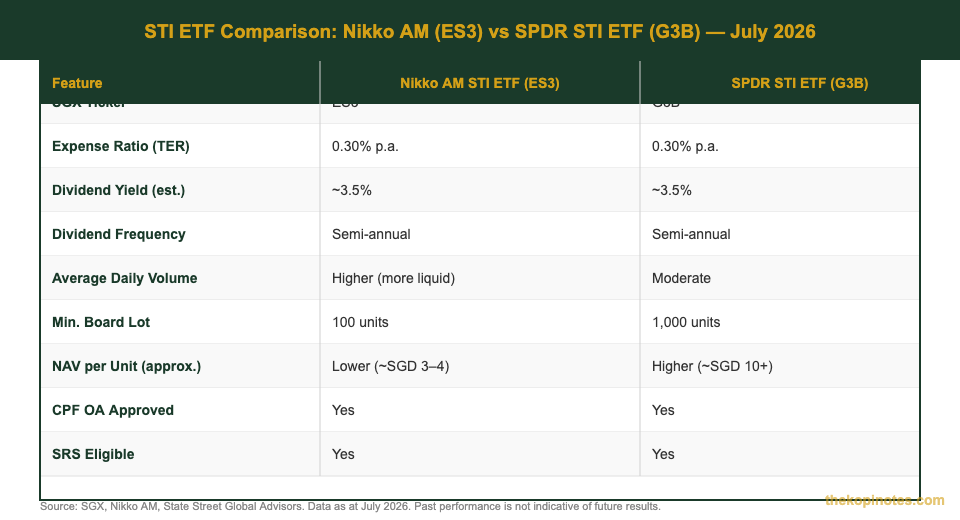
Both ETFs qualify for CPF Ordinary Account (OA) investment under the CPF Investment Scheme (CPFIS) and for Supplementary Retirement Scheme (SRS) contributions. This makes them powerful long-term retirement vehicles — you’re essentially using tax-advantaged money to buy Singapore’s 30 biggest companies.
If you invest via Syfe referral code and sign-up bonus or FSMOne referral code, you can access both ETFs with competitive brokerage commissions. FSMOne in particular is popular for STI ETF due to its Regular Savings Plan (RSP) feature — you can set up automatic monthly purchases for as little as SGD 50.
STI Performance: What the Data Shows
The chart below shows the approximate annual total return of the STI (price appreciation plus dividends reinvested) from 2020 to 2026 YTD. Total return matters because the STI’s dividend yield is a significant chunk of investor returns.
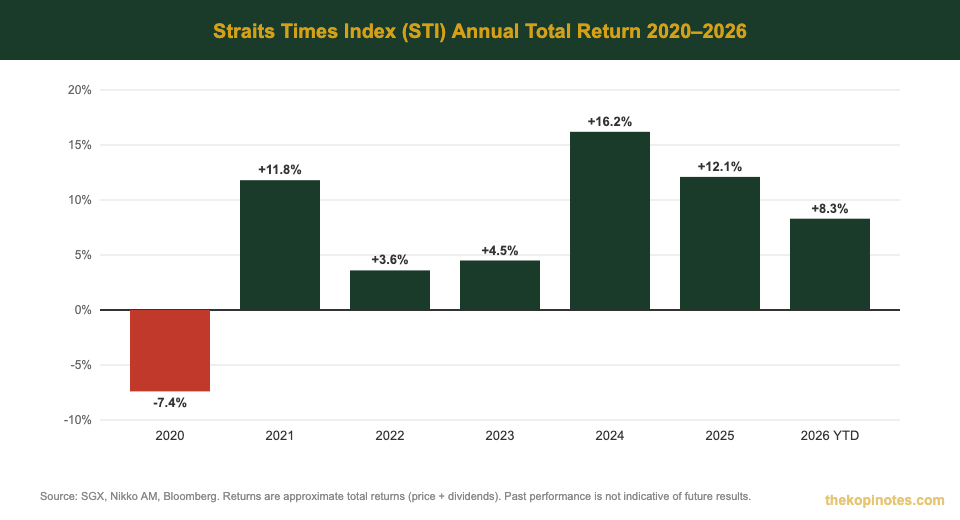
A few observations from this data:
2020 was the pandemic dip. The STI fell in price terms as COVID-19 hit Singapore hard. However, dividends partially cushioned the blow for long-term holders.
2021 was a partial recovery. Banks reopened their dividend taps after the MAS-imposed cap was lifted. But the recovery was modest compared to global markets.
2022–2023 held steady. While global markets were volatile (US stocks fell sharply in 2022), the STI was relatively resilient. Singapore’s banking-heavy index actually benefited from rising interest rates.
2024–2026: The big run. Rate-cut expectations, REIT recovery, and strong bank dividends drove the STI to record levels. YTD 2026 returns have been especially strong.
| Metric | STI ETF (ES3) | Context |
|---|---|---|
| 10-Year Annualised Total Return | ~7–8% p.a. | Historical estimate incl. dividends |
| Dividend Yield (2026 est.) | ~3.5% | Paid semi-annually |
| Expense Ratio (TER) | 0.30% p.a. | Deducted from NAV daily |
| Number of Holdings | 30 stocks | Full STI replication |
| CPF OA / SRS Eligible | Yes / Yes | Tax-advantaged account use |
Source: Nikko AM, SGX. Data as at July 2026. Past performance is not indicative of future results.
How to Buy STI ETF in Singapore (Step-by-Step)
Buying an STI ETF is simpler than buying individual stocks. Here’s exactly how to do it:
Step 1: Open a brokerage account. You need a CDP-linked brokerage or a custodian brokerage. Options include IBKR (low commissions), moomoo Singapore, Syfe Brokerage, or FSMOne. If you want a Regular Savings Plan (RSP) to invest automatically each month, FSMOne is one of the best options.
Step 2: Fund your account in SGD. Transfer SGD from your bank account. ES3 and G3B are both SGD-denominated, so there’s no currency conversion needed.
Step 3: Search for the ticker. On your brokerage platform, search for “ES3” (Nikko AM) or “G3B” (SPDR). Both trade on the SGX Mainboard.
Step 4: Place your order. You can buy at market price or place a limit order at your target price. For ES3, the minimum board lot is 100 units — check the current price to estimate your total outlay.
Step 5: Monitor dividends. Both ETFs pay out dividends twice a year. Dividends are deposited directly to your brokerage cash account or CDP account.
Using CPF OA to buy STI ETF: You can invest your CPF Ordinary Account savings into ES3 or G3B via the CPFIS scheme. Open a CPFIS investment account with DBS, OCBC, or UOB, then instruct them to buy the ETF. Note: you need at least SGD 20,000 remaining in your OA after the investment. For more on using CPF for investing, see our guide on CPF investment strategy.
Using SRS to buy STI ETF: Open an SRS account with DBS, OCBC, or UOB. Contribute up to SGD 15,300 per year (for Singaporeans/PRs). Then invest via the bank’s brokerage arm or through Endowus referral code for managed SRS fund options.
Risks to Watch in 2H 2026
Record highs feel exciting, but go in with clear eyes about the risks.
Interest rate risk. The STI’s banks thrived in a high-rate environment. If the US Fed cuts rates faster than expected, bank net interest margins (NIMs) will compress. Lower NIMs mean lower profits — and potential pressure on bank stocks, which drag the STI down.
S-REIT fragility. The REIT recovery assumes rates continue to fall. Any surprise inflation data that delays cuts could reverse REIT gains quickly.
Bank-heavy concentration. With ~44% in banks, the STI behaves more like a banking index than a broad market index. If you already hold DBS or UOB shares directly, buying ES3 adds more bank exposure — not true diversification.
Regional geopolitical risk. Singapore’s economy is highly connected to global trade flows. A US-China escalation or major trade disruption could hurt Singapore’s financial hub status and export-oriented STI companies.
The bottom line: the STI is a solid, dividend-paying index with a long track record. But “record high” doesn’t mean “risk-free.” For broader income diversification, read our Singapore REIT ETF guide alongside this article.
Should You Buy STI ETF Now or Wait?
This is the question everyone asks at a market high. The honest answer: nobody knows when the top is.
Here’s what the data says: markets make new record highs regularly during bull markets. Buying at record highs has not historically been worse than buying at random times — because if you wait for a dip that doesn’t come, you miss months of dividends and gains.
If you’re investing a lump sum and the timing feels uncomfortable, dollar-cost averaging (DCA) is your friend. Put in SGD 1,000 per month for 10 months instead of SGD 10,000 today. You’ll buy some units at higher prices and some at lower — smoothing your average cost over time.
Our Singapore retirement calculator can help you model how different STI ETF investment amounts affect your retirement projections. Use it before committing a large sum.
- Always have 3–6 months of expenses in cash before investing
- Never invest money you need in the next 3 years in equities
- Use DCA if you’re uncertain about timing
- Compare STI ETF vs best S-REITs in Singapore 2026 for your income goals
Frequently Asked Questions
Is it a good time to invest in Singapore stocks at a record high?
Record highs don’t necessarily mean you should wait. Historically, buying at market highs has performed comparably to buying at random times, because markets often continue making new highs during bull runs. The key risk is short-term volatility — if you need the money in 1–2 years, wait. If you’re investing for 10+ years, the current level matters less than your consistency. Dollar-cost averaging (DCA) is the recommended approach for lump-sum investors uncomfortable with current prices.
Which is better: SPDR STI ETF (ES3) or Nikko AM/Amova STI ETF (G3B)?
Both ETFs track the exact same index with similar TERs (ES3 at 0.28%, G3B at 0.30%). The practical differences are minor: ES3 has a lower unit price and higher average daily trading volume, making it slightly easier to buy in smaller amounts. G3B is backed by State Street, one of the world’s largest ETF managers. For most retail investors, ES3 is the default choice due to better liquidity. Check your broker’s commission structure — some charge a minimum fee per trade.
Can I use my CPF OA to buy STI ETF?
Yes. Both SPDR STI ETF (ES3) and Nikko AM/Amova STI ETF (G3B) are approved under the CPF Investment Scheme (CPFIS-OA). To invest, you need: (1) a CPFIS investment account with DBS, OCBC, or UOB, (2) at least SGD 20,000 remaining in your OA after the investment. Note that CPF OA earns a guaranteed 2.5% p.a. — only invest CPF funds if you believe the STI will outperform this over your time horizon.
What is the dividend yield of STI ETF in 2026?
The STI ETF dividend yield in 2026 is estimated at approximately 3.5% per year, though this varies with index performance and underlying company payouts. Dividends are paid semi-annually. The actual amount depends on how much DBS, OCBC, UOB, and other index constituents pay out. Note that dividends from Singapore-listed ETFs are not subject to withholding tax for Singapore residents — a key advantage over US-listed ETFs.
How do I start investing in Singapore stocks as a beginner?
Start with an STI ETF rather than picking individual stocks. Simple beginner path: (1) Open a brokerage account — moomoo, Syfe Brokerage, or FSMOne are beginner-friendly; (2) Start with SGD 500–1,000 in ES3 to learn how ETF investing works; (3) Set up a Regular Savings Plan (RSP) via FSMOne to invest automatically each month; (4) As your confidence grows, explore passive income Singapore strategies for income diversification. The most important thing is to start consistently.
This article was researched with the help of AI. While we strive to keep all information accurate and up to date, there may be errors. If you notice any discrepancies, please contact us.