ETF Singapore: Complete Guide to Investing in ETFs (2026)
Best ETFs for Singapore investors — index funds, S-REIT ETFs, tax advantages, and step-by-step buying guide.
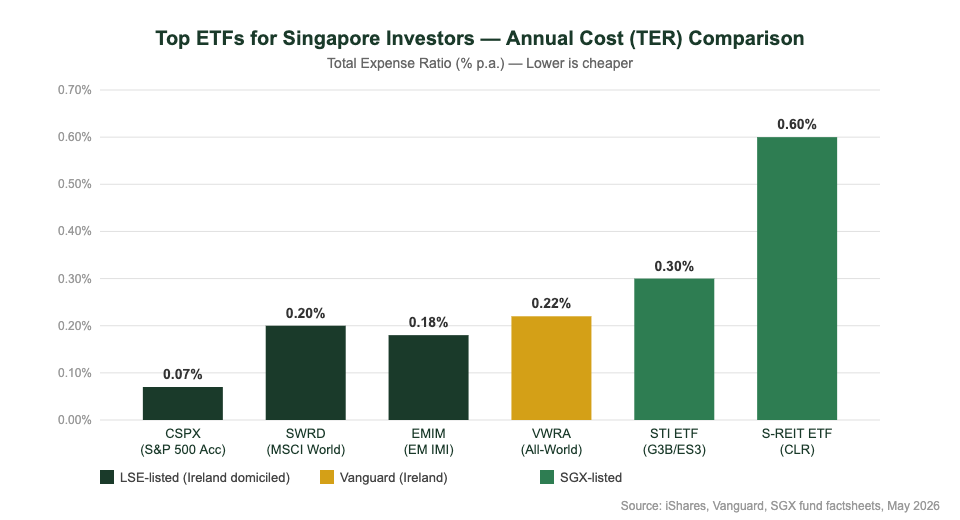
ETFs (Exchange-Traded Funds) are the most cost-effective way for Singapore investors to access global markets. The best ETFs for Singapore investors are Ireland-domiciled funds like CSPX (S&P 500) and VWRA (global) listed on the London Stock Exchange — they offer 15% withholding tax vs 30% for US-domiciled equivalents, no US estate tax exposure, and TERs from just 0.07% p.a. SGX also lists local S-REIT ETFs and STI ETFs for dividend-focused portfolios.
Not financial advice. All figures are for educational reference only. Data as at May 2026 unless noted.
Table of Contents
Contents — Click to expand
- What Is an ETF?
- Why ETFs Are Popular in Singapore
- Best ETFs for Singapore Investors 2026
- LSE ETFs vs SGX ETFs: Which Should You Choose?
- Tax Advantages of Ireland-Domiciled ETFs
- How to Buy ETFs in Singapore (Step-by-Step)
- Broker Comparison for ETF Investing
- CPF and SRS: Can You Buy ETFs with Government Savings?
- Frequently Asked Questions
What Is an ETF?
An Exchange-Traded Fund (ETF) is a basket of securities — stocks, bonds, REITs, or commodities — that trades on a stock exchange like a single share. When you buy one share of CSPX, you instantly own a proportional slice of approximately 503 of the largest US companies, from Apple and Microsoft to Nvidia and Amazon.
Unlike unit trusts sold through banks, ETFs trade intraday on an exchange at market prices. You pay a brokerage commission to buy and sell, but there are no upfront sales charges (the 3–5% “front-end load” common in traditional funds). The ongoing cost — called the Total Expense Ratio (TER) — is deducted from the fund’s NAV daily and is already reflected in the ETF’s price. For the best index ETFs, TERs are as low as 0.07% p.a., making them far cheaper than actively managed unit trusts that typically charge 1.0–1.5% p.a.
There are two key ETF structures relevant to Singapore investors:
- Accumulating ETFs — dividends are automatically reinvested into the fund. The NAV grows over time. You pay no tax on reinvested dividends in Singapore. Examples: CSPX, VWRA, SWRD.
- Distributing ETFs — dividends are paid out to your brokerage account in cash. Useful if you want passive income. Examples: VWRD, VUSD, most SGX-listed STI and S-REIT ETFs.
For long-term wealth accumulation, accumulating ETFs are generally more tax-efficient for Singapore investors since you avoid the friction of manually reinvesting distributions.
Why ETFs Are Popular in Singapore
Singapore investors have embraced ETFs for several structural reasons that make them particularly well-suited to the local context:
No capital gains tax. Singapore does not impose capital gains tax. When you sell an ETF at a profit, you keep 100% of the gain. This structural advantage makes long-term buy-and-hold ETF investing extremely attractive compared to jurisdictions like the UK or Australia where capital gains are taxed at 18–45%.
No dividend income tax. Singapore also has no personal income tax on dividends received. For distributing ETFs, dividend payments land in your account untaxed at the Singapore level (though withholding tax is deducted at source — more on this below).
Access to global diversification cheaply. A single share of VWRA gives a Singapore investor exposure to over 3,700 companies across 50+ countries — including the US, Europe, Japan, and emerging markets. As of May 2026, one VWRA share costs approximately USD 114. There is no minimum investment requirement beyond one share.
Strong broker infrastructure. Singapore-based and Singapore-regulated brokers like Interactive Brokers (IBKR), Saxo Markets, and MooMoo all offer access to the London Stock Exchange (LSE) and major ETFs at competitive commissions. Platforms like Syfe offer fractional ETF investing through their managed portfolio products.
Singapore’s retail investment community has grown significantly since 2020, with the STI ETF and global index ETFs ranking among the most discussed investment topics on local finance forums and communities.
Best ETFs for Singapore Investors 2026
Below are the most recommended ETFs across the key categories. All data is sourced from fund factsheets and SGX as at May 2026.
Global Index ETFs (LSE-Listed, Ireland-Domiciled)
| ETF | Ticker | Index | TER | Structure | AUM |
|---|---|---|---|---|---|
| iShares Core MSCI World | SWRD | MSCI World | 0.20% | Accumulating | USD 9.8B |
| iShares Core S&P 500 | CSPX | S&P 500 | 0.07% | Accumulating | USD 82B |
| Vanguard FTSE All-World Acc | VWRA | FTSE All-World | 0.22% | Accumulating | USD 23B |
| iShares Core MSCI EM IMI | EMIM | MSCI Emerging Markets IMI | 0.18% | Accumulating | USD 12.1B |
| iShares MSCI World Quality Factor | IWQU | MSCI World Quality Factor | 0.30% | Accumulating | USD 5.2B |
Source: iShares and Vanguard fund factsheets, May 2026. AUM figures approximate.
SGX-Listed ETFs (Singapore Exchange)
| ETF | Ticker | Focus | TER | Dist. Yield | CPFIS |
|---|---|---|---|---|---|
| Nikko AM STI ETF | G3B | STI (30 SG Blue Chips) | 0.30% | ~3.5% | ✅ OA & SA |
| SPDR STI ETF | ES3 | STI (30 SG Blue Chips) | 0.30% | ~3.5% | ✅ OA & SA |
| Lion-Phillip S-REIT ETF | CLR | Singapore REITs | 0.60% | ~5.5% | ✅ OA |
| NikkoAM-StraitsTrading Asia ex-Japan REIT | CFA | Asia ex-Japan REITs | 0.55% | ~6.0% | ✅ OA |
| Lion-OCBC Singapore Low Carbon ETF | BYF | SG Low Carbon Index | 0.50% | ~2.8% | ❌ |
Source: SGX ETF listings, fund factsheets, May 2026. Distribution yields are trailing 12-month estimates.
LSE ETFs vs SGX ETFs: Which Should You Choose?
The choice between LSE-listed global ETFs and SGX-listed local ETFs depends on your investment goals, portfolio size, and whether you want passive income or long-term growth.
Choose LSE ETFs (CSPX, VWRA, SWRD) if:
- You want maximum global diversification — 503 to 3,700+ holdings vs 30 for the STI ETF
- Your goal is long-term capital appreciation and you don’t need regular income payouts
- Your portfolio is above SGD 20,000 — FX conversion and commission costs are proportionally lower at scale
- You want the full benefit of Ireland-domicile tax efficiency (15% WHT vs 30%)
- You can access Interactive Brokers or Saxo Markets (both offer LSE trading)
Choose SGX ETFs if:
- You want to invest using CPF (Ordinary Account) or SRS — only SGX-listed CPFIS-approved ETFs qualify
- You want regular dividend income in SGD (STI ETF yields ~3.5%; S-REIT ETFs yield ~5.5–6.0%)
- You’re a beginner and prefer to trade in familiar SGD without FX currency risk
- Your investable amount is small — some SGX ETFs can be bought in smaller lots
- You want exposure specifically to Singapore real estate via the Singapore REIT ETF guide
Many experienced Singapore investors hold both: LSE-listed index ETFs for core global exposure and SGX S-REIT ETFs for passive income. This combination captures both growth and yield while maximising tax efficiency.
Tax Advantages of Ireland-Domiciled ETFs
The single biggest reason Singapore investors prefer LSE-listed, Ireland-domiciled ETFs over their US-listed counterparts is the significant tax advantage. There are two key differences:
1. Withholding Tax (WHT) on US Dividends
When an ETF holds US stocks (like the S&P 500), US companies pay dividends that are subject to withholding tax before they reach the ETF. The rate depends on the ETF’s country of domicile and its tax treaty with the US:
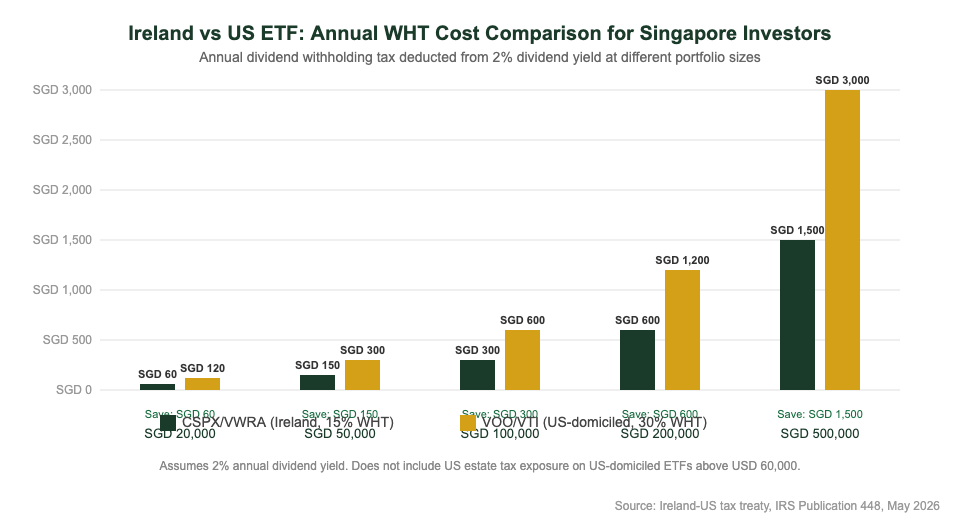
- Ireland-domiciled ETF (CSPX, VWRA): 15% WHT under the Ireland-US tax treaty
- US-domiciled ETF (VOO, VTI): 0% WHT (no withholding on domestic dividends)
- Luxembourg-domiciled ETF: 30% WHT (no treaty benefit for most indices)
Wait — so why not just buy the US ETF at 0% WHT? Because as a non-US person, you face a second layer of US estate tax risk.
2. US Estate Tax
Non-US persons (including Singapore residents) face a US estate tax of up to 40% on US-situs assets (which includes US-listed ETFs) above USD 60,000 upon death. Ireland-domiciled ETFs listed on the LSE are NOT US-situs assets — they are exempt from US estate tax regardless of the portfolio size.
This is not a theoretical risk. A Singapore investor with SGD 300,000 in VOO who passes away could face a US estate tax bill of approximately USD 96,000 on the amount above the USD 60,000 threshold. The same portfolio in CSPX? Zero US estate tax.
| ETF | Domicile | US WHT Rate | US Estate Tax Risk | TER |
|---|---|---|---|---|
| CSPX (LSE) | Ireland | 15% | None | 0.07% |
| VOO (NYSE) | USA | 0% | Yes (above USD 60k) | 0.03% |
| VWRA (LSE) | Ireland | 15% | None | 0.22% |
| VTI (NYSE) | USA | 0% | Yes (above USD 60k) | 0.03% |
Source: iShares/Vanguard factsheets, IRS Publication 448 (Estate Tax for Non-Residents), May 2026.
The bottom line for Singapore investors: Despite the lower TER of US ETFs, the 15% WHT savings and zero estate tax risk make Ireland-domiciled ETFs the recommended choice for most Singapore portfolios above SGD 10,000. The net return advantage for CSPX over VOO for a Singapore investor on a SGD 100,000 portfolio works out to approximately SGD 450 per year in WHT savings alone — more than enough to offset the 0.04% TER difference.
How to Buy ETFs in Singapore (Step-by-Step)
The process for buying ETFs in Singapore differs slightly depending on whether you’re buying LSE-listed ETFs or SGX-listed ETFs, and which broker you use. Here is the general step-by-step process:
Step 1: Choose Your Broker
For LSE-listed ETFs (CSPX, VWRA, SWRD): Use Interactive Brokers (IBKR), Saxo Markets, or MooMoo. All three provide access to the London Stock Exchange.
For SGX-listed ETFs (G3B, CLR): Any Singapore broker works — DBS Vickers, OCBC Securities, Phillip Securities, moomoo Singapore, or Tiger Brokers. You can also buy CPFIS-approved SGX ETFs using your CPF OA through the CPF Investment Scheme.
Step 2: Open and Fund Your Account
Account opening is fully digital for most brokers and takes 1–3 business days. You’ll need your NRIC/FIN, SingPass for MyInfo verification, and a bank account for funding. Minimum funding amounts vary: IBKR has no minimum; MooMoo requires SGD 0; Saxo requires SGD 3,000.
Step 3: Search for the ETF by Ticker
For LSE ETFs, search by the exact ticker symbol (e.g., CSPX). Make sure you select the London Stock Exchange (LSE) as the exchange, not NYSE or NASDAQ. CSPX trades in USD on the LSE; VWRA also trades in USD on the LSE.
Step 4: Place Your Order
You can place a market order (executes immediately at current price) or a limit order (executes only at your specified price or better). For ETFs with high liquidity like CSPX and VWRA, market orders during London trading hours (3pm–11pm SGT) are generally fine. Limit orders are recommended for smaller or less liquid ETFs.
Step 5: Monitor and Rebalance (Optional)
Most long-term investors use a buy-and-hold strategy, reviewing their ETF portfolio quarterly or annually. If you’re building a retirement portfolio, the Singapore retirement calculator can help you determine how much to invest monthly to reach your goal.
For those with CPF savings looking for ways to optimise their CPF investment strategy, note that LSE ETFs are not eligible for CPFIS — only specific SGX-listed ETFs approved by CPF Board qualify.
Broker Comparison for ETF Investing
The choice of broker significantly affects your total cost of ownership, especially for smaller portfolios where minimum commissions bite hard.
| Broker | LSE Access | Commission (LSE) | Min Commission | FX Spread | Best For |
|---|---|---|---|---|---|
| IBKR | ✅ | 0.05% of trade value | USD 1.00 | ~0.2 bps (interbank) | Larger portfolios, active traders |
| Saxo Markets | ✅ | 0.08% of trade value | GBP/EUR 4.00 | ~0.5 bps | Premium features, research tools |
| MooMoo SG | ✅ | 0.03% of trade value | USD 0.99 | ~0.3 bps | Beginners, low-cost trading |
| Syfe Brokerage | ✅ | 0% commission (flat fee model) | SGD 1.49/mo (platform fee) | FX at mid-rate | Regular investors, DCA approach |
| DBS Vickers | ❌ (SGX only) | SGD 10 or 0.28% (higher) | SGD 10.00 | N/A | CPF investing, SGX ETFs only |
Source: Broker fee schedules, May 2026. Fees are indicative and subject to change. Check brokers’ official websites for current rates.
For regular investors doing dollar-cost averaging (DCA) monthly, Syfe’s flat fee model can be cost-effective for smaller monthly amounts. IBKR’s USD 1 minimum commission means you need to invest at least USD 2,000 per trade to keep costs below 0.05% — ideal for lump sum investors but less efficient for small monthly purchases.
If you’re comparing managed portfolio platforms for global ETF exposure (without picking individual ETFs yourself), you can explore the Endowus referral code for fund-based ETF portfolios or FSMOne referral code for their regular savings plan.
CPF and SRS: Can You Buy ETFs with Government Savings?
This is one of the most frequently asked questions by Singapore investors. The short answer: yes, but only specific SGX-listed ETFs, and not LSE-listed ETFs.
CPF Investment Scheme (CPFIS): You can invest CPF Ordinary Account (OA) savings in a limited list of approved instruments. As at May 2026, the CPFIS-approved ETFs include the Nikko AM STI ETF (G3B), SPDR STI ETF (ES3), and both S-REIT ETFs (CLR, CFA). LSE-listed ETFs like CSPX and VWRA are not CPFIS-eligible because they are foreign-listed securities. Note: CPF SA savings can only be invested in specific SA-approved products with stricter requirements.
SRS (Supplementary Retirement Scheme): SRS funds can be used to buy any SGX-listed ETF through an SRS-linked brokerage account. Some brokers (including IBKR and Saxo) also allow SRS funds to be used for LSE-listed ETFs — check with your broker before assuming this applies. SRS investments offer income tax relief of up to SGD 15,300 per year (for Singapore citizens), making this a popular vehicle for ETF investing among higher-income earners.
If you’re planning your retirement strategy around CPF, ETFs, and other passive income sources, the passive income Singapore guide provides a comprehensive framework for combining multiple income streams.
Disclaimer: The information above is for educational purposes only and does not constitute financial advice. ETF investing involves market risk including the possible loss of principal. Past performance is not indicative of future results. Please consult a licensed financial adviser before making investment decisions. Data accurate as at May 2026.
Frequently Asked Questions
What is the best ETF to invest in Singapore in 2026?
For long-term growth, the best ETFs for Singapore investors in 2026 are CSPX (iShares Core S&P 500, TER 0.07%) for US market exposure and VWRA (Vanguard FTSE All-World Accumulating, TER 0.22%) for global diversification — both listed on the London Stock Exchange and Ireland-domiciled for tax efficiency. For dividend income, the Lion-Phillip S-REIT ETF (CLR, TER 0.60%) offers approximately 5.5% yield from Singapore REITs and is CPFIS-eligible. The “best” ETF depends on your goal: capital growth, dividend income, or CPFIS compatibility.
Can Singapore investors buy ETFs on the London Stock Exchange?
Yes, Singapore investors can buy LSE-listed ETFs through international brokers like Interactive Brokers (IBKR), Saxo Markets, MooMoo Singapore, and Syfe Brokerage. You simply open an account, fund it in SGD (which the broker converts to USD or GBP), search for the ETF by ticker (e.g., CSPX or VWRA), and select the London Stock Exchange as the exchange. The London Stock Exchange operates from approximately 3pm to 11pm SGT, so you can place orders during Singapore evening hours.
Are ETF gains taxable in Singapore?
No, Singapore does not impose capital gains tax. Any profit you make from selling an ETF at a higher price than you paid is completely tax-free for individual investors. Singapore also has no personal income tax on dividends received. However, withholding tax is deducted at source by the fund before dividends reach you — this is 15% for Ireland-domiciled ETFs on US dividends (vs 30% for US-domiciled ETFs). The net effect is that accumulating ETFs like CSPX and VWRA, which reinvest dividends internally, are especially tax-efficient for Singapore investors.
Can I buy ETFs with my CPF funds in Singapore?
Yes, but only specific SGX-listed ETFs approved under the CPF Investment Scheme (CPFIS). As at May 2026, CPFIS-approved ETFs include the Nikko AM STI ETF (G3B), SPDR STI ETF (ES3), Lion-Phillip S-REIT ETF (CLR), and NikkoAM-StraitsTrading Asia ex-Japan REIT ETF (CFA). LSE-listed ETFs like CSPX, VWRA, and SWRD are NOT eligible for CPFIS investment as they are foreign-listed securities. You can invest CPF OA savings (not SA) through a CPFIS-OA linked brokerage account with DBS Vickers, OCBC Securities, or Phillip Securities.
What is the minimum amount needed to start investing in ETFs in Singapore?
There is no regulatory minimum for ETF investing in Singapore. The practical minimum is the price of one share plus brokerage commission. As at May 2026, CSPX costs approximately USD 590 per share (~SGD 800), VWRA costs approximately USD 114 per share (~SGD 155), and STI ETF (G3B) costs approximately SGD 3.40 per share. At IBKR with a USD 1 minimum commission, you’d want to invest at least USD 2,000 per trade to keep fees under 0.05%. MooMoo’s USD 0.99 minimum makes smaller investments more viable. Syfe’s flat-fee model suits very regular smaller purchases.
What is the difference between an ETF and a unit trust in Singapore?
The main differences are cost, flexibility, and trading. ETFs trade on a stock exchange like shares — you buy and sell at live market prices throughout the day, paying brokerage commissions but no sales charges. Unit trusts (mutual funds) are bought and sold at end-of-day NAV prices through a fund platform like Endowus, FSMOne, or a bank. Unit trusts typically have no brokerage fees but charge annual management fees of 1.0–1.5% and sometimes a front-end sales charge of up to 5%. For passive investing tracking a market index, low-cost index ETFs almost always deliver better net returns than actively managed unit trusts due to lower fees.
Is it safe to invest in ETFs in Singapore?
ETFs from reputable issuers like iShares (BlackRock), Vanguard, and SPDR (State Street) are regulated financial products with strong investor protections. Funds like CSPX (USD 82B AUM) and VWRA (USD 23B AUM) are extremely unlikely to close or face liquidity issues. The main risks are market risk (the ETF’s value falls if the index falls), currency risk (SGD/USD exchange rate fluctuations affect your returns in SGD terms), and FX conversion costs when buying in a foreign currency. ETFs do not carry credit risk or default risk the way bonds do — your assets are held in a segregated custody account, separate from the broker’s own assets, in compliance with MAS regulations.
Ready to Start Investing in ETFs?
Open a brokerage account and buy your first ETF today. Use our referral links for exclusive sign-up bonuses.
This article was researched with the help of AI. While we strive to keep all information accurate and up to date, there may be errors. If you notice any discrepancies, please contact us.