STI ETF Singapore: Complete Guide 2026 (ES3 vs G3B, Yields & How to Buy)
Singapore’s benchmark index ETF — covering dividends, CPFIS eligibility, broker comparisons and 2026 yield data.
The STI ETF is an exchange-traded fund listed on the Singapore Exchange (SGX) that tracks the Straits Times Index (STI) — Singapore’s benchmark of 30 blue-chip companies. Two versions exist: ES3 (SPDR STI ETF) by State Street and G3B (Nikko AM STI ETF). Both have a 0.30% TER, pay quarterly dividends yielding approximately 3.5% per annum, and are CPFIS-OA eligible — making them a rare CPF-investable equity option for Singapore investors.
Not financial advice. All figures are for educational reference only. Data as at May 2026 unless noted.
Table of Contents
Contents — Click to expand
- What Is the STI ETF?
- ES3 vs G3B: Key Facts at a Glance
- Why Singapore Investors Choose the STI ETF
- Dividend Yield and Historical Performance
- Expense Ratio and Total Costs
- Is the STI ETF CPFIS Eligible?
- How to Buy the STI ETF in Singapore (Step-by-Step)
- STI ETF vs Alternatives
- Who Should Buy the STI ETF?
- Frequently Asked Questions
What Is the STI ETF?
The STI ETF is an exchange-traded fund that tracks the Straits Times Index (STI), Singapore’s premier stock market benchmark comprising 30 of the largest and most liquid companies listed on the SGX. These include DBS Group, OCBC Bank, UOB, Singapore Telecommunications (Singtel), CapitaLand Integrated Commercial Trust, and other blue-chip names that form the backbone of Singapore’s economy.
There are two STI ETFs available to Singapore investors, both listed on the Singapore Exchange (SGX):
- ES3 — SPDR Straits Times Index ETF by State Street Global Advisors (SSgA). Launched in 2002, it is Singapore’s oldest and most liquid ETF with assets under management (AUM) of approximately SGD 1.6 billion as at Q1 2026. ES3 is the more widely traded version, with higher daily trading volume.
- G3B — Nikko AM Singapore STI ETF by Nikko Asset Management. Launched in 2009, with AUM of approximately SGD 600 million as at Q1 2026. G3B tends to have slightly lower bid-ask spreads on certain days, making it a competitive alternative for smaller investors.
Both ETFs hold the same 30 constituent stocks of the STI in proportion to their market capitalisation. They distribute dividends quarterly — collecting the underlying dividends from constituent companies and passing them to unitholders after a small withholding. The STI is a price-weighted, dividend-distributing index: all dividends are paid out rather than reinvested, which makes these ETFs appealing to income-seeking investors.
Unlike global ETFs such as CSPX or VWRA — which are listed on the London Stock Exchange and track global or US indices — the STI ETF is SGX-listed, denominated in Singapore dollars (SGD), and invests purely in Singapore equities. This makes it far simpler to buy through any Singapore brokerage, and critically, makes it one of the very few equity ETFs eligible under the CPF Investment Scheme Ordinary Account (CPFIS-OA).
ES3 vs G3B: Key Facts at a Glance
| Metric | ES3 (SPDR STI ETF) | G3B (Nikko AM STI ETF) |
|---|---|---|
| Manager | State Street Global Advisors | Nikko Asset Management |
| SGX Ticker | ES3 | G3B |
| Index Tracked | Straits Times Index (STI) | Straits Times Index (STI) |
| Exchange | SGX (Singapore) | SGX (Singapore) |
| Currency | SGD | SGD |
| TER (Expense Ratio) | 0.30% p.a. | 0.30% p.a. |
| Structure | Distributing (quarterly dividends) | Distributing (quarterly dividends) |
| AUM (Q1 2026) | ~SGD 1.6 billion | ~SGD 600 million |
| Number of Holdings | 30 | 30 |
| Dividend Frequency | Quarterly | Quarterly |
| CPFIS-OA Eligible | Yes | Yes |
Source: SGX, State Street Global Advisors, Nikko Asset Management factsheets, May 2026
Why Singapore Investors Choose the STI ETF
The STI ETF offers a unique value proposition that no other ETF can replicate for Singapore investors: it combines SGX-listing convenience, CPFIS eligibility, SGD denomination, quarterly income, and blue-chip Singapore equity exposure in a single low-cost product.
Here are the key reasons Singapore investors buy the STI ETF in 2026:
1. CPFIS-OA Eligibility
Both ES3 and G3B are approved CPFIS-OA investments. This is rare — most equity ETFs, including global giants like CSPX and VWRA, cannot be bought with CPF savings. Singapore investors with substantial CPF-OA balances (beyond the minimum sum) can deploy this capital into the STI ETF and potentially earn above the 2.5% CPF-OA interest rate through dividends and capital appreciation. This makes the STI ETF a compelling alternative for CPF investors who would otherwise leave money in the OA at a fixed 2.5% rate.
2. No FX Risk or FX Conversion Costs
Because both ETFs are denominated in SGD and invest in SGX-listed Singapore companies, there is no currency conversion required. Unlike buying CSPX (priced in USD/GBP) or VWRA (GBP), which incurs FX spread costs of 0.15–0.50% per transaction, the STI ETF is a clean SGD-in, SGD-out investment. For investors sensitive to FX exposure or costs, this is a meaningful advantage.
3. Quarterly Dividend Income
The STI’s constituent companies — banks, real estate investment trusts, and telecommunications firms — are among Singapore’s most reliable dividend payers. ES3 and G3B both distribute quarterly, making the STI ETF one of the most income-friendly equity ETFs available to Singapore retail investors. As at May 2026, the trailing dividend yield is approximately 3.3–3.7% per annum.
4. Simplicity and SGX Accessibility
The STI ETF can be purchased through virtually any Singapore brokerage — CDP-linked brokers like DBS Vickers, POEMS, UOB Kay Hian, and digital brokers like Syfe Brokerage and moomoo Singapore. Unlike LSE-listed ETFs that require an international brokerage account (IBKR, Saxo), the STI ETF works with a simple SGX-connected local broker. This simplicity makes it particularly popular with first-time investors and those who prefer to keep investments in the local ecosystem.
Dividend Yield and Historical Performance
The STI ETF has delivered consistent dividend income over the past decade, though total returns (dividends + capital appreciation) have lagged global equity benchmarks like the S&P 500. Understanding this trade-off is critical for any Singapore investor evaluating the STI ETF.
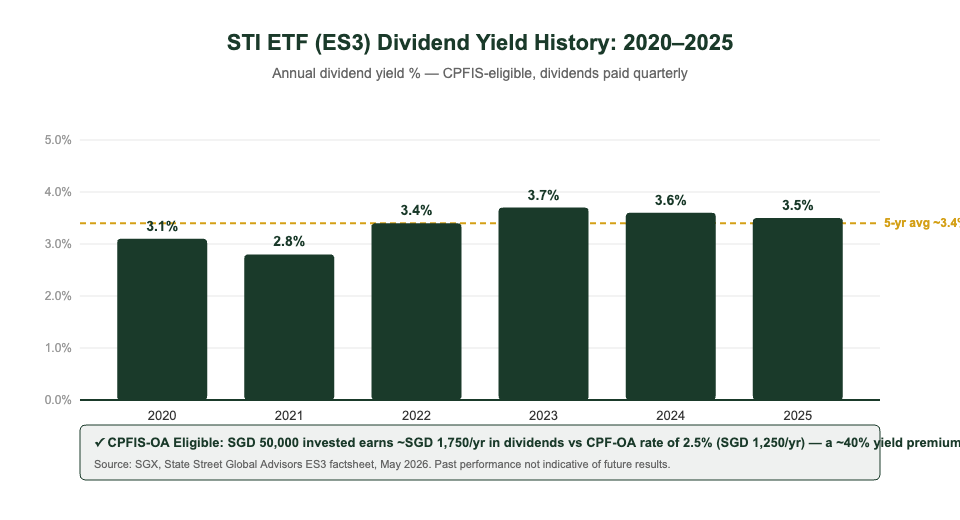
Here is the approximate dividend yield history for ES3 (SPDR STI ETF):
| Year | ES3 Div Yield (approx.) | STI Price Return | Total Return (est.) |
|---|---|---|---|
| 2020 | 3.1% | -11.8% | -8.7% |
| 2021 | 2.8% | +9.8% | +12.6% |
| 2022 | 3.4% | +4.1% | +7.5% |
| 2023 | 3.7% | +0.2% | +3.9% |
| 2024 | 3.6% | +5.3% | +8.9% |
| 2025 (est.) | 3.5% | +3.5% est. | ~7.0% |
Source: SGX, State Street Global Advisors ES3 annual reports. Past performance is not indicative of future results. Total return figures are approximate.
The STI ETF’s 5-year average dividend yield of approximately 3.4% is competitive with Singapore Savings Bonds (which currently yield around 2.8–3.1% for 10-year terms) and meaningfully above the CPF-OA rate of 2.5%. However, unlike SSBs or the CPF, the STI ETF carries equity market risk — as seen in 2020, when a -11.8% price decline more than offset that year’s dividend income.
For investors seeking a comparison, you can use our Singapore retirement calculator to model how a STI ETF allocation might grow over time alongside other assets like S-REITs or bonds.
Expense Ratio and Total Costs
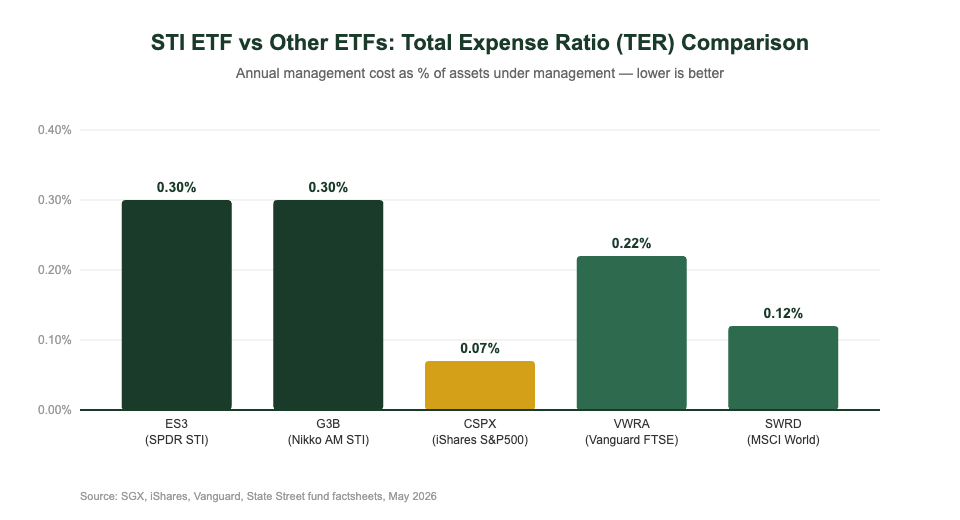
Both ES3 and G3B carry a Total Expense Ratio (TER) of 0.30% per annum. This is deducted from the fund’s assets daily and reflected in the ETF’s net asset value (NAV) — investors do not see a separate line-item charge. On a SGD 50,000 investment, this translates to approximately SGD 150 per year in management fees.
How does this compare with other options?
- CSPX (iShares S&P 500 UCITS ETF): 0.07% TER — significantly cheaper, but tracks the S&P 500 (US market), not Singapore. Read our CSPX ETF buying guide for a full comparison.
- VWRA (Vanguard FTSE All-World UCITS ETF): 0.22% TER — broader global exposure at lower cost than the STI ETF, but not CPFIS-eligible and requires a foreign brokerage account.
- Direct STI stock investment: Zero TER, but you would pay brokerage commissions on 30 individual stocks, rebalancing costs, and significant time managing the portfolio. The STI ETF’s 0.30% TER more than pays for itself in administrative convenience.
One important nuance: because the STI ETF invests in Singapore-listed companies, there is no foreign withholding tax on dividends at the fund level. Singapore does not impose dividend withholding tax on residents. This contrasts sharply with global ETFs like CSPX (which incur a 15% US dividend withholding tax at the fund level under the Ireland-US tax treaty). For dividend-focused investors, the STI ETF’s gross yield is the net yield — nothing is deducted before distribution.
Is the STI ETF CPFIS Eligible?
Yes — both ES3 (SPDR STI ETF) and G3B (Nikko AM STI ETF) are approved investments under the CPF Investment Scheme — Ordinary Account (CPFIS-OA). This is one of the STI ETF’s most significant advantages over virtually all other equity ETFs available to Singapore investors.
To invest your CPF-OA savings in the STI ETF, you must first have funds in excess of the minimum CPF-OA balance ($20,000 must remain in the OA at all times). The investable amount is the balance above this threshold. Here’s how a CPF scenario plays out:
| CPF-OA Balance | Min. Required in OA | Max. Investable | Estimated Div. Income (3.5% yield) | vs CPF-OA Rate (2.5%) |
|---|---|---|---|---|
| SGD 50,000 | SGD 20,000 | SGD 30,000 | SGD 1,050/yr | +SGD 300/yr |
| SGD 100,000 | SGD 20,000 | SGD 80,000 | SGD 2,800/yr | +SGD 800/yr |
| SGD 150,000 | SGD 20,000 | SGD 130,000 | SGD 4,550/yr | +SGD 1,300/yr |
Source: CPF Board CPFIS rules, May 2026. Dividend yield based on ~3.5% trailing yield estimate; actual yield will vary. Not financial advice.
Important caveats: the STI ETF carries equity market risk. In a down year (as in 2020), your CPF investment could fall in value below what you put in — you would not earn the guaranteed 2.5% CPF-OA rate on that portion. The CPF Board recommends investors assess their risk tolerance before investing CPFIS savings. For more on deploying CPF savings effectively, see our guide on CPF investment strategy Singapore.
How to Buy the STI ETF in Singapore (Step-by-Step)
Because ES3 and G3B are SGX-listed, you can buy them through any broker with SGX access — including CDP-linked brokers and custodian-model brokers. Here is a step-by-step guide for the most popular platforms:
Option 1: Syfe Brokerage (Best for Beginners)
Syfe offers commission-free ETF trading on SGX with no minimum deposit. It is a custodian-based broker (shares held in Syfe’s name, not your CDP account). Steps: (1) Open a Syfe Brokerage account — use our Syfe referral code for exclusive sign-up bonuses; (2) Fund with SGD via PayNow or bank transfer; (3) Search for “ES3” or “G3B” in the app; (4) Select “SGX” exchange; (5) Enter number of units and place a limit order or market order; (6) Monitor your dividend payments quarterly in the app.
Option 2: moomoo Singapore (Best for Active Traders)
moomoo offers competitive commissions of SGD 0.99–1.99 per trade for SGX stocks and ETFs. It is also a custodian broker. For a full breakdown of fees and features, see our moomoo Singapore review. Steps: (1) Open moomoo SG account; (2) Fund SGD; (3) Search “ES3” or “G3B” under SGX; (4) Place order.
Option 3: DBS Vickers / POEMS / UOB Kay Hian (CDP-Linked)
Traditional brokers link directly to your Central Depository (CDP) account, so shares are held in your own name. This matters for CPFIS investing — to use CPF-OA funds, you must use a CPFIS-approved agent bank and broker (DBS, OCBC, UOB). Brokerage commissions are typically 0.18–0.28% per trade (min SGD 18–25). Steps: (1) Open CDP account at SGX if you don’t have one; (2) Open a trading account with your preferred CDP-linked broker; (3) To use CPFIS, link your CPF-OA account via your agent bank (DBS/OCBC/UOB); (4) Search for ES3 or G3B; (5) Place order — SGD settles T+2.
Minimum Investment
Both ES3 and G3B trade in board lots of 100 units on SGX. As at May 2026, ES3 trades at approximately SGD 3.45–3.60 per unit, so a minimum purchase is approximately SGD 345–360. G3B trades at similar levels. There is no ongoing minimum — you can buy one lot and hold indefinitely.
STI ETF vs Alternatives
The STI ETF is not the only way to invest in Singapore or build a passive income portfolio. Here is how it compares with the main alternatives available to Singapore investors as at May 2026:
| Investment | TER | Div Yield (est.) | CPFIS? | Exchange | Best For |
|---|---|---|---|---|---|
| ES3 / G3B (STI ETF) | 0.30% | ~3.5% | Yes | SGX | SG income, CPF investing |
| CSPX (S&P 500) | 0.07% | ~1.2% (accumulating) | No | LSE | US growth, long-term capital |
| VWRA (Global All-World) | 0.22% | ~1.8% (accumulating) | No | LSE | Global diversification |
| S-REIT ETFs (Lion-Phillip etc.) | 0.50–0.60% | 5–7% | No | SGX | High income, SG REITs exposure |
| Singapore Savings Bonds | 0% | 2.8–3.1% (10yr) | No | MAS / DBS/OCBC/UOB | Capital-safe fixed income |
Source: SGX, iShares, Vanguard, MAS, CPF Board, May 2026. CSPX and VWRA yields reflect fund distributions; CSPX is accumulating so yield is reinvested. Yields are approximate and will vary.
For Singapore investors who want both local dividend income and global growth, the most common strategy is to combine the STI ETF (for Singapore exposure + CPFIS) with CSPX or VWRA (for global growth exposure). The STI ETF also complements the best S-REITs in Singapore 2026 as a lower-volatility counterpart in a local income portfolio.
If you are interested in higher-yielding income options within the SGX ecosystem, our Singapore REIT ETF guide covers the Lion-Phillip S-REIT ETF and Nikko AM-Straits Trading Asia ex Japan REIT ETF in detail.
Who Should Buy the STI ETF?
The STI ETF is ideal for Singapore investors who meet one or more of the following criteria:
The STI ETF is ideal if you:
- Want to invest your CPF-OA savings in equities and potentially earn above the 2.5% OA rate
- Prefer quarterly dividend income in SGD without FX risk
- Are a first-time investor who wants simple, low-cost exposure to Singapore’s blue-chip companies via a local brokerage
- Want Singapore “home bias” in your portfolio alongside global ETFs like CSPX or VWRA
- Are building a passive income Singapore portfolio and want an equity ETF to complement your S-REIT holdings
Consider alternatives if you:
- Want higher total returns — over the past 10 years, the S&P 500 has significantly outperformed the STI on a total return basis. If capital growth is your primary goal, CSPX or VWRA may be more appropriate
- Want higher dividend yields — S-REITs typically yield 5–7%, compared to the STI ETF’s ~3.5%. For maximum income, see our passive income Singapore guide
- Want global diversification — 100% Singapore equity exposure concentrates your portfolio in a small market. The STI’s 30 stocks are heavily weighted toward banks (DBS, OCBC, UOB = ~45% of the index), reducing diversification
- Are comfortable with international brokerages — if you can open IBKR or Saxo, accessing CSPX or VWRA at lower TER and broader global exposure may be more efficient for long-term wealth building
For SRS (Supplementary Retirement Scheme) investors, both ES3 and G3B can be purchased with SRS funds through brokers like DBS, OCBC, and UOB, providing an additional tax benefit on contributions. Combine the STI ETF with a Singapore retirement planning calculator to model your long-term outcomes.
Not financial advice. Always assess your own financial situation and risk tolerance before investing. Consider consulting a licensed financial adviser if needed.
Frequently Asked Questions
What is the STI ETF and how does it work?
The STI ETF is an exchange-traded fund that tracks the Straits Times Index (STI), a benchmark of Singapore’s 30 largest listed companies including DBS, OCBC, UOB, Singtel, and major REITs. There are two versions: ES3 (by State Street Global Advisors) and G3B (by Nikko Asset Management). Both hold the same 30 constituent stocks and distribute quarterly dividends collected from those companies. The ETF trades on the Singapore Exchange (SGX) in SGD, and its price moves with the overall performance of Singapore’s blue-chip equity market.
Is the STI ETF CPFIS eligible? Can I buy it with my CPF?
Yes — both ES3 and G3B are approved under the CPF Investment Scheme Ordinary Account (CPFIS-OA). You can invest CPF-OA savings exceeding SGD 20,000 into either STI ETF through a CPFIS-approved agent bank (DBS, OCBC, UOB) and their linked brokerage. This is one of the STI ETF’s key advantages — most other equity ETFs including CSPX and VWRA are not CPFIS-eligible. You cannot, however, invest CPF Special Account (SA) savings in equities.
What is the difference between ES3 and G3B?
ES3 (SPDR STI ETF by State Street) and G3B (Nikko AM STI ETF) both track the same Straits Times Index and have identical TERs of 0.30% per annum. The main differences are: ES3 has significantly higher AUM (~SGD 1.6 billion vs G3B’s ~SGD 600 million) and higher daily trading volume, meaning tighter bid-ask spreads for large orders. G3B sometimes has a slightly lower bid-ask spread for small retail orders. For most investors, the practical difference is negligible — both are equivalent ways to get STI exposure. ES3 is the more popular choice due to its greater liquidity.
What dividend yield does the STI ETF pay?
The STI ETF (both ES3 and G3B) has historically paid a trailing dividend yield of approximately 3.0–3.7% per annum, distributed quarterly. As at May 2026, the trailing yield is approximately 3.3–3.5%. The exact yield fluctuates with the underlying companies’ dividend payments and the ETF’s unit price. Dividends are paid in SGD and there is no withholding tax deducted at source for Singapore tax residents — the gross yield is the net yield, unlike global ETFs that suffer fund-level withholding taxes.
Which broker is best for buying the STI ETF in Singapore?
For beginners, Syfe Brokerage offers commission-free SGX ETF trading with no minimum deposit — ideal for small, regular purchases. moomoo Singapore charges SGD 0.99–1.99 per trade and is well-suited to more active investors. For CPFIS investing (using CPF-OA savings), you must use a CDP-linked broker through DBS Vickers, OCBC Securities, or UOB Kay Hian. Traditional brokers like POEMS (Phillip Securities) and DBS Vickers offer CDP-linked accounts with full CPFIS support. The right choice depends on whether you are investing cash or CPF funds.
Is the STI ETF a good investment in 2026?
The STI ETF offers steady dividend income (~3.5% yield) and Singapore blue-chip exposure in a low-cost, CPFIS-eligible wrapper — making it a solid building block for Singapore-focused income portfolios. However, the STI has historically delivered lower total returns than global benchmarks like the S&P 500, and its concentration in banks and property stocks means sector risk is elevated. For most Singapore investors, the STI ETF works best as part of a diversified portfolio alongside global ETFs (CSPX, VWRA) and potentially S-REITs — not as a standalone investment. It is particularly compelling for CPFIS investors seeking equity exposure above the 2.5% CPF-OA rate.
Can I buy the STI ETF with my SRS account?
Yes — both ES3 and G3B can be purchased with Supplementary Retirement Scheme (SRS) funds through eligible brokers including DBS Vickers, OCBC Securities, and UOB Kay Hian. SRS contributions reduce your taxable income (up to SGD 15,300 per year for Singapore Citizens and PRs), and investments held in SRS are only taxed upon withdrawal at retirement age (50% tax concession applies). Combining SRS contributions with STI ETF investments is a tax-efficient strategy for retirement planning. Use our Singapore retirement calculator to model the compounding effect of SRS investing over your working years.
Ready to Start Investing in the STI ETF?
Open a brokerage account and buy ES3 or G3B today. Use our referral links for exclusive sign-up bonuses.
This article was researched with the help of AI. While we strive to keep all information accurate and up to date, there may be errors. If you notice any discrepancies, please contact us.